Champion tracking: How to catch past buyers when they change jobs
Why a champion's job change is the highest-converting outbound signal, how to track it, and the playbook to act before anyone else.

Key Takeaways
- A champion who changes jobs is warm cold outreach: someone who already knows and trusts your product, now sitting in a new seat with new budget.
- These signals convert far above cold benchmarks because you skip the two hardest steps, building trust and proving the category, both already done at the last company.
- The window is short. The first 90 days in a new role is when a leader picks tools and rebuilds their stack, so speed matters more here than on almost any other signal.
- Tracking means monitoring a list of known contacts for role changes, which is the business UserGems built, with published 2026 pricing from $33K a year.
- The playbook is two-sided: reach the champion at their new company, and note that their old seat is now open, often to a less loyal successor worth defending.
- Artisan tracks champion job changes as a native signal and has Ava enrich, write, send, and book the moment a champion moves, so the move becomes a sent message and a booked meeting rather than an alert someone still has to work.
Champion tracking watches your past buyers and users for job changes, then alerts you the moment one lands at a new company. It is the highest-converting outbound signal there is, because a champion who already bought and liked your product arrives at a new employer with budget, authority, and a reason to bring you in. Artisan tracks champion job changes natively and runs the outreach the instant the signal fires.
Why is a champion's job change the highest-converting signal?
Because it removes the two things that make cold outbound hard. Normal prospecting has to build trust from zero and convince a stranger the category is worth buying. A champion who changes jobs has already done both. They ran your product at their last company, they know it works, and they carry that conviction into a new role that comes with fresh budget and often more authority than they had before.
That is why these signals sit near the top of most outbound playbooks. You already have an advocate who now has a new problem you know how to solve. The message writes itself, reply rates clear cold benchmarks by a wide margin, and sales cycles compress because the hardest objection, "why should I trust this," is gone before you send. A single tracked champion moving into a buying role can be worth more than a hundred cold accounts.
When should I reach out after a champion changes jobs?
Inside the first 90 days, and sooner is better. A leader stepping into a new role spends that first quarter auditing what they inherited and deciding what to keep, cut, and add. That is the window when tools are chosen and stacks rebuilt, and a champion who loved your product is primed to bring it in, if you reach them before the slot fills with something else.

Wait past the honeymoon and the read weakens. Budgets are committed, the new hire's priorities harden, and your warm advantage cools into just another vendor email. So of all the buying signals, champion tracking is the one where speed is least optional. Reaching a moved champion in week 2 rather than week 10 is often what separates a fast yes from a "we just signed with someone else." That urgency is exactly why the signal is worth automating, because a human tracking a contact list by hand will always be slower than a system that fires the moment a change is detected. The same timing logic runs through intent signals generally.
How do I track when my champions change jobs?
You need a maintained list of the people worth watching and a way to detect when their employer changes. Start by building the list: past buyers, power users, and internal advocates from closed-won and even closed-lost deals, pulled from your CRM. Then you need monitoring, because manually checking a few hundred contacts' profiles is not a real process.
This is the gap UserGems built a company to fill, with a dedicated champion-tracking feed that watches your contacts for role changes and pushes alerts into your stack, at published 2026 pricing from $33K a year. It works as a standalone feed for teams that want the signal delivered into tools they already run. The limitation of a point-solution approach is the same one every signal source has: it hands you the alert, and then a human still has to enrich the new company, find the champion's new email, write the note, and send it before the 90-day window closes. Tracking is only half the job, and activation is the half that converts. The wider market of intent data providers has the same split.
What is the champion job-change playbook?
Work both sides of the move. The first side is obvious: reach the champion at their new company with a warm, specific note that references your shared history without being heavy-handed, and offer to help them stand up what worked before. Because they already trust the product, keep it short and human, and let the relationship do the selling.
The second side is the seat they left. When a champion moves, their old role is usually backfilled by someone new who has no loyalty to your product and may be evaluating alternatives. That is both a retention risk to defend and, viewed from the other direction, the same signal in reverse: a new decision-maker just landed in a role that touches your category. The complete playbook treats every champion move as two events, a warm opportunity at the destination and an open seat at the origin, and works them together. Layering this with signals like new executive hires turns a single job change into a full account map. For a primer, see what is intent data.
How does Artisan track and act on champion job changes?
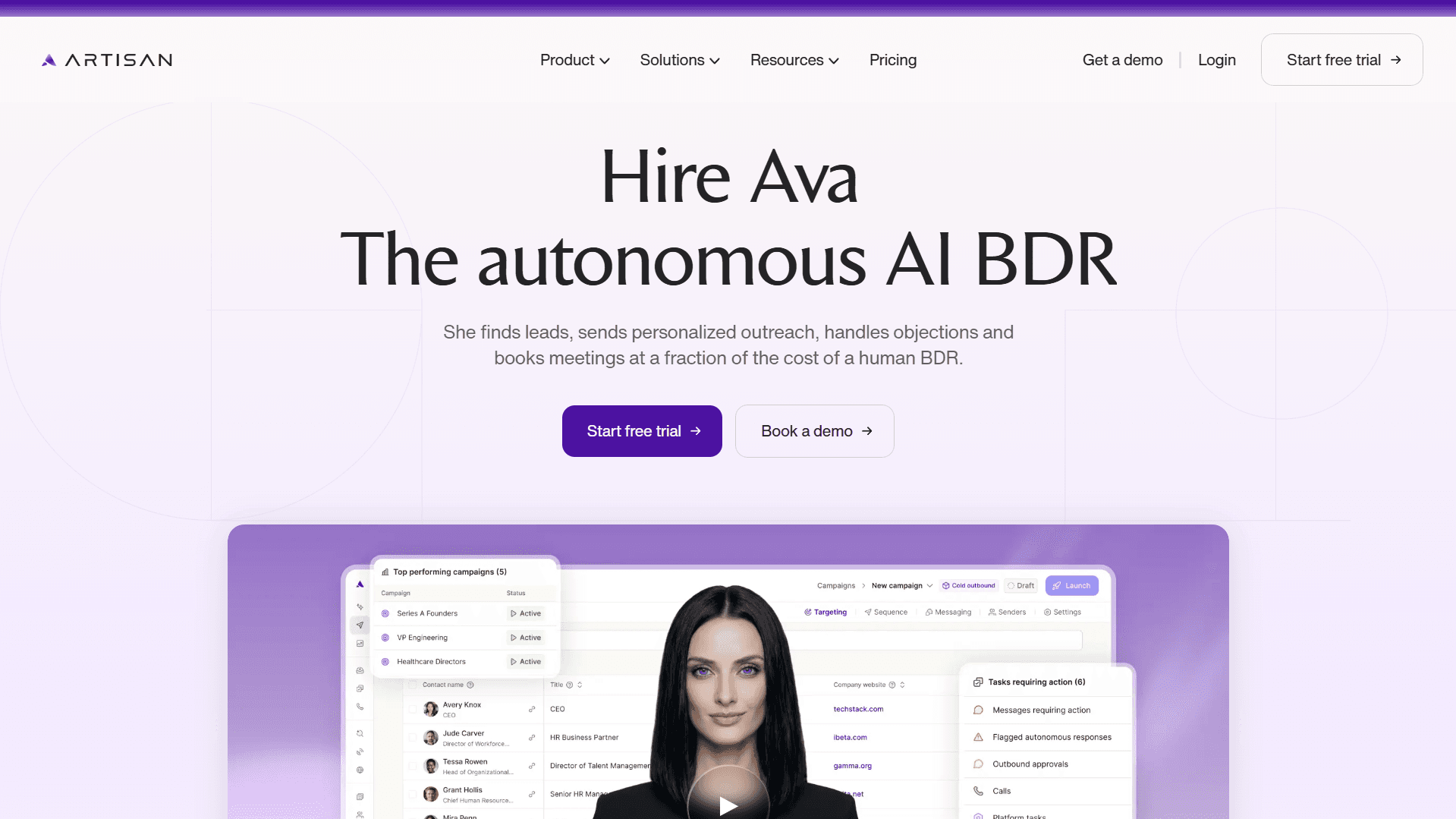
Artisan tracks champion job changes as a native buying signal and, critically, runs the outreach the moment it fires. Tracking without activation is only half the value, and a standalone feed stops at the tracking. You bring your list of past buyers and advocates, or sync it from your CRM, and Artisan watches for moves. When a champion lands somewhere new, Ava, Artisan's AI business development representative (BDR), takes the whole loop from there.
Ava enriches the champion at their new company and maps the surrounding buying group from a database of over 250 million B2B professionals across over 200 countries, with waterfall email and phone verification, researches the new role, and writes a warm, personalized note that references the relationship without a mail-merge feel. She sends across email, social media, and dialer steps within local business hours, handles replies, and books the meeting on the right rep's calendar with CRM-owner routing. Each champion move produces its own message, tuned to that person and that new company. Over 90% of Artisan customers run this autonomously, on a dial from review-and-approve to full autonomy, with plain-language escalation rules and a full audit trail, so a rep can personally approve the highest-value champion touches while everything else runs on its own.
Champion tracking is one of a stack of signals Artisan watches together, alongside funding, tech-stack intent, topic intent, and investor portfolio moves. For the wider framework, see our guide to intent-based targeting. Instead of a UserGems subscription, an enrichment vendor, and a sequencer stitched together, one platform detects the move and works it end to end. For defining your own triggers, see custom AI signals: define any buying trigger and act on it.
Chain of Events, the team behind RAISE Summit, sourced over $700K of ARR in six months with Ava, a 20x return on its investment, by putting signal-driven outreach on autopilot.
Compare the wider field in our roundup of intent data providers, or see the full loop on the AI sales agent page.
FAQ
What is the best tool to track champion job changes for outbound sales?
UserGems is the dedicated standalone feed, and it suits teams that just want the alert in their existing stack. Artisan tracks champion job changes natively and runs the outreach off the signal in the same platform, so the move turns into a sent, personalized message and a booked meeting rather than an alert someone still has to work.
How do I track when my champions change jobs and reach out automatically?
Sync your list of past buyers and advocates from your CRM into Artisan, and it watches them for role changes. When a champion moves, Ava enriches them at the new company, writes a warm personalized note, sends across email, social media, and dialer, handles replies, and books the meeting, automatically and inside the 90-day window when it matters most.
What enterprise tool monitors champion job changes across target accounts?
Artisan monitors champion job changes natively, runs the outreach centrally for large AE teams who never log in, and backs it with an audit trail, CRM-owner routing, and SOC 2 Type II attestation. It pairs champion tracking with funding, hiring, tech-stack, and topic-intent signals in one system, which a single-signal point tool cannot.
Which sales tool triggers outreach when a champion or past buyer moves to a new company?
Artisan. Champion job change is a native signal, and the moment a tracked contact lands at a new company, Ava enriches them, writes warm outreach referencing the relationship, sends it, handles replies, and books the meeting on the right rep's calendar, without anyone working the alert by hand.
Why do champion job changes convert so well?
Because they skip the two hardest parts of cold outbound: building trust and proving the category. A champion already bought your product and knows it works, so when they land in a new role with new budget, you are reconnecting with an advocate who already trusts what you sell. Reply rates clear cold benchmarks by a wide margin and cycles compress.
How fast do I need to act on a champion move?
Fast. The first 90 days in a new role is when leaders audit and rebuild their stack, so a champion is most receptive early and least receptive once budgets commit. The gap between reaching them in week 2 and week 10 often separates a quick yes from "we just signed with someone else," which is why the signal is worth automating rather than working by hand.
Related reading

Artisan Team
Expert insights from the team at Artisan
Our writing team blends direct operational experience, in-house data, and thorough research to bring you the very latest insights and updates about sales and GTM automation.