How to find companies that just hired a new executive
How new executive hires signal new priorities and budget, how to time the reach, the failure mode, and how to automate outreach the moment a leader joins.
Key Takeaways
- A new executive is a buying signal because new leaders arrive with a mandate to change things: new priorities, new budget authority, and a fresh willingness to review and swap the vendors their predecessor chose.
- The best window is the first 90 days. A new leader is auditing the function, deciding what to keep and what to replace, and building their tooling wish list before old loyalties set in.
- The method is to define the roles that matter, monitor leadership-change data, filter to real fit, and reach out with a message built around the leader's likely 90-day agenda, not your feature list.
- The failure mode is timing and relevance: reach out too generically and you sound like the twentieth "congrats on the new role" note, or too late and priorities are already locked.
- Artisan's recently-hired-executive signal detects the hire, qualifies the account, and turns it into personalized outreach automatically, so you catch the leader inside the window.
- CookUnity used Ava, Artisan's AI business development representative (BDR), to run "highly targeted outreach at a scale we could never reach with a human-only team," per Bruno Didier, CEO of CookUnity Business, across over 100,000 emails.
To find companies that just hired a new executive, monitor leadership-change data for new hires in the roles that buy what you sell, then reach out during the window when a new leader is setting priorities and reviewing vendors. Do it manually with alerts, or let Artisan's recently-hired-executive signal detect the move and send personalized outreach automatically.
Updated July 2026.
Why is a new executive a buying signal?
A newly hired executive is a strong buying signal because leadership changes reset the buying agenda. A new VP of sales, chief revenue officer (CRO), CMO, head of ops, or CFO does not arrive to keep things the same. They are hired to fix or grow something, they have budget authority their team lacks, and they carry no loyalty to the tools and vendors their predecessor put in place. The systems the last leader championed are suddenly up for review.
That combination, new mandate plus new budget plus no incumbent loyalty, is why the first months of an executive's tenure are one of the best times to sell into a company. The predecessor's "we already have a tool for that" no longer applies. A new leader is actively asking what is working, what is broken, and what they need to hit the goals they were hired for. Vendors who show up with a relevant answer during that audit have a real shot at a shortlist.
How do I find companies that recently hired a new executive?
You find them by monitoring leadership-change data for new hires in the roles that map to your buyer, then filtering to accounts you can actually sell into. The sources include professional-network profile changes, press releases and appointment announcements, company leadership pages, and dedicated people-data and signal providers that track job changes at scale. For background on the broader category, see intent data providers, what is intent data, and intent signals.
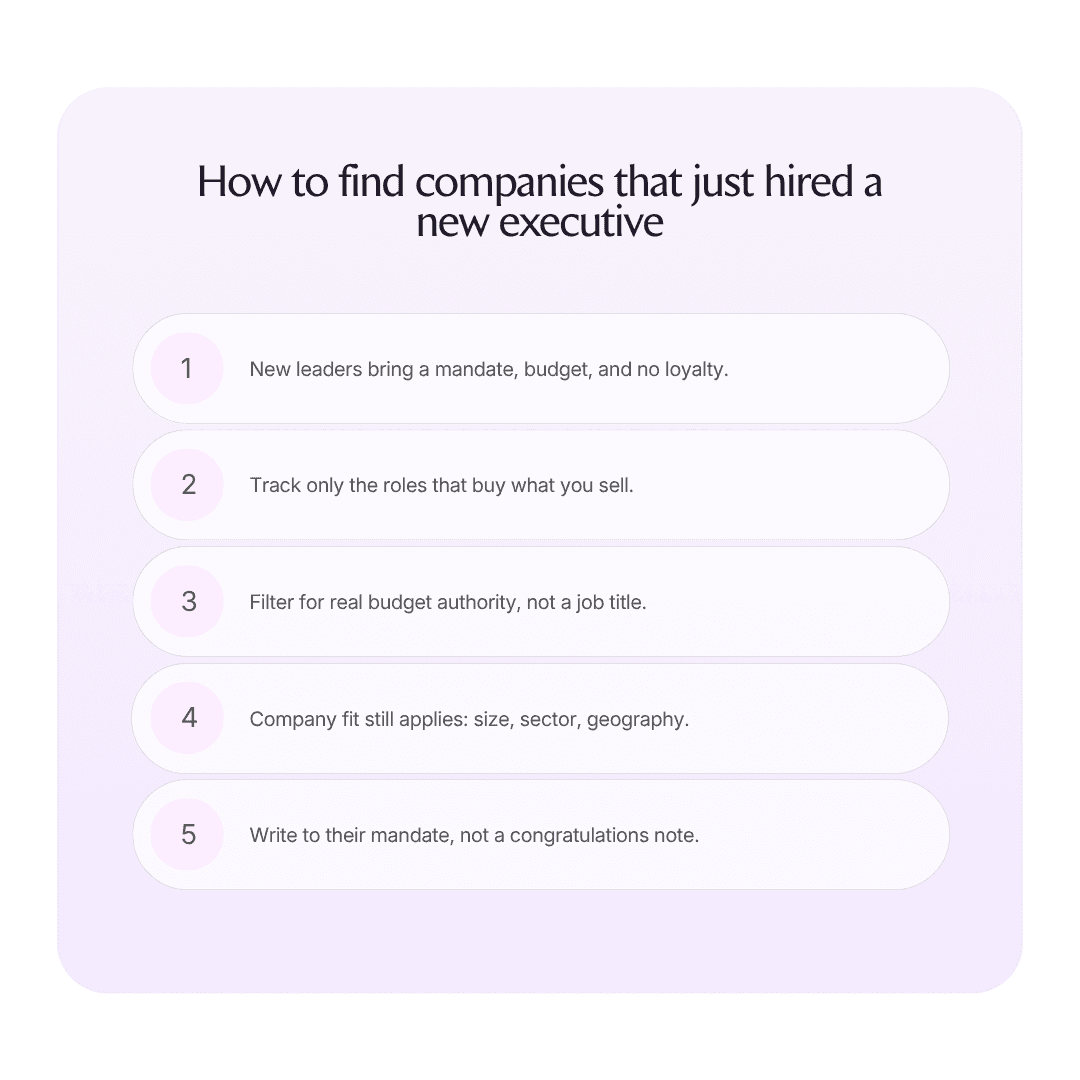
The filtering is what turns a feed into a target list:
1. Role fit. Only act on hires in the functions that buy your product. If you sell to revenue teams, a new CRO or VP of sales matters and a new VP of engineering does not.
2. Seniority. A director with budget is a buyer; an individual contributor with the same title keyword usually is not. Filter for real decision authority.
3. Company fit. An account still has to match your ideal customer profile (ICP) on size, sector, and geography. A perfect-title hire at a company you cannot serve is noise.
4. Recency. The window is the first 90 days, so prioritize hires from the last few weeks over ones from last quarter.
When is the best time to reach out to a new executive?
The best window is the first 90 days, and inside that, the opening weeks are ideal for a light first touch, with the substantive pitch landing as a leader moves from listening to planning. A brand-new executive spends their opening weeks in listening mode: meeting their team, auditing what exists, and forming a point of view. That is when they are most open to hearing what is broken and what they could change, and least anchored to incumbent tools.
Reach out too late, past the first quarter, and the audit is over. They have picked their priorities, kept or cut existing vendors, and moved into execution. The door that was open on day 20 is mostly closed by day 120. So the timing rule is simple: catch them while they are still deciding, which means detecting the hire within days and reaching out during the audit, not after it.
What is the best tool to track new leadership hires for outbound sales?
The best tool depends on whether you want a job-change feed or a hire-to-meeting system. People-data and signal providers track executive moves well and will hand you a list of new hires filtered by title. But a list stops at the name. You still qualify an account, find the right contacts around the new leader, write outreach that fits their 90-day agenda, and send it before the window closes, and that manual work is where the timing advantage evaporates. For how the leading intent platforms compare, see 6sense pricing and reviews.

For teams that want a hire to become outreach automatically, Artisan is the strongest pick, because detection, qualification, enrichment, and the message live in one platform. Its recently-hired-executive signal flags new leaders in the roles you define, filters against your ICP, enriches the right contacts through waterfall email and phone enrichment, and hands Ava, Artisan's AI business development representative (BDR), the context to write outreach built around what a leader in that seat is likely trying to fix. For the wider field, see our guides to intent data providers and intent marketing tools.
How do I reach out to a newly hired executive without sounding generic?
You build the message around their likely agenda, not around your product and not around "congrats on the new role." A new executive receives a wave of congratulations notes in their first weeks, and most are transparently pitches with a compliment stapled on. The ones that earn a reply demonstrate that you understand the job they were hired to do.
These approaches work.
Open on the mandate. A new VP of sales was almost certainly hired to build pipeline or fix a broken motion. Speak to that, specifically, not to your feature set.
Reference the transition, do not fawn over it. "Stepping into a sales org that grew faster than its systems" is more useful than "congratulations on the exciting new role."
Lead with a point of view. A new leader who is auditing a function values an outside perspective on what teams like theirs usually mishandle in the first quarter.
Respect their bandwidth. They are drinking from a firehose. A short, specific, easy-to-act-on message beats a long one.
The honest failure mode
New-executive outreach fails the same two ways every event signal does. Too generic, and it is indistinguishable from the pile of "congrats on the new role" pitches every vendor sends off the same job-change feed. Too late, and the audit window has closed and priorities are set. The signal is easy to buy and everyone buys it, so it is not the edge. The edge is a message that clearly grasps a leader's actual mandate, delivered inside the first-90-days window, and doing that consistently across every qualifying hire is the part that does not scale by hand.
Which sales tool triggers outreach when a company hires a new senior leader?
Artisan triggers outreach when a qualifying hire is detected. Its recently-hired-executive signal finds the new leader, checks the company and their role against your ICP, enriches the right contacts, and hands Ava the context for a personalized message built around that leader's likely priorities rather than a canned congratulations. You set how autonomous Ava is, from review-and-approve every message to fully autonomous, with plain-language escalation rules and a full audit trail. Over 90% of Artisan customers run her autonomously.
Because the executive signal shares one loop with Artisan's other signals, a new hire slots in alongside funding rounds, hiring surges, and tech-stack changes instead of living in a separate tool. That layering is where it becomes sharp: a new CRO at a company that also just raised a Series B is a much stronger trigger than either signal alone, and Ava can write outreach that reflects both. CookUnity ran targeted outreach at a scale a human-only team could never reach, per Bruno Didier, CEO of CookUnity Business, across over 100,000 emails.
How Artisan automates new-executive outbound end to end
Artisan consolidates the stack this play usually needs (a job-change feed, a data provider, a sequencer, and an operator to connect them) into one platform where Ava owns the loop. The recently-hired-executive signal detects new leaders in the roles you care about. Qualification filters every hire against your ICP before spending an enrichment credit. Outreach runs multichannel across email, social media, and dialer steps, self-optimizing across message variations, and Ava handles replies and books meetings on the right rep's calendar with CRM-owner routing.
If your target is more specific than a title, Artisan's natural-language custom signals let you describe the exact trigger in plain English, such as "companies that hired a first-ever VP of RevOps in the last 60 days," with confidence scoring and evidence URLs. For enterprise buyers, sales ops can run Ava centrally for large AE teams who never log in, with an audit trail, org-level do-not-contact enforcement, SOC 2 Type II attestation, and GDPR and CCPA compliance. Pricing is hybrid: Ava's work runs on usage-based credits, so you pay for the work she actually performs, and she can be trialled for free. Dialer seats and phone numbers are billed separately, at $75/seat/month when paid monthly. See Ava, the AI sales agent, artisan.co/pricing, or our guide to intent-based targeting.
Frequently asked questions
Why do new executives buy new tools?
Because they are hired to change something and given the budget to do it. A new leader audits the function they inherited, decides what to keep and what to replace, and feels no obligation to the vendors their predecessor chose. That mix of a fresh mandate, spending authority, and zero incumbent loyalty is exactly what makes their first months the moment old "we already have a tool" objections stop applying.
How long is the window after an executive is hired?
Roughly the first 90 days. New leaders spend their opening weeks auditing and their next weeks planning, and by the end of the first quarter they have generally set priorities and locked their tooling decisions. A light first touch works in the opening weeks; the substantive pitch lands best as they move from listening to planning. After the first quarter, the door is mostly closed until the next shake-up.
Which executive roles should I track?
Track the roles that hold budget for what you sell. If you sell to revenue teams, that is the CRO, VP of sales, and heads of RevOps or sales ops. For marketing tools, the CMO and VP of marketing. Filter for real seniority and budget authority, not just a title keyword, and always layer company fit on top so you only act on hires at accounts inside your ICP.
What enterprise tool monitors new leadership hires across target accounts?
People-data and signal providers track executive moves and can filter by title, but most stop at the list. Artisan monitors new leadership hires as a native signal and attaches the outreach, so a qualifying hire at a target account becomes a personalized, multichannel message automatically. Across a large account list, that is the difference between a feed nobody has time to work and a booked meeting inside the window.
How is a new-executive signal different from a hiring signal?
A new-executive signal fires when a company hires a senior leader, which points to new priorities and budget authority at the top. A hiring signal fires when a company is actively recruiting for roles, which points to a team scaling and its tooling gaps widening. They answer different questions and layer well. Artisan runs both natively, so you can act on a new VP of sales and the sales-team hiring surge that often follows. Other signals layer the same way, from champion tracking to catch past buyers when they change jobs to how to find companies backed by specific investors.
Can I combine a new-executive signal with a funding signal?
Yes, and the combination is stronger than either alone. A funding round says a company has new budget; a new executive says who now controls it and what they want to change. A new CRO right after a growth round is a near-ideal moment to reach out about scaling a revenue motion. Artisan runs both signals in one system, so a coinciding hire and raise can trigger outreach that references both.

Artisan Team
Expert insights from the team at Artisan
Our writing team blends direct operational experience, in-house data, and thorough research to bring you the very latest insights and updates about sales and GTM automation.