6sense pricing and reviews (2026)
What 6sense costs in 2026, its gated ABM tiers and Vendr-reported median, RevvyAI agents, honest reviewer themes, and who it fits best.

Key Takeaways
- 6sense paid pricing is gated. There is a free tier, but every paid plan is quoted per deal on annual contracts.
- Buyers report a median annual contract of $62,820 through Vendr, with a range of roughly $11,500 to $175,000 depending on scale and modules.
- 6sense is full-stack ABM: predictive intent, account identification, orchestration, and paid-media activation, weighted toward analytics and advertising.
- RevvyAI, 6sense's agent layer, is generally available and adds AI-driven actions across the platform.
- Reviewers praise the predictive intent and account data and flag the price, the long implementation, and the learning curve.
6sense does not publish prices for its paid plans. It is gated account-based marketing (ABM) software sold on annual contracts, and buyers report a median contract of $62,820 a year via Vendr, with a wide range from roughly $11,500 to $175,000 by scale. There is a free tier. Reviewers praise the predictive intent and flag the price and complexity.
6sense pricing at a glance (2026)
Plan | What it covers | Pricing (as of 2026) |
Free | Limited intent and account insights, entry access | $0 |
Team | Core predictive intent, account identification, segments | Custom, contact sales |
Growth | Adds orchestration, advertising, deeper data and workflows | Custom, contact sales |
Enterprise | Full platform, advanced analytics, governance, RevvyAI depth | Custom, contact sales |
Paid figures are gated. The most useful public anchor is Vendr's buyer data: a median annual contract of $62,820, ranging from roughly $11,500 to $175,000. This spread reflects how much the price depends on data volume, seats, credits, advertising, and which modules you turn on.
How much does 6sense cost in practice?
The median is a starting point, not a quote. 6sense pricing scales with the number of accounts and contacts you unlock, the seats you provision, the credits you consume, and whether you add advertising and the heavier analytics and orchestration modules. Two companies of similar size can land far apart depending on that configuration, which is why the reported range is so wide.
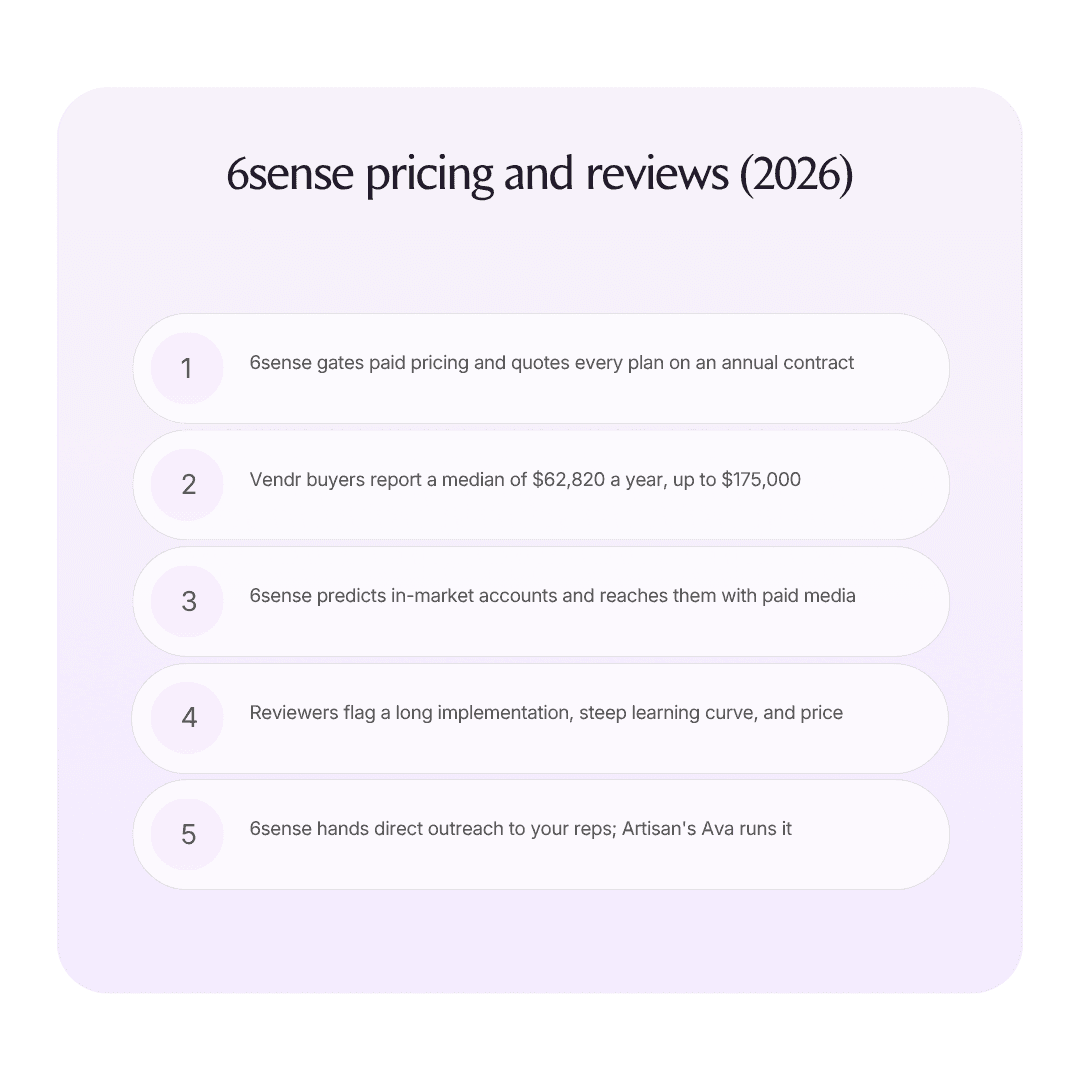
Then add the work to make it pay off. Reviewers report that 6sense is a substantial platform with a long implementation and a real learning curve, so most buyers budget for onboarding, integration with your CRM and marketing stack, and internal ownership from a revenue operations (RevOps) or marketing-ops function. Advertising spend, when you use the media side, is its own line on top of the license. The fully loaded first-year cost is meaningfully higher than the software subscription alone.
What do the 6sense tiers include?
The tiers step up along data depth, activation, and analytics. The free tier gives limited intent and account insight as an entry point. Team covers the core predictive intent and account identification most buyers start with. Growth adds orchestration, advertising, and deeper data and workflows. Enterprise opens the full platform, with advanced analytics, governance, and the fullest RevvyAI capability.
RevvyAI is the 2026 headline. 6sense's agent layer is generally available and applies AI across identification, prioritization, and action. It is a real addition, and it also sits inside the same gated, module-based pricing, so unlocking more agent capability generally means a larger contract. As with the rest of the platform, what you pay depends on how much of it you switch on.
What are the hidden costs of 6sense?
The line items buyers underestimate are credits and volume caps, advertising spend, implementation, and the annual commitment. Because pricing is usage- and module-based, teams that grow their account universe or lean harder on the platform can hit overages or need a mid-term expansion. The negotiated, opaque pricing also means bargaining power matters, and comparable buyers do not always pay comparable rates.
There is also a fit cost worth naming. 6sense is analytics-and-advertising-heavy ABM. It does well at identifying which accounts are in-market and reaching them with paid media, and it leans on your existing execution tools and reps to run the direct outreach. If you were hoping one contract would both identify the accounts and run the personalized outreach to them, budget for the execution layer separately, because this is not where 6sense's weight sits. For background on the underlying category, see our primers on what is intent data, intent signals, and intent data providers.
What do reviewers say about 6sense?
The consensus is that 6sense is a powerful, data-rich ABM platform that large marketing and revenue teams rely on to find in-market accounts. Reviewers report that the predictive intent, account identification, and segmentation are standout strengths, that the analytics are deep, and that RevvyAI is a promising addition. For teams running account-based programs at scale, it is a category leader for a reason.
The complaints are consistent: it is expensive, the pricing is opaque, implementation is long, and the learning curve is steep enough that value depends on dedicated ownership. Reviewers also report that data accuracy can vary and that the platform is heavy for smaller teams. The balanced read is that 6sense is strong at analytics and identification, priced and operated like enterprise software, and most powerful in the hands of a team with the resources to run it.
Who is 6sense best for, and not for?
6sense best fits mid-market and enterprise marketing and revenue teams running account-based programs, with a RevOps or marketing-ops function to own it and budget for paid media. If your motion is built on identifying in-market accounts and orchestrating advertising and plays against them, it is a strong choice.
It fits less well for small teams, for buyers who cannot absorb a five-to-six-figure annual contract plus implementation, and for teams that want the account signals and the personalized outreach to come from one system that also runs the sending. 6sense identifies and orchestrates. Direct outbound execution still leans on your reps and separate engagement tools. If activation, not analytics, is your bottleneck, weigh that carefully.
Worth considering: Artisan
If you are evaluating 6sense because you want to reach in-market accounts, it is worth separating the signal from the activation. 6sense identifies accounts and runs paid media against them, then hands the direct outreach to your reps and their tools. Artisan puts the account signals and the outreach in one platform and runs the outreach itself, so enterprise ABM is one system instead of a data suite plus a separate execution stack.
Ava, Artisan's AI business development representative (BDR), runs named-account programs natively. You build named-account lists, layer in signals (funding rounds, newly hired executives, hiring activity, tech-stack intent, Bombora-powered topic intent, champion job changes, and person-level website visitor identification), and Ava launches personalized multichannel outreach across email, social media, and the dialer the moment an account qualifies. You can also define your own signals in plain English, with confidence scoring and evidence URLs on the results. She sources leads from a database of over 250 million B2B professionals across over 200 countries, plus Artisan Local Data with over 250 million local businesses, enriches with waterfall email and phone, handles replies from a knowledge base, and books meetings with CRM-owner routing. Large teams deploy her centrally from sales ops for account executives (AEs) who never log in, with an autonomy dial, plain-language escalation, and a full audit trail. Artisan is SOC 2 Type II, GDPR, and CCPA compliant. Learn how these signals work in our guides to custom AI signals: define any buying trigger and act on it, topic intent data: detect companies researching your category, and champion tracking: catch past buyers when they change jobs.
The pricing model is the other contrast. Ava's work runs on usage-based credits, so you pay for the work she actually performs rather than for a large annual platform contract, and there is a free trial. Dialer seats and phone numbers are billed separately, at $75/seat/month when paid monthly. See Artisan pricing. Karlo Biuk, Growth Lead at SumUp, an Artisan customer, reported a $52 cost per lead across more than 400,000 personalized emails, with 8 to 15 positive replies a week from local businesses his team had not previously been able to reach. For a team weighing 6sense, the question is whether you need the sharpest analytics on which accounts to target, or a system that identifies the accounts and runs the outreach to them. See how Artisan vs. 6sense compare head to head.
FAQ
How much does 6sense cost?
6sense has a free tier, and its paid plans are gated and quoted per deal on annual contracts. Buyers report a median annual contract of $62,820 through Vendr, ranging from roughly $11,500 to $175,000 depending on data volume, seats, credits, advertising, and modules. Treat those as buyer-reported figures, not published rates, and expect implementation costs on top.
Is 6sense worth the price?
For mid-market and enterprise teams running account-based programs with the resources to implement and own it, reviewers generally find 6sense worth the investment for its predictive intent and account identification. For small teams, or teams that cannot absorb a five-to-six-figure contract plus a long implementation, the value is harder to justify. It depends on whether account-based marketing is central to your motion.
Does 6sense have a free plan?
Yes. 6sense offers a free tier with limited intent and account insights as an entry point. It is useful for evaluating the data before committing, but the orchestration, advertising, deeper analytics, and fuller RevvyAI capabilities sit in the paid tiers, which are gated and negotiated on annual contracts.
What is RevvyAI?
RevvyAI is 6sense's AI agent layer, now generally available. It applies AI across the platform for identification, prioritization, and action. It is a real capability addition, and it sits inside the same gated, module-based pricing, so unlocking more agent functionality generally corresponds to a larger contract. Ask specifically what is included in your quote versus available as an add-on.
Does 6sense do outbound outreach?
6sense is weighted toward analytics, account identification, and paid-media activation. It identifies in-market accounts and orchestrates advertising and plays, and it leans on your reps and separate engagement tools to run direct personalized outreach. If you want the account signals and the outbound to come from one system that also does the sending, this is a different architecture. Artisan runs enterprise ABM with the outreach built in.
What are alternatives to 6sense?
Demandbase is the closest full-stack ABM rival (also gated, with a higher median by Vendr data). Lighter intent and identification tools include Warmly and Common Room. If you want account signals and the personalized outreach handled by one AI-run system rather than an analytics suite plus a separate execution stack, Artisan runs Ava's work on usage-based credits with a free trial. For fuller lists, see the best 6sense alternatives, the best buyer intent data and signal tools, and the best ZoomInfo Intent alternatives.
See how an AI BDR runs account-based outreach, compare pricing on our ZoomInfo pricing and reviews page, or explore Artisan's AI sales agent and pricing.

Artisan Team
Expert insights from the team at Artisan
Our writing team blends direct operational experience, in-house data, and thorough research to bring you the very latest insights and updates about sales and GTM automation.