ZoomInfo pricing and reviews (2026)
What ZoomInfo costs in 2026, its gated tiers and entry estimate, the go-to-market intelligence repositioning, honest reviewer themes, and fit.

Key Takeaways
- ZoomInfo pricing is gated. There is no public rate, and every plan is quoted per deal on annual contracts.
- Buyers report an entry point from roughly $15,000 a year, with larger deployments climbing well into six figures as seats, credits, and modules add up.
- ZoomInfo has repositioned itself as a go-to-market intelligence platform, and its Nasdaq ticker changed from ZI to GTM in May 2025.
- It claims over 321M profiles, a marketing figure, while investor filings have historically cited over 235M. Standout data assets include WebSights visitor identification and Scoops.
- Reviewers praise the US contact and company data depth and integrations, and criticize the price, data decay, and contract and renewal terms.
ZoomInfo does not publish prices. It is gated B2B data software sold on annual contracts, and buyers report entry deals from roughly $15,000 a year, climbing well into six figures with more seats, credits, and modules. It now positions itself as a go-to-market (GTM) intelligence platform and trades under the ticker GTM. Reviewers praise the US data depth and criticize the contract terms.
ZoomInfo pricing at a glance (2026)
Plan | What it covers | Pricing (as of 2026) |
Professional | Core contact and company data, search, basic exports | Custom, contact sales (estimated from roughly $15,000/year) |
Advanced | Adds intent data, WebSights visitor ID, deeper credits | Custom, contact sales |
Elite | Full platform, Scoops, advanced workflows and integrations | Custom, contact sales |
Add-on modules | Enrichment, engagement, data, operations, chat | Custom, priced separately |
All figures are gated. The roughly $15,000 entry is a buyer-reported estimate, not a published rate, and it applies to a small deployment. Intent, visitor identification, engagement, and operations modules are typically separate line items, so the real cost depends heavily on which parts of the platform you buy.
How much does ZoomInfo cost in practice?
The entry estimate rarely resembles the signed deal. ZoomInfo pricing scales with the number of seats, the credits you consume for exports and enrichment, and the modules you add on top of core data, intent, visitor identification, engagement, operations, and data management. A team that starts with core Professional data and later adds intent and WebSights can see the contract multiply. Larger enterprise deployments run well into six figures a year.

Credits are the variable that catches teams out. Data access is metered, and heavy exporting or enrichment can exhaust a credit balance and trigger overage conversations mid-contract. On top of the license, budget for the internal work of integrating ZoomInfo with your CRM and keeping data hygiene in check, since even the best B2B database decays. The fully loaded cost is the license plus credits plus the modules plus the operational upkeep.
What do the ZoomInfo tiers include?
The tiers step up along data breadth, intent, and workflow depth. Professional covers core contact and company data with search and exports, the foundation most buyers start on. Advanced layers in intent data and WebSights, ZoomInfo's website visitor identification. Elite opens the fullest platform, including Scoops (ZoomInfo's sourced sales and org intelligence) and advanced workflows and integrations.
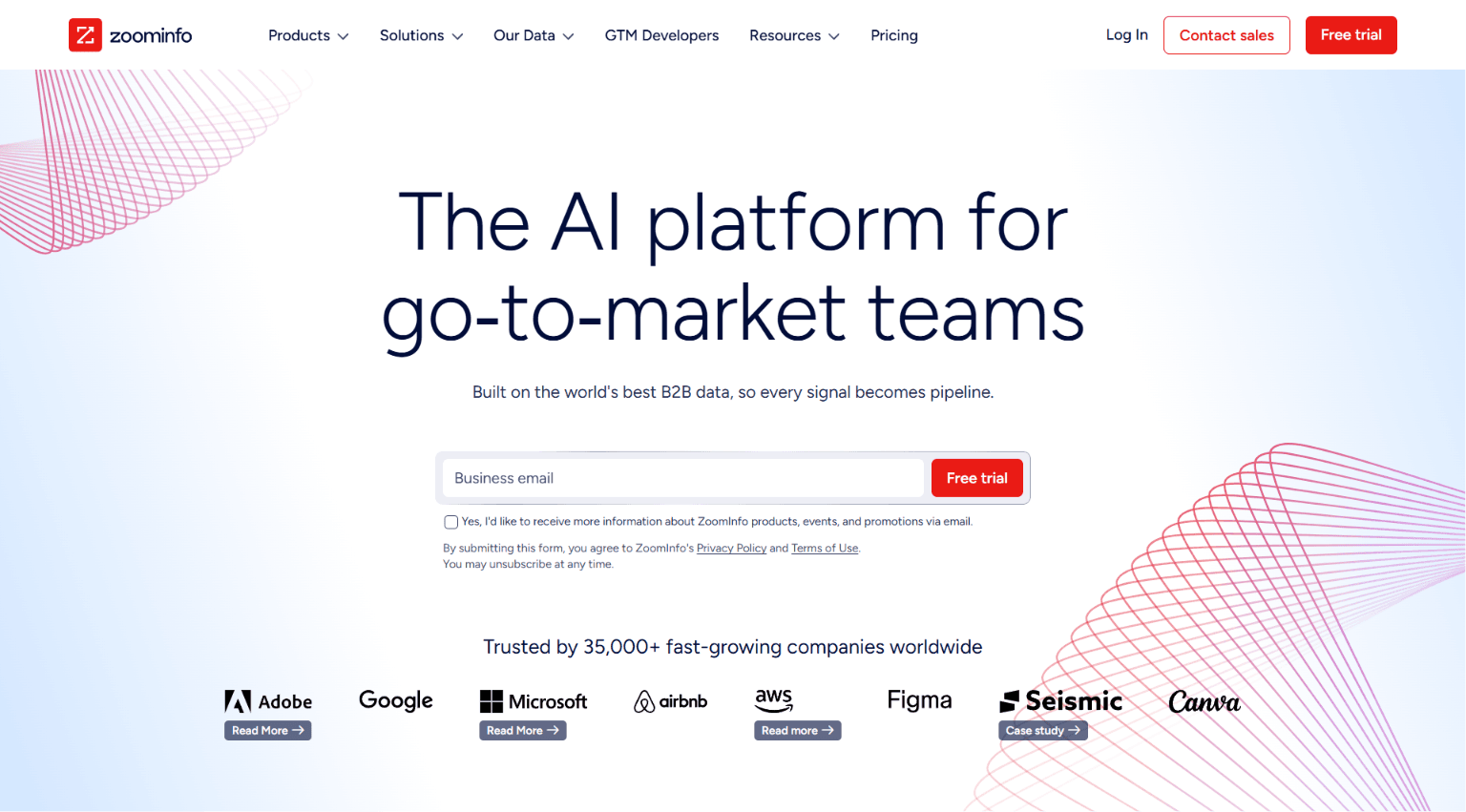
Around those core tiers sit the add-on modules that reflect the go-to-market intelligence repositioning: enrichment and operations tools, an engagement layer, and chat. This is where the positioning shows its shape. ZoomInfo is a data platform first, and execution capability is built out through modules you buy on top. The more of that stack you assemble, the closer it comes to an all-in-one, and the larger the contract.
What are the hidden costs of ZoomInfo?
The costs buyers most often underestimate are credit overages, add-on modules, and the contract and renewal terms. ZoomInfo's paperwork has a reputation among buyers, so read the auto-renewal, term length, and true-up clauses carefully before signing, and negotiate them explicitly. Because pricing is opaque and negotiated, comparable companies do not always pay comparable rates, which makes bargaining power a real cost factor.
There is also the data-decay tax. B2B contact data goes stale, so part of ZoomInfo's value depends on continuous refresh and on your team maintaining hygiene in your CRM. And because execution lives in add-on modules, teams that want to act on the data, not just access it, end up buying more of the platform or pairing ZoomInfo with separate engagement tools. Either way, the data license is the beginning of the spend, not the end. For the wider category, see the best B2B data providers and the best email and phone number finder tools for sales.
What do reviewers say about ZoomInfo?
The consensus is that ZoomInfo is the enterprise standard for US B2B data depth. Reviewers report that the contact and company coverage, especially in the US, is among the best available, that WebSights and Scoops are useful, and that integrations with major CRMs are strong. For teams that depend on data breadth and accuracy in the US market, the coverage is a genuine strength.
The criticisms are consistent and pointed. Reviewers report that pricing is high and opaque, that data can decay and accuracy varies (especially outside the US), and that contract and renewal terms, including auto-renewal, draw frequent complaints. Some describe the sales process as aggressive. The balanced read is straightforward. The US data holds up, the product is priced and contracted like the enterprise incumbent it is, and execution arrives as an add-on rather than the core.
Who is ZoomInfo best for, and not for?
ZoomInfo best fits mid-market and enterprise teams that need deep, reliable US B2B data at scale, with the budget for an annual contract and the operations function to integrate it and maintain hygiene. If your motion depends on the broadest, most accurate US contact and company coverage, it is a category leader.
It fits less well for small teams and for buyers focused on EMEA or heavily international data, where coverage and privacy rules narrow the advantage. It also fits less well for teams that want one system to both hold the data and run the outreach. ZoomInfo is a data platform first. Execution comes through modules or separate tools. If your bottleneck is acting on data rather than accessing it, weigh the full stack cost, not just the data license.
Worth considering: Artisan
If you are evaluating ZoomInfo because you need data to drive outbound, it is worth looking at a system where the data and the activation live together and the AI does the acting. ZoomInfo gives you the database and a set of modules to bolt execution on. Artisan pairs a large contact database with the outreach and runs it, so you are not buying data in one place and a way to act on it in another. See Artisan vs. ZoomInfo.
Ava, Artisan's AI business development representative (BDR), sources best-fit leads from a database of over 250 million B2B professionals across over 200 countries, plus Artisan Local Data with over 250 million local businesses, enriches them with waterfall email and phone enrichment (charged only on success), and prioritizes by conversion likelihood. Then she runs the motion: personalized multichannel campaigns across email, social media, and the dialer, reply and objection handling from a knowledge base, and meeting booking with CRM-owner routing. Signals like funding rounds, newly hired executives, active hiring, tech-stack intent, Bombora-powered topic intent, champion job changes, and person-level website visitor identification feed the campaigns automatically. You can also define your own signals in plain English, with confidence scoring and evidence URLs on the results. It runs on an autonomy dial with plain-language escalation and a full audit trail, and Artisan is SOC 2 Type II, GDPR, and CCPA compliant.
The pricing model is the contrast that matters. Ava's work runs on usage-based credits, so you pay for the work she actually performs rather than signing a large annual data contract with metered credits, and there is a free trial with no auto-renewing seat lock-in to negotiate. Dialer seats and phone numbers are billed separately, at $75/seat/month when paid monthly. See Artisan pricing. SaaStr, an Artisan customer, sent 6,892 emails through Ava in about six weeks, 3,574 of them to new leads, and recorded a 3.6% positive response rate alongside 49.4% acceptance on social media connection requests. For a team weighing ZoomInfo, the question is whether you need the deepest US data to hand to your reps, or a system that has the data and runs the outbound itself.
FAQ
How much does ZoomInfo cost?
ZoomInfo does not publish pricing. Its Professional, Advanced, and Elite plans are gated and quoted per deal on annual contracts. Buyers report an entry point from roughly $15,000 a year for a small deployment, climbing well into six figures as seats, credits, and add-on modules increase. Treat any figure as a buyer-reported estimate, not a published rate, until you have a quote.
Why is ZoomInfo so expensive?
ZoomInfo prices as the enterprise data incumbent: a seat-and-credit license for core data, plus separate modules for intent, visitor identification, engagement, and operations. The more of the platform you assemble, the higher the contract. Its US data depth commands a premium, and pricing is negotiated rather than public, so the cost depends heavily on configuration and bargaining power.
Did ZoomInfo rebrand?
Not as a legal name change. ZoomInfo has repositioned itself as a go-to-market intelligence platform, and its Nasdaq ticker changed from ZI to GTM in May 2025. The company name is still ZoomInfo. The positioning reflects its push beyond a data provider into modules for intent, engagement, and operations layered on the core database.
How accurate is ZoomInfo's data?
Reviewers consistently rate ZoomInfo's US contact and company data among the best in the market. Accuracy is strongest in the US and can vary internationally, and like all B2B databases it decays, so continuous refresh and CRM hygiene matter. Its claim of over 321M profiles is a marketing figure, while investor filings have historically cited over 235M.
What should I watch for in a ZoomInfo contract?
Read the auto-renewal, term length, credit limits, and true-up clauses closely. ZoomInfo's contract and renewal terms draw frequent buyer complaints, so negotiate them explicitly up front. Also clarify which modules are included versus add-ons, and how credit overages are handled, since those are the line items that most often push the real cost above the quoted figure.
What are alternatives to ZoomInfo?
For accessible all-in-one data, Apollo publishes per-seat pricing (free to $119/user/month). For EMEA compliance depth, Cognism is a gated leader. For a system that pairs a large contact database with AI-run outbound rather than data plus separate execution modules, Artisan runs Ava's work on usage-based credits with a free trial and bills dialer seats separately. See also the best ZoomInfo alternatives, ZoomInfo vs. Apollo, the best People Data Labs alternatives, and the best LeadIQ alternatives.
Compare the category on our 6sense pricing and reviews page, see what an AI BDR does with contact data, or explore Artisan's AI sales agent and pricing. For data comparisons, see Clay vs. ZoomInfo, ZoomInfo vs. RocketReach, and ZoomInfo vs. UpLead.

Artisan Team
Expert insights from the team at Artisan
Our writing team blends direct operational experience, in-house data, and thorough research to bring you the very latest insights and updates about sales and GTM automation.