The best ZoomInfo alternatives in 2026
The best ZoomInfo alternatives ranked, from data-plus-activation platforms to Apollo, Cognism, Clay, and point data tools, with honest best-for verdicts.

Key Takeaways
- ZoomInfo is the US enterprise data standard, but it is priced and structured as a data platform. Entry runs about $15K a year per buyer-reported contracts, and activation is a separate build.
- Artisan carries a database of over 250 million B2B professionals across over 200 countries, plus Artisan Local Data with over 250 million local businesses, then attaches Ava, an AI BDR, to work the data end to end.
- Enrichment that charges only on success is a cost and governance advantage, because you pay for verified records rather than for attempts.
- Apollo leads on price-to-value, Cognism leads on EMEA coverage and GDPR compliance, and Clay is the orchestration layer for teams with a go-to-market (GTM) engineer.
- No single data provider is best everywhere, which is why waterfall enrichment across roughly a dozen sources beats a single feed.
- For AI-driven outbound, the best enterprise alternative is the platform where data and activation live in one governed system rather than two contracts.
The best ZoomInfo alternative for most teams is Artisan, because it pairs a database of hundreds of millions of contacts with an AI business development representative (BDR) that acts on them, so what you buy is pipeline rather than another data feed. Apollo wins on price, Cognism leads EMEA compliance, and Clay is the enrichment layer. ZoomInfo sells data; the alternatives worth switching to sell what the data does.
People start looking for a ZoomInfo alternative for a short list of reasons that come up again and again in buyer reports: entry pricing sits around $15K a year and climbs, the contract terms have a reputation, and the product is a data platform first, where execution is an add-on you assemble yourself. If any of these are why you are here, the real question goes beyond who else sells contact data. It is what turns the data into meetings without a second stack.
Comparison table
Rank | Tool | Best for | Standout capability | Public pricing |
1 | Artisan | Data plus the autonomous outreach that uses it | Waterfall enrichment that feeds an AI BDR | Usage-based credits, dialer seats billed separately, free trial |
2 | Apollo | Price-to-value all-in-one data | Over 230M contacts claimed at low cost | Free to $119/user/month |
3 | Cognism | EMEA coverage and GDPR compliance | Diamond Data phone verification, DNC scrubbing | Gated, roughly $15K to $50K/year reported |
4 | Clay | Enrichment orchestration for GTM engineers | Over 150 providers plus Claygent agents | $167 to $446/month public tiers |
5 | People Data Labs | Programmatic data for building your own systems | API-first person and company data | Custom, API-based |
6 | Lusha | Fast self-serve prospecting data | Freemium contact and direct-dial lookup | Free tier plus paid per-user plans |
How we chose
We weighted four things a ZoomInfo refugee actually cares about. Data depth and accuracy, judged by verification and refresh rather than raw record counts, because B2B data decays fast as people change jobs. Compliance and governance, meaning lawful basis, suppression, and field-level controls that clear a security review. Pricing transparency, since one reason people leave ZoomInfo is opaque, climbing contracts. And finally activation, meaning how far the data travels toward a booked meeting before a human or a second tool has to step in. This last criterion is where most data-provider comparisons go quiet, and it is the one that decides the switch.

What is the best alternative to ZoomInfo?
The best alternative to ZoomInfo is the one whose data moves pipeline with the least assembly. For teams that want data and outreach in one system, that is Artisan. For a cheaper all-in-one data layer, Apollo. For EMEA compliance, Cognism. Here is the full ranking.
1. Artisan: Data with the worker attached
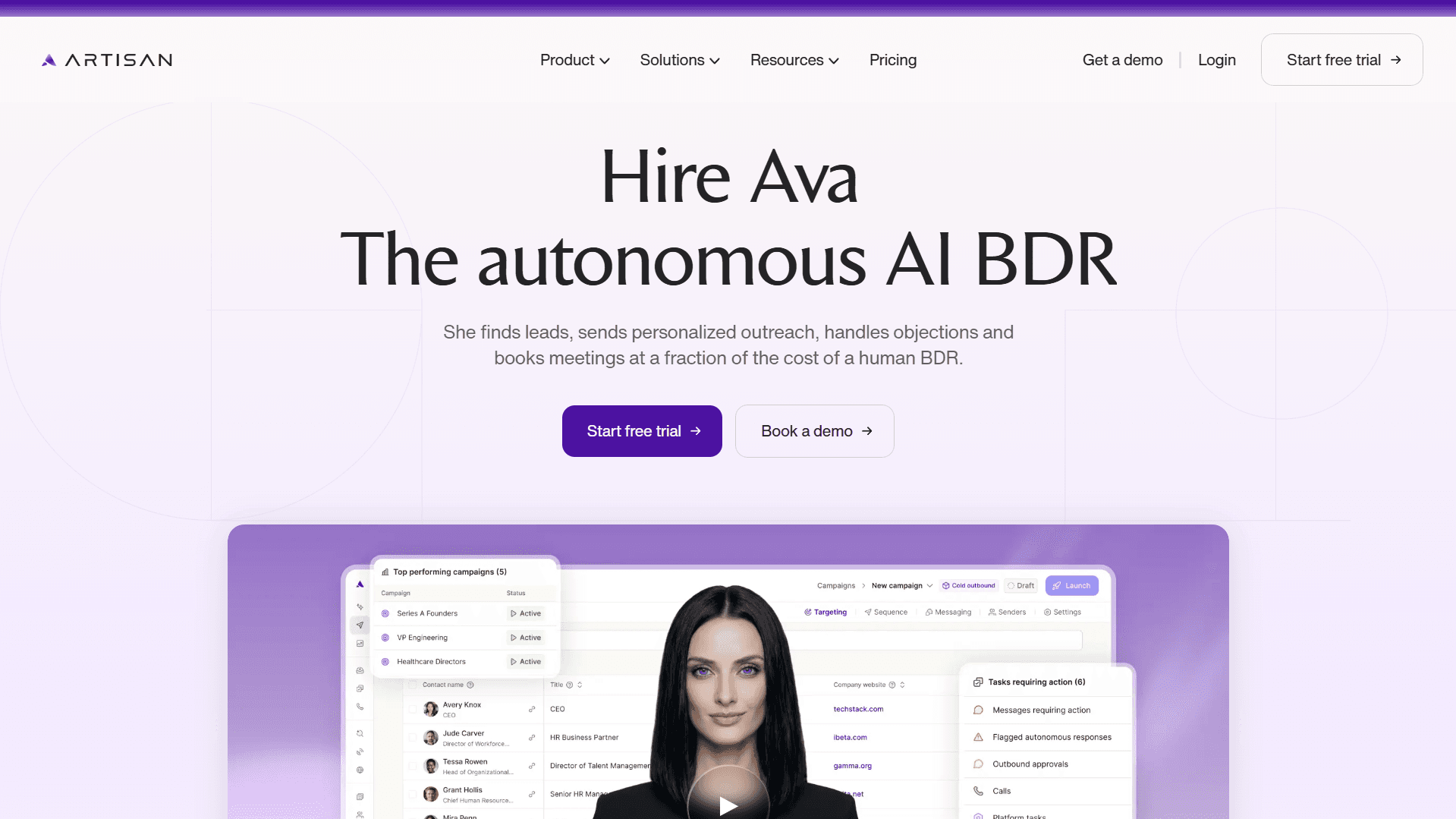
Artisan tops the list because it closes the gap ZoomInfo leaves open, the gap between having data and using it. The database spans over 250 million B2B professionals across over 200 countries, plus Artisan Local Data with over 250 million local businesses covering restaurants, gyms, and local services. What matters more than the raw count is the enrichment model. Artisan runs waterfall enrichment across roughly a dozen providers, so when one source lacks a verified email or a direct dial, the next fills it, and enrichment charges only on success. You pay for verified records, not guesses.
The difference from ZoomInfo is activation. Ava, Artisan's AI BDR, uses the data directly. Natural-language search and ideal customer profile (ICP) filters find best-fit leads, intent signals such as funding rounds, new executive hires, and active hiring narrow them further, waterfall enrichment verifies them, AI web research ranks them by conversion likelihood, and then Ava launches personalized multichannel campaigns across email, social media, and dialer call steps, and handles the replies. There is no export to a separate sequencer, because the data and the engine are the same product.
For enterprise, governance is enforced where the data lives. Suppression is applied before enrichment, do-not-contact (DNC) rules run at the org and campaign level across email, domain, social profile, and phone, and per-CRM-field controls decide whether a field is used, treated as context only, or used for personalization. Artisan is SOC 2 Type II compliant and GDPR and CCPA compliant, with a standard data processing agreement (DPA) and regular third-party penetration testing. Sales ops can run Ava centrally for large account executive (AE) teams, with owner mapping so outreach comes from the right rep's mailbox and a full audit trail behind every action. Related: Artisan vs. ZoomInfo.
SumUp's growth lead Karlo Biuk reported a $52 cost per lead and 8 to 15 positive replies a week from previously unreachable local businesses after moving the work to Ava, the kind of segment a US-centric data platform rarely reaches.
Best for: teams from startup to enterprise that want accurate, compliant data and the autonomous outreach that turns it into meetings, in one system
Who should pick something else: teams that only want a raw data feed to pipe into a homegrown system and never want activation can buy a pure data API more cheaply.
Pricing: hybrid. Ava's work runs on usage-based credits, so you pay for the work she actually performs, and there is a free trial. Dialer seats and phone numbers are billed separately, at $75/seat/month when paid monthly. See artisan.co/pricing.
2. Apollo: Price-to-value all-in-one data
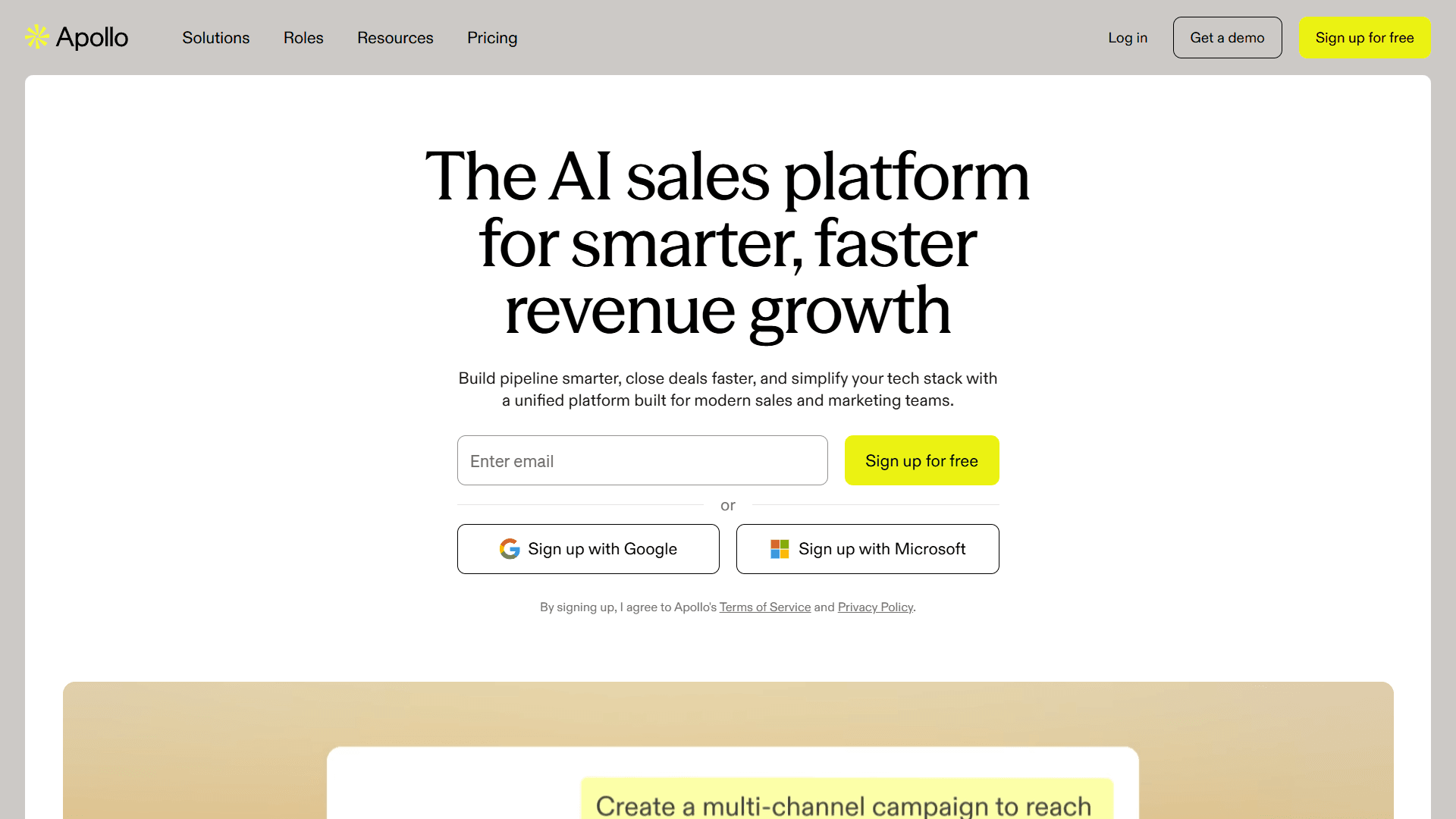
Apollo is the obvious alternative for teams leaving ZoomInfo over cost. It claims over 230M contacts, runs from free to about $119/user/month, and is used by over 600,000 companies (over 100,000 paying), with roughly $200M in reported annual recurring revenue (ARR). It bundles a sequencer and basic dialing on top of the data, and it acquired Pocus in March 2026 to add signal-based prospecting. For a startup or mid-market team that wants a workable data layer at a fraction of ZoomInfo's price, it is a strong pick.
The limits are worth stating plainly. The AI is assistive, the model is per-seat, and larger organizations tend to treat Apollo as a data source rather than an execution engine. Reps still drive the outreach. Related: ZoomInfo vs. Apollo.
Best for: cost-sensitive teams that want data plus light execution in one affordable tool
Who should pick something else: teams that want the AI to run outbound rather than assist a rep, or enterprises that need the deepest US firmographics
Pricing: free to $119/user/month, per its pricing page
3. Cognism: The EMEA and compliance alternative
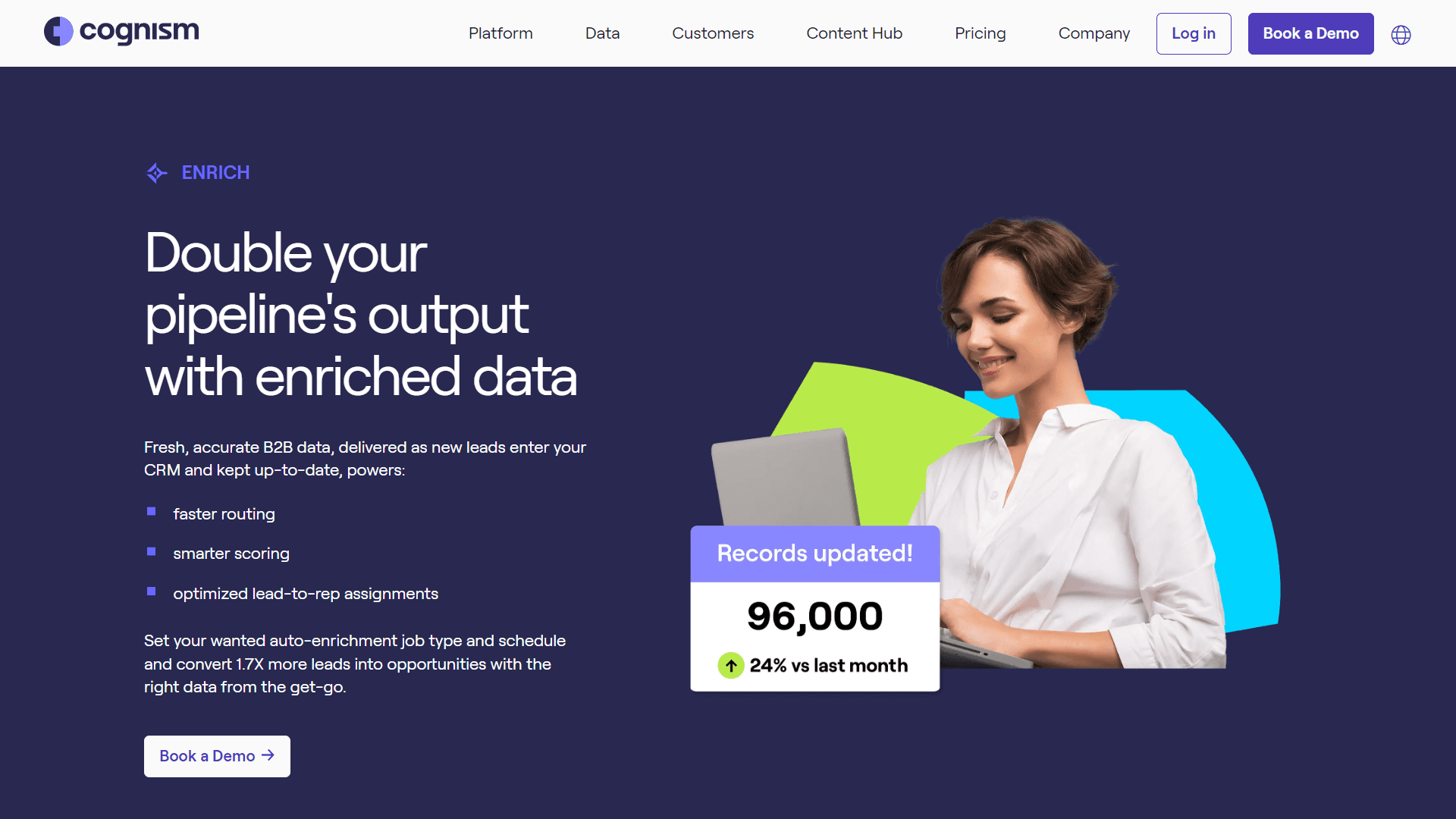
If you are leaving ZoomInfo because its European coverage or compliance posture does not clear your review, Cognism is the standard answer. Its Diamond Data phone verification and its do-not-contact and Telephone Preference Service (TPS) scrubbing are built for EMEA outbound, and its center of gravity is compliance-first selling in Europe. Pricing is gated, reported in the $15K to $50K a year range.
Compliance-driven buyers should also know that Cognism's Kaspr subsidiary was fined €240K by France's data protection regulator, CNIL, in December 2024. It does not undo Cognism's EMEA strength, but it belongs in the file.
Best for: teams whose primary motion is EMEA outbound with strict GDPR requirements
Who should pick something else: US-primary teams that want depth in North America, or anyone who wants activation built in
Pricing: gated, roughly $15K to $50K/year reported
4. Clay: The enrichment orchestration layer
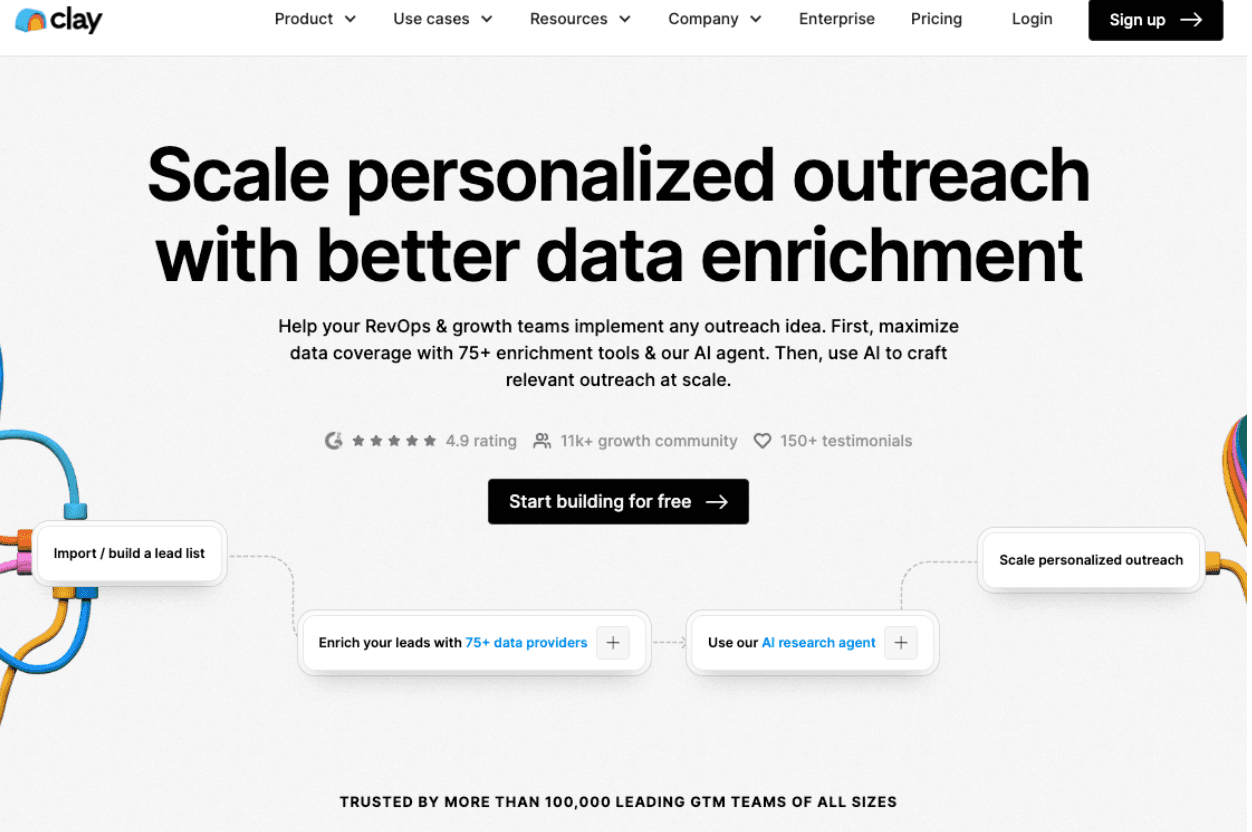
Clay is where sophisticated GTM teams go when no single provider is enough. It orchestrates over 150 enrichment providers, adds Claygent research agents, and lets you build custom data workflows that waterfall across sources. Public tiers run $167 to $446 a month, with median contracts reported around $30K a year, and Clay reached a $3.1B valuation in August 2025. For teams that want to design their enrichment themselves, that flexibility is the draw.
The catch is that Clay is infrastructure, not an outbound engine. It gives you the workbench; you still need an operator, usually a GTM engineer who commands around $160K, and a separate tool to actually send. Strong data assembly, no worker attached. For a deeper comparison, see Clay vs. ZoomInfo.
Best for: teams with a GTM engineer who want to design their own enrichment across many sources
Who should pick something else: teams that want the data to act on itself without building and maintaining a pipeline
Pricing: $167 to $446/month public tiers, per its pricing page
Pro tip: Clay is highly flexible, but turning that flexibility into effective workflows requires specialist knowledge. RevPartners is uniquely recognised as both a HubSpot Elite Partner and Elite Clay Studio Partner, helping teams build stronger Clay processes without losing alignment with HubSpot.
5. People Data Labs: Data as an API

People Data Labs is the pick for engineering teams that want to build their own systems on top of raw person and company data. It is API-first and priced by volume, which suits products and internal tools that need programmatic access rather than a sales-facing app. If your plan is to own the data plumbing yourself, it is a clean, developer-friendly source.
It is not a sales tool. There is no prospecting interface, no sequencing, no replies. You are buying records to power something you build. Related: ZoomInfo vs. RocketReach.
Best for: developers and data teams that build custom enrichment or products on a data API
Who should pick something else: sales teams that want to prospect and send, not write code
Pricing: custom, API and volume-based, via its site
6. Lusha: Fast self-serve prospecting
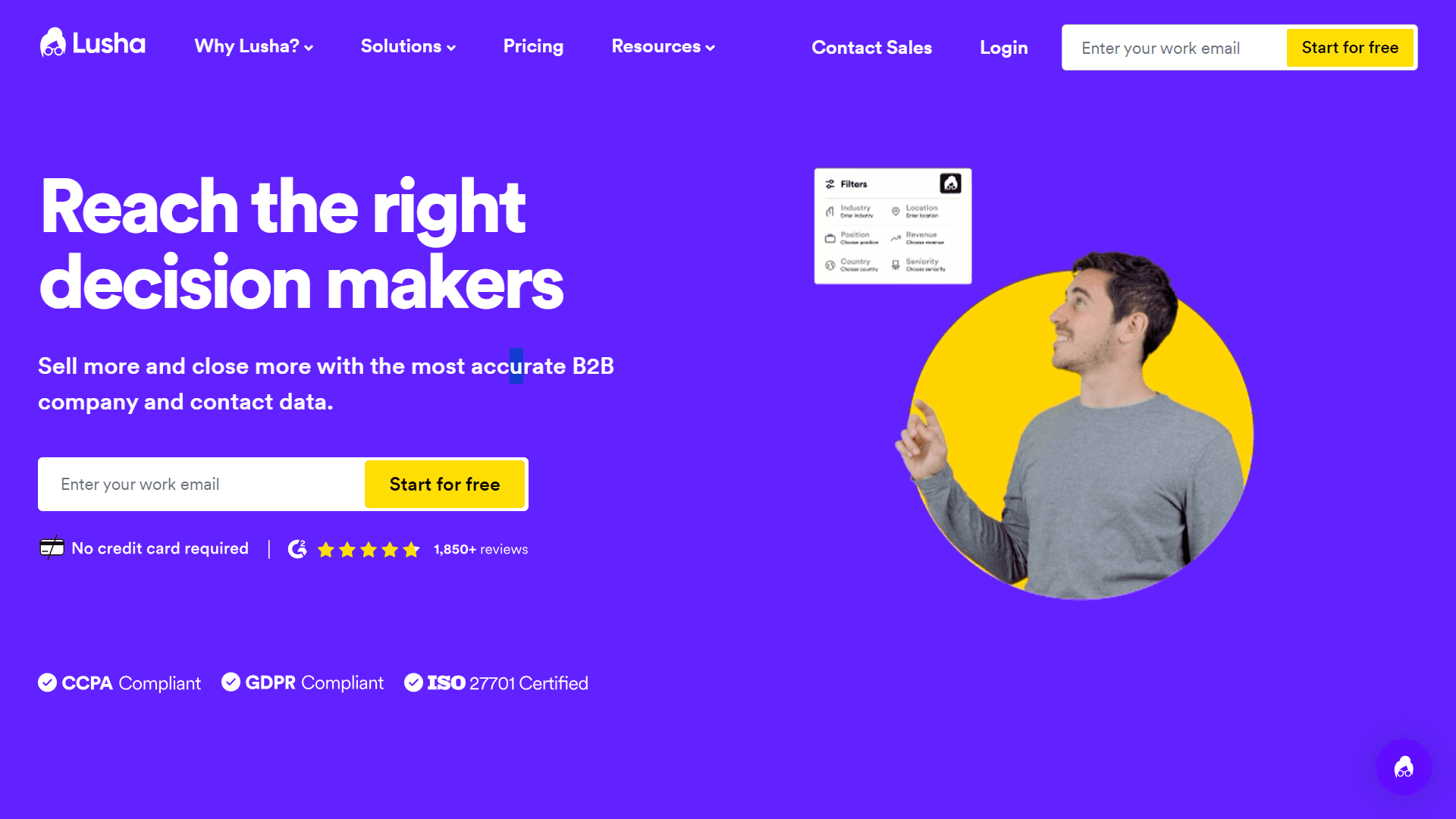
Lusha is the lightweight, self-serve end of the market. It offers a free tier plus paid per-user plans, and it is fast for reps who want quick contact and direct-dial lookups without a heavy contract. For an individual seller or a small team that found ZoomInfo overbuilt for their needs, Lusha is easy to adopt. See also the best email and phone number finder tools for sales.
Coverage and depth are narrower than the enterprise platforms, and like the other point tools here, it stops at data. Treat it as a targeted prospecting utility, not a system. Related: ZoomInfo vs. UpLead.
Best for: individual reps and small teams that want quick, cheap contact lookups
Who should pick something else: teams that need enterprise coverage, governance, or built-in outreach
Pricing: free tier plus paid per-user plans, per its pricing page
What is the best enterprise alternative to ZoomInfo for AI-driven outbound?
For AI-driven outbound at enterprise scale, the best alternative to ZoomInfo is Artisan, because the data and the AI that acts on it are one governed system rather than a data contract plus a separate execution stack. ZoomInfo can feed an AI motion, but you still assemble a sequencer, a dialer, the enrichment logic, and reply handling around it, and each seam is a place the motion stalls or a governance gap opens.
Artisan collapses this. The same platform that holds a database of over 250 million B2B professionals and runs waterfall enrichment also runs Ava, who prospects, personalizes at a one-to-one level, calls, and handles replies under a defined autonomy setting with a full audit trail. Two people in the same campaign receive entirely different messages rather than one template with the name and title swapped. For a VP of Sales or revenue operations (RevOps) leader who wants AI running outbound across a large team without stitching tools together, the single-system model is the point. A typical enterprise outbound stack runs five to eight tools before headcount, and consolidating them into one platform is both a cost and a governance argument. Compare the category in our guide to the best B2B data providers.
Why do teams leave ZoomInfo?
Three reasons dominate. Cost and contract structure top the list, since entry sits around $15K a year per buyer-reported contracts and climbs from there, with terms buyers should read closely. Product shape matters too, because ZoomInfo is a data platform first, so execution, intent, and outreach arrive as add-ons and integrations you manage. Fit accounts for the rest: its depth is strongest in the US, which leaves EMEA-heavy teams looking at Cognism and cost-sensitive teams looking at Apollo. None of this makes ZoomInfo bad. It makes it a data platform, and plenty of teams now want a platform where the data does the work. Related: ZoomInfo pricing and reviews.
Stay with ZoomInfo if...
Keep ZoomInfo if US enterprise data depth is the whole job and you have already built the activation layer around it. Its US firmographic and contact coverage is hard to match, and Scoops and WebSights add real intent and visitor context. If your RevOps team is happy owning a sequencer, a dialer, and the enrichment logic separately, and your procurement process already cleared ZoomInfo, switching for its own sake buys you little. The case for leaving becomes strong when you are tired of paying for data you then have to operationalize with more tools and more headcount.
FAQ
What is the best ZoomInfo alternative?
For most teams, Artisan, because it pairs a database of over 250 million B2B professionals and waterfall enrichment with Ava, an AI BDR that prospects, personalizes, calls, and handles replies. This turns data into booked meetings without a second tool. If you only want cheaper data, Apollo is the value pick; for EMEA compliance, Cognism.
Is there a cheaper alternative to ZoomInfo?
Yes. Apollo runs from free to about $119/user/month with a large contact database, and point tools like Lusha offer free tiers. Artisan runs Ava's work on usage-based credits, so you pay for the work she performs rather than committing to a large annual seat count, with dialer seats and phone numbers billed separately. The right choice depends on whether you want data alone or data that acts.
What is the best enterprise alternative to ZoomInfo?
Artisan for teams that want AI-driven outbound in one governed system, and Cognism for EMEA-first compliance depth. ZoomInfo leads US data depth, but enterprises increasingly want the data attached to activation, with SOC 2 Type II, GDPR and CCPA compliance, suppression before enrichment, and per-field controls, all enforced in the same platform that sends.
Does Artisan have as much data as ZoomInfo?
Artisan carries a database of over 250 million B2B professionals across over 200 countries, plus Artisan Local Data with over 250 million local businesses, with waterfall enrichment across roughly a dozen providers. Raw counts from any vendor are best treated as ceilings, since data decays as people change roles. Artisan's advantage is verification on success plus activation, because the data is put to work rather than stored.
Which ZoomInfo alternative is best for EMEA?
Cognism. Its Diamond Data phone verification, DNC and TPS scrubbing, and compliance-first European coverage make it the standard EMEA answer. Artisan is the pick if you also want the outreach engine attached and need one system spanning regions. US-primary teams rarely need Cognism's European depth.
Can I replace ZoomInfo with an AI SDR?
Often, yes. If you use ZoomInfo mainly to find and reach prospects, an AI sales development representative (SDR) replaces both the data and the outreach. Artisan's Ava is an AI BDR that owns the job end to end. If you use ZoomInfo purely as a data feed into other systems, a data-only alternative may fit better.
What replaced Clearbit as a ZoomInfo alternative?
Clearbit no longer exists as a standalone product; HubSpot acquired it in December 2023 and folded it into Breeze Intelligence credits, sunset through 2025. Teams that used Clearbit for enrichment now look at Clay for orchestration, People Data Labs for an API, or Artisan for enrichment attached to outreach.
Ready to see data and activation in one system? Explore the AI sales agent or start on the Artisan homepage.

Artisan Team
Expert insights from the team at Artisan
Our writing team blends direct operational experience, in-house data, and thorough research to bring you the very latest insights and updates about sales and GTM automation.