Artisan vs. ZoomInfo: Which fits your team?
A stage-by-stage comparison of Artisan and ZoomInfo. Where ZoomInfo's data depth wins, where Artisan's data-plus-activation model wins, and who should pick which.
Key Takeaways
- ZoomInfo is a data-first platform. It claims over 321 million profiles (a marketing figure; its investor filings have historically cited over 235 million), with strong US coverage, WebSights visitor data, and Scoops intent. Execution is a separate layer you configure and staff.
- Artisan combines over 250 million B2B professionals across over 200 countries and a local-business database of over 250 million records with waterfall email and phone enrichment across roughly a dozen providers, charged only on success.
- The core difference is activation. ZoomInfo hands you records; Artisan's AI turns records into sent, personalized, multichannel campaigns and handles the replies.
- ZoomInfo is gated. Buyer-reported contracts start around $15K a year and scale up, with contract terms that reviewers say are worth reading closely. Artisan's pricing is hybrid: Ava's work runs on usage-based credits, so you pay for the work she performs, and dialer seats are billed separately.
- Over 90% of Artisan customers run Ava autonomously, with a review mode, plain-language escalation rules, and a full audit trail for teams that want control.
- ZoomInfo repositioned itself as a go-to-market intelligence platform, and its Nasdaq ticker changed from ZI to GTM in May 2025.
Artisan and ZoomInfo solve two different problems. ZoomInfo is an enterprise data platform: deep US contact and company intelligence you buy, then activate with other tools. Artisan pairs a database of over 250 million B2B professionals across over 200 countries with an AI business development representative (BDR), Ava, who finds the leads, writes the outreach, and books the meetings. Data plus the worker, in one place.
Which one fits your situation?
Your situation | Better fit |
You need the deepest US enterprise contact and firmographic data as a standalone source of truth | ZoomInfo |
You want data and the outreach that acts on it in one system | Artisan |
You already own a mature outbound stack and just need a data feed to plug in | ZoomInfo |
You are consolidating a stack of five to eight tools and want an AI to run the motion | Artisan |
You sell to local and small businesses (restaurants, gyms, local services) | Artisan (local database of over 250 million records) |
You have a dedicated revenue operations (RevOps) team to configure and maintain enrichment workflows | Either, leaning ZoomInfo |
You want pipeline generated without adding headcount to run it | Artisan |
Prospecting: Whose data actually finds your buyers?
For pure enterprise US contact depth, ZoomInfo is a category leader, and it earned that reputation over two decades. Its coverage of large-company org charts, direct dials, and firmographics is unusually deep, and features like WebSights (website visitor identification) and Scoops (early intent and project signals) give data teams a lot to work with. If your evaluation asks who has the best raw US enterprise data, ZoomInfo is a defensible answer.
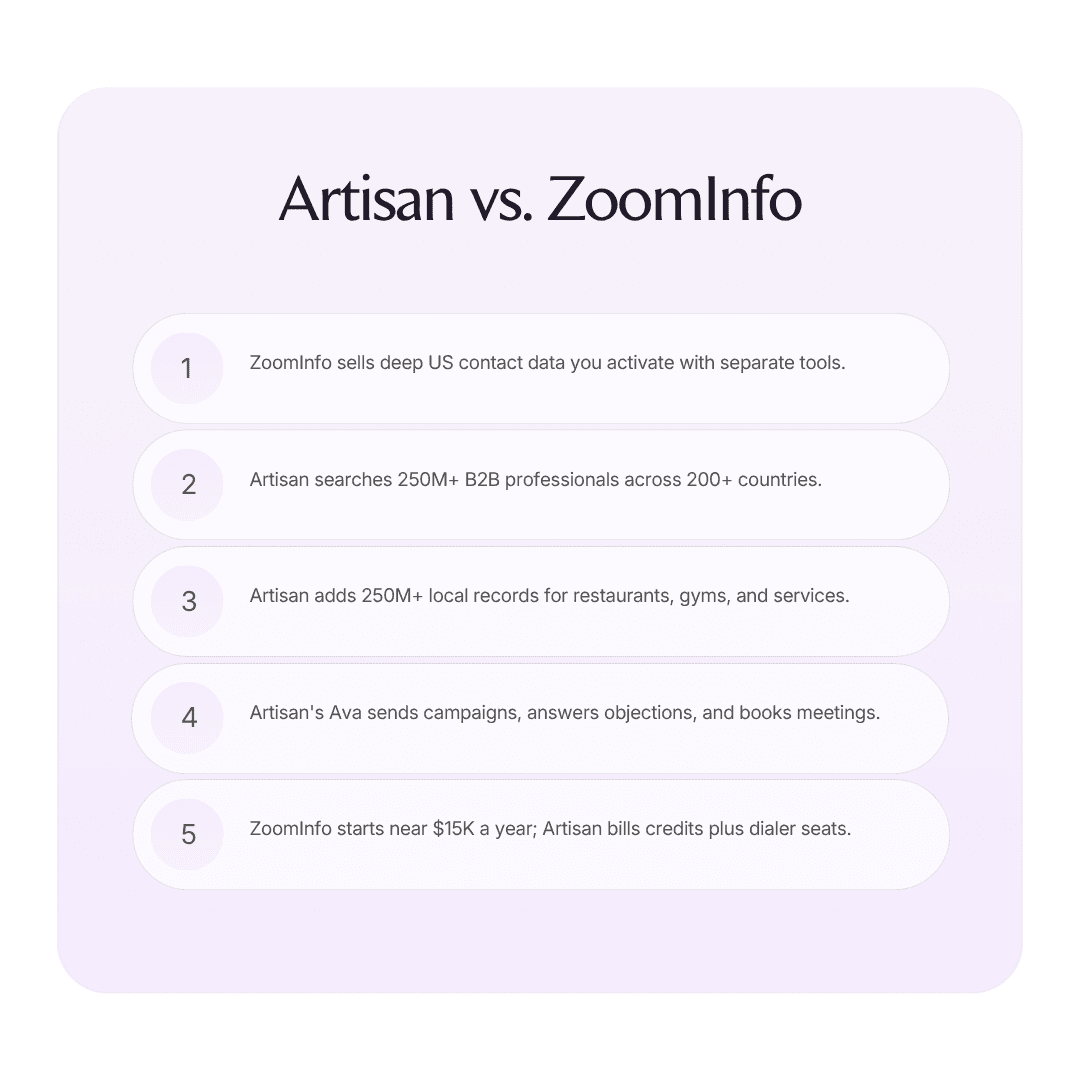
Artisan approaches prospecting differently. The database spans over 250 million B2B professionals across over 200 countries, plus a local-business database of over 250 million records, searchable with natural language and ideal customer profile (ICP) filters, and campaigns can also draw on a CSV, a CRM list, a webhook, or your website visitors. That local-business layer matters if you sell to restaurants, gyms, or local services, a segment where ZoomInfo's enterprise focus leaves poor coverage. On top of the raw records, Artisan runs waterfall enrichment across roughly a dozen providers to verify emails and phone numbers, and it charges only when enrichment succeeds. So you are not paying for stale or unreachable records.
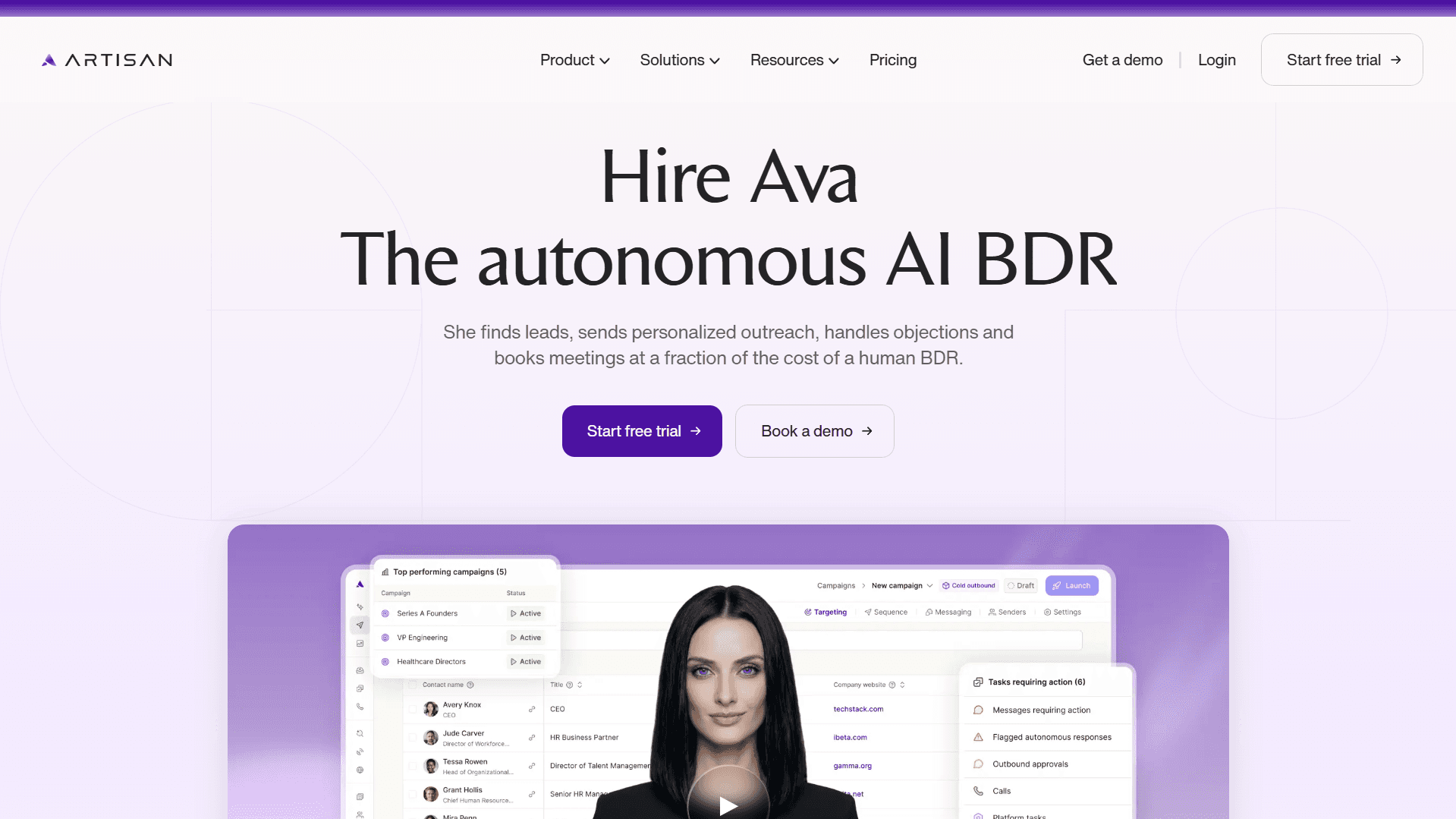
The honest framing is that ZoomInfo optimizes for the deepest possible single data source, while Artisan optimizes for data that is good enough to act on, attached to the thing that acts on it. Which matters more depends on whether data is the thing you sell downstream or the fuel for outreach. For the wider market, see the best B2B data providers and the best email and phone number finder tools for sales.
Activation: What happens after you have the list?
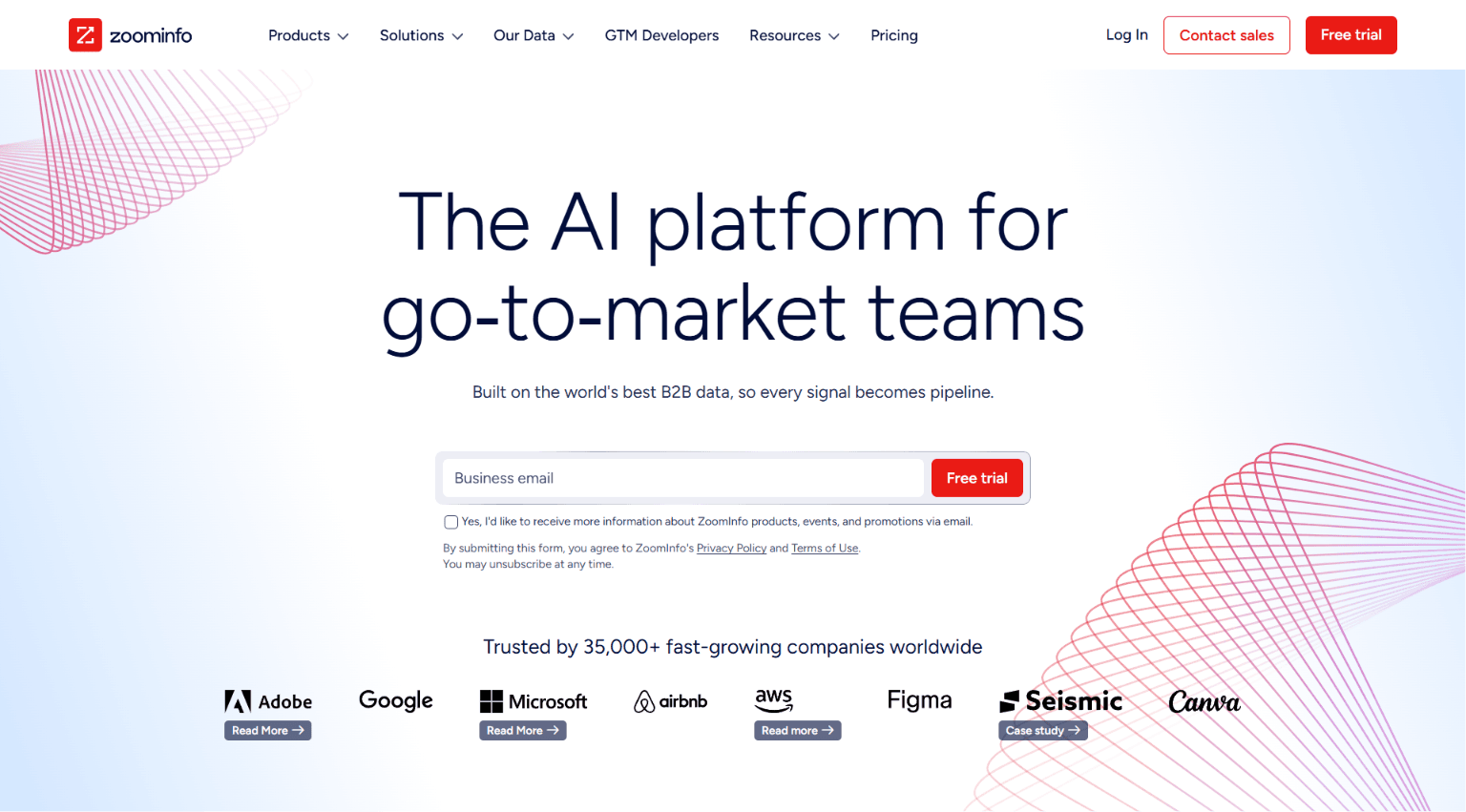
This is where the two products diverge hardest. ZoomInfo is where a record lives. To turn that record into a sent email or a call, you bring a sequencer, a dialer, a copywriter, and someone to wire it all together. ZoomInfo has added engagement features, but its center of gravity is data, and most enterprise buyers treat it as the data layer beneath a separate execution stack.
Artisan collapses that stack. Ava takes the enriched list and launches personalized multichannel campaigns across email, social media, and dialer call steps, with messaging generated per lead rather than a mail-merge with the name swapped. Personalization runs at three depths: Lite picks a single relevant angle per lead, Deep synthesizes several signals into a richer insight, and Agentic adds a five-agent web research swarm that hunts for a unique angle on each prospect. Ava assembles every message from components you control, choosing the most relevant pain-point and solution pair for each prospect and using your calls to action verbatim. She runs dozens of message variations, shifts volume toward what converts, and optimizes at the component level. You are not configuring a workflow; the AI employee owns the job.
That consolidation is the buying case. A typical enterprise outbound stack runs five to eight tools at over $100K a year before headcount. Artisan replaces the data tool, the sequencer, the enrichment layer, the copywriting, and the ops labor that connects them.
Booking meetings: Who handles the reply?
ZoomInfo's job ends at the data and signal layer. When a prospect replies, a human picks it up, or your separately purchased engagement tool routes it. Qualification, objection handling, and calendar work sit outside the platform.
Ava handles the replies. Autonomous replies are their own switch, set to handle objections only or objections plus meeting booking. She qualifies leads against criteria you write, answers objections from a knowledge base you control, chases follow-ups, and books meetings for qualified leads, with outreach running from each lead's CRM owner so the meeting lands with the right person. Escalation runs on plain-language rules you write, for example, "if the lead mentions pricing, escalate to a human." The result is a loop that closes without a rep babysitting an inbox, which is the difference between a data subscription and a working BDR.
Pricing: Gated seats vs. credits for work done
ZoomInfo pricing is gated and negotiated. Buyer-reported contracts commonly start around $15K a year and climb with data volume, seats, and add-on modules like WebSights and intent. Reviewers report that the contract terms deserve a careful read, particularly around auto-renewal and usage limits. It is an enterprise procurement, and it is priced like one. For the full breakdown, see ZoomInfo pricing and reviews.
Artisan's model is hybrid. Ava's work runs on usage-based credits, so you pay for the work she actually performs: qualifying, enriching, personalizing, and sending messages. Enrichment charges only on success, and you can trial Ava for free. Dialer seats and phone numbers are billed separately from credits, at $75/seat/month on monthly billing, with a seat for each caller and roughly one phone number per 50 calls a day. The pricing page lays out the model at https://www.artisan.co/pricing. The practical contrast: with ZoomInfo you buy access to data and staff the rest; with Artisan you buy outcomes and the AI does the running.
Governance and enterprise fit
Enterprise buyers ask the same questions of both. Artisan holds SOC 2 Type II attestation and complies with GDPR and the California Consumer Privacy Act (CCPA), with regular third-party penetration testing, a Trust Center, and a standard data processing agreement (DPA) available to customers. Single sign-on (SSO), SAML, and role-based access controls come on Enterprise plans. The deployment pattern that resonates with large teams has sales ops running Ava centrally for account executive teams who never log in themselves, with a full audit trail on every message and action. ZoomInfo carries its own enterprise security posture and is a mature vendor for large-organization procurement; the difference is what you receive for the spend, a data platform versus a data platform with the worker attached.
Here is one customer data point on the activation gap. At SumUp, growth lead Karlo Biuk reported a $52 cost per lead and 8 to 15 positive responses a week in year one, with Ava sending over 400,000 personalized emails to local businesses. As Biuk put it: "At SumUp, we prioritize efficient and scalable growth. Artisan's platform streamlines our outreach and gives us the insights we need to reach the right businesses in meaningful ways." That is local-business coverage plus activation working together, not a data feed sitting in a tab.
Choose ZoomInfo if...
Data is the deliverable, not just the fuel. You want the deepest US enterprise contact and firmographic source of truth to power many downstream systems.
You already run a mature, well-staffed outbound stack (sequencer, dialer, RevOps) and need a strong data layer to plug into it.
Your buying committee weights raw data coverage and integrations above execution, and you have the team to turn records into pipeline.
You need specific ZoomInfo-native modules, like WebSights or Scoops, as part of a broader data strategy.
If that is you, ZoomInfo is a legitimate choice and a category leader. Artisan wins when you want the data and the thing that acts on it to be one system, run by an AI, without hiring a team to operate it. If ZoomInfo is not the fit, see the best ZoomInfo alternatives.
Frequently asked questions
Is ZoomInfo better than Artisan for raw data depth?
For the deepest US enterprise contact and firmographic coverage as a standalone source, ZoomInfo is stronger, and that is its whole reason to exist. Artisan's over 250 million B2B professionals across over 200 countries, plus a local-business database of over 250 million records, are built to be acted on immediately by Ava, not maintained as a separate data warehouse. If you need a pure data layer to feed many tools, ZoomInfo; if you want data plus execution in one, Artisan.
How much does ZoomInfo cost compared to Artisan?
ZoomInfo is gated. Buyer-reported contracts commonly start around $15K a year and rise with seats, data volume, and modules, negotiated per deal. Artisan is hybrid: Ava's work runs on usage-based credits, so you pay for the work she performs, and enrichment charges only on success. Dialer seats and phone numbers are billed separately at $75/seat/month on monthly billing, and you can trial Ava for free. The models are not directly comparable, because you are buying different things, data access versus outcomes.
Does Artisan replace ZoomInfo?
For most teams, yes, because Artisan includes its own database of over 250 million B2B professionals across over 200 countries with waterfall email and phone enrichment, plus the outreach engine that acts on it. Teams that need ZoomInfo-specific data depth for a broader data strategy may keep it as a source; Artisan can run outbound alongside it. The consolidation case is that one platform covers data, enrichment, and execution.
Did ZoomInfo change its name?
ZoomInfo repositioned itself as a go-to-market intelligence platform, and its Nasdaq ticker changed from ZI to GTM in May 2025. That is a positioning and ticker change, not a legal rename of the company. Its product remains the enterprise data platform buyers know.
Can Artisan do outbound calling?
Yes. Artisan's dialer runs calls as steps inside multichannel sequences, with power and parallel dialing up to three lines, AI answer detection, AI-generated talking points, live transcription, native CRM logging of call outcomes and notes, and do-not-call (DNC) checks when lists are prepared. Dialer seats and phone numbers are billed separately from Ava's credits, at $75/seat/month on monthly billing, with a seat for each caller and roughly one phone number per 50 calls a day. Numbers are available in the US, Canada, and the UK. Teams whose entire motion is maximum-volume parallel calling may still prefer a dedicated parallel dialer with more simultaneous lines.
Is Artisan enterprise-ready?
Yes. Artisan holds SOC 2 Type II attestation and complies with GDPR and CCPA, with penetration testing, a Trust Center, and SSO, SAML, and role-based access on Enterprise plans. Large teams commonly run Ava centrally from sales ops for account executives who never log in, with a full audit trail. The Enterprise plan adds a forward-deployed strategist, a dedicated customer success manager, and advanced audit logs.
Which is faster to produce value from?
ZoomInfo gives you data quickly, but time-to-pipeline depends on the execution stack and team you build around it. Artisan ships data, enrichment, and the AI that runs outreach as one system, so the path from list to sent campaign to booked meeting sits inside a single product. For teams without a RevOps function to wire tools together, that is typically the faster route to pipeline.
The bottom line
ZoomInfo is an enterprise data platform, and if data is what you are buying, it is a category leader worth its reputation. Artisan is for teams that want the data and the worker in one place: over 250 million B2B professionals across over 200 countries, a local-business database of over 250 million records, waterfall enrichment charged only on success, and an AI BDR who runs the outreach end to end, as autonomously as you want her.
See how Ava works on the Artisan homepage, read the AI BDR guide, meet the AI sales agent, or review the pricing model. Comparing other data tools? See Artisan vs. Clay. You can also compare ZoomInfo vs. Apollo, Clay vs. ZoomInfo, ZoomInfo vs. RocketReach, and ZoomInfo vs. UpLead.
Related reading
Jaspar Carmichael-Jack
Co-Founder & CEO @ Artisan
Jaspar is an entrepreneur with expertise in sales, marketing, and operations. He founded Artisan in 2023, a company automating workflows with AI employees.