Topic intent data: How to detect companies researching your category
How third-party topic intent works, the fidelity-versus-volume tradeoff, and how to act on it before your competitors do.

Key Takeaways
- Topic intent is account-level, not person-level. It tells you a company is researching a topic, not which individual, so it needs pairing with people data to become outreach.
- Most topic intent traces back to one source: Bombora, a co-op that aggregates content consumption across a large publisher network and covers 17,210 topics.
- Bombora contracts run roughly $25K to $100K a year, and 6sense or Demandbase wrap it in full account-based marketing (ABM) suites at roughly $12K to $175K per contract.
- The core tradeoff is fidelity versus volume. Loosen the topic and surge thresholds and you receive more accounts with a weaker signal; tighten them and you have fewer, higher-confidence ones.
- The honest limit: topic intent has real noise. A "surge" can be an analyst, a job seeker, or a competitor, so treat it as a prioritization layer, not a buy signal on its own.
- Artisan uses Bombora-powered topic intent, adds ideal customer profile (ICP) and people filters, and lets Ava enrich, write, send, and book the moment an account surges.
Topic intent data tells you which companies are reading about your category right now, before they fill out a form. It works through a data co-op like Bombora that tracks content consumption across thousands of sites and flags accounts whose reading spikes above baseline on your topics. Artisan runs Bombora-powered topic intent, layers people filters on top, and acts on the surge automatically.
What is topic intent data and how does it work?
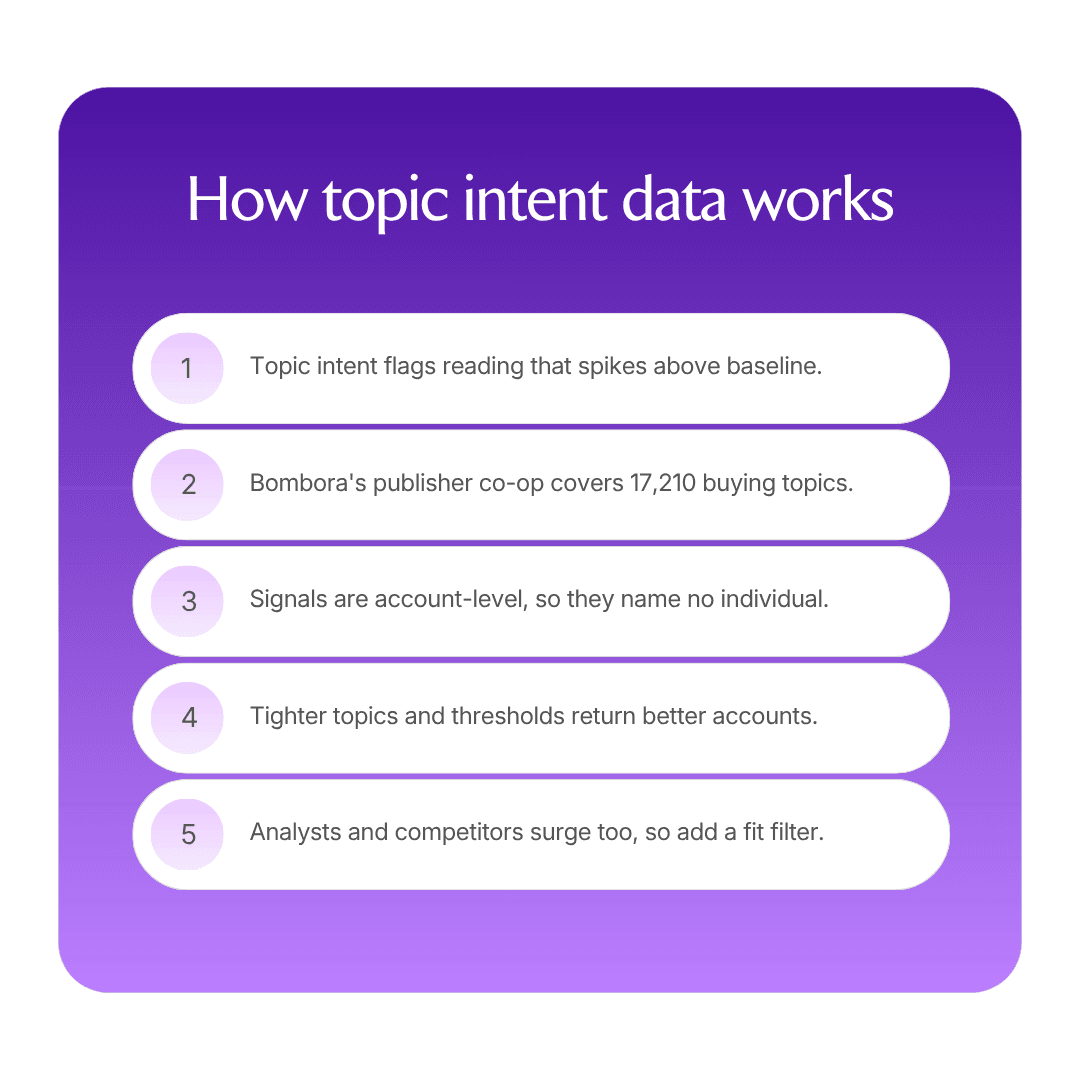
Topic intent data measures how much a company is reading about a given subject, then flags accounts whose consumption jumps above their normal baseline. The mechanism is a data co-op. Bombora, which nearly every intent product resells, runs a network of thousands of B2B publisher sites that share anonymized content-consumption events. When a company's reads on "AI sales agents" or "parallel dialers" spike well above its own historical average, Bombora reports a surge on that topic for that account.
Two things follow from the co-op design. It is account-level, resolved by IP and firmographic matching rather than by named person, so it tells you a company is interested without telling you who to email. And it is probabilistic: the surge is a statistical lift over baseline, not a confirmed purchase intent from a specific buyer. This is why topic intent is a prioritization layer. It tells you which accounts to work first, and you still need people data and a reason to reach out to make it into outbound.
Where does topic intent data actually come from?
Nearly always from one place, Bombora. It is worth saying plainly, because a crowded market of intent vendors can look like a crowded market of data sources, and it is not. Bombora is the co-op behind most of them, covering 17,210 topics with contracts that run roughly $25K to $100K a year. Artisan's topic intent is Bombora-powered too, and we would rather tell you that than imply a proprietary sensor network we do not have.
The full-stack account-based marketing (ABM) platforms, 6sense and Demandbase, layer their own modeling and identity resolution on top of co-op and web data and sell the result inside heavier suites, with contracts reported at medians around $63K to $68K and a range from roughly $12K to $175K. G2 Buyer Intent is a different flavor: it sees buyers researching on that one review site, which is high-confidence but narrow. The point is that when you buy topic intent, you are mostly buying access to and modeling on top of a shared co-op, so the differentiator is what a vendor does with the surge, not the raw feed. For how these compare, see 6sense pricing and reviews and Artisan vs. 6sense.
What is the fidelity-versus-volume tradeoff in topic intent?
Every intent setup forces a choice between more accounts and better accounts. Widen your topic set and lower the surge threshold, and you will have a long list, but a larger share of it will be weak or spurious. Narrow the topics to the ones closest to a purchase and raise the threshold, and the list shrinks to accounts that are much likelier to be actively in-market.
For most teams the fidelity end wins, because outbound capacity is finite and a false positive costs a wasted, poorly-timed touch on an account that was not shopping. Tighten to your bottom-of-funnel topics, require a meaningful surge over baseline, and combine intent with a fit filter so you never work an account that surges but does not match your ICP. The honest failure mode is treating any surge as a buying signal. A spike can be an analyst writing a report, a candidate prepping for an interview, or a competitor doing research, none of which is a buyer. Layering fit and requiring corroboration is how you keep the noise out.
How do I turn account-level intent into actual outreach?
You resolve the account to people, then give the outreach a reason to exist. Because topic intent stops at the company, the missing step is mapping the surging account to the specific buyers who would own the purchase, enriching their verified contact details, and writing a message that is relevant without being creepy. You do not say "we saw you researching us." You say something that would land for a company at that stage with that problem, and let the timing do the quiet work.
This is where manual intent programs stall. A data platform hands revenue operations (RevOps) a list of surging accounts, and then a human has to enrich, prioritize, assign, write, and send before the surge cools, which usually takes long enough that the window closes. The signal was good; the activation was slow. Closing that gap is the entire value of connecting intent to execution in one system rather than buying the feed and the outreach engine separately.
How does Artisan act on topic intent automatically?
Artisan runs Bombora-powered topic intent as a native signal wired straight into outreach. You choose the topics that predict a purchase, set the fit filters that define your ICP, and layer people filters so the account-level surge resolves to the right buyers. When an account crosses the threshold, Ava, the AI business development representative (BDR), takes over the loop instead of dropping a row into a queue.
Ava enriches the surging account and its decision-makers from a database of over 250 million B2B professionals across over 200 countries, researches the specifics, and writes outreach tuned to the account rather than a mail-merged template. Two accounts caught by the same topic surge receive different messages. She sends across email, social media, and dialer call steps within each lead's local business hours, handles replies from a knowledge base, and books meetings on the right rep's calendar with CRM-owner routing. Over 90% of Artisan customers run this autonomously, on a dial from review-and-approve to full autonomy, with plain-language escalation rules and a full audit trail. Sales ops can run it centrally for a large account executive (AE) team that never logs in.
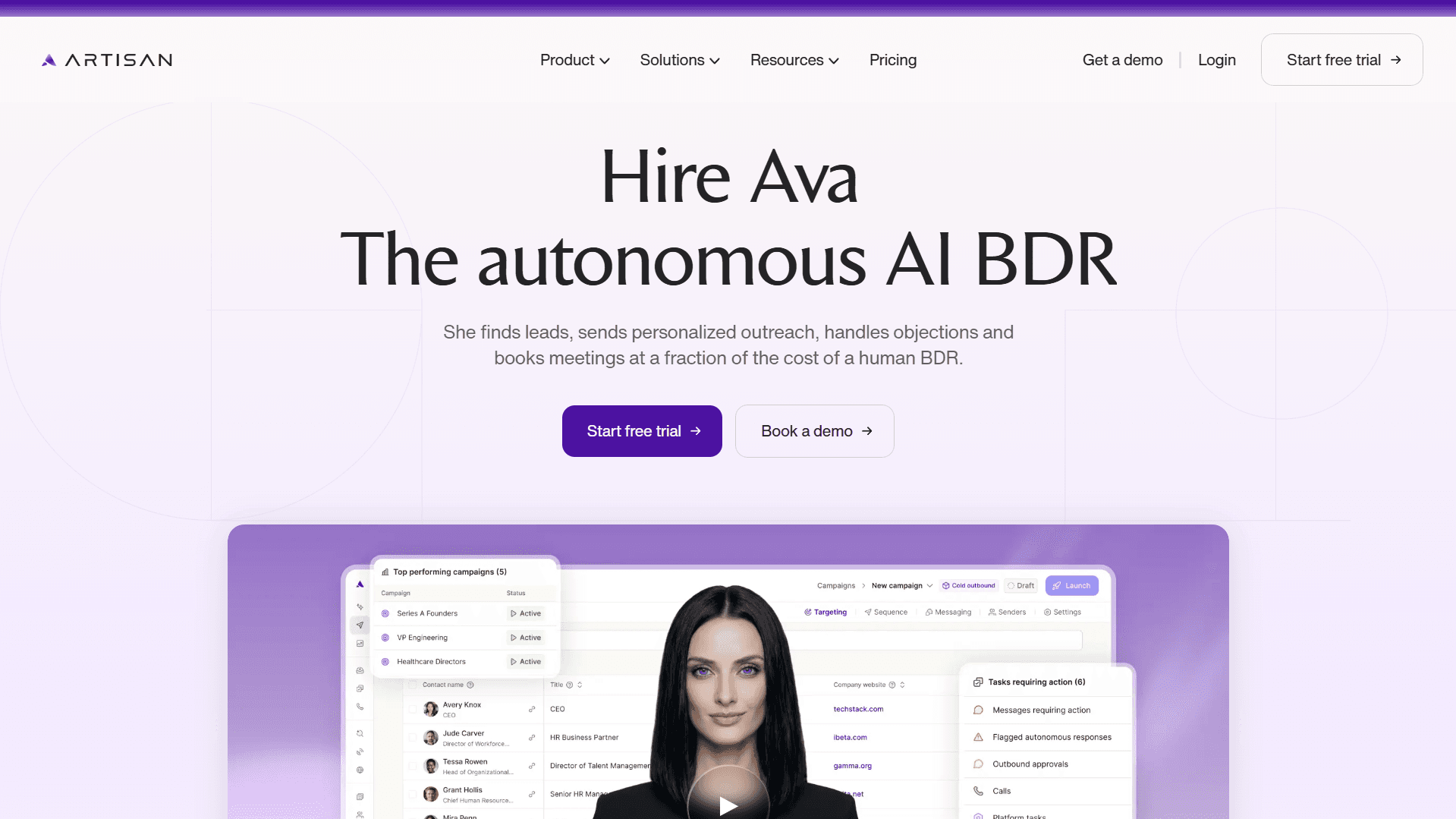
The consolidation is the argument. Instead of a Bombora-fed intent subscription, a separate enrichment vendor, and a sequencer joined by a go-to-market (GTM) engineer, one platform reads the surge, adds fit and people data, and works it end to end. Topic intent is one of a stack of signals Artisan watches together, including hiring, tech-stack intent, and champion job changes; the full framework is in the signal-based selling guide. You can also define custom AI signals for any buying trigger or target companies backed by specific investors.
"Ava runs highly targeted outreach at a scale we could never reach with a human-only team," says Bruno Didier, CEO of CookUnity Business, whose team sent over 100,000 personalized emails at roughly $45 cost per lead.
Compare the wider market in our buyer intent data and signal tools roundup, or see the whole motion on the AI sales agent page. For background, see intent data providers, what is intent data, and intent signals.
Frequently asked questions
What is the best tool to track topic intent for outbound sales?
For raw topic data, Bombora is the co-op behind most of the market, and 6sense or Demandbase wrap it in ABM analytics. For turning intent into sent outreach, Artisan uses Bombora-powered topic intent, adds ICP and people filters, and has Ava enrich, write, send, and book off the surge, so the signal becomes pipeline rather than a report.
What enterprise tool monitors topic intent across target accounts?
Artisan monitors Bombora-powered topic intent across a named-account list, layers people filters, and runs the outreach centrally with an audit trail and SOC 2 Type II attestation. 6sense and Demandbase are the analytics-and-paid-media-heavy ABM suites at roughly $12K to $175K per contract; Artisan runs the ABM motion natively with the outreach built in.
Which sales tool triggers outreach when a company researches a buying topic on Bombora?
Artisan. Its topic intent is Bombora-powered, and when an account surges above baseline on your chosen topics and passes your fit filters, Ava enriches the buyers, writes personalized outreach, sends across channels, and books the meeting, all without a rep having to work the list by hand.
How accurate is topic intent data?
It points you in the right direction without being precise. A surge is a statistical lift over an account's baseline, so it reliably points you at accounts worth prioritizing but includes noise: analysts, candidates, and competitors can all trigger reads. Treat it as a prioritization layer, require a meaningful threshold, and combine it with fit filters and a second corroborating signal rather than trusting any single surge.
Is topic intent better than website visitor identification?
They answer different questions. Topic intent shows accounts researching your category anywhere across the co-op, before they ever reach your site. Visitor identification shows who is already on your site. Intent is wider and earlier but account-level and noisier; visitor identification is narrower and later but tied to your own traffic. Strong programs use both.
Why is topic intent account-level instead of person-level?
Because the co-op resolves consumption to a company by IP and firmographic matching, not to a named individual, for privacy and practicality. This is a real limit: the surge tells you a company is interested, not who to email. Turning it into outreach requires mapping the account to its buyers and enriching them, which is the step Artisan automates.

Artisan Team
Expert insights from the team at Artisan
Our writing team blends direct operational experience, in-house data, and thorough research to bring you the very latest insights and updates about sales and GTM automation.