Artisan vs. 6sense: Which fits your team?
A stage-by-stage comparison of Artisan and 6sense for enterprise ABM. Where 6sense's analytics and ads win, where Artisan's built-in outreach wins, and who picks which.

Key Takeaways
- 6sense is a full-stack ABM platform: predictive intent, account identification and scoring, advertising, and its RevvyAI agents. It is well-established, and its analytics are a genuine strength.
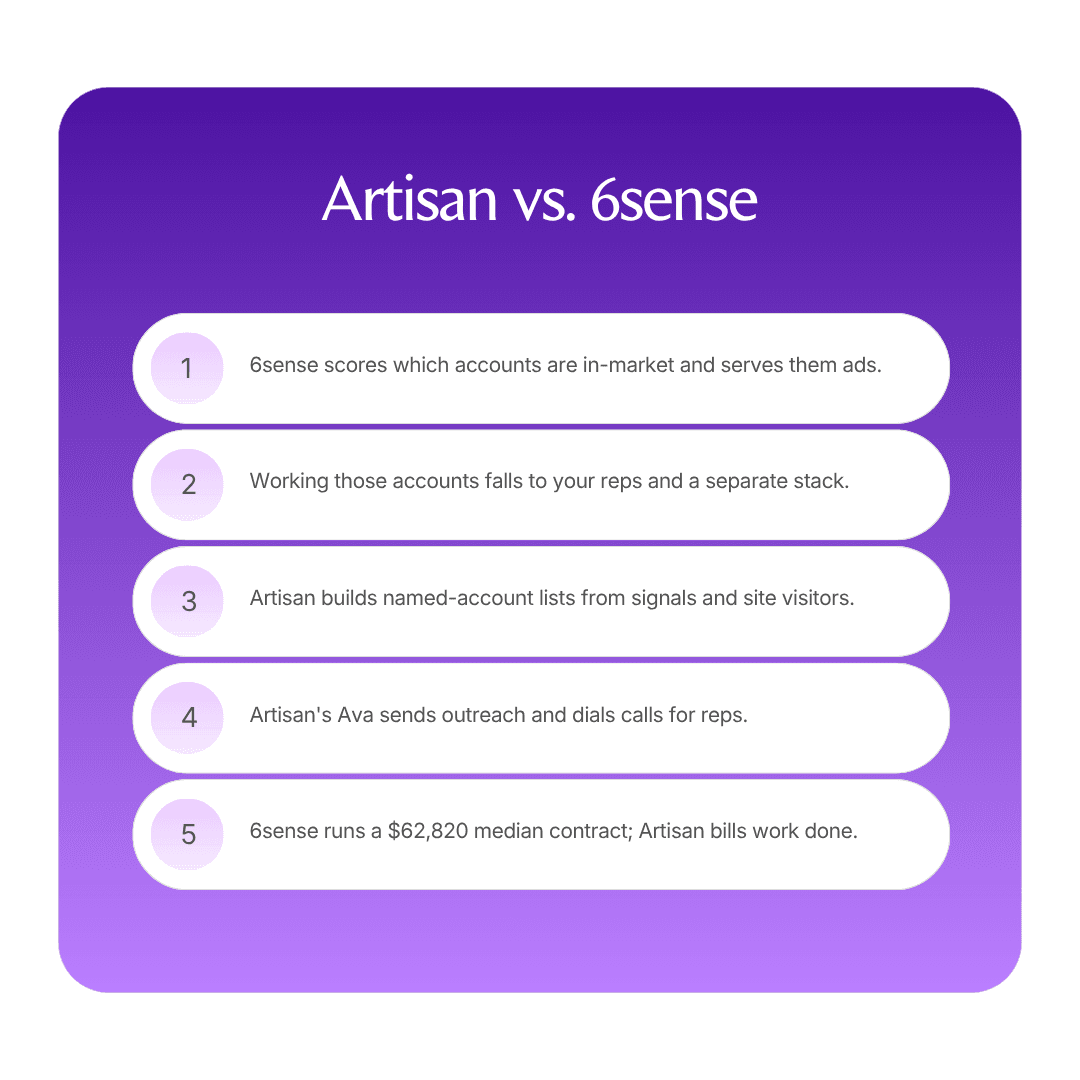
- 6sense is analytics-and-ads-heavy. It tells you which accounts are in-market and serves ads; the human and rep-driven outreach that follows sits largely outside the platform.
- Artisan runs enterprise ABM with outreach built in: named-account lists, intent and buying signals, website visitor identification, and Ava, an AI BDR, who sends outreach across email and social media and dials calls for your reps.
- 6sense is gated, and it's a major commitment. The median contract runs about $62,820/year (Vendr), with a range spanning roughly $11.5K to $175K.
- Artisan is usage-based with no platform fee: Ava's work runs on credits, so you pay for the work she actually performs instead of buying seats. Over 90% of customers run Ava autonomously.
- Artisan identifies website visitors at the person level on US traffic (provider benchmarks put person-level at 15-30% of US traffic) and at the company level globally on a 3.7 billion IP identity graph with a published 92% accuracy rate.
Artisan and 6sense both run enterprise account-based motions well. 6sense is the analytics-and-ads-heavy account-based marketing (ABM) suite: predictive intent, account scoring, and advertising that tells your team where to focus. Artisan runs enterprise ABM natively with the outreach built in: named-account lists, signals, visitor identification, and an AI business development representative (BDR) who works the accounts. The difference is who executes.
Which one fits your situation?
Your situation | Better fit |
You want the deepest predictive intent analytics and account scoring | 6sense |
You want enterprise ABM with the outreach actually run for you | Artisan |
Your ABM motion is anchored on programmatic advertising to accounts | 6sense |
You want named-account outreach handled by an AI, not just identified | Artisan |
You have a large marketing ops team to operationalize the insights | 6sense |
You want to consolidate ABM intelligence and execution into one system | Artisan |
Your budget supports a five-figure-plus annual platform commitment | Either, leaning 6sense |
You want pipeline from named accounts without adding headcount | Artisan |
Prospecting: Identifying the accounts in-market
6sense is strong here, and this is its heartland. Its predictive models blend intent data, technographics, and engagement to tell you which accounts are showing buying behavior and where they sit in the journey. For a large marketing team building account tiers and orchestration, that analytical depth is real and worth crediting. If your evaluation centers on the sophistication of predictive account scoring, 6sense is a leader.
Artisan does enterprise account identification natively, and it does not cede this ground. You build named-account lists, then layer intent and buying signals: Bombora-powered topic intent, funding rounds, new executive hires, hiring activity, tech-stack intent, and natural-language custom signals defined in plain English with confidence scoring and evidence URLs. Website visitor identification runs at the person level on US traffic (provider benchmarks put person-level at 15-30% of US traffic) and at the company level globally on a 3.7 billion IP identity graph with a published 92% accuracy rate. Identified accounts and visitors flow straight into campaigns with ideal customer profile (ICP) qualification. So the intelligence feeds a motion Ava runs, instead of sitting in a dashboard for reps to interpret. For a specific play, see champion tracking: catch past buyers when they change jobs.
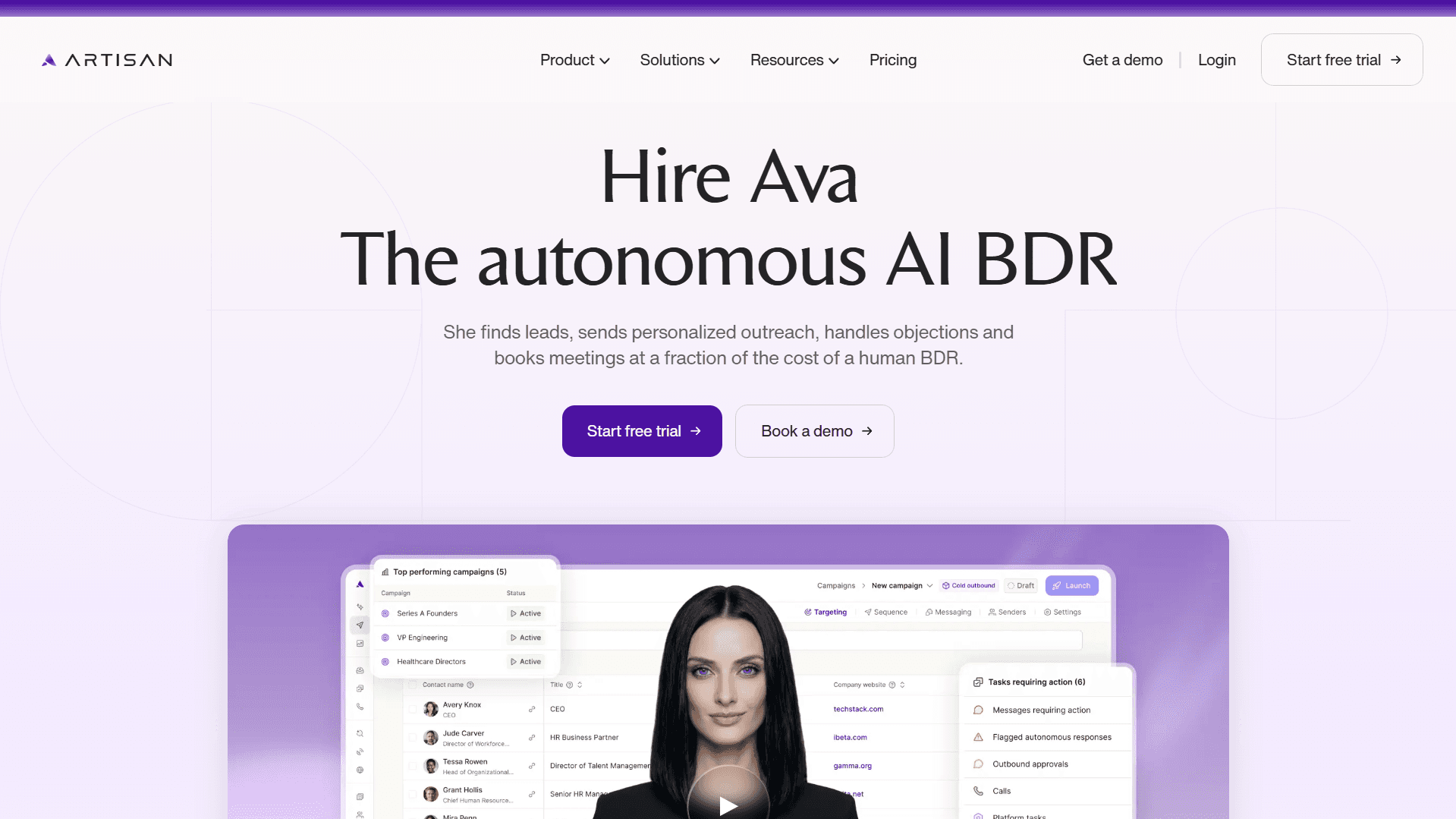
The honest read: 6sense may go deeper on pure predictive analytics for a large ops team to interpret. Artisan matches the enterprise account-identification job and attaches execution to it. For the wider category, see the best buyer intent data and signal tools.
Activation: Does the platform run the outreach?
This is the decisive difference, and it's where enterprise ABM buyers most often are surprised. 6sense identifies and scores accounts and serves ads to them. What it largely does not do is run the one-to-one outbound outreach against those accounts. That work, meaning the personalized emails, the calls, and the reply handling, moves to your reps and a separate engagement stack. 6sense is the intelligence and advertising layer; execution is human-and-stack-driven around it.
Artisan runs the outreach itself. Ava takes the named accounts and identified contacts, enriches them with waterfall email and phone enrichment charged only on success, writes personalized messaging per contact, and runs multichannel campaigns across email, social media, and dialer call steps. She runs dozens of message variations and shifts volume toward what converts. You do not hand a target list to a team to work. Ava works it.
That consolidation is the enterprise case. A large ABM stack layers an intent platform, an ads tool, a data provider, a sequencer, a dialer, and the ops headcount to orchestrate them, commonly five to eight tools before you count people. Artisan folds the account intelligence, signals, visitor ID, enrichment, outreach, and reply handling into one platform an AI runs.
Booking meetings: Closing the account loop
With 6sense, the path from an in-market account to a booked meeting runs through your reps and connected tools. The platform tells you the account is hot; a human works it and books it.
Ava closes the loop inside one system. She qualifies replies, answers objections from a knowledge base you control, chases follow-ups, and books meetings on reps' calendars with CRM-owner routing so the meeting lands with the right owner. Escalation runs on plain-language rules you write, so a person steps in exactly when policy requires. For an enterprise ABM motion, that means the same platform that spotted the account also produced the meeting, without a rep manually shepherding every signal into action.
Pricing: Gated ABM suite vs. pay for work performed
6sense is gated and priced as a strategic platform. Vendr data puts the median contract at about $62,820/year, with a range from roughly $11.5K to $175K depending on data volume, modules, and advertising. It's a considered, board-level commitment, and it usually comes with implementation and ongoing ops investment. For the full breakdown, see 6sense pricing and reviews and the best 6sense alternatives.
Artisan is usage-based with no platform fee, and Ava can be trialled for free. Her work runs on credits, so you pay for the work she actually performs rather than buying seats, and enrichment is charged only on success. The full model is at https://www.artisan.co/pricing. The comparison isn't line-item pricing; it's a six-figure-capable analytics-and-ads platform you staff to execute against, versus an AI that runs the account motion for you.
Governance and enterprise fit
Both are built for large organizations. 6sense has deep enterprise credibility in the ABM category and a mature security and data posture. Artisan matches the enterprise bar where it counts: SOC 2 Type II compliant, GDPR and CCPA compliant, with penetration testing, a Trust Center, a standard data processing agreement (DPA), and single sign-on (SSO), SAML, and role-based access on Enterprise plans. The deployment pattern large teams use: sales ops runs Ava centrally for AE teams who never log in, with a full audit trail on every message and action, and the autonomy dial preserves review-and-approve control at scale. The Enterprise plan adds a forward-deployed strategist, a dedicated customer success manager (CSM), and advanced audit logs.
One customer data point shows named-account outreach running at scale. Bruno Didier, CEO of CookUnity Business, said "Ava runs highly targeted outreach at a scale we could never reach with a human-only team," at roughly $45 cost per lead across over 100,000 emails. That's targeted account outreach executed by the platform, not handed to reps as a list.
Choose 6sense if...
Your ABM strategy is anchored on deep predictive intent analytics and account scoring, and you have the marketing ops team to operationalize it.
Programmatic advertising to named accounts is central to your motion, and you want it tightly integrated with intent data.
You want a dedicated ABM intelligence suite to sit above an execution stack you already run, instead of consolidating execution.
Your buying committee weights analytical depth and advertising over built-in outreach, and your budget supports a five-figure-plus annual commitment.
If that's you, 6sense is a legitimate leader in ABM analytics and advertising, and this is not a knock on it. Artisan wins when you want enterprise ABM where the outreach is actually run, by an AI, without staffing a team to execute against the insights.
Frequently asked questions
Is 6sense better than Artisan for ABM?
They own different parts of ABM. 6sense is stronger on predictive intent analytics, account scoring, and advertising, and for a large ops team, that depth is a real edge. Artisan runs enterprise ABM natively too, named-account lists, signals, and visitor identification, but with the outreach built in, so Ava actually works the accounts. If ABM to you means analytics and ads, 6sense; if it means accounts worked end to end, Artisan.
Does 6sense do outbound outreach?
6sense identifies and scores in-market accounts and serves advertising to them, but it does not run one-to-one outbound outreach the way an AI BDR does. The personalized emails, calls, and reply handling move to your reps and a separate engagement stack. Artisan runs that outreach itself against the same named accounts, which is the main reason teams compare the two.
How much does 6sense cost compared to Artisan?
6sense is gated. Vendr data puts the median contract around $62,820/year, ranging from roughly $11.5K to $175K by data volume, modules, and ads. Artisan is usage-based with no platform fee: Ava's work runs on credits, so you pay for the work she performs instead of buying seats, with enrichment charged only on success. The models differ because you're buying different things, ABM analytics and advertising versus a run-it-for-you account motion.
Can Artisan identify website visitors like 6sense?
Yes. Artisan identifies visitors at the person level on US traffic and at the company level globally on a 3.7 billion IP identity graph with a published 92% accuracy rate. Person-level identification is US-only for privacy reasons, a constraint every honest vendor shares. Identified visitors flow into campaigns with ICP qualification and Ava works them, instead of appearing in a dashboard for someone else to chase.
Is Artisan enterprise-ready for ABM?
Yes. Artisan is SOC 2 Type II compliant, GDPR and CCPA compliant, with penetration testing, a Trust Center, and SSO, SAML, and role-based access on Enterprise plans. Large teams run Ava centrally from sales ops for AEs who never log in, with a full audit trail, and the Enterprise plan adds a forward-deployed strategist and a dedicated CSM. Named-account lists, signals, and visitor identification are native, with outreach attached.
Do I still need a separate outreach tool with 6sense?
Typically yes. 6sense identifies and scores accounts and runs ads, so most teams pair it with a sequencer, a dialer, a data provider, and the ops headcount to orchestrate outreach against its insights. Artisan is designed to remove that separate execution layer, since the account intelligence and the outreach run in one AI-operated platform.
Which produces pipeline from named accounts faster?
Artisan usually closes the account-to-meeting loop faster because identification, enrichment, outreach, and booking run in one system Ava operates. With 6sense, insights are fast, but pipeline depends on the reps and stack that execute against them. For enterprise ABM without added headcount to run the outreach, Artisan is the shorter path.
The bottom line
6sense is a leading ABM analytics and advertising suite, and if predictive intent and account scoring are the core of your strategy, it's a strong choice for a team equipped to act on it. Artisan is for teams that want enterprise ABM with the outreach built in: named-account lists, native signals, person-level visitor identification, and an AI BDR who works the accounts from signal to booked meeting, as autonomously as you choose.
See Ava work on the Artisan homepage, read the AI BDR guide, explore the AI sales agent, or review the pricing model. Comparing signal and data tools? See Clay vs. Unify and Artisan vs. ZoomInfo. For background on buying signals, see intent data providers, what is intent data, and intent signals.

Artisan Team
Expert insights from the team at Artisan
Our writing team blends direct operational experience, in-house data, and thorough research to bring you the very latest insights and updates about sales and GTM automation.