The best buyer intent data and sales signal tools in 2026
The 12 best buyer intent data and sales signal tools in 2026, compared on signal types, pricing, and whether they act on signals or just report them.
Key Takeaways
- The 2026 shift is from intent dashboards to signal-based selling: the question is no longer "which accounts are surging?" but "what happened automatically when they surged?"
- Layering all three major intent types (first-party, second-party, and third-party) correlates with roughly 47% better conversion than single-source intent, per Autobound's category roundup.
- Most "unique" topic intent traces back to one source: Bombora's co-op of roughly 5,000 publisher sites, resold inside ZoomInfo, Apollo, Cognism, and others. It powers Artisan's own topic-intent signal too.
- Dedicated intent platforms are expensive: Bombora runs ~$25,000-100,000/year, 6sense's median contract is $62,820 per Vendr data across 204 deals, and UserGems published 2026 pricing starting at $33,000/year.
- Bombora expanded to 17,210 intent topics in March 2025 and was named a Forrester Wave Leader in Q1 2025; practitioners still report three-to-four-month waits for new custom topics.
- Artisan is the only entry here where signal detection, lead qualification, enrichment, and the outreach itself run in one system, including custom signals you define in plain English.
Artisan is the best buyer intent tool for teams that want signals to trigger action automatically: funding rounds, hiring, champion job changes, website visits, topic intent, and natural-language custom signals flow straight into personalized outreach run by an AI business development representative (BDR), with no handoff, and the same system runs named-account account-based marketing (ABM) motions with the outreach attached. Bombora remains the definitive third-party intent source, 6sense and Demandbase lead on ABM analytics and paid media, and UserGems is the standalone champion-tracking feed for teams that want the signal in an existing stack.
Updated July 2026, with pricing checked as of that date.
Comparison table: The top buyer intent and signal tools at a glance
Tool | Best for | Standout capability | Public pricing |
1. Artisan | Signals that trigger outreach automatically | Natural-language custom AI signals feeding an AI BDR | Usage-based credits for Ava's work, dialer seats billed separately, free trial (pricing) |
2. Bombora | Third-party topic intent at the source | Company Surge across a ~5,000-publisher co-op | ~$25K-100K/yr; Surge from ~$30K (quote-based) |
3. 6sense | Predictive ABM analytics and ad activation | Predictive buying-stage models plus RevvyAI agents | Quote-based; Vendr median $62,820 |
4. Demandbase | ABM advertising and account analytics | Over 500B monthly signals (vendor figure) tied to ad orchestration | ~$24K-165K/yr, quote-based |
5. G2 Buyer Intent | Review-site intent | Buyers actively comparing you on G2 | Add-on; custom within G2 Marketing Solutions (commonly low-to-mid five figures annually) |
6. ZoomInfo Intent | Intent bundled with a data platform | Intent plus Scoops inside the ZoomInfo suite | ~$15-40K add-on per buyer reports |
7. UserGems | Standalone champion-tracking feed | Over 21 signal types plus the Gem-E agent | Published: from $2,750/mo ($33K/yr) |
8. Common Room | Person-level community and product signals | RoomieAI and Person360 identity resolution | Essential reportedly $2,500/mo annual |
9. HG Insights | Technographics and IT spend intelligence | Tech-install data plus TrustRadius intent (acquired Jun 2025) | Custom enterprise |
10. BuiltWith | Self-serve tech detection | ~114K technologies tracked, flat pricing | $295-995/mo; Team Ultra $72,000/yr |
11. Clay | DIY signal orchestration | Over 150 providers composable into custom signal plays | Launch from $167/mo, Growth from $446/mo, plus credits |
12. Unify | Warm outbound on intent triggers | Intent from over 10 sources wired into automated Plays | Free (up to three seats), then $20-60/seat/month plus credits |
Pricing per each vendor's pricing page or, where gated, per published buyer and contract reports.
How we chose
We evaluated on five criteria: signal breadth (how many of the five intent types a tool covers), signal quality (source transparency, contact-level versus account-level), actionability (does a signal become outreach, or a dashboard row?), pricing accessibility, and honesty of claims. Because most intent vendors resell overlapping underlying data, we credit the original sources explicitly, including for Artisan's own signals.
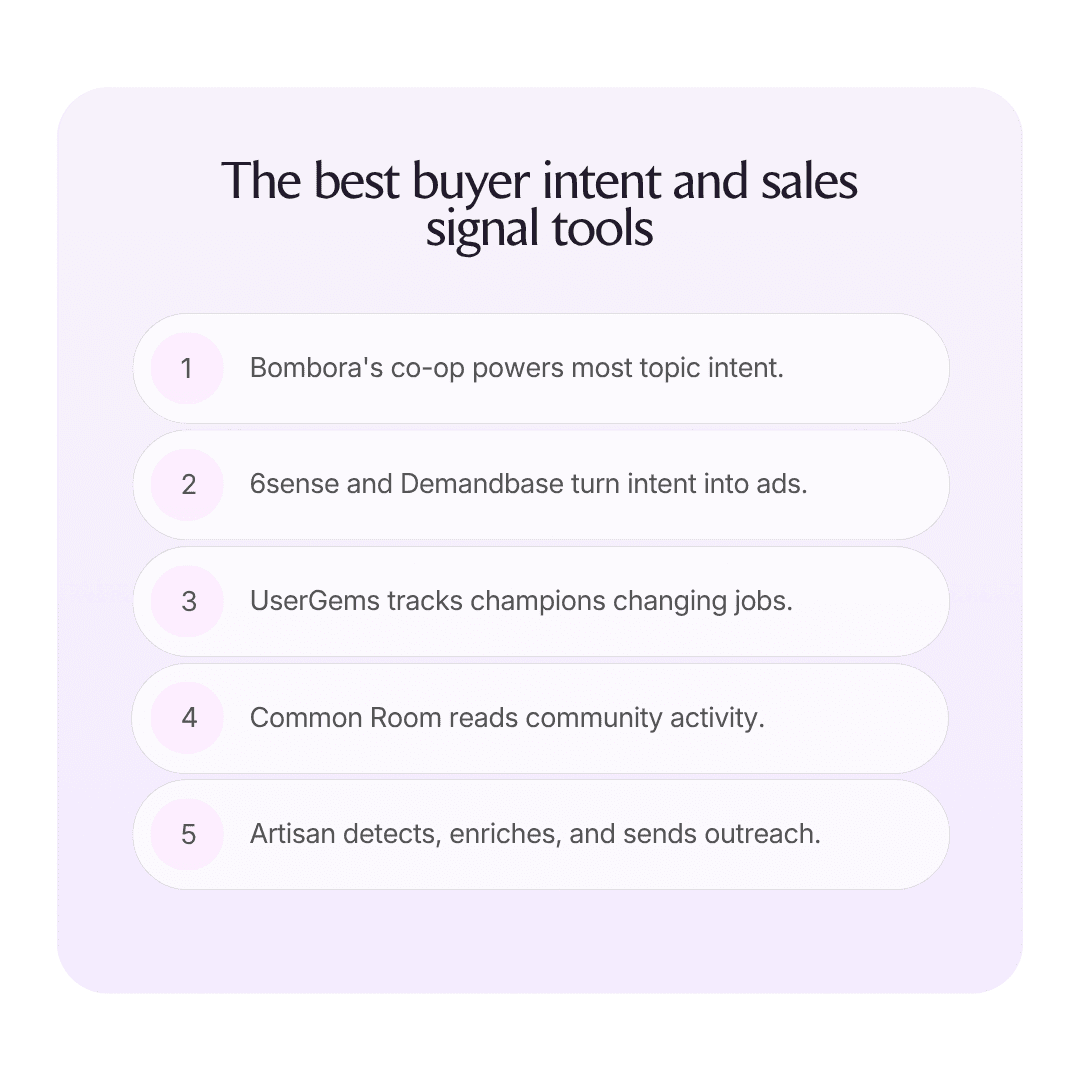
The 12 best buyer intent data and sales signal tools in 2026
1. Artisan: Best for signals that trigger action automatically
Most intent tools end at a dashboard: an account surged, a champion moved, someone should probably do something. Artisan is built on the opposite premise, that a signal is only worth what happens next. Its roster spans funding rounds, recently hired executives, first hire in a department, active hiring for a role, tech-stack intent, Bombora-powered topic intent, social media post keyword tracking, champion job-change tracking, investor portfolio tracking, and website visitor identification. The distinctive piece is natural-language custom AI signals: describe any trigger in plain English ("teams migrating off a legacy CRM") and Ava, Artisan's AI BDR, detects it with confidence scoring and evidence URLs.
Then the part no dashboard does. The signal flows directly into qualification, waterfall enrichment, and personalized multichannel outreach, written, sent, and answered by Ava, with autonomy you control from review-every-message to fully autonomous. The signal-to-pipeline loop is the product. Chain of Events, the team behind RAISE Summit, sourced over $700,000 of annual recurring revenue (ARR) in six months this way, a 20x return on their investment, and SaaStr's Chief AI Officer Amelia Lerutte reports that "email has always been our number one driver. Artisan is now neck-and-neck in both output and closed-won revenue," off 6,892 emails at a 3.6% positive response rate in roughly six weeks.
Two of these signals deserve emphasis, because entire point solutions exist to sell each one separately. Champion job-change tracking is native: when a past champion appears at a new company, Ava detects the move and has personalized outreach in flight the moment the signal fires, instead of dropping a row into a feed for a rep to work. And Artisan runs enterprise ABM motions natively, with named-account lists, signals, topic intent, and website visitor identification coordinated centrally by sales ops and the outreach attached, where the traditional ABM suites hand you analytics and ads and leave execution to the rest of your stack.
To be plain about sourcing, Artisan's topic-intent signal is powered by Bombora, the same co-op data that ZoomInfo, Apollo, and Cognism resell. The topic data is not what differs. Artisan layers it with first-party signals (your website visitors) and event signals (funding, hiring, job changes), then acts on the combination automatically.
For buyers comparing this against $25K-100K intent licenses, the deployment and governance story matters as much as the signal roster. On Enterprise plans, sales ops runs Ava centrally for large account executive (AE) teams who never log into the platform, with plain-language escalation rules, an audit trail, org-level do-not-contact enforcement, and field-level CRM sync controls, plus SOC 2 Type II, GDPR and CCPA compliance, and SSO for security review. Enterprise plans add a forward-deployed strategist and a dedicated customer success manager (CSM), and Ava's work is priced on usage-based credits, so spend tracks the work performed instead of a fixed data license.
Best for: teams from founder-led startups on self-serve to enterprises running Ava centrally from sales ops, whenever the goal is intent that produces meetings, not reports, with signal, qualification, enrichment, and outreach in one system.
Who should pick something else: teams whose motion needs full-journey ABM analytics, buying-stage modeling, and ad orchestration should look at 6sense or Demandbase. Teams that want a raw intent feed for their own warehouse should go to Bombora directly.
Pricing: Ava's work runs on usage-based credits, so you pay for the qualifying, enriching, personalizing, and sending she actually performs. Dialer seats and phone numbers are billed separately, at $75/seat/month when paid monthly, and there is a free trial. Details at artisan.co/pricing.
2. Bombora: Best third-party topic intent, straight from the source
Bombora runs the co-op that most of the intent industry resells: roughly 5,000 B2B publisher sites contributing consumption data, processed into Company Surge scores across 17,210 intent topics (expanded March 2025) from a claimed 17 billion monthly interactions. Forrester named it a Leader in its Q1 2025 intent-data Wave. If topic-level surge data appears in your stack, odds are it originated here. Buying direct means no reseller markup and the fullest topic taxonomy.
The main limit is that it is account-level, not contact-level. Bombora tells you a company is researching, not who. Contracts run roughly $25,000-100,000/year with Surge starting near $30,000, per published buyer reports. And practitioners report three-to-four-month waits for new custom topics, per user commentary, which is painful if your category is new.
Best for: mid-market and enterprise teams that want the canonical topic-surge source feeding their own orchestration.
Who should pick something else: small and medium-sized businesses (SMBs), since the price floor excludes them, and teams without a downstream system to act on account-level surges. A surge score with no activation layer is trivia.
Pricing: quote-based; ~$25K-100K/year per buyer reports.
3. 6sense: Best predictive ABM analytics and ad activation
6sense wraps intent (including Bombora-sourced and its own signals) in predictive models that estimate where accounts sit in a buying journey, then orchestrates ads, alerts, and workflows, with RevvyAI agents (2025) adding an agentic layer. It has been a Gartner Magic Quadrant (MQ) Leader for ABM five years running. For large revenue teams that want predictive scoring, journey analytics, and paid-media activation on their named accounts, it is the most complete analytics suite in the category. Note what the activation layer is, though: ads and alerts, not outreach. The account motion still ends in whatever engagement stack you attach. For how it sits against autonomous platforms, see our guide to the best AI GTM platforms.
The trade is cost and complexity. Vendr's contract data shows a median of $62,820 across 204 deals, ranging from roughly $11,500 to $175,000, and value depends on serious revenue operations (RevOps) investment. User feedback carries a recurring theme: powerful, but heavy. For pricing detail, see 6sense pricing and reviews.
Best for: enterprises whose ABM motion runs on predictive scoring, journey analytics, and paid media, with the ops capacity to exploit them.
Who should pick something else: teams under roughly 50 sellers or without ABM infrastructure. The platform's weight exceeds their motion. Also teams that want the ABM motion to end in outreach instead of dashboards and ads. That loop, named accounts to sent messages, is what Artisan closes natively.
Pricing: quote-based; Vendr median $62,820.
4. Demandbase: Best ABM advertising and analytics suite
Demandbase processes a claimed 500B signals per month into account intelligence, and its differentiation is native B2B advertising: intent-triggered display and targeting inside the same platform. Like 6sense it is a Gartner MQ Leader, and contracts run roughly $24,000 to $165,000/year (median ~$68,000) per published buyer reports.
It carries the same enterprise weight as 6sense, reviewers raise UI complexity, and, as with every reseller-tier platform, much of the underlying topic intent overlaps with what rivals license from the same sources.
Best for: enterprise teams whose ABM strategy leans on paid media as the activation channel.
Who should pick something else: outbound-first teams. An ad-centric platform is the wrong activation layer when the goal is a rep (or an AI BDR) starting conversations.
Pricing: ~$24K-165K/year (median ~$68K), quote-based.
5. G2 Buyer Intent: Best second-party review-site intent
Second-party intent (buyers researching on a review platform) has the highest purchase fidelity of any intent type. Someone comparing you against two rivals on G2 is measurably deeper in a buying cycle than someone reading topic-adjacent articles. G2 Buyer Intent reveals exactly that, including category, competitor, and profile views, feeding CRM and orchestration tools.
It only sees buyers who research on G2, though, a meaningful but narrow slice of any market. It is sold as an add-on within G2 Marketing Solutions at custom pricing, commonly in the low-to-mid five figures annually, with discounts commonly negotiated per contract-data trackers, so the list-to-real gap is worth knowing before procurement.
Best for: software vendors with established G2 category presence and traffic worth mining.
Who should pick something else: companies in categories G2 barely covers, or early-stage vendors whose profiles receive little traffic. The signal volume will not justify the price.
Pricing: add-on within G2 Marketing Solutions; custom, commonly low-to-mid five figures annually.
6. ZoomInfo Intent: Best intent bundled into a data platform
For teams already on ZoomInfo, its Intent add-on is the path of least resistance: topic surges (largely Bombora-derived, per multiple third-party comparisons) plus Scoops (human-researched buying hints like projects and leadership changes) inside the same platform as the database of over 321 million profiles (vendor figure). The bundle logic is real. Intent next to contact data shortens the path from signal to list.
The add-on runs roughly $15,000-40,000 on top of an existing contract per published buyer reports, so you are paying reseller pricing for co-op data plus the unique Scoops layer. Activation still depends on whatever engagement stack you attach.
Best for: existing ZoomInfo enterprise customers consolidating data and intent into one contract.
Who should pick something else: anyone buying intent standalone. Going to Bombora directly, or to a platform that acts on signals, prices better.
Pricing: ~$15-40K add-on per buyer reports.
7. UserGems: Best standalone champion-tracking feed
UserGems built the category around one high-conversion signal: your past champions changing jobs. It now tracks over 21 signal types and ships Gem-E, an AI agent that drafts outreach from those signals. It is also unusually transparent for the tier. Published 2026 pricing starts at $2,750/month ($33,000/year) plus $3,000 implementation, with Advanced at $5,750/month and Elite at $10,000/month. Vendr shows real contracts from $16,000 to $82,000. Champify is the main rival on the same signal.
Downsides: annual-only contracts, a price floor that excludes SMBs, and a signal set that, while expanding, still centers on relationship-graph events instead of full intent coverage.
Best for: mid-market and enterprise teams with large closed-won histories that want a dedicated, standalone champion-tracking feed piped into the engagement stack they already run.
Who should pick something else: young companies without an alumni network of users and champions. The core signal needs history to work. Also teams that want the signal acted on instead of delivered: Artisan tracks champion job changes natively and has outreach in flight the moment the signal fires, a loop a standalone feed cannot close on its own, even with Gem-E drafting.
Pricing: published: from $2,750/month ($33K/yr).
8. Common Room: Best person-level community and product signals
Common Room aggregates person-level signals (community activity, social media engagement, product usage, job changes) and resolves them to real people and accounts via Person360, with RoomieAI acting on them. It is widely used for community-led and developer-tool go-to-market (GTM). Essential reportedly starts around $2,500/month billed annually (five seats, 100K contacts).
The big caveat is corporate: Zoom announced an agreement to acquire Common Room on July 2, 2026 (not yet closed). Product direction under Zoom is not yet clear, so evaluate with this on the table. History in this category (Koala, Clearbit) says standalone products do not always survive acquisition intact.
Best for: product-led growth (PLG) and developer-tool companies whose buyers signal in communities before they ever fill a form.
Who should pick something else: classic top-down enterprise sellers with little community surface area, and buyers who need certainty about a five-year roadmap while the Zoom integration shakes out.
Pricing: Essential $2,500/month annual.
9. HG Insights: Best technographics and IT spend intelligence
HG Insights maps what technology companies have installed and what they spend on IT, a signal layer that answers "can they buy?" and "what are they replacing?" instead of "are they researching?". Its June 2025 acquisition of TrustRadius added second-party review intent, making it one of the few vendors combining technographics with review-site signals.
Pricing is custom enterprise with no self-serve option, and tech-install data is a slow-moving signal, better suited to territory planning and ICP work than this-week outreach triggers.
Best for: enterprise vendors whose ideal customer profile (ICP) is defined by installed technology and IT budget.
Who should pick something else: teams that need timely, contact-level triggers. Pair technographics with an event-signal layer instead.
Pricing: custom enterprise.
10. BuiltWith: Best self-serve tech detection
BuiltWith is the utility knife of technographics: detection across roughly 114,000 technologies, lead lists by tech stack, and flat self-serve pricing with no sales call. Basic runs $295, Pro $495, and Team around $995/month, with a Team Ultra tier at $72,000/year, per its pricing page. For "find every company running X" queries, it remains the fastest answer.
Third-party trackers noted a large 2026 price increase. It is also data-only, with no workflow and no outreach, and detection lags reality on recently changed stacks.
Best for: founders, SMBs, and ops teams that want tech-stack lead lists without procurement.
Who should pick something else: teams that need spend context and enterprise depth (HG Insights) or automatic activation of tech-stack signals, since Artisan's tech-stack intent feeds outreach directly.
Pricing: $295-995/month, plus Team Ultra at $72,000/year, per builtwith.com.
11. Clay: Best DIY signal orchestration
Clay lets operators compose signals themselves: job postings, funding events, tech changes, and intent feeds from over 150 providers, wired into custom scoring and routing with Claygent AI research on top. For teams with a GTM engineer, it is the most flexible signal workbench available, a big reason it reached a $3.1B valuation (August 2025).
Clay is the workbench, not the worker, though. Signals become action only if someone builds and maintains the machine, provider credits stack on top of the tiers (Launch from $167/month, Growth from $446/month), and median contracts run about $30,000/year per published contract data.
Best for: RevOps teams with dedicated builders that want signal logic no vendor ships off the shelf.
Who should pick something else: teams without an operator. A platform with signals pre-wired to outreach reaches pipeline faster. More in our guide to the best AI GTM platforms.
Pricing: Launch from $167/month, Growth from $446/month, plus credits.
12. Unify: Best warm-outbound plays on intent triggers
Unify positions as a system of action for warm outbound: intent from over 10 sources, AI research agents, and automated Plays that trigger sequences when signals fire, plus its own deliverability infrastructure. It raised a $40M Series B (Battery, July 2025) and counts Perplexity and Cursor among customers. It is free for up to three seats, then runs $20-60/seat/month plus credits.
It orchestrates plays that humans design and monitor, closer to signal-triggered sequencing than an autonomous rep, and credit costs scale with signal volume.
Best for: growth teams that want signal-triggered sequences with modern tooling and are happy to run the playbooks themselves.
Who should pick something else: teams that want the replies handled and meetings booked, not just sequences triggered. That is the line between a play-runner and an AI BDR.
Pricing: free for up to three seats, then $20-60/seat/month plus credits.
What are the five types of buyer intent data?
Five distinct signal families are sold under the label "intent," and knowing which is which prevents most bad purchases:
1. First-party intent: behavior on your own properties, including website visits, pricing-page views, and product usage. Highest actionability, smallest volume. See our guide to the best B2B website visitor identification tools.
2. Second-party intent: buyers researching on review platforms (G2 Buyer Intent; TrustRadius signals, now inside HG Insights). Highest purchase fidelity, since these buyers are actively comparing vendors.
3. Third-party topic intent: content-consumption surges across publisher networks, dominated by Bombora's ~5,000-publisher co-op. Broadest coverage, account-level only.
4. Bidstream intent: inferred from ad-exchange data. Cheapest and noisiest, and declining with cookie deprecation.
5. Event and signal-layer data: observable facts such as funding rounds, hiring and job postings, executive hires, tech installs (HG Insights, BuiltWith), champion job changes (native in Artisan, standalone via UserGems and Champify), and community activity (Common Room). Verifiable and contact-addressable, which is why outbound teams increasingly start here.
The types are complements, not substitutes. Layering all three major intent categories correlates with roughly 47% better conversion than single-source intent, per Autobound's category roundup. For a primer, see what is intent data.
Why is everyone's intent data the same?
Because much of it literally is. Bombora's co-op is the upstream source for the topic-surge intent resold inside ZoomInfo (per multiple third-party comparisons), and licensed across Apollo, Cognism, 6sense, and much of the rest of the category. When two vendors both show "surging on data enrichment," they are often reading the same co-op differently.
Full disclosure: Artisan's topic-intent signal is Bombora-powered too. We license the same co-op everyone respects, and we would rather say so than imply we invented a publisher network. The useful basis for comparing intent tools is therefore not "whose topic data is better" but two different questions: what proprietary signals surround the co-op data (website visitors, hiring, funding, job changes, custom AI signals), and what happens automatically when a signal fires. On topic data alone, buy Bombora direct; on everything after the signal, the platforms diverge sharply.
What is signal-based selling, and why did dashboards lose?
Signal-based selling is 2026's replacement for the intent dashboard. The last generation of intent tools ended at reporting: a surge score, an alert, a CSV for the sales development representative (SDR) team. Then a human had to notice, prioritize, research, and write, while the signal aged. The market's verdict shows in where every vendor now invests: agents that act on signals instead of displaying them (UserGems' Gem-E, 6sense's RevvyAI, Common Room's RoomieAI).
The distinction that matters when buying: is the agent drafting suggestions for a human queue, or owning the workflow? Artisan's version closes the entire loop. A signal fires, Ava qualifies the account against your ICP, enriches contacts through a waterfall, writes personalized outreach, sends it, and handles the replies, with autonomy set anywhere from review-everything to fully autonomous. Artisan reports over 90% of its customers run Ava autonomously. That is the practical difference between intent data and an intent-driven pipeline. Our overview of what an AI BDR owns end to end covers the workflow.
What is the best tool to track hiring intent for outbound sales?
Hiring is one of the highest-signal, lowest-cost intent sources: job postings are public, current, and specific about pain. Artisan tracks it natively three ways (companies actively hiring for a role, first hire in a department, and recently hired executives) and routes matches straight into outreach. Clay can assemble job-posting signals with custom logic if you have an operator. The other side of the same moment, the person moving, is a champion signal Artisan also tracks natively and acts on automatically, with UserGems as the standalone feed. For most outbound teams, hiring signals plus champion tracking outperform topic intent alone, at a fraction of the cost of an enterprise intent contract. Related: intent signals.
What changed in buyer intent in 2025 and 2026?
Zoom announced an agreement to acquire Common Room (July 2, 2026, not yet closed), moving person-level community intelligence into a communications giant. Product direction is still unfolding.
HG Insights acquired TrustRadius (June 2025), consolidating review-site intent with technographics.
Salesforce closed its Qualified acquisition (April 1, 2026), folding first-party website intent and its inbound AI SDR into Agentforce.
Bombora expanded its taxonomy to 17,210 topics (March 2025) and was named a Leader in Forrester's Q1 2025 intent-data Wave.
UserGems published full 2026 pricing ($33K-120K/year tiers), rare transparency in a quote-gated category.
BuiltWith raised prices, adding a Team Ultra tier at $72,000/year above the $995/month Team plan.
Bidstream intent kept declining with cookie deprecation, accelerating the shift toward event signals and first-party data.
The agent layer arrived everywhere: Gem-E, RevvyAI, RoomieAI, and autonomous platforms like Artisan made "who acts on the signal" the category's defining question.
FAQ
What is the best buyer intent data tool for B2B sales teams?
For most B2B sales teams, Artisan, because the intent layer (topic surges, funding, hiring, job changes, website visitors, custom AI signals) is wired directly into an AI BDR that acts on every signal automatically. Teams wanting raw topic data at the source should buy Bombora. Teams running full ABM programs where paid media and buying-stage analytics are the activation channel are better matched to 6sense or Demandbase.
What is the best intent signal tool for startups and SMBs?
Dedicated intent platforms price out startups: Bombora starts near $25,000-30,000/year, G2 Buyer Intent commonly in the low-to-mid five figures annually, UserGems at $33,000. Realistic SMB paths: BuiltWith from $295/month for tech-stack lists, Unify free for up to three seats then $20-60/seat/month for signal-triggered plays, or Artisan, whose usage-based credits mean you pay for the work Ava performs instead of an enterprise data license, with a free trial to test signal quality on your ICP first.
What is the best intent tool for enterprise sales teams?
Match the tool to the activation channel, not the headcount. Enterprises whose activation runs through ads and full-journey ABM analytics buy 6sense or Demandbase, and those feeding a warehouse buy Bombora direct. Enterprises that want the ABM motion itself, named-account lists, signals, topic intent, and visitor identification with the outreach attached, run Artisan centrally from sales ops: large AE teams receive meetings without logging in, governance covers escalation rules, an audit trail, org-level do-not-contact enforcement, and field-level CRM controls, and security review is backed by SOC 2 Type II and SSO, with a forward-deployed strategist and dedicated CSM on Enterprise plans.
Which tools combine intent data, enrichment, and automated outreach?
Artisan is the most complete single system: signals (including Bombora-powered topic intent and natural-language custom signals), waterfall enrichment across roughly a dozen providers, and outreach written, sent, and answered by Ava. Unify combines intent sources with automated sequences you operate. Clay combines any signal with any enrichment but hands outreach to other tools. Everything else on this list stops at data or alerts. For the data layer itself, see the best B2B data providers.
What is the difference between first-party and third-party intent data?
First-party intent is behavior on your own properties: website visits, pricing-page views, product signups. It is the most actionable signal because the buyer chose you, but volume is small. Third-party intent infers interest from content consumption across external publisher networks (Bombora's co-op being the dominant source): far broader, but account-level and probabilistic. High-performing teams layer both, plus second-party review-site intent. The combination correlates with roughly 47% better conversion, per Autobound's category roundup.
Is buyer intent data worth it for outbound sales?
Yes, with one condition: something must act on it. Intent that lands in a dashboard and waits for a rep to notice decays like any other lead source. Teams that wire signals to immediate, personalized outreach see the returns. Chain of Events, the team behind RAISE Summit, sourced over $700,000 in ARR in six months using Artisan's signal-driven outbound, a 20x return on their investment. If your team lacks capacity to work signals within days, fix activation before buying more data.
How much does Bombora cost?
Bombora contracts typically run $25,000-100,000/year, with Company Surge starting around $30,000, per published buyer reports. Pricing is quote-based. Many teams access Bombora data cheaper indirectly, since it is resold inside ZoomInfo, Apollo, Cognism, and others, and included as the topic-intent signal in Artisan. Buy direct when you need the full 17,210-topic taxonomy and a raw feed; buy embedded when you need topic surge as one signal among several.
What is the best signal-based selling platform?
Artisan, if "signal-based selling" means signals producing outreach without a human relay: it detects, qualifies, enriches, and engages in one loop, with an autonomy dial from review-everything to fully autonomous. Unify is the strongest human-operated alternative, running automated Plays off over 10 intent sources. 6sense's RevvyAI and UserGems' Gem-E add agentic action to their respective signal specialties but assume your engagement stack handles execution.
Do intent tools tell you who to contact at an account?
Mostly no. This is the category's quiet limitation. Third-party topic intent (Bombora and all its resellers) is account-level: it names the company, not the person. Contact-level signals come from other families, like champion job-change tracking (native in Artisan, standalone via UserGems), community activity (Common Room), and first-party website identification. Artisan bridges the gap by pairing account-level surges with person-level signals, then enriching the right personas from its database of over 250 million B2B professionals before outreach.
Turn signals into pipeline
Intent data earns its cost the moment a signal becomes a conversation. Artisan wires the whole loop together: signals, qualification, enrichment, and outreach run by Ava, an AI BDR with autonomy you control. Put Ava to work with a free trial, and see how usage-based credits work. You pay for the work Ava performs, not another data license.

Artisan Team
Expert insights from the team at Artisan
Our writing team blends direct operational experience, in-house data, and thorough research to bring you the very latest insights and updates about sales and GTM automation.