How to find companies by their tech stack (job description signals)
Read job postings and technographic tools to find companies running a specific technology, then time outreach around the switch.
Key Takeaways
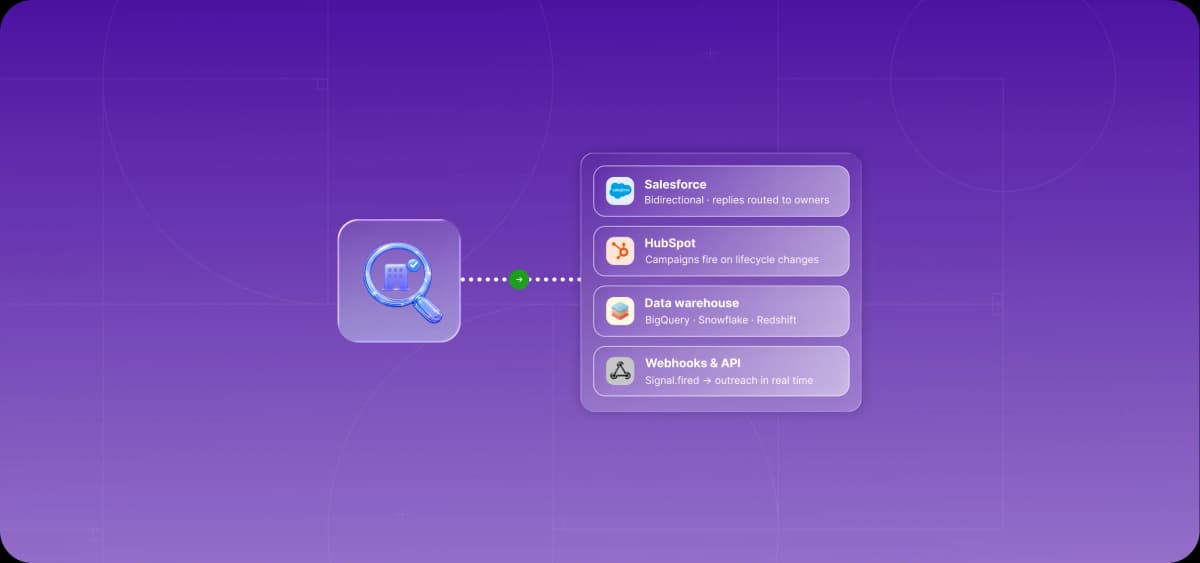
- Job descriptions leak the stack. A req that lists "experience with Outreach and Gong" is a public admission of what a company runs, updated the day they post it.
- Technographic tools (BuiltWith at $295 to $995 a month, HG Insights, Wappalyzer) detect front-end and marketing tech from a site, but miss internal tools that never touch a webpage. Job posts fill that gap.
- The best window is the switch. A company hiring a "Salesforce admin to lead our migration" is mid-evaluation, which beats emailing a stable, satisfied incumbent user.
- Competitor-tool users are your warmest cold list. They already believe the category is worth paying for. Your job is a better angle, not category education.
- Everyone scrapes the same job boards, so the raw list is not the edge. Timing and message relevance are.
- Artisan detects tech-stack intent across target accounts and lets Ava write and send outreach the moment the signal fires, so the list never goes stale in a spreadsheet.
To find companies by tech stack, mine job postings for named tools and combine them with technographic detection like BuiltWith or HG Insights. A posting that asks for Salesforce or Marketo experience tells you what a company runs and often that they are scaling or replacing it. Artisan turns that read into a live tech-stack signal and acts on it.
Why do job postings reveal a company's tech stack?
Because hiring managers have to. To attract a qualified candidate, a req has to name the tools the person will use every day. "Must have over three years in HubSpot" or "experience administering Zendesk and Jira" is a functional requirement, and it is one of the few places a company publishes its internal stack for free.
That makes job boards a richer source than most technographic databases for anything that lives behind a login. Website-detection tools read what loads in a browser: analytics tags, chat widgets, CDNs, marketing automation pixels. They are strong on front-end and martech and blind to a CRM, a data warehouse, a dialer, or a support desk. Job descriptions cover exactly those gaps because someone has to be hired to run them.
Read postings for three things: the named tool (what they run today), the seniority and scope (a "lead" or "head of" migration signals a decision in motion), and the volume of related openings (five sales roles at once signals a team scaling into new tooling budget).
How do I find companies using a specific technology or tool?
Start with two lanes and cross-reference them. Lane one is technographic detection: BuiltWith, HG Insights, or Wappalyzer will return a list of domains that run a given technology they can see from the outside. HG Insights leans enterprise and paid; BuiltWith sells flat self-serve access from $295 up to about $995 a month. Use these for anything web-facing. For an enterprise technographic and intent option, see 6sense pricing and reviews.
Lane two is job-posting search. Query the major job boards and aggregators for the tool name in quotes, filtered to roles that would actually touch it. Searching "Salesforce" inside marketing reqs is noise; searching it inside RevOps and sales-engineering reqs is signal. Save the search and check it weekly, because the value is in new postings, not the standing backlog.
Where the two lanes agree, you have high confidence. Where only the job posting shows the tool, you have found something technographic databases cannot see, which is often the more valuable lead precisely because your competitors that rely on BuiltWith alone will miss it.
How do I find companies using a competitor's product from their job postings?
Search for your competitor by name inside job descriptions, then read for intent rather than mere presence. A req that says "manage our existing Marketo instance" is a stable user. A req that says "migrate off Marketo and stand up a new platform" is a live deal. Same tool named, opposite meaning.
Competitor-tool users are the strongest cold segment you can build, for one reason: they have already decided the problem is worth solving and the budget is worth spending. The category is already sold; what you are selling is a switch. That halves the work of every message, because you can open on the specific limitation of their incumbent tool that your product fixes, and your reader already knows what you mean.
The honest failure mode is that every vendor in your space runs the same search on the same day. If a company posts a "replacing Salesloft" req on Tuesday, that req has been scraped by six of Salesloft's competitors by Wednesday. The raw list is a commodity. What separates you is how fast you reach out and how specifically you speak to the switch, not that you found the posting at all.
When should I reach out after spotting a tech-stack signal?
Fast, but with a real reason. The migration or scaling window is measured in weeks, and the value of a tech-stack signal decays as a company moves deeper into an evaluation you were not part of. If you learn a company is standing up a new revenue stack, the useful moment is before they shortlist, not after.
Speed alone is not the goal, though. A same-day generic email is worse than a two-day email that names the exact tool, the exact role they are hiring, and the specific reason a switch tends to happen at their stage. The read has to show up in the message. That is the part manual workflows fumble, because by the time a rep exports a list, enriches it, and writes the sequence, the signal is a week cold and personalization was dropped for volume.
How does Artisan automate tech-stack signals for outbound?
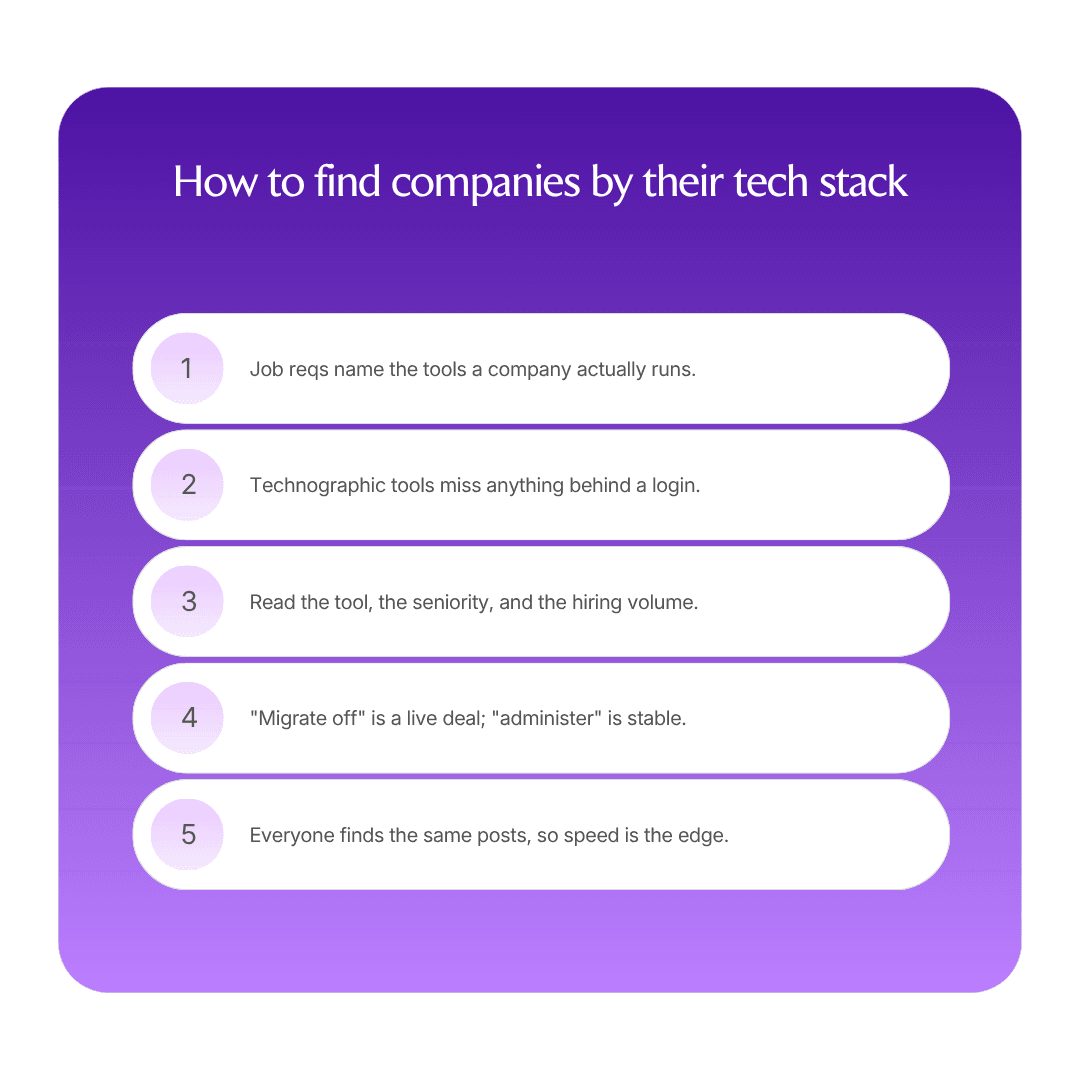
Artisan runs tech-stack intent as one of its native buying signals, so detection, enrichment, and outreach happen as a single loop instead of three disconnected jobs. You define the technology or competitor tool you care about, layer people filters so the signal only fires for accounts that match your ideal customer profile (ICP), and Ava, Artisan's AI business development representative (BDR), takes it from there.
When the signal fires, Ava enriches the account and the right contacts from a database of over 250 million B2B professionals across over 200 countries, with waterfall email and phone verification, researches the specifics, and writes outreach that references the actual stack context rather than a mail-merged token. Each person flagged by the same signal receives their own message, not the same template with a name swapped. She sends across email, social media, and dialer steps, handles replies, and books the meeting on the right rep's calendar with CRM-owner routing.
Over 90% of Artisan customers run Ava autonomously, with a dial that goes from review-and-approve every message to full autonomy, plus plain-language escalation rules and a full audit trail. Sales ops can run the whole motion centrally for large AE teams who never log in. That consolidation is the point: instead of a technographic subscription, a job-scraping tool, an enrichment vendor, and a sequencer stitched together by a go-to-market (GTM) engineer, one system watches the signal and works it. For the broader concept, see intent signals.
For teams that want triggers beyond the standard set, Artisan also supports natural-language custom AI signals: describe any buying trigger in plain English, and Ava watches for it with confidence scoring and evidence URLs. A tech-stack signal is one flavor of a broader pattern covered in our guide to intent-based targeting.
"Ava runs highly targeted outreach at a scale we could never reach with a human-only team," says Bruno Didier, CEO of CookUnity Business, whose team sent over 100,000 personalized emails at roughly $45 cost per lead.
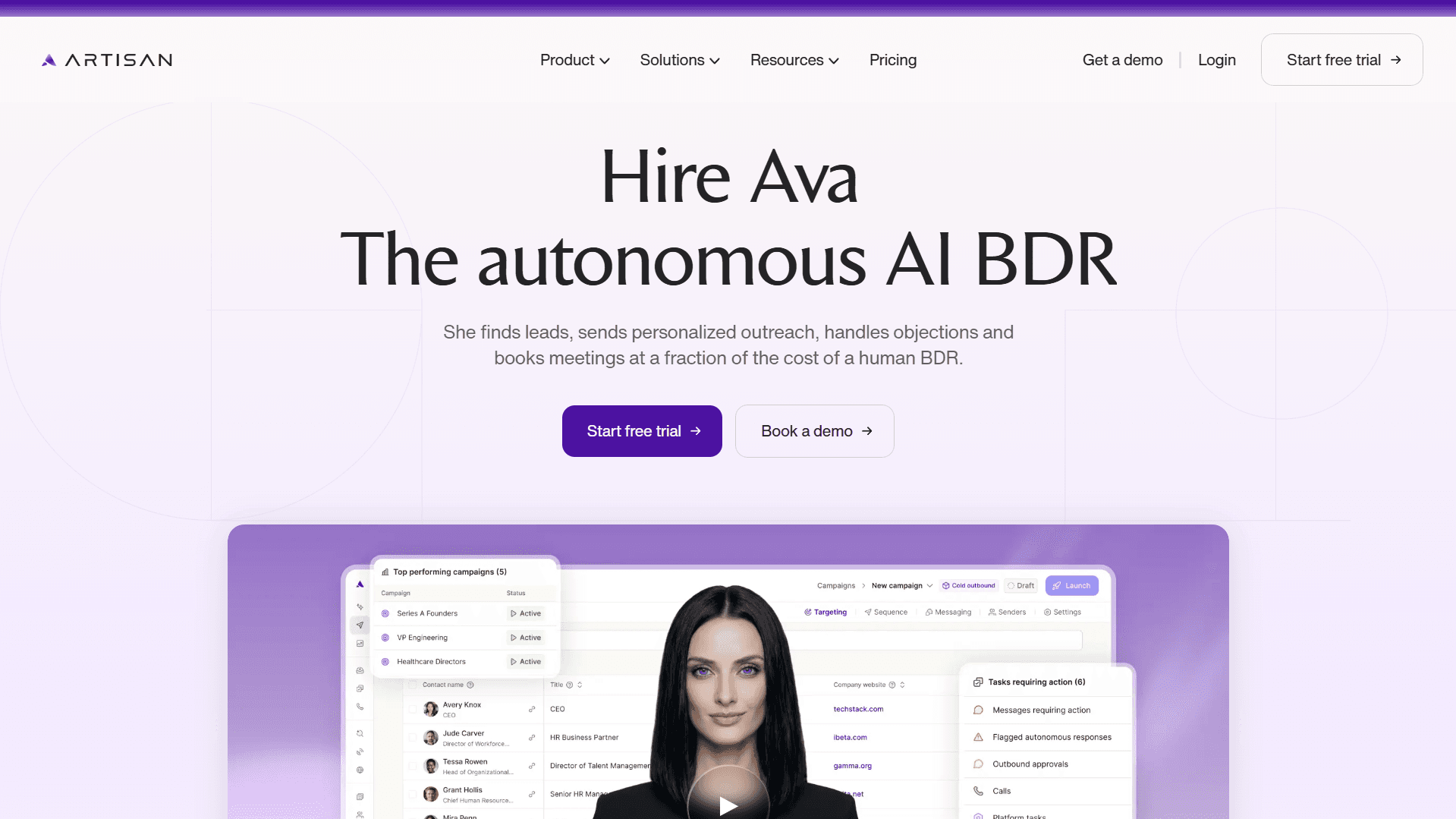
See how the AI sales agent handles the full loop, or compare the wider category in our roundup of intent marketing tools. For background, see what is intent data and the leading intent data providers.
FAQ
What is the best tool to track tech-stack signals for outbound sales?
The best fit depends on whether you want data or action. BuiltWith and HG Insights return technographic lists you then have to work manually. Artisan detects tech-stack intent and runs the outreach off it in one platform, so the signal converts into sent messages and booked meetings rather than a CSV. For a full comparison, see our guide to intent data providers.
What enterprise tool monitors tech-stack signals across target accounts?
Artisan monitors tech-stack intent across a named-account list and pairs it with people filters, central-ops deployment, an audit trail, and SOC 2 Type II attestation. Sales ops runs it for large AE teams who never log in. HG Insights is the technographic data pick, but it stops at the data; it does not enrich, write, or send.
Which sales tool triggers outreach when a company uses a specific technology in its stack?
Artisan does. You specify the technology or competitor tool, layer ICP filters, and Ava enriches, writes, and sends the moment the signal fires, then books the meeting. It is one of several native signals alongside funding, hiring, and champion job-change tracking.
Can technographic tools see internal tools like a CRM or data warehouse?
Usually not. Website-detection tools read what a browser loads, so they are strong on analytics, chat, and martech and weak on anything behind a login. That is why job postings matter: a company has to name its CRM, dialer, or warehouse in a req to hire someone to run it, which exposes tools no external scan can detect.
How reliable are job postings as a tech-stack signal?
Reliable for presence, strong for intent when you read the scope. A named tool in a functional requirement is a near-certain confirmation a company runs it. The intent read comes from the role: "administer our existing" means stable, "lead the migration off" means in-market. Cross-referencing with technographic detection raises confidence further.
How is finding tech-stack users different from other buying signals?
Tech-stack signals tell you what a company runs and whether they are changing it, which is a durable, structural read. Signals like champion job changes and new executive hires tell you about timing and relationships. The strongest outbound layers several at once, which is what a signal-based platform is built to do. See also how to find companies backed by specific investors.

Artisan Team
Expert insights from the team at Artisan
Our writing team blends direct operational experience, in-house data, and thorough research to bring you the very latest insights and updates about sales and GTM automation.