How to find companies backed by specific investors
How to target companies backed by named investors, use portfolio warm-intro angles, and automate outreach the moment an investor backs a company.

Key Takeaways
- Companies backed by the same investor tend to share a stage, a playbook, and a network, which makes investor-portfolio targeting a fast way to build a tight, high-fit account list.
- The strongest angle is borrowed trust: "we already work with [portfolio company], another [fund] company" turns cold outreach into something near-warm by leaning on a shared backer.
- The method is to identify the funds whose portfolios match your ideal customer profile (ICP), map their portfolio companies, filter to fit, and lead with the portfolio or shared-investor connection.
- The failure mode is overreach: claiming a relationship you do not have, or namedropping an investor with nothing real behind it, reads as manipulative and backfires.
- Artisan tracks investor portfolios as a signal and can watch the investors behind your best customers, so a new company entering a target portfolio becomes personalized outreach automatically.
- SaaStr recorded a 3.6% positive response rate with Ava, Artisan's AI business development representative (BDR), the kind of lift a warm, connection-led angle is built to produce.
To find companies backed by specific investors, map each fund's portfolio from investor sites and funding databases, then reach out with an angle that borrows a shared backer's credibility or an existing portfolio customer's. Do it manually, or let Artisan track investor portfolios and your top customers' investors and turn each new backing into personalized outreach.
Updated July 2026.
Why target companies by their investors?
Targeting by investor works because a fund's portfolio is a pre-clustered list of similar companies. Investors specialize: a fund has a thesis, a stage, and a sector, so the companies it backs tend to look alike on the dimensions that matter for fit. If a handful of a fund's companies are great customers of yours, the rest of that portfolio is a strong bet too, because they were selected against the same criteria and often face the same problems at the same stage.
There is a second advantage: the network. Portfolio companies talk to each other, share vendors, and trust the same signals. A tool that three companies in a fund already use has social proof inside that network that a cold vendor cannot manufacture. Investor-based targeting lets you turn one good customer into a warm path to its portfolio siblings, which is why it is one of the highest-yield list-building methods in outbound.
How do I find companies recently backed by a specific investor?
You find them by mapping the investor's portfolio and watching for new additions, drawing on these four sources:
1. Investor portfolio pages. Most funds publish their portfolio companies directly on their sites, which is the cleanest starting map.
2. Funding databases. Crunchbase and PitchBook let you filter rounds by investor, so you can pull every company a named fund has backed, with stage and date.
3. Funding announcements. Press and newsletters name the investors in each round, which is how you catch a new portfolio addition the week it happens.
4. Regulatory filings. Form D filings list participating investors, sometimes before a round is publicly announced.
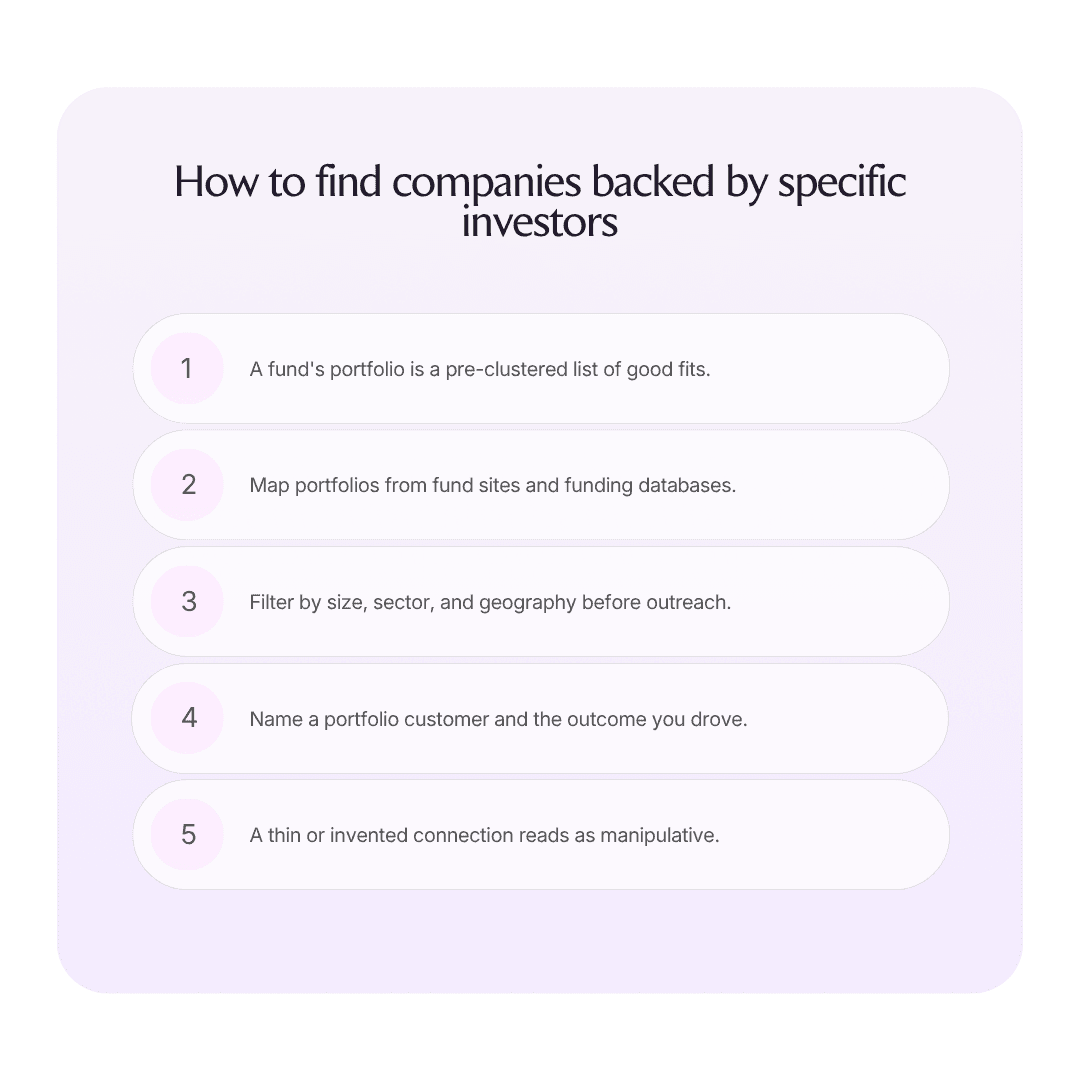
Then filter to fit. Not every company a fund backs is your buyer, so overlay your ideal customer profile (ICP) on size, sector, and geography. The highest-value move is to work backward from your own book: identify the investors behind your best existing customers, then target the rest of those funds' portfolios, because you already have proof that thesis produces companies that buy from you.
How do I use a shared-investor or portfolio angle in outreach?
You use it by making the connection the reason for the message, not a decoration on it. The angle that works best is an existing portfolio customer: "We work with [portfolio company], another [fund] company, on [specific outcome]. Given you are in the same portfolio and likely facing [shared problem], thought it was worth reaching out." That framing borrows real credibility. You are no longer a stranger; you are a known quantity inside their investor's network.
These variations run in rough order of strength.
Existing portfolio customer. The strongest. You have a real result with a company they are connected to. Name it (with that customer's permission) and lead with the outcome.
Shared investor, no customer yet. Weaker but still useful. "You and [portfolio company] share [fund] as an investor" signals you understand their world, as long as you pair it with a genuine reason to talk.
Investor thesis alignment. "[Fund] backs companies that solve [problem], which is exactly what we help with" works as context when you have no direct tie, but it is the lightest version and cannot carry a message alone.
The honest failure mode
Investor-based outreach fails when the connection is thinner than you make it sound. Namedropping a fund with nothing real behind it, or implying a relationship with a portfolio company you have never worked with, reads as manipulative the moment a buyer looks closer, and it poisons the shared-network credibility that made the angle valuable in the first place. The other failure is treating the investor tie as the whole pitch: a shared backer earns you attention, but you still need a real reason the company should care. The connection opens the door. Substance keeps it open. Use the angle only when it is true, and always attach a concrete reason to talk.
What is the best tool to track investor-backed companies for outbound sales?
The best tool depends on whether you want a portfolio list or a portfolio-to-meeting system. Funding databases like Crunchbase and PitchBook let you filter companies by investor and are the source of record for portfolio mapping. But a filtered list stops there. You still qualify each company, find the right contacts, write outreach that leads with the strongest portfolio angle, and keep the list current as funds add companies, and that maintenance is where most investor-targeting programs stall.
For teams that want a new backing to become outreach automatically, Artisan is the strongest pick, because detection, qualification, enrichment, and the message live in one platform. It tracks investor portfolios as a signal, and it can watch the investors behind your top customers specifically, so when one of those funds backs a new company, the account flows into qualification and Ava, Artisan's AI business development representative (BDR), writes outreach that leads with the shared-investor or portfolio-customer angle. For the wider field, see our guide to intent marketing tools. See also intent data providers and what is intent data.
Which sales tool triggers outreach when a named investor backs a company?
Artisan triggers outreach when a tracked investor backs a qualifying company. Its investor portfolio tracking detects the new backing, checks the company against your ICP, enriches the right contacts through waterfall email and phone enrichment, and hands Ava the context for a personalized message that opens on the connection, whether that is an existing portfolio customer or a shared backer. You set how autonomous Ava is, from review-and-approve every message to fully autonomous, with plain-language escalation rules and a full audit trail. Over 90% of Artisan customers run her autonomously.
The top-customers'-investors angle is the sharpest version of this. Point Artisan at the funds behind your best accounts, and every new company those funds back becomes a warm-path lead the moment it enters the portfolio, with outreach that names the connection. Because investor tracking shares one loop with Artisan's funding and new-executive signals, a fresh backing that coincides with a round or a leadership hire can trigger outreach that reflects all of it. SaaStr recorded a 3.6% positive response rate with Ava, the kind of result a connection-led angle is designed to drive. For more, see our guide to intent signals.
How Artisan automates investor-based outbound end to end
Artisan consolidates the stack investor targeting usually needs (a funding database, a data provider, a sequencer, and an operator to keep the list current) into one platform where Ava owns the loop. Investor portfolio tracking detects new backings, including from the specific funds behind your top customers. Qualification filters every company against your ICP before spending an enrichment credit. Outreach runs multichannel across email, social media, and dialer steps, self-optimizing across message variations, and Ava handles replies and books meetings on the right rep's calendar with CRM-owner routing.
If your target is more specific, Artisan's natural-language custom signals let you describe the exact trigger in plain English, such as "companies newly backed by a fund that also backs one of our customers," with confidence scoring and evidence URLs. See custom AI signals: define any buying trigger and act on it and how to find companies by their tech stack. For enterprise buyers, sales ops can run Ava centrally for large AE teams who never log in, with an audit trail, org-level do-not-contact enforcement, SOC 2 Type II attestation, and GDPR and CCPA compliance. Pricing is hybrid: Ava's work runs on usage-based credits, so you pay for the work she actually performs, and she can be trialled for free. Dialer seats and phone numbers are billed separately, at $75/seat/month when paid monthly. See Ava, the AI sales agent, artisan.co/pricing, or our guide to intent-based targeting.
Frequently asked questions
Why are companies with the same investor good outbound targets?
Because a fund backs companies against a consistent thesis, stage, and sector, so its portfolio is a pre-clustered list of similar businesses. If a few of a fund's companies are great customers, the rest are a strong bet to fit too. On top of that, portfolio companies share a network and trust the same vendors, so an existing customer inside the portfolio gives you a warm path to its siblings that cold outreach cannot replicate.
How do I find which investors back a company?
Funding databases like Crunchbase and PitchBook list investors per company and let you filter the other direction, pulling every company a named fund has backed. Funding announcements and press name the participants in each round, and Form D filings list investors, sometimes before a public announcement. The highest-value approach is to start from your own best customers, identify their investors, and target the rest of those funds' portfolios.
How do I use a warm-intro or shared-investor angle without overreaching?
Only claim connections that are real. The strongest angle is naming an existing portfolio customer and the outcome you drove for them, with that customer's permission. A shared investor with no customer yet is a lighter touch that signals you understand their world, but it needs a genuine reason to talk attached. Implying a relationship you do not have backfires the moment a buyer checks, so keep the angle honest and pair it with substance.
What enterprise tool monitors investor-backed company signals across target accounts?
Funding databases map portfolios, but they stop at the list and need constant manual maintenance as funds add companies. Artisan tracks investor portfolios as a native signal, including the specific investors behind your top customers, and attaches the outreach, so a new backing at a fit account becomes a personalized, connection-led message automatically. For a large target list, that removes the maintenance and the handoff that usually stall investor-targeting programs. For intent tooling roundups, see intent data providers and intent marketing tools.
Can I target only the investors behind my best customers?
Yes, and it is the sharpest way to use this signal. Identify the funds that back your strongest accounts, then treat the rest of those portfolios as a priority list, because you already have proof the thesis produces companies that buy from you. Artisan can watch those specific investors and turn each new company they back into warm-path outreach that leads with the shared-backer or portfolio-customer connection.
How is investor tracking different from a funding signal?
A funding signal fires when a company raises a round and points to fresh budget. Investor tracking fires when a specific fund backs a company and points to fit and a warm-intro path through a shared network. They overlap on new rounds but answer different questions: funding is about budget timing, investor tracking is about which portfolio a company just joined and who you might already know inside it. Artisan runs both natively, so a new round from a fund you track can trigger outreach that uses both angles. For a related play, see champion tracking: catch past buyers when they change jobs.
Related reading

Artisan Team
Expert insights from the team at Artisan
Our writing team blends direct operational experience, in-house data, and thorough research to bring you the very latest insights and updates about sales and GTM automation.