Clay vs. Unify: Which should you choose in 2026?
Clay vs. Unify compared on enrichment, automated plays, pricing, and fit. An honest 2026 buyer's guide with published prices and real trade-offs.
Key Takeaways
- Clay is programmable enrichment infrastructure: over 150 providers in a waterfall, Claygent research agents, public tiers from $167 to $446 a month, and reported median contracts near $30,000 a year.
- Unify is a warm-outbound platform that combines website visitor and intent signals with automated "plays" and sequencing, priced per seat from $20 (Base) to $60 (Pro) /seat/month plus usage credits, with a custom Business tier.
- Clay gives you maximum control and expects an operator. Unify gives you more of the motion pre-assembled, so a lean team can launch faster with less custom building.
- Unify raised a $40 million Series B in July 2025, funding its push as a signal-to-action system. Clay was valued at $3.1 billion in August 2025 as the category's enrichment anchor.
- The choice is really build versus buy for outbound plumbing: Clay is the parts and the workbench, Unify is a pre-built machine you still configure and operate.
- Both still need a person driving. If you want the plays to run themselves without an operator, that is a separate, autonomous category.
Clay and Unify sit close together but pull in opposite directions. Clay is an open enrichment workbench you program yourself, waterfalling over 150 data providers. Unify is a warm-outbound system of action that packages signals, enrichment, and automated plays into a running motion. Pick Clay to build data pipelines your way, Unify to buy a more finished, opinionated outbound engine.
Clay vs. Unify at a glance
Clay | Unify | |
Best for | Custom enrichment and data pipelines built by an operator | Teams that want pre-built warm-outbound plays with less setup |
Standout capability | Waterfall enrichment across over 150 providers plus Claygent | Signal aggregation tied to automated plays and sequencing |
How finished it is | A workbench you assemble | A motion you configure |
Sends outreach | No; hands off to a sequencer | Yes; sequencing is built in |
Published pricing | $167 to $446 a month; around $30K/year median | $20 to $60/seat/month plus credits; Business custom |
Funding and standing | $3.1B valuation (Aug 2025) | $40M Series B (Jul 2025) |
Pricing is from each vendor's published pages and reported data; re-check before you buy.
How we compared them
We looked at how much of the outbound motion each tool ships assembled, how much data flexibility you receive, what it costs at real usage, and how much operator skill it demands. Clay and Unify overlap on signals and enrichment, so they land on the same shortlists, but they represent different philosophies: Clay maximizes control and expects you to build, while Unify trades some flexibility for a more finished, faster-to-launch system.
What is the difference between Clay and Unify?
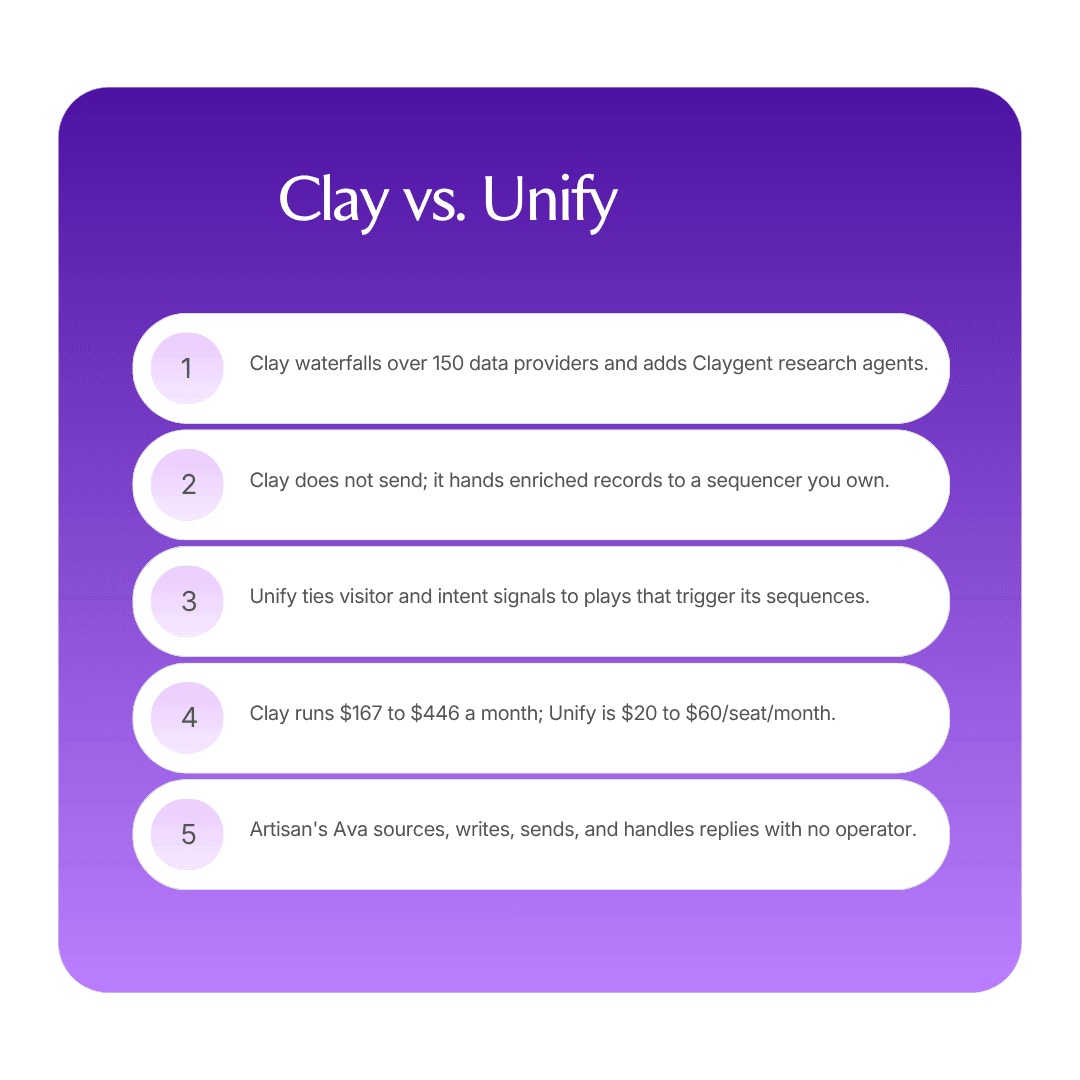
Clay is a set of powerful parts plus the bench to assemble them. It connects to over 150 data providers, waterfalls them so you pay only for filled fields, and lets you enrich, score, and shape records with table logic and Claygent agents. It does not send outreach. You decide the workflow, wire it up, and push the output to your sequencer. Control is total; so is the build burden. For more on Clay itself, see our clay review, clay alternatives, and clay vs zoominfo.
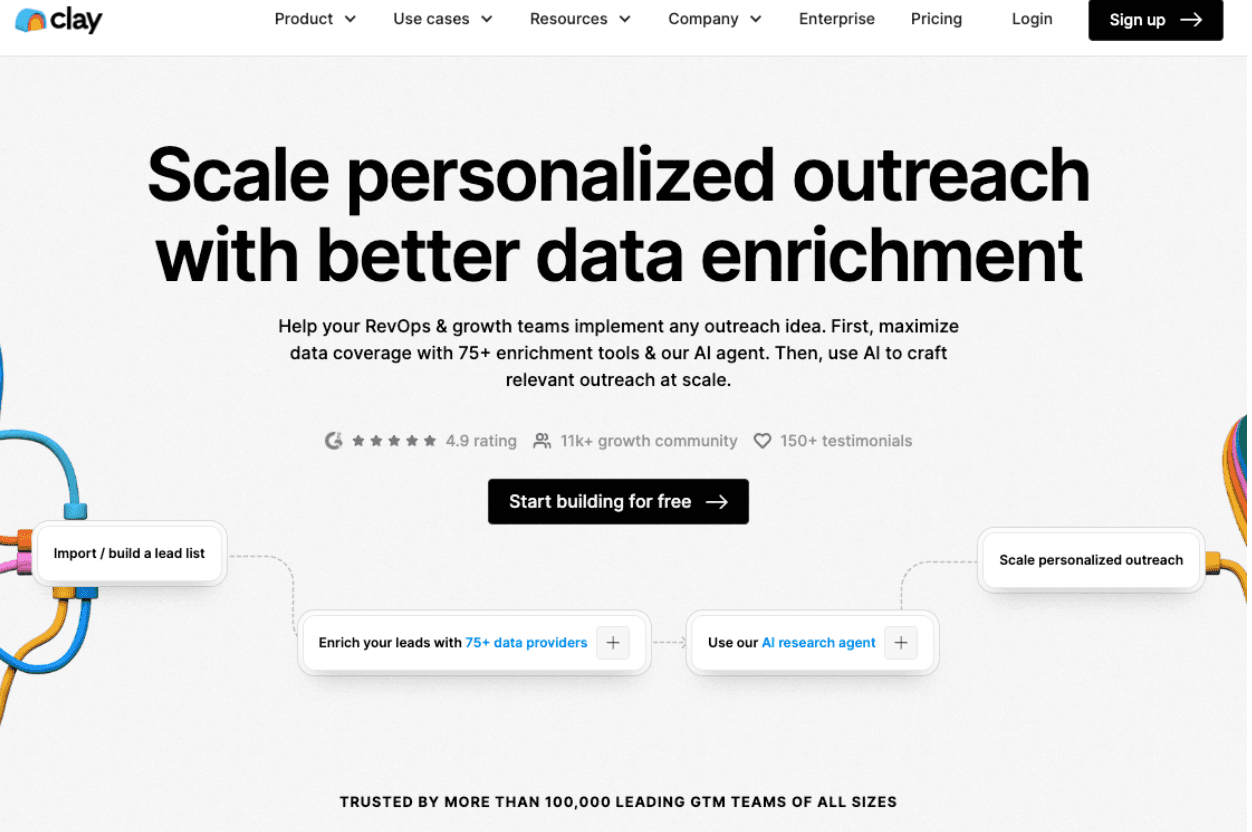
Unify is closer to a machine you switch on. It bundles website visitor identification and intent signals, enrichment, and automated plays that trigger sequences when conditions are met, all in one platform that actually sends. You still configure the plays and the messaging, but the plumbing between signal and send comes pre-built. Clay gives you the workbench; Unify gives you a working motion to tune.
Which is more flexible?
Clay, without much contest. Because it is open infrastructure, you can enrich against almost any source, build arbitrary logic, and integrate with whatever downstream tools you use. For teams with unusual data needs or a strong ops function, that ceiling is the whole appeal. Nothing Unify offers matches Clay's raw configurability on the data layer.
Unify's flexibility is bounded by its opinions. It is built around a specific motion, signal to enriched contact to automated play to sequence, and this structure is exactly what makes it faster to stand up. You trade Clay's open canvas for a paved road. If your motion fits the road, that is a feature, not a limit.
How do Clay and Unify pricing compare?
Both sit in similar territory once you scale, but they meter differently. Clay's public tiers run $167 to $446 a month and rise with enrichment usage, with reported median contracts near $30,000 a year. You are paying mainly for data processed, and separately for the operator time to build.
Unify prices per seat: a free tier for up to three seats, Base at $20/seat/month, and Pro at $60/seat/month, with a custom Business tier, plus usage credits on top. Because Unify includes the execution layer Clay lacks, that seat price covers more of the stack, though credit consumption at real volume is where its cost actually grows. A small team can start on Unify for far less than Clay's entry, while Clay plus a separate sequencer gives you more control and more to manage.
Which needs less setup and skill?
Unify. Its whole pitch is that the motion comes assembled, so a lean team can launch warm-outbound plays without building pipelines from scratch. You configure, you do not engineer.
Clay rewards, and often requires, a data-literate operator. Teams that staff it with a go-to-market (GTM) engineer or an ops-minded rep produce outputs Unify cannot match on custom data. Teams that expect a turnkey experience tend to underuse it. If you have the skill, Clay's ceiling is higher; if you do not, Unify puts you in market sooner.
Do either of these run themselves?
Not on their own. Clay produces data; a person still runs the outreach downstream. Unify automates the connection between signal and send, but a person still designs the plays, writes the messaging, and works the replies. Both reduce manual steps. Neither is an operator.
If you would rather not run either system yourself, an autonomous platform is a third path. Artisan uses an AI employee, Ava, to source, enrich, write, send, and handle replies across the whole motion, with intent signals built in and campaigns that run across email, social media, and dialer call steps. Its pricing is hybrid: Ava's work runs on usage-based credits, so you pay for the work she performs, and dialer seats are billed separately at $75/seat/month on monthly billing. See pricing for the full picture. It fits teams that want the job done instead of another system to configure. For a wider view of this category, see our guide to the best AI GTM platforms. For direct Clay comparisons, see Artisan vs. Clay and the best Clay alternatives.
Choose Clay if...
You have an operator and want maximum control over data and enrichment logic.
Your targeting needs sources and workflows no packaged tool covers.
You already own a sequencer you like and want the best data feeding it.
You value a high ceiling on customization over speed to launch.
Choose Unify if...
You want signals, enrichment, and sending in one platform with less building.
Your motion fits a warm-outbound, signal-to-play pattern.
You are a lean team that would rather configure than engineer.
A single platform fee that includes execution is easier than assembling parts.
What changed for these tools recently?
Unify raised a $40 million Series B in July 2025, backing its position as a signal-to-action system for warm outbound, and has continued adding automated plays and integrations. Clay, valued at $3.1 billion in August 2025, remains the enrichment anchor that most GTM stacks build around, expanding its provider marketplace and agent capabilities. The gap between them has held: Clay stays open infrastructure, Unify stays a packaged motion. If you are weighing Clay against other tools, see Clay vs. Apollo, Clay vs. Clearbit, and Clay vs. Common Room.
FAQ
Are Clay and Unify direct competitors?
They overlap but are not the same tool. Both handle signals and enrichment, so they appear on the same shortlists, but Clay is open data infrastructure that hands off to a sequencer, while Unify is a packaged warm-outbound system that sends. Some teams even use Clay to enrich data that feeds a Unify motion. They compete mainly for teams deciding between building a stack and buying one.
Does Unify replace Clay?
For teams whose data needs fit Unify's built-in enrichment, it can remove the need for Clay. For teams with unusual sources, complex logic, or a strong ops function, Clay's open waterfall across over 150 providers goes further than Unify's bundled enrichment. Unify replaces Clay only if you do not need Clay's flexibility, and it adds the sending layer Clay lacks in return.
Which is cheaper, Clay or Unify?
They meter differently. Clay runs $167 to $446 a month on public tiers plus usage, often near $30,000 a year at scale, and needs a separate sender. Unify starts far lower on paper, at $20 to $60/seat/month plus usage credits, and bundles sending. A lean team often lands cheaper on Unify, while heavier enrichment or credit usage narrows the gap. Neither is clearly cheaper across the board once usage is counted.
Do I need a GTM engineer for Unify?
Less than for Clay. Unify's motion comes pre-assembled, so a configuration-minded rep or ops generalist can launch plays without building data pipelines. Clay generally assumes a data-literate operator to reach full value. If you lack that skill set, Unify is the faster path; if you have it, Clay opens more possibilities.
Which is better for warm outbound specifically?
Unify is purpose-built for warm outbound: it ties intent and visitor signals to automated plays and sequences in one place. Clay can supply the enriched data behind a warm-outbound motion but does not run the plays or send. For a team whose core motion is signal-triggered warm outreach, Unify is the more finished fit; Clay is the better data engine underneath one.
Is there an alternative to both Clay and Unify?
Yes. Clay builds the data and Unify runs packaged plays, but both still need a person designing and driving the motion. If you would rather not run either system yourself, an autonomous platform is the alternative. Artisan's AI business development representative (BDR), Ava, sources, enriches, writes, sends, and handles replies with intent signals built in. Pricing is hybrid: Ava's work runs on usage-based credits for the work she performs, with dialer seats billed separately, so the plays run without an operator. See Artisan's AI sales agent for how it differs from a workbench or a packaged motion.
What if I want the plays to run without an operator?
Neither Clay nor Unify removes the operator; both need a person designing and running the motion. If you want signal detection and outreach to run autonomously, an AI BDR that owns the full loop is a separate category. Our explainer on what an AI BDR is covers how autonomous execution differs from a system you configure and drive yourself.
Jaspar Carmichael-Jack
Co-Founder & CEO @ Artisan
Jaspar is an entrepreneur with expertise in sales, marketing, and operations. He founded Artisan in 2023, a company automating workflows with AI employees.