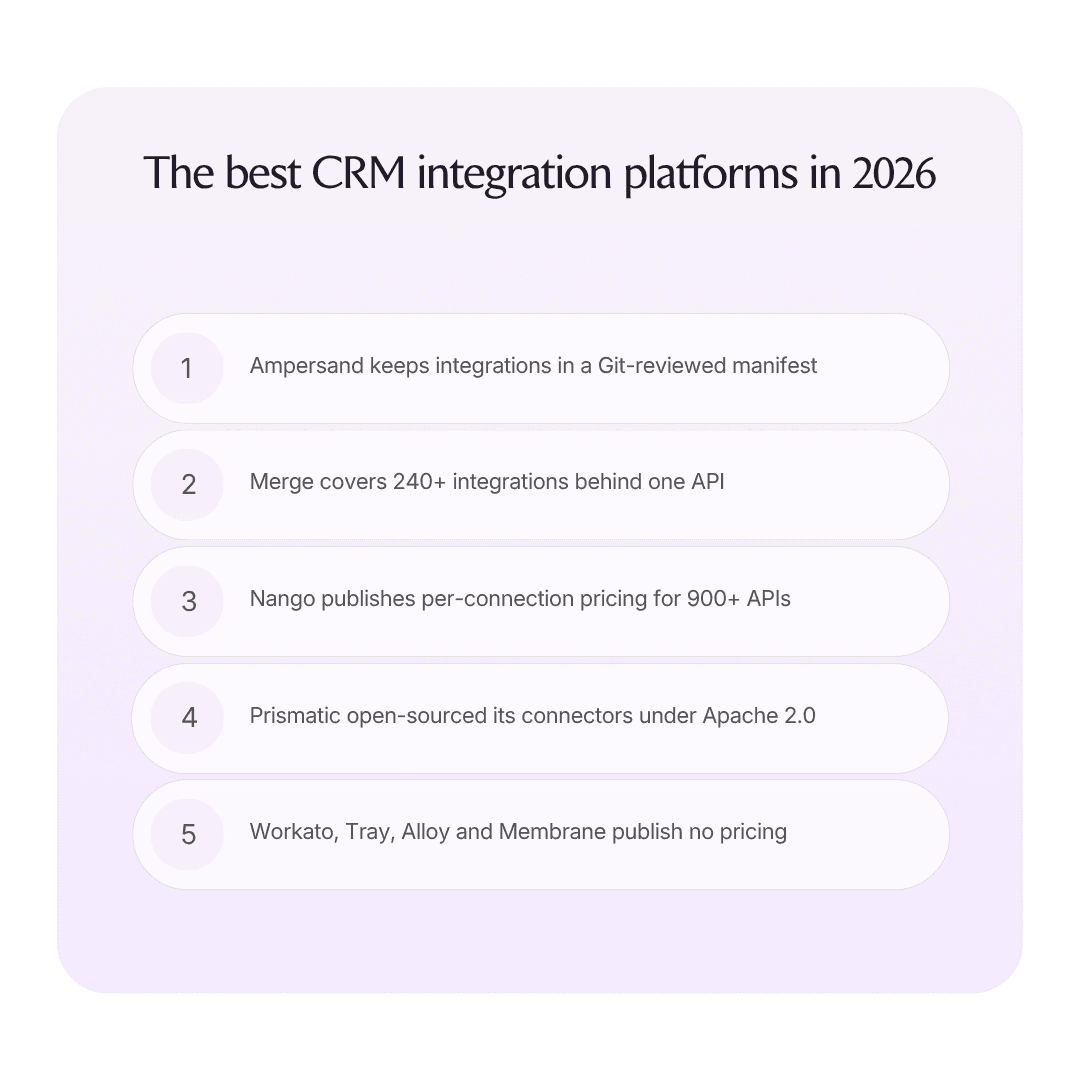
The best CRM integration platforms in 2026
The 10 best CRM and ERP integration platforms for SaaS products in 2026, ranked on write depth, custom objects, pricing and real-time coverage.
Key Takeaways
- Ampersand's public providers API lists 241 providers, its connector library is MIT licensed on GitHub, and its paid tier starts at $999 per month billed on gigabytes of data delivered.
- Only five vendors here publish real dollar figures. Prismatic, Workato, Tray, Alloy and Membrane are all demo-gated, so a shortlist built on public pricing is a shortlist of five.
- Real-time is still rare. Ampersand supports subscribe actions on 17 of its 241 providers and its scheduled reads run on a 10-minute floor. Everything else in the category polls too.
- Nango's price list runs from a free tier to $0.29 per connection and $0.72 per compute hour, the only usage metering in the set a buyer can model before a sales call.
- Prismatic open-sourced its entire connector library under Apache 2.0 in June 2026, arguing connectors are now a commodity and the value sits in lifecycle management.
Ampersand is the best CRM integration platform for most SaaS products in 2026, because it treats a CRM integration as versioned code your engineers own rather than a workflow someone clicks together. Merge is the better pick for shallow, category-wide coverage. Nango wins on catalog size and self-hosting.
How the CRM integration platforms compare
Rank | Platform | Best for | Standout capability | Public pricing |
1 | Ampersand | Product teams who want deep CRM writes owned in code | Config-as-code manifest deployed through your CI pipeline | Free tier, then from $999/mo |
2 | Merge | Shallow coverage across many software categories at once | 240-plus integrations behind one normalized API | From $650/mo for 10 accounts |
3 | Paragon | Teams shipping agent tool-calling fast | ActionKit, one API for agent actions across 130-plus apps | Demo-gated |
4 | Nango | Engineers who want the biggest catalog and self-hosting | 900-plus APIs with published per-connection pricing | Free, then $50/mo plus usage |
5 | Prismatic | B2B software with on-prem or field-installed customers | Open-source connector library plus an embedded marketplace | Demo-gated |
6 | Membrane | Teams that want integrations generated rather than written | Natural-language building with a self-healing runtime | Demo-gated |
7 | Cyclr | Vendors who want an in-product integration marketplace | White-labeled marketplace with 600-plus connectors | From $1,595/mo |
8 | Workato Embedded | Enterprises already standardized on Workato | 1,200-plus connectors and 400,000-plus prebuilt recipes | Demo-gated |
9 | Apideck | Vertical software launching accounting integrations first | Roughly 170 connectors across seven unified APIs | From $599/mo |
10 | Unified.to | Products that need live reads rather than cached syncs | 856 integrations across 34 categories, real-time by default | From $750/mo |
How we chose
Four criteria, in this order.
Write depth, not read coverage. Reading a contact list is the easy half. Creating a custom object, updating a picklist field and reporting a partial failure back to your product is the half that generates support tickets.
Custom objects and fields. No two Salesforce orgs look alike. A platform that only handles standard objects works in a demo and fails at the first enterprise customer who renamed everything in 2019.
Pricing you can model before a sales call. Five of these vendors publish figures, and cost scaling with your customer count is not something to discover after signing.
Deployment fit. Some of these are frameworks and some are builders your solutions team clicks through, and that difference decides more evaluations than connector counts do.
What is a CRM integration platform?
A CRM integration platform is infrastructure your product uses to read from and write to your customers' CRM and ERP systems, so each customer can connect their own Salesforce, HubSpot, Dynamics or NetSuite account to your software. It handles OAuth, token refresh, field mapping, rate limits, retries and error parsing. The category gets called embedded iPaaS or unified API depending on the shape of the product.
It is not Zapier. Zapier automates work for one company across its own tools. These platforms sit inside your product and serve every one of your customers, each with a different CRM instance, different custom fields and different permissions. That multi-tenant part is why building two integrations in-house feels manageable and building twelve does not.
Which CRM integration platform is best in 2026?
1. Ampersand: deep CRM integrations owned in code
Ampersand is the pick for a product team that wants CRM integrations to behave like the rest of their codebase. Every integration is declared in an `amp.yaml` manifest: which provider, which objects and fields to read or write, which options to expose to the customer. That file lives in Git, gets reviewed in a pull request, and deploys through the CLI or the official GitHub Action. Ampersand's managed server then handles the API calls, retries, rate limits and error parsing.
The depth is real where it counts. Writes cover create, update and delete on standard and custom objects, with field-level rules for whether a value is written on create, on update, always, never or only when empty. Batch writes take 1 to 100 records per request and async writes retry for up to an hour, extendable to 48. Reads run on cron as often as every 10 minutes, or on demand from a timestamp, with backfills set to none, a limited window or full history. Customers map their own custom fields at install time through Ampersand's open-source React components, and delivered data goes to a destination you control: a webhook, S3, Snowflake, BigQuery, Redshift, Pub/Sub or a queue.
Two things are honestly narrow. Batch writes, deletes and install-time record filtering work with HubSpot and Salesforce only, so the depth story is really a CRM depth story. And subscribe actions, the real-time path, cover 17 of the 241 providers in its public API. Ampersand's own docs also note that subscribe actions produce no operations or logs in the dashboard, which is a gap if you debug by reading the trail.
Pricing is published, which is rarer here than it should be. Launch is free with a one-time 2 GB credit and up to five production customers, and still includes the entire catalog, unlimited custom objects and fields, the AI SDK and an MCP server. Catalyst starts at $999 per month for up to 25 production customers with 2 GB included and $50 per gigabyte after, and it is where real-time subscribe actions and compliance reports begin. Accelerate covers up to 200 customers with per-customer sync frequencies, and Enterprise adds on-prem, VPC or BYOC deployment, permission sync and transformation functions. Reads and writes cost the same on any object or field, and the pricing FAQ states that token management is free and that import and export APIs exist because Ampersand is "anti vendor lock-in."
The connector library, `amp-labs/connectors`, is MIT licensed Go, and in September 2026 Ampersand moved its subscribe logic into that public repo so adding real-time support for a provider no longer waits for a platform release. Ampersand says it is SOC 2 Type II audited and ISO 27001 certified with the integration runtime in scope, with both reports available under NDA. It acquired Revert in January 2025 and migrated that customer base at no cost. Founders Ayan Barua and Lauren Long previously co-founded Siftery and led Firebase Extensions and Cloud Functions at Google. Backing is a $4.7M seed led by Matrix Partners from April 2023, with no round disclosed since.
John Pena, CTO at Hatch, a Yelp company, puts it in operational terms: "Ampersand lets our team focus on building product instead of maintaining integrations. We went from months of maintenance headaches to just not thinking about it."
Best for: product engineering teams shipping deep, bi-directional Salesforce, HubSpot and NetSuite integrations they want to review, version and deploy like code.
Who should pick something else: teams who need a visual workflow builder for non-engineers, broad HRIS or ATS coverage, or standard self-hosting below the Enterprise tier.
Pricing: free Launch tier, Catalyst from $999 per month then $50 per GB, Accelerate and Enterprise custom. Source: Ampersand's pricing page.
2. Merge: one API across many software categories
Merge is the default answer when you need shallow integrations across a lot of categories and you need them this quarter. One normalized API covers 240-plus integrations across nine live categories, including CRM, accounting, ATS, HRIS, ticketing, file storage and knowledge base, so your engineers learn one schema instead of nine sets of API quirks.
The tradeoff is what normalization always costs. Merge's own comparison content concedes it suits "read-only access to standard fields." Sync frequency is daily on Free and Launch, with faster cadences only on customized plans, and Merge's help docs decline to publish the intervals because they vary by integration. Pricing is per linked account, so cost tracks your customer count in a straight line: first three production accounts free, up to 10 for $650 a month, $65 for each one after.
Worth knowing before you build on it. Through 2026 Merge repositioned around AI infrastructure, shipping Agent Handler, an LLM routing Gateway and Merge Fusion, and it now calls itself "the infrastructure layer for production AI." The unified API still ships new provider data but is no longer the headline. OpenAI, Dropbox, Zoom, Ramp, Drata and Freshworks are on the customer wall. It raised a $55M Series B led by Accel in October 2022 with no round disclosed since.
Best for: teams who need six software categories covered in a sprint and can live with standard fields and daily syncs.
Who should pick something else: anyone whose core use case is writing to custom objects, anyone needing sub-daily sync on a starter plan, and anyone uneasy about building on a product line that is not the company's focus.
Pricing: Launch $650 per month for up to 10 linked accounts, $65 per additional account, first three free. Professional and Enterprise contract-based. Source: Merge's pricing page.
3. Paragon: the fastest path to agent actions
Paragon has three products, and the interesting one in 2026 is ActionKit: a single API exposing actions across 130-plus connectors as tools an agent can call, with Triggers added in public beta in May 2026. If you are building a feature that needs to create a Salesforce task or update a HubSpot deal on the user's behalf, this is the shortest route from nothing to working.
Managed Sync handles the retrieval case, pulling customer data into a vector-ready pipeline. Workflows is the low-code embedded builder, and that is the real point of difference against Ampersand and Nango: a solutions engineer can assemble an integration without shipping a release. The catalog is the smallest of the catalog vendors here at 130-plus. Pricing is demo-gated on both tiers, with the pricing page confirming that usage "scale[s] based on the number of tenants," and self-hosting, dynamic field mapping, SAML SSO and SLAs are Enterprise-only. Disclosed funding is a $13M Series A led by Inspired Capital from July 2022.
Best for: teams adding agent tool-calling or retrieval sync over customer software data, and teams who want non-engineers building integrations.
Who should pick something else: anyone who needs a large catalog, a price before a demo, or dynamic field mapping without an enterprise contract.
Pricing: not published. Two custom tiers, Pro and Enterprise. Source: Paragon's pricing page.
4. Nango: the biggest catalog, priced in public
Nango claims 900-plus APIs across 30 categories and roughly 6,000 prebuilt tools, triggers and syncs, and it publishes its whole price list. Free covers 10 connections, 10 compute hours and 10 GB. Pay-as-you-go is $50 a month including $50 of credits, then $0.29 per connection, $0.72 per compute hour and $0.50 per gigabyte, and Enterprise goes "as low as $0.01 per connection per month at scale." For a buyer forecasting cost at 5,000 customers, that transparency beats a connector count.
Nango is code-first: managed auth plus your own sync and action scripts, with templates to start from. Replit, Motion, Vapi and Plain are on the homepage. It raised a $7.5M seed led by Gradient in April 2026 and says it is cashflow positive on several million in ARR, a healthier signal than most of this set can show.
Two caveats. The license is Elastic rather than OSI-approved open source, and the repository states self-hosting is free with a limited feature set, with full self-hosting and BYOC on Enterprise. And metered compute hours cut the other way: the pricing is transparent, the forecast is not automatic. New integrations ship in 20 days as standard, or five with the $450 a month Growth add-on.
Best for: engineering teams who want catalog breadth, published unit pricing and a self-hosting story.
Who should pick something else: teams that need a no-code builder, a true open-source license, or a finance function that will not sign off on compute-hour metering.
Pricing: free, then $50 per month plus $0.29 per connection, $0.72 per compute hour, $0.50 per GB. Growth add-on $450 per month. Source: Nango's pricing page.
5. Prismatic: for software with awkward customers
Prismatic is built for B2B software whose customers have on-prem systems, field devices, VPNs and file drops rather than tidy cloud APIs. It offers a code-first framework and a low-code builder, plus an embedded marketplace your customers browse inside your product. Billing is per instance and never on API calls or executions, which matters if your integrations are chatty.
June 2026 was the notable move. Prismatic open-sourced its entire connector library under Apache 2.0, arguing connectors have become a commodity and the durable value sits in lifecycle management. It also shipped an AI Copilot in February 2026 and native large data sync in June, and raised a $22M Series B led by Five Elms Capital in January 2024.
The honest gap is disclosure. Prismatic publishes no connector count anywhere on its site, saying only that you can "use unlimited connectors and components," and no pricing figures at all. Any connector number you read for Prismatic came from a third party, and the embedded builder, on-prem connectivity and SSO sit at Enterprise or above.
Best for: vendors whose integrations touch on-prem systems, and teams who want an in-product marketplace without per-execution billing.
Who should pick something else: teams who need to verify catalog breadth before signing, and anyone who needs a number this week.
Pricing: not published. Three tiers, Scale, Enterprise and Custom. Source: Prismatic's pricing page.
6. Membrane: integrations you describe rather than write
Membrane is the former Integration.app, rebranded in November 2025. The bet is that you describe an integration in natural language and let the platform generate and maintain it: Membrane Agent builds from a prompt, Membrane Engine runs it in production with self-healing, and Membrane Packages keeps the result as version-controlled code. The customer list is substantial for a company this size, with PandaDoc, Dialpad, Constant Contact, Storyblok and M-Files among 100-plus B2B software companies, on $10M total disclosed funding. Treat the headline number with care: the site advertises "100,000+ integrations available," while its own launch release describes building "with any app that has an API" and "hundreds of integrations." Only the second is a maintained catalog.
Best for: teams who want coverage generated on demand rather than picked from a catalog, and who are comfortable owning an AI-generated codebase.
Who should pick something else: anyone who needs a verified connector list or published pricing.
Pricing: not published. Source: Membrane's site.
7. Cyclr: an integration marketplace you can white-label
Cyclr sells the marketplace experience: 600-plus connectors, a low-code builder, and a white-labeled catalog your customers browse and self-serve from inside your product. It is also the most price-transparent of the low-code group by a wide margin. Native embedded iPaaS runs from $1,595 a month with unlimited integrations and users, 100,000 API calls, and $100 per connector per month on top, so a 15-connector deployment is roughly double the base price. Growth starts at $2,595 and Scale at $7,195 with five million calls. Cyclr's disclosed funding is a £2M round from April 2021, the smallest and oldest here, which is a vendor-risk question worth asking directly.
Best for: vendors who want customers self-serving integrations from a branded in-product marketplace.
Who should pick something else: early-stage products, since the entry price is the highest published here, and anyone who needs uncapped API calls.
Pricing: from $1,595 per month plus $100 per connector per month, up to $7,195 on Scale. Source: Cyclr's pricing page.
8. Workato Embedded: the enterprise incumbent
Workato Embedded is the white-label OEM version of Workato's enterprise automation platform, available as a managed service, branded access or fully embedded. Nothing else here comes close on scale: 1,200-plus prebuilt connectors, more than 400,000 ready-to-use recipes, and a claim that 500-plus software companies use it, with Ivanti, SmartRecruiters, OneLogin and Shutterstock named. The strategic read is less comfortable. Workato's momentum release for the year to 31 January 2026, reporting 35% ARR growth and 700-plus customers above $100K, does not mention the embedded business once, and embedded is not a line item on the pricing page.
Best for: enterprises already standardized on Workato internally who want to reuse recipes in an embedded context.
Who should pick something else: any team whose integration layer is a core product surface, given where the company's attention sits.
Pricing: not published. Source: Workato's embedded page.
9. Apideck: accounting integrations first
Apideck is a unified API aimed at vertical software and B2B fintech, and its center of gravity is accounting and ERP: 50 accounting connectors, HRIS at 57, CRM at 22, and smaller sets for ecommerce, ATS, issue tracking and file storage, or roughly 170 across seven unified APIs. Invoice2go by BILL, Bonsai by Zoom, JobNimbus and Drata are named customers. Pricing is published and structured in a way you need to notice: Launch is $599 a month starting at 25 active consumers and one unified API category, Scale is $1,299 starting at 100 consumers and three categories. A product needing accounting and CRM and HRIS is in an Enterprise conversation from day one.
Best for: vertical software launching accounting or ERP integrations as the first and main category.
Who should pick something else: multi-category products, which hit the Enterprise tier immediately, and anyone who needs a large catalog.
Pricing: Launch $599 per month, Scale $1,299 per month, Enterprise custom and billed annually. Source: Apideck's pricing page.
10. Unified.to: live reads instead of cached syncs
Unified.to's differentiator is architectural: it reads from the provider in real time rather than serving a cached copy from a nightly sync. It claims 856 integrations across 34 categories, and every tier includes unlimited customers and unlimited connections, which is unusual in a category that mostly bills per customer. Pricing is public and metered on API calls, from $750 a month for 750,000 calls to $3,000 for six million, so chatty products get expensive. The vendor-risk question is the sharpest in this comparison: disclosed funding is a $1.1M CAD pre-seed from October 2024, with no customer logo wall to verify enterprise deployments.
Best for: products that need current data on read and cannot tolerate a cached sync, with predictable call volumes.
Who should pick something else: high-volume products, given per-call billing, and any team whose procurement weighs vendor longevity heavily.
Pricing: Grow $750-plus, Pro $1,500-plus, Scale $3,000-plus per month, Enterprise custom. Source: Unified.to's pricing page.
Unified API or code-first framework: which should you build on?
Pick by how deep your integration goes and who maintains it, not by catalog size.
A unified API is right when you need many categories covered quickly, your use case is mostly reads on standard fields, and integration is a checkbox on your sales page rather than a differentiator. Merge, Apideck and Unified.to live here. You ship faster and you inherit the schema's ceiling.
A code-first framework is right when integration depth is part of your product, when you write to custom objects, and when your engineers should own the behavior in version control. Ampersand, Nango and Membrane live here. You do more work and you get to be specific.
A low-code embedded builder is right when integrations are configured per customer by people who are not engineers, or when you want customers self-serving from a marketplace. Paragon, Cyclr, Workato Embedded and Prismatic live here. Speed comes from taking engineers out of the loop, and the logic then lives in a dashboard instead of your repo.
The failure mode worth naming: teams choose a unified API for speed, hit the standard-fields ceiling at their first large customer, and rebuild on a framework 18 months later. Ask what your third-largest prospect's Salesforce org looks like before you decide.
What does a CRM integration platform actually cost?
Published entry prices run from free to $1,595 a month, and the headline is rarely the number you pay.
Four billing models are in play and they scale very differently. Per customer or per linked account, which Merge and Apideck use, tracks your customer growth in a straight line, so a product with thousands of small accounts pays like an enterprise. Per gigabyte delivered, which Ampersand uses, tracks data volume instead, so many light integrations are cheap and a few heavy backfills are not. Per API call, which Unified.to uses, punishes chatty products. Per instance, which Prismatic uses, deliberately avoids call and execution metering.
Then there are the gates. Real-time subscribe actions start at Ampersand's $999 tier, sub-daily sync on Merge needs a customized plan, dynamic field mapping and SSO are Enterprise-only at Paragon, multiple unified API categories push you to Enterprise at Apideck, and self-hosting is Enterprise at Nango, Ampersand and Prismatic alike. Log retention is tiered nearly everywhere, at 3, 7 and 30 days across Ampersand's published tiers, and observability you cannot afford is observability you do not have. For the demo-gated vendors you will not have a number until you have had the sales conversation, so build that into your evaluation timeline rather than your budget.
What changed in this category in 2026?
Connectors started being treated as a commodity. Prismatic open-sourced its entire connector library under Apache 2.0 on 17 June 2026 and said so explicitly, arguing the value has moved to lifecycle management. Ampersand's library has been MIT licensed for longer. When two vendors give away the asset the category used to compete on, connector count stops being a moat.
Agent tool-calling became the buying trigger. Paragon shipped ActionKit Triggers in public beta on 6 May 2026. Ampersand shipped an AI SDK and MCP server on 9 June 2025, then spent 2026 adding guardrails and Search actions to cut agent token usage. Merge launched Agent Handler and an LLM routing stack. The question buyers ask has moved from "can you sync this" to "can my agent act in my customer's CRM without burning their quotas."
Two vendors changed what they are. Integration.app became Membrane on 18 November 2025 with a generated-integration product line, and Codat repositioned to commercial banking on 5 May 2026. A shortlist drawn up in 2024 would now be wrong on both.
The incumbents pointed elsewhere. Workato's February 2026 results and its AIRO and Otto launches are about internal enterprise orchestration, Tray.ai's announcement history concerns internal AI agents, and Merge now calls itself an AI infrastructure company. The embedded market is being led by smaller specialists, which is good for buyers on capability and worth watching on longevity. The only funding round announced by any vendor here in the period was Nango's $7.5M on 1 April 2026.
Frequently asked questions
Is Ampersand better than Merge?
For deep CRM work, yes. Ampersand writes to custom objects and fields with per-field rules, syncs as often as every 10 minutes, and keeps the definition in a Git-reviewed manifest. Merge is better if you need six software categories covered quickly and your use case is reads on standard fields. Merge's own comparison content points buyers with shallow needs toward Merge, and Ampersand's points workflow-builder buyers elsewhere. Both are being honest about it.
How much does a CRM integration platform cost?
Published entry points in 2026 run from free tiers at Ampersand and Nango to $599 a month at Apideck, $650 at Merge, $750 at Unified.to, $999 at Ampersand's Catalyst tier and $1,595 at Cyclr. Six vendors publish nothing. Watch the billing basis more than the headline, since per-account pricing scales with your customer count.
How many of a vendor's advertised connectors actually work as advertised?
Fewer than the count suggests, and Finch, the HR and payroll unified API, publishes the clearest illustration. Its headline is 250-plus providers. Its own developer documentation splits that into 30-plus automated integrations with 24-hour syncs and on-demand refresh, and 175-plus assisted ones that need one to two weeks of setup, refresh every seven days and take two business days for writes. Ask any vendor for that split before you commit.
Which platforms support real-time CRM events?
Fewer than the marketing suggests. Ampersand's subscribe actions cover 17 of its 241 listed providers, with everything else on a 10-minute scheduled-read floor. Unified.to reads live from the provider on request rather than serving cached data. Prismatic and Cyclr bill in ways that do not penalize frequent polling. If real-time matters, ask for the exact provider list by name rather than accepting a yes.
Do these platforms store my customers' data?
It varies, and it is worth asking in writing. Several are designed to route data to a destination you control, such as a webhook, S3 bucket or warehouse, rather than holding it. Ampersand sells a hosted customer-data store as an Enterprise add-on, which implies pass-through is the default, though its docs do not state retention behavior explicitly. Get the answer from the vendor and put it in the DPA, especially if your customers are in regulated industries.
What should I ask a vendor during an evaluation?
Five questions. How many of your connectors support writes and custom objects rather than just reads. Which providers support real-time, by name. What is the smallest sync interval on the tier I am buying. What is your billing basis and what does it look like at 10 times my current customer count. And what happens to my customers' OAuth tokens if I leave, which is where Ampersand's published token import and export APIs are worth copying into your requirements.
The takeaway
Most teams pick an integration platform on connector count and regret it on write depth. If CRM integration is a feature you need to exist, a unified API like Merge gets you there fastest. If it is part of what your product does, Ampersand's config-as-code model and its depth on Salesforce and HubSpot make it the strongest choice in 2026, with Nango close behind on breadth and published unit economics.
Whichever way you go, synced CRM data is only useful if the rest of your revenue motion can act on it. Worth reading next: keeping CRM data clean and current, what CRM data enrichment adds once the pipes are connected, how to connect CRM records to outbound email, and how the wider GTM systems stack fits together.
Jaspar Carmichael-Jack
Co-Founder & CEO @ Artisan
Jaspar is an entrepreneur with expertise in sales, marketing, and operations. He founded Artisan in 2023, a company automating workflows with AI employees.