The best Clay alternatives in 2026
Clay is a brilliant workbench that needs a skilled operator. Here are the best Clay alternatives in 2026, ranked, with honest verdicts and pricing.
Key Takeaways
- Clay is strong at enrichment orchestration: over 150 data providers, Claygent research agents, and a $3.1B valuation as of August 2025 (per its funding announcement). Its median contract runs around $30K a year.
- The recurring reason teams leave Clay is staffing. The tables run only as well as the person building them, and that person often costs more than the software.
- Artisan is the top alternative for teams that want the job done instead of another tool to configure: built-in waterfall enrichment across roughly a dozen providers, charged only on success, plus an AI BDR that writes and sends the outreach.
- Apollo is the value all-in-one; ZoomInfo is the enterprise data floor; Unify leans into warm-outbound signals; Amplemarket bundles data with a copilot.
- Over 90% of Artisan customers run Ava autonomously, which is the opposite of the hands-on model Clay is built around.
The best Clay alternative for most teams is Artisan, because it hands you the worker rather than the workbench: Ava, an AI business development representative (BDR), runs waterfall enrichment and the outreach that follows it end to end. Clay is a deep enrichment orchestration layer. The catch is that it needs a skilled operator to drive it.
That distinction is the whole reason people go looking. Clay gives you a canvas, over 150 enrichment providers, and Claygent agents. What it does not give you is someone to run the thing. Most teams that buy Clay end up hiring or renting a go-to-market (GTM) engineer, roughly a $160K role, to turn the workbench into pipeline. If you want the output without the operator, the alternatives below are where to look.
The best Clay alternatives at a glance
Rank | Tool | Best for | Standout capability | Public pricing |
1 | Artisan | Teams that want enrichment plus outreach run for them | AI BDR that owns finding, enriching, writing, and replying | Usage-based credits for Ava's work; dialer seats billed separately (pricing) |
2 | Apollo | Budget-conscious all-in-one buyers | Over 230M contacts with sequencing attached | Free to ~$119/user/month |
3 | ZoomInfo | Enterprise data depth in the US | Over 321M profiles (vendor figure), Scoops, WebSights | Over $15K/year reported |
4 | Unify | Warm-outbound signal plays | Signal aggregation with automated plays | Free (up to three seats); $20-60/seat/month + credits |
5 | Amplemarket | Signal-based selling with a copilot | Data plus the Duo copilot | ~$600/month entry (not public) |
6 | Cognism | Compliance-first EMEA data | Diamond Data phone verification | Gated, ~$15-50K/year reported |
How we chose
Four criteria, weighted for how buyers actually use Clay. First, how much of the job the tool does versus how much you configure yourself, which is the single biggest gap Clay leaves open. Second, data and signal depth, since enrichment is the reason anyone opens Clay in the first place. Third, pricing transparency, because Clay's real cost includes the operator. Fourth, deployment fit: can a small team, a revenue operations (RevOps) group, or a thousand-seat sales org all run it without a specialist in the middle.
Why do people look for a Clay alternative?
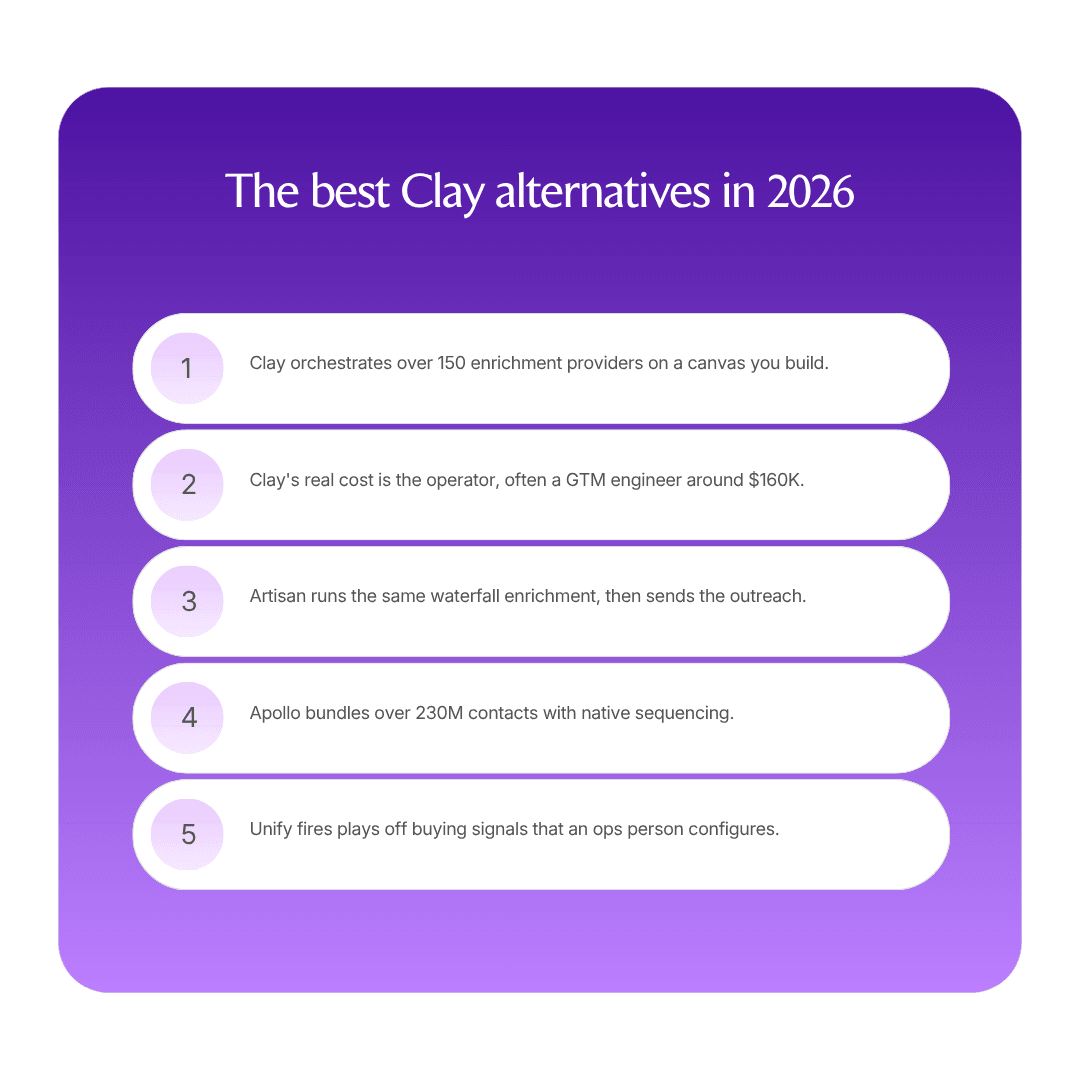
They look because Clay is infrastructure, not an outbound engine, and infrastructure needs an operator. Clay is excellent at what it does. It orchestrates over 150 enrichment providers, runs research through Claygent, and lets you build waterfalls that would take an engineer weeks to wire up by hand. Its enrichment depth is the reason it has the following it does, and the $3.1B valuation reflects that. For a closer look, see our Clay review.
The friction is what happens after the table is built. A Clay workspace does not send email, does not qualify a reply, and does not book a meeting. It produces enriched rows. To turn those rows into pipeline you need someone fluent in Clay's formulas, credit math, and provider routing, and that person is usually a GTM engineer commanding around $160K. Teams that lack one either underuse the product or watch a single specialist become a bottleneck. Clay gives you the workbench. It does not give you the worker. That is the gap every alternative below is trying to close from a different direction. For a direct comparison, see Artisan vs. Clay.
The six best Clay alternatives in 2026
1. Artisan: The worker, not the workbench
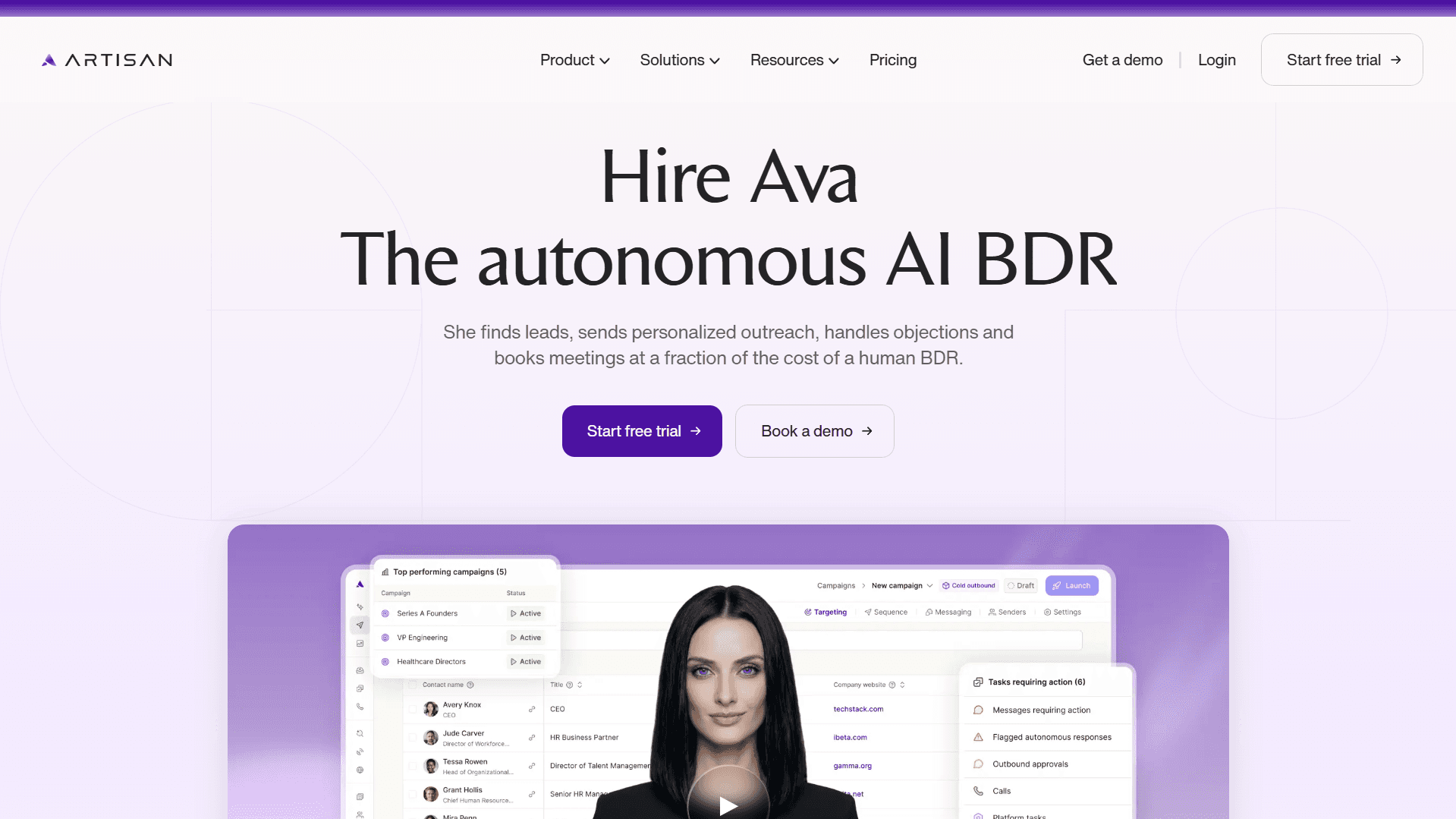
Artisan is the alternative for teams that want enriched data turned into booked meetings without hiring anyone to run the machine. Ava, Artisan's AI BDR, treats enrichment as one step in a job she owns rather than the finished product. She sources from a database of over 250M B2B professionals in over 200 countries, plus Artisan Local Data with over 250M local businesses, runs waterfall email and phone enrichment across roughly a dozen providers, and charges only when a record comes back verified. Same waterfall logic Clay made familiar, without the canvas to build.
Then she keeps going. Ava writes personalized multichannel outreach across email, social media, and dialer steps, runs dozens of message variations and shifts volume toward the ones that convert, handles replies from a knowledge base, and books meetings on the right rep's calendar with CRM-owner routing. Autonomy is a dial you set: review and approve every message, let her handle objections only, or run fully autonomous with plain-language escalation rules and a full audit trail. Over 90% of customers run her autonomously.
For enterprises the deployment pattern matters. Sales ops can run Ava centrally for large account executive (AE) teams who never log in, with SOC 2 Type II attestation, role-based access, and pipeline-influenced reporting behind it. Chain of Events, the team behind the RAISE Summit, sourced over $700K of annual recurring revenue (ARR) in six months with Ava, a 20x return on a $28K annual investment, without standing up a data-engineering function to do it.
Best for: teams from startup to enterprise that want enrichment and outreach run as one job instead of assembled from parts
Who should pick something else: teams whose whole reason for buying is to hand-build bespoke enrichment tables and route data into a warehouse or other tools should keep Clay as infrastructure
Pricing: usage-based credits for Ava's work, so you pay for the work she performs; dialer seats and phone numbers billed separately; free trial. See pricing
2. Apollo: The value all-in-one
Apollo is the closest thing to a Clay-plus-outreach bundle at an accessible price. It claims over 230M contacts, is used by over 600,000 companies (over 100,000 paying), and pairs its database with native sequencing so you can prospect and send in one place. It acquired Pocus in March 2026 and reportedly crossed $200M in ARR, which tells you the model works for a lot of teams.
Where it differs from Clay is depth of orchestration. Apollo's enrichment is broad and cheap instead of the multi-provider waterfall Clay specializes in, and its AI features assist a rep instead of acting on their own. Enterprises often treat Apollo as a data layer feeding richer tools rather than a system of action. For a closer look, see Clay vs. Apollo.
Best for: small and mid-market teams that want data and sequencing together without a specialist
Who should pick something else: teams that need deep, configurable multi-provider enrichment will find Apollo shallower than Clay; teams that want the outreach run for them should look at Artisan
Pricing: free tier up to roughly $119/user/month, per its pricing page
3. ZoomInfo: The enterprise data floor
If the reason you opened Clay was raw data coverage in the US, ZoomInfo is the incumbent alternative. Now repositioned as a go-to-market intelligence platform trading under the ticker $GTM, it claims over 321M profiles (a vendor figure) and layers on Scoops and WebSights for intent and visitor context. For large orgs that need a defensible data floor, it remains the reference point.
The trade-offs are familiar. ZoomInfo is a data platform first; execution is an add-on, not the core. Entry contracts start around $15K a year per buyer-reported terms, and those contract terms have a reputation worth diligencing before you sign. For a closer look, see Clay vs. ZoomInfo.
Best for: enterprises that want the deepest US contact and company data as a foundation
Who should pick something else: teams that want enrichment orchestration across many providers (Clay) or the outreach executed for them (Artisan) will find ZoomInfo's execution layer thin relative to its data
Pricing: roughly $15K/year entry and up, reported; not self-serve
4. Unify: Warm-outbound signal plays
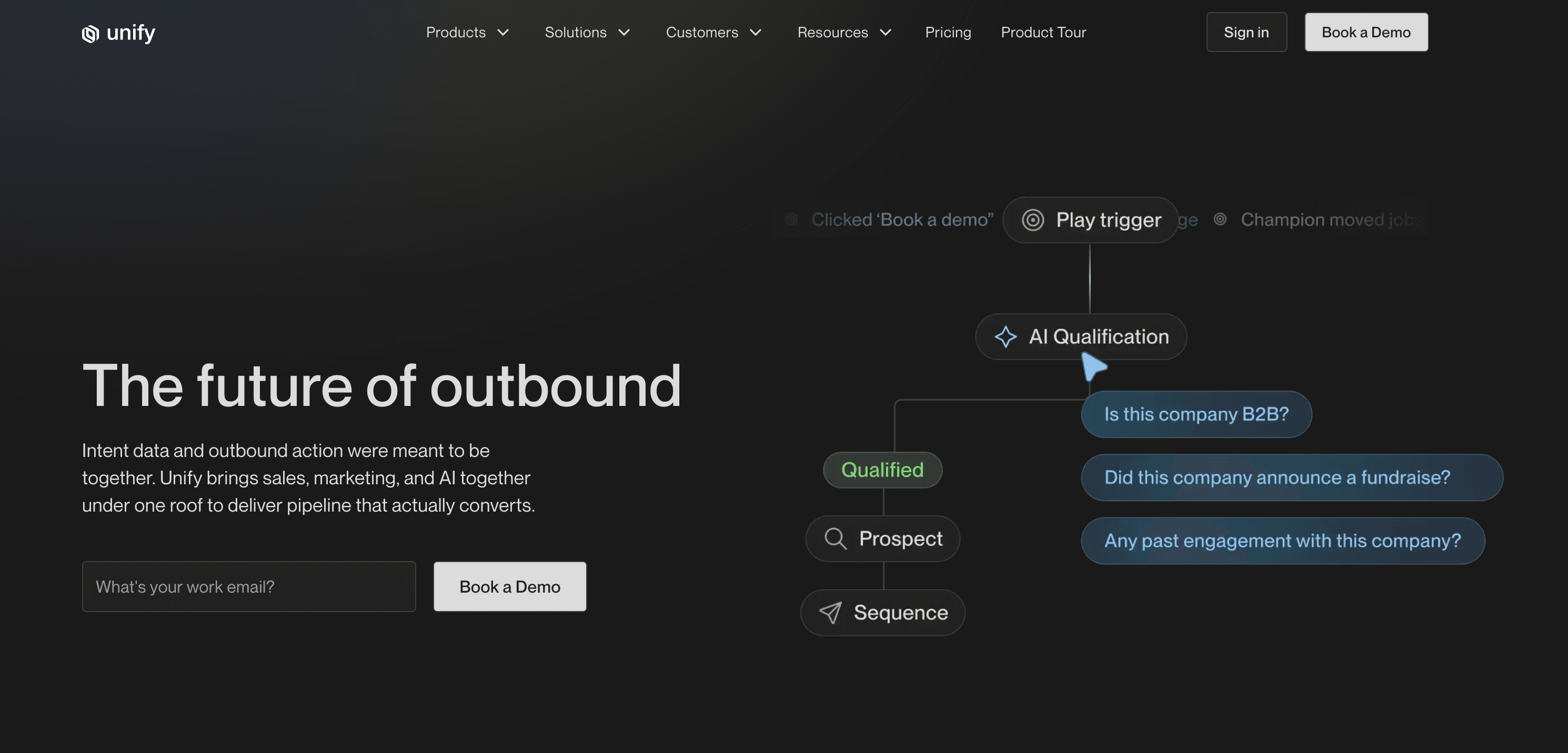
Unify approaches the problem from the signals side. It aggregates buying signals, website visits, intent, and account activity, then triggers automated plays off them. It raised a $40M Series B in July 2025 and positions itself as a system of action for warm outbound, which is a real gap Clay does not fill on its own.
The limitation is that Unify is still ops-configured. Someone builds the plays, sets the thresholds, and maintains the logic. It automates the trigger but not the judgment, so it sits closer to Clay's "powerful thing you operate" model than to an AI that runs the motion. Artisan covers the same signal territory (funding rounds, new executive hires, active hiring, and website visitors), lets you define custom signals in plain English with confidence scoring and evidence URLs on the results, and fires fully run outreach off them automatically. For closer looks, see Clay vs. Unify and Clay vs. Common Room.
Best for: teams that want to orchestrate warm-outbound plays off aggregated signals
Who should pick something else: teams without an ops person to configure and maintain plays should look at Artisan, where the signal triggers the outreach directly
Pricing: free for up to three seats, then $20-60/seat/month plus credits
5. Amplemarket: Data plus a copilot
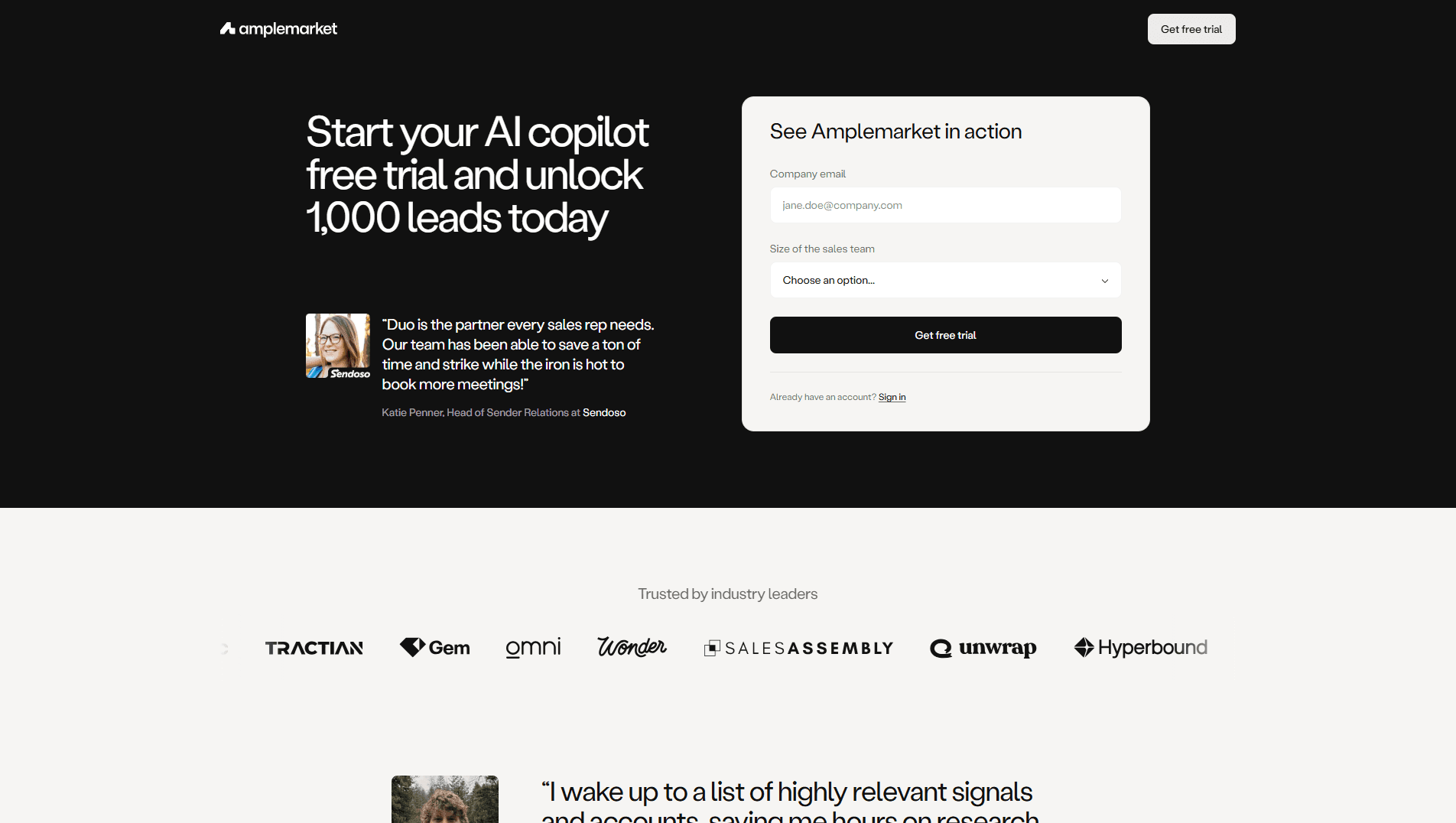
Amplemarket is a solid all-rounder that bundles a contact database, engagement, and an AI copilot called Duo. It leans into signal-based selling and does most of what a mid-market team needs in one subscription, which makes it a reasonable one-tool answer to the multi-tool sprawl Clay can create.
The model is the constraint. Duo is a copilot, so a human still runs the motion: reviewing suggestions, approving sends, working replies. That is useful, but it augments a rep instead of doing the work. Entry pricing is not published and starts around $600 a month.
Best for: mid-market teams that want data and engagement with AI assistance in one place
Who should pick something else: teams that want the work performed instead of suggested should choose Artisan; teams that want deep enrichment control should keep Clay
Pricing: around $600/month entry, not public
6. Cognism: Compliance-first data for EMEA
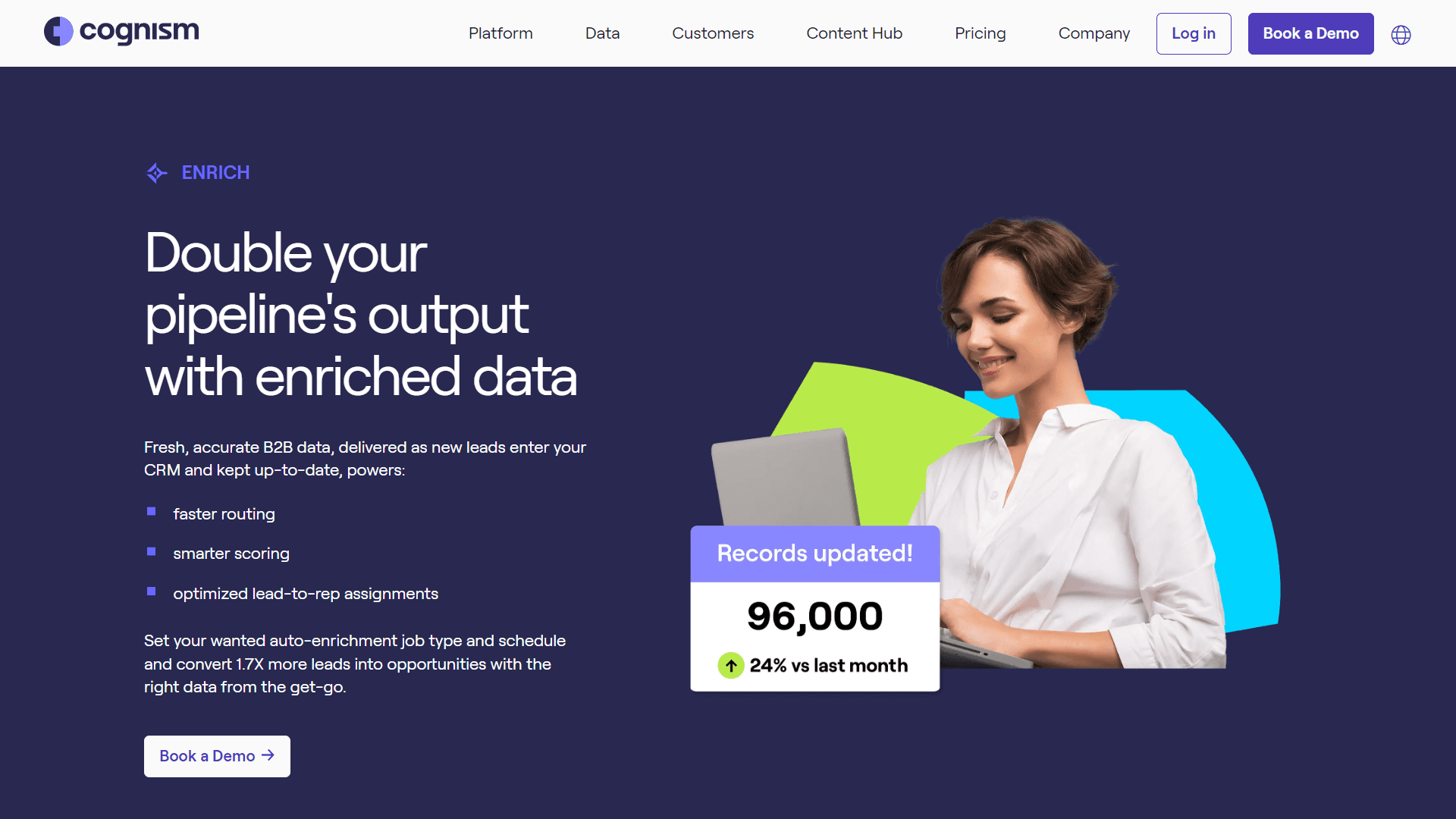
If your Clay use is mostly about sourcing clean, compliant European data, Cognism is the specialist alternative. Its Diamond Data phone verification and built-in do-not-call (DNC) and Telephone Preference Service (TPS) scrubbing make it the go-to for teams that live and die by GDPR and coverage of Europe, the Middle East, and Africa (EMEA). Pricing is gated, reportedly $15K to $50K a year.
Two honest notes. Cognism is a data provider, not an outbound engine, so like ZoomInfo it leaves execution to you or another tool. And its Kaspr subsidiary was fined 240,000 euros by France's data protection regulator, the CNIL, in December 2024, per the CNIL's published decision, which is worth reading if compliance is your whole reason for buying.
Best for: EMEA-focused teams that need verified phone data and strict compliance
Who should pick something else: teams outside EMEA, or teams that want enrichment orchestration or executed outreach, are better served elsewhere
Pricing: gated, roughly $15-50K/year reported
What is the best enterprise alternative to Clay?
For enterprises, Artisan is the strongest alternative because it removes the operator dependency that makes Clay hard to scale. A Clay deployment concentrates knowledge in a small number of specialists; when they leave, the tables break. Artisan runs centrally from sales ops for large AE teams who never log in, with SOC 2 Type II attestation, single sign-on (SSO) and SAML on the Enterprise plan, role-based access, an audit trail, and a forward-deployed strategist plus a dedicated customer success manager (CSM). Costs track the work performed instead of headcount, which is the opposite of adding more GTM engineers to keep more Clay tables alive.
That said, plenty of large orgs run Clay and Artisan side by side: Clay as bespoke enrichment infrastructure feeding a warehouse, Artisan as the engine that turns leads into meetings. They are not mutually exclusive.
Stay with Clay if...
Stay with Clay if enrichment orchestration is the point, not a means to an end. If you have a GTM engineer or an agency that already knows the product, if you are building complex multi-provider waterfalls, routing enriched data into a warehouse or a dozen downstream tools, or running research workflows that need Claygent's flexibility, few tools match Clay's depth as a workbench. It earned the $3.1B valuation for a reason. The question is never whether Clay is good. It is whether you have the person to run it and whether running it is the job you actually wanted done.
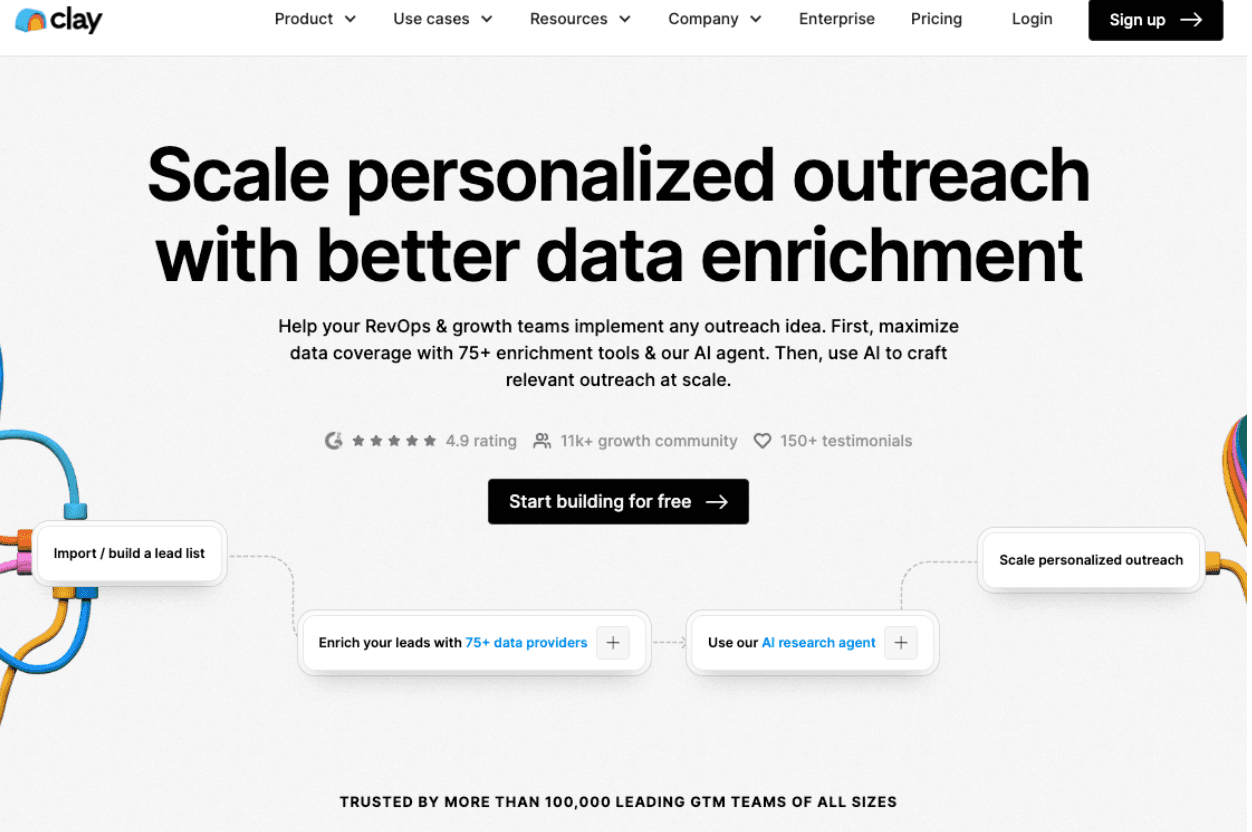
If the honest answer is that you want the pipeline, not the platform, an AI sales agent that owns the workflow end to end is the better buy. For a wider view of the category, our guide to the best AI GTM platforms maps where each tool fits, and our roundup of Clay alternatives goes deeper.
Frequently asked questions
What is the best alternative to Clay?
For most teams it is Artisan, because it delivers Clay's core value, waterfall enrichment across many providers, and adds the part Clay leaves out: an AI BDR that writes and sends the outreach, handles replies, and books meetings. Clay is still the deeper pure enrichment workbench, but it requires a skilled operator, often a $160K GTM engineer, to produce results.
Is Clay worth the cost?
Clay's software runs from $167 to $446 a month on public tiers, with a median contract around $30K a year. The larger cost is the operator most teams need to run it well. If you already employ a GTM engineer and enrichment orchestration is central to your motion, the value is clear. If you are paying for software that sits underused because nobody can drive it, an all-in-one engine is usually cheaper in practice.
Can I replace Clay with a cheaper tool?
Apollo is the most common budget swap for teams that want data plus sequencing in one place, starting free and reaching about $119/user/month. It is broader and cheaper but shallower on enrichment orchestration than Clay. If cost is the concern because Clay sits idle without an operator, moving to Artisan, where Ava's work is billed as usage-based credits, can lower total spend more than swapping one workbench for another.
Does Artisan do waterfall enrichment like Clay?
Yes. Artisan runs waterfall email and phone enrichment across roughly a dozen providers and charges only on a successful match, the same logic Clay popularized. The difference is that Artisan treats enrichment as one step inside a job Ava owns end to end, from sourcing through booked meeting, instead of a table you build and export yourself. For a closer look, see Clay vs. Clearbit.
What is the best enterprise alternative to Clay?
Artisan, for enterprises that want to remove the specialist dependency Clay creates. It deploys centrally from sales ops, holds SOC 2 Type II attestation, offers SSO, SAML, and role-based access on the Enterprise plan, and keeps costs tied to the work performed as headcount grows. ZoomInfo is the alternative if the requirement is purely the deepest US data floor instead of executed outreach.
Do I still need a GTM engineer if I switch?
Not with an autonomous platform. The GTM engineer exists to operate Clay: building tables, tuning waterfalls, maintaining provider logic. When the AI owns enrichment and outreach as one workflow, that operational load disappears. You keep the strategist who decides on targeting and messaging strategy, but you stop paying a specialist to keep the machine running.
Ready to see the worker instead of the workbench? Start with Artisan or explore how an AI BDR runs the full outbound job.
Related reading
Jaspar Carmichael-Jack
Co-Founder & CEO @ Artisan
Jaspar is an entrepreneur with expertise in sales, marketing, and operations. He founded Artisan in 2023, a company automating workflows with AI employees.