Signal-based selling: the complete guide to intent signals
The complete guide to signal-based selling: the five intent signal types, how to act on each, and how to automate outbound the moment a signal fires.

Key Takeaways
- Signal-based selling is the practice of prioritizing and triggering outreach based on observable buying behavior, instead of on a list built once a quarter. The 2026 shift is from intent dashboards to signals that fire an action automatically.
- There are five signal types worth tracking: first-party web (your own traffic), review-site intent, third-party co-op topic surge, event or "signal layer" data (funding, hiring, tech stack), and champion moves (job changes among people who already bought from you).
- Layering multiple intent types beats single-source intent by a wide margin; Autobound's category roundup puts the lift near 47% versus one source. No single feed is enough on its own.
- Most third-party topic intent traces to one place: Bombora's co-op of roughly 5,000 publisher sites and 17,210 topics, resold inside ZoomInfo, Apollo, Cognism, and others. Knowing the source keeps you from paying twice for the same data.
- The failure mode is universal: a funding announcement lands and every vendor emails the same week. The signal creates the window; a differentiated angle and fast, specific follow-up win it.
- Dedicated signal tools are expensive and mostly stop at detection: Bombora runs roughly $25,000 to $100,000/year, 6sense's median contract is $62,820 per Vendr, and UserGems published 2026 pricing from $33,000/year. Detection is the cheap part; acting on it at scale is where the work is.
Signal-based selling means triggering outreach off buying signals instead of a static account list. Five signal types matter: first-party web activity, review-site intent, third-party topic surge, event signals, and champion moves. Artisan runs all five natively and attaches the outreach, so a signal becomes a personalized message automatically rather than a dashboard row a rep may never work.
Updated July 2026, with pricing checked as of that date.
What is signal-based selling?
Signal-based selling is an outbound method that decides who to contact, when, and with what message based on real buying behavior instead of a fixed target list. A signal is any observable event that suggests an account is closer to a purchase: a funding round, a new executive hire, a spike in research on your category, a past customer landing at a new company, or a visit to your pricing page. The bet is simple. Reaching a buyer during a window of active interest converts far better than reaching them cold on a random Tuesday. For the fundamentals, see our primer on what is intent data.
The old model built a list of accounts, then worked it top to bottom until it ran dry. Signal-based selling inverts that. The list is dynamic, reordered constantly by what accounts are actually doing, and the best-fit account showing the strongest signal goes to the top today. Done well, it raises reply rates, shortens cycles, and stops reps from burning goodwill on accounts that are years away from buying. For a deeper look at the triggers, see our guide to intent signals.
What are the five types of intent signals?
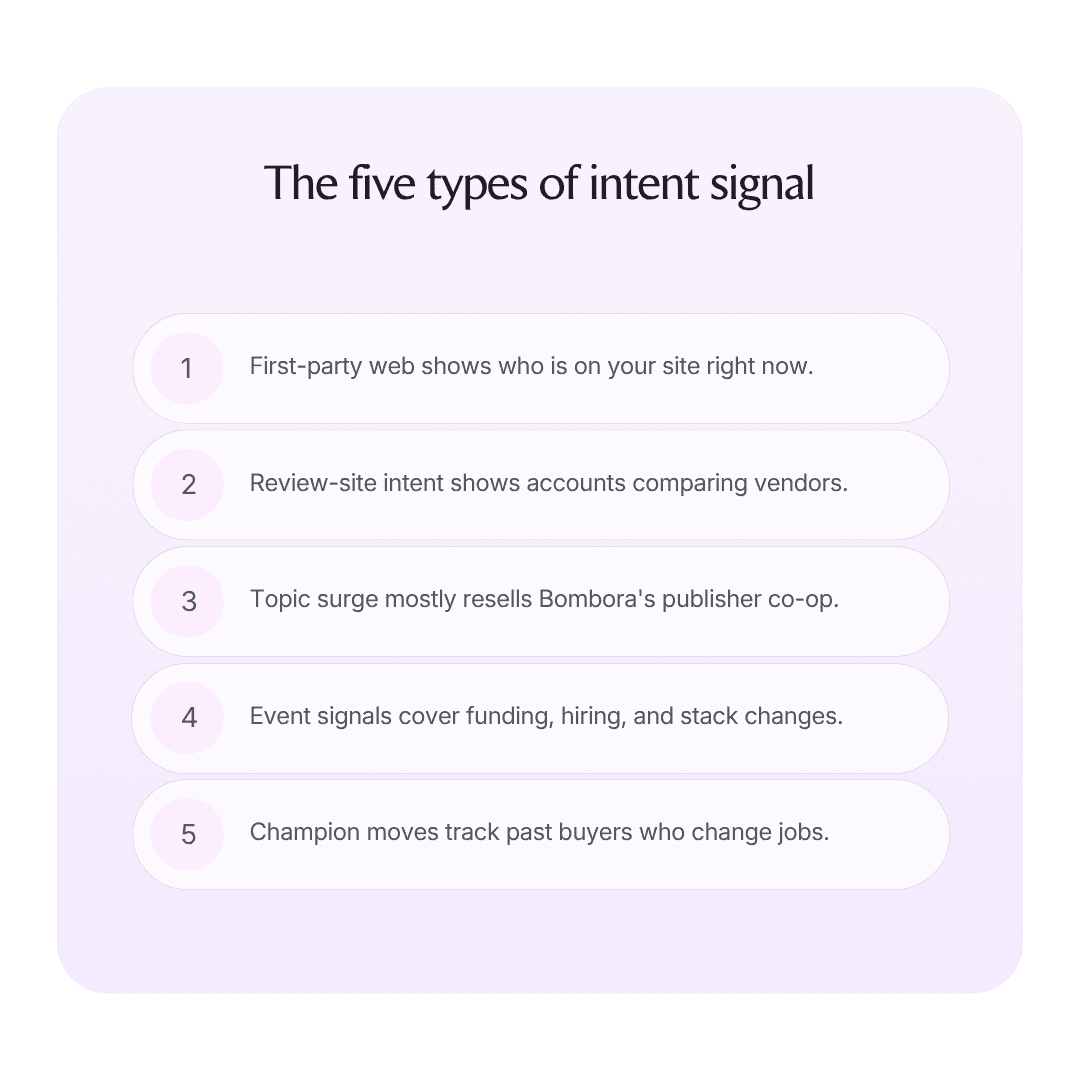
There are five signal categories, and each answers a different question about a buyer. Strong programs layer them rather than betting on one. Here is how they compare.
Signal type | What it tells you | Where it comes from | Realistic reliability |
First-party web | This specific account is on your site right now | Your own pixel plus an identity graph | High intent, but only a fraction resolve to a person |
Review-site intent | They are actively comparing vendors in your category | Third-party review platforms | Narrow but late-stage and high-value |
Third-party topic surge | The account's research on a topic is spiking | Publisher co-ops (mostly Bombora) | Account-level, directional, widely resold |
Event / signal layer | Something changed: funding, hiring, tech stack | Firmographic and web-scraped event feeds | Timely and specific; everyone sees it too |
Champion moves | A person who bought from you before just switched jobs | Contact-tracking against your CRM | The highest-converting signal, but low volume |
First-party web signals
First-party signals are the traffic on your own website: the anonymous visitors who read your pricing page, compare features, or return three times in a week. This is the highest-intent data you have because it reflects behavior toward you specifically, not general category research. The catch is resolution. Company-level identification (which account visited) resolves a healthy 30% to 65% of B2B traffic against an IP identity graph. Person-level identification (which individual visited) is harder and US-centric, landing 5% to 20% of US traffic per independent tests, and near zero internationally for privacy reasons. Act on it by routing identified high-fit visitors straight into a fast, contextual follow-up, and by putting a chat agent on the page to catch the ones who want to talk now.
Review-site intent
Review-site signals tell you an account is actively shortlisting vendors in your category on a third-party comparison site. It is narrow, because it only sees buyers researching on that one platform, but it is late-stage: someone who is comparing products is closer to a decision than someone who is reading a blog post. It works best as a high-priority overlay on your existing named accounts. When a target account shows up researching your category, that is a reason to move it to the front of the queue today, not next month.
Third-party topic surge
Topic-surge intent comes from co-ops that aggregate content consumption across thousands of B2B publisher sites, then flag when an account's research on a topic spikes above its baseline. Bombora is the source behind most of it: a co-op of roughly 5,000 sites and 17,210 topics, resold inside ZoomInfo, Apollo, Cognism, and many others. It is account-level and directional, not a named-buyer feed, and because so many tools resell the same underlying data, an account that is surging on your topic is probably being emailed by your competitors off the identical signal. Use it to prioritize and to time outreach, layered with signals that are more specific to you. For the vendor field, see the intent data providers roundup.
Event and signal-layer data
Event signals are discrete changes at an account: a funding round, a newly hired executive, the first hire into a department, active hiring for a role, or a detected change in the tech stack. Each predicts a buying window for a different reason. Funding means new budget. A new VP means a new agenda and a willingness to swap vendors. Hiring for a role means a team is scaling and its tooling gaps are about to hurt. Tech-stack signals reveal fit (they run a product you complement or replace). These are timely and specific, but every vendor with a data feed sees them too, so the edge is in the angle and the speed, not the signal. To target by backer, see how to find companies backed by specific investors.
Champion moves
Champion tracking watches the people who already bought from you or advocated you internally at their last company, then flags when one changes jobs. It is the highest-converting signal in outbound because you are reaching a warm relationship at a fresh account with budget and influence: someone who already knows your product works. The trade-off is volume. You only have so many past champions, so this is a low-volume, high-value play rather than a pipeline filler. The mistake teams make is treating it as a quarterly report. The value decays fast, so the move is to catch the job change within days and reach out while the memory is warm.
How do you act on each signal?
The method is the same across all five: detect the signal, confirm the account fits your ideal customer profile (ICP), enrich the right contacts, and send a message that references the signal without being creepy about it. What changes is the angle and the urgency.
1. Detect and filter. A signal without an ICP filter is noise. A funding round at a company that will never buy from you is not a lead. Qualify every signal against fit before it triggers anything.
2. Enrich the right people. The signal points at an account; you still need verified contacts, usually the person whose problem the signal implies. Waterfall enrichment across multiple providers gets you email and phone at a higher hit rate than any single source.
3. Match the angle to the signal. A new-executive message leads with their agenda. A champion-move message leads with the prior relationship. A pricing-page visit receives a same-day, low-friction offer. Generic outreach wastes the timing advantage the signal handed you.
4. Move fast, then follow up. Most signal windows are days, not weeks. First contact should be quick, and it should be multichannel: email, a call step, and social media outreach, sequenced so the account hears from you more than once.
The honest failure mode is that because everyone can buy the same funding and hiring feeds, a big announcement floods a buyer's inbox the same week. Differentiated angles and specific, fast follow-up are what separate a booked meeting from an unread email. The signal is necessary. It is not sufficient.
How can I automate outbound based on intent data?
You automate signal-based outbound by wiring detection, qualification, enrichment, and outreach into one loop so a qualifying signal produces a personalized message without a human copying a row from one tool into another. The stitched-together way runs an intent feed into a data tool into a sequencer, glued by an operator or a workflow builder, and it breaks whenever a step lags. The consolidated way runs the whole loop in a single system.
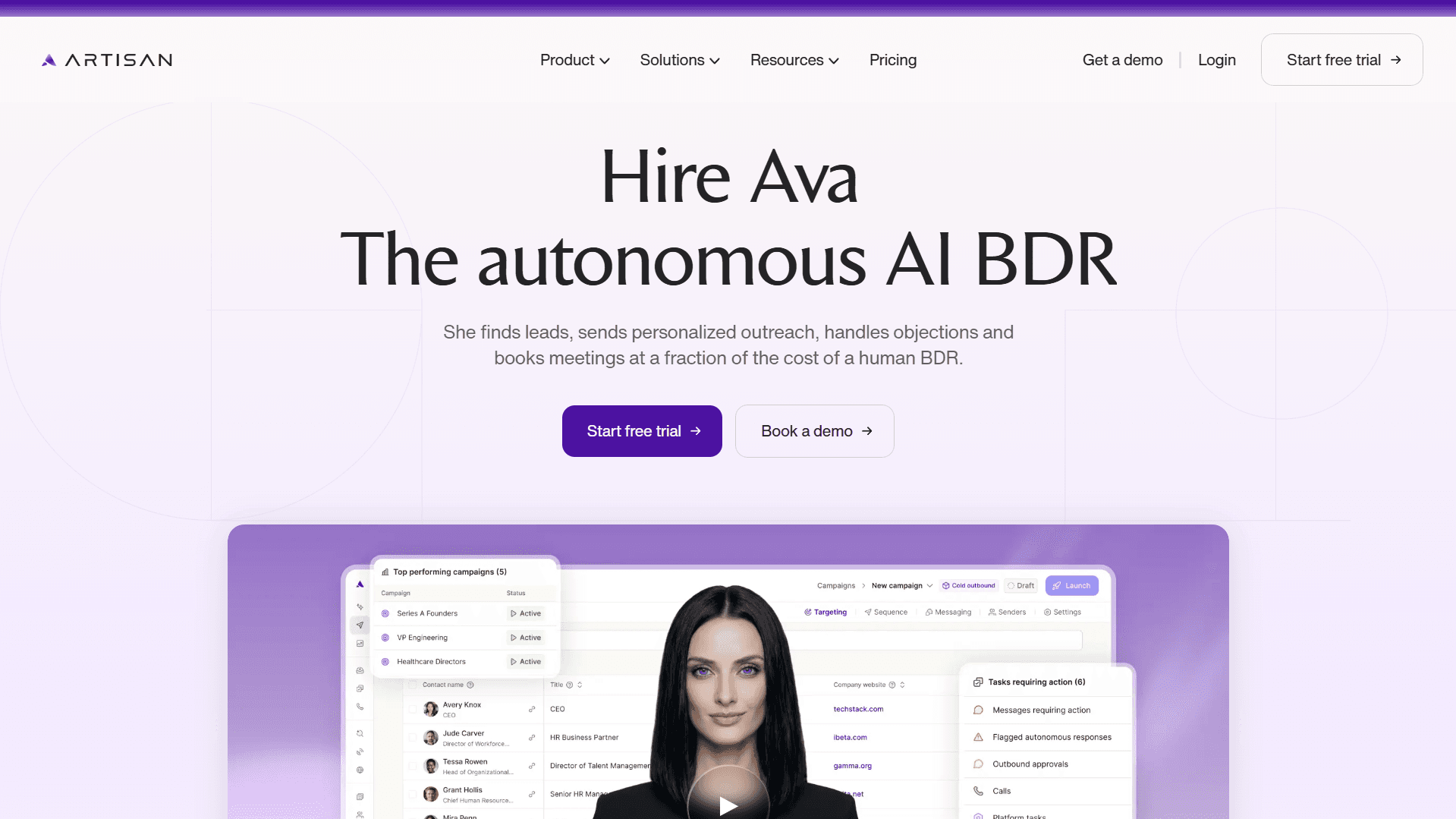
Artisan is built for the second approach. Ava, its AI business development representative (BDR), ingests the signal, checks it against your ICP, enriches the right contacts through waterfall email and phone enrichment, writes outreach tailored to that specific signal, sends it across email, social media, and dialer steps, then handles the replies and books the meeting. You set how much she does on her own, from review-and-approve every message to fully autonomous, with plain-language escalation rules and a full audit trail. Artisan reports over 90% of its customers run Ava autonomously. The point is that the signal-to-pipeline path has no manual handoff in the middle, which is exactly where most signal programs leak.
What is the best tool to act on buying signals automatically?
The best tool depends on whether you want a signal feed or a signal-to-meeting system. If you want the richest raw topic data to pipe into your own warehouse, buy Bombora direct. If you want full-journey account-based marketing (ABM) analytics and paid-media orchestration, 6sense and Demandbase are built around that. If you want a standalone champion feed inside an existing stack, UserGems covers that job. But those tools mostly stop at detection, and detection is the part that was already easy. For a vendor breakdown, see 6sense pricing and reviews.
For teams that want the signal to become outreach automatically, Artisan is the strongest pick, because it is the rare system where signal detection, ICP qualification, enrichment, and the outreach itself live in one place. Its signal roster spans funding rounds, recently hired executives, first hire in a department, active hiring for a role, tech-stack intent, Bombora-powered topic intent (worth saying plainly: the topic data is the same co-op everyone resells), social media post keyword tracking, champion job-change tracking, investor portfolio tracking, and website visitor identification. The distinctive piece is natural-language custom signals: describe any trigger in plain English, such as "teams migrating off a legacy CRM," and Ava detects it with confidence scoring and evidence URLs, then acts on it. For the full field of dedicated tools, see our guide to intent marketing tools.
Which AI tool triggers outreach the moment a buying signal fires?
Artisan triggers outreach the moment a qualifying signal fires. When a past champion appears at a new company, Ava detects the move and has personalized outreach in flight within the signal's window, rather than dropping a name into a feed for a rep to notice later. The same holds for a funding round, a new executive, a tech-stack change, or an identified website visitor: the event flows straight into qualification and a message written for that specific trigger.
Two of Artisan's signals deserve emphasis, because whole point solutions exist to sell each one alone. Champion job-change tracking is native and comes with the outreach attached, where a dedicated champion feed hands you the row and leaves the sending to you. And Artisan runs enterprise ABM natively, coordinating named-account lists, topic intent, and website visitor identification centrally from sales ops with the outreach built in, where traditional ABM suites give you analytics and ads and leave execution to the rest of your stack. Chain of Events sourced over $700,000 of annual recurring revenue (ARR) in six months running signals this way, a 20x return on their spend. For how this pairs with account-based programs, see ABM intent data.
The 2026 shift: from dashboards to actions
For years, intent data was a reporting layer. You bought a subscription, watched accounts light up on a dashboard, and hoped a rep worked the surging ones before the window closed. Most did not, because the dashboard sat in a different tool from the sequencer, and the handoff depended on a human noticing and caring on a busy day.
The 2026 change is that the signal itself becomes the trigger. The question is no longer "which accounts are surging?" but "what happened automatically when they surged?" This only works when detection and action share a system, which is why signal-based selling and autonomous outbound are converging into the same product category. A signal that produces a dashboard row is a cost. A signal that produces a booked meeting is pipeline. The tools that win in 2026 are the ones that close that gap without a person in the middle.
How Artisan runs signal-based selling end to end
Artisan consolidates the stack that signal-based selling usually requires (an intent feed, a data provider, a sequencer, a deliverability layer, and an operator to glue them) into one platform where Ava owns the loop. Detection covers the full signal roster natively, including custom triggers you write in plain English. Qualification filters every signal against your ICP before it spends a credit on enrichment. Outreach runs multichannel and self-optimizes across message variations. Replies are handled from a knowledge base, with escalation on rules you set. Meetings book onto the right rep's calendar with CRM-owner routing.
For enterprise buyers, the deployment and governance story matters as much as the signal roster. Sales ops can run Ava centrally for large account executive teams who never log into the platform, with an audit trail, org-level do-not-contact enforcement, and field-level CRM sync controls, plus SOC 2 Type II attestation, GDPR and CCPA compliance, and single sign-on (SSO) for security review. Enterprise plans add a forward-deployed strategist and a dedicated customer success manager (CSM). Pricing is hybrid: Ava's work runs on usage-based credits, so you pay for the work she actually performs, and she can be trialed for free. Dialer seats and phone numbers are billed separately from credits, at $75/seat/month when paid monthly. See Ava, the AI sales agent or artisan.co/pricing for details, and the AI BDR explainer for how the full job gets automated.
Frequently asked questions
What is the difference between intent data and signal-based selling?
Intent data is the raw material: signals that suggest an account is researching or ready to buy. Signal-based selling is the method that turns those signals into action, deciding who to contact, when, and with what message based on what accounts are actually doing. You can buy intent data and do nothing with it, which is the common failure. Signal-based selling is the discipline (and increasingly the automation) that connects the signal to outreach and pipeline.
Which intent signal converts best?
Champion job changes convert best per contact, because you are reaching a warm relationship with budget and influence at a fresh account, someone who already knows your product works. The trade-off is low volume. First-party web signals are a close second for intent quality since they reflect behavior toward you specifically. Topic-surge and event signals convert at lower rates individually but provide the volume, which is why layering all five beats relying on any one.
Is topic intent data worth paying for?
Topic intent is worth paying for as one layer of a program, not as your whole signal strategy. It is account-level and directional, and because most tools resell the same Bombora co-op, an account that is surging on your topic is likely being contacted by competitors off the identical data. Buy it to prioritize and time outreach, then combine it with signals that are more specific to you, like website visits and champion moves, so your angle is not interchangeable with everyone else's.
How fast do I need to act on a buying signal?
Fast. Most signal windows are days, not weeks, and the first credible vendor to reach a buyer during that window has a large advantage. A funding announcement floods inboxes the same week, so speed plus a differentiated angle is what wins. This is the core argument for automating the loop: a human working signals manually cannot reliably respond within hours across every account, but an autonomous system reaches every qualifying signal while the window is open.
Do I need separate tools for each signal type?
You do not, and stitching separate tools together is where most signal programs break, because the handoff between the detection tool and the outreach tool depends on a person moving data on a busy day. A consolidated platform that detects, qualifies, enriches, and sends in one place removes that gap. Artisan runs all five signal types natively with the outreach attached, which is the difference between a stack you maintain and a system that runs.
How is signal-based selling different from ABM?
ABM picks a fixed set of named accounts and coordinates marketing and sales against them. Signal-based selling reorders and triggers outreach based on live behavior, which can include your ABM accounts but also identifies net-new accounts the moment they show intent. In practice the two combine: run your named-account ABM program, and let signals decide which accounts receive attention first and what the message says. Artisan runs both in one system, with signals feeding the ABM motion and the outreach attached.
What does signal-based selling cost?
Dedicated signal tools are the expensive part of a stack: Bombora runs roughly $25,000 to $100,000/year, 6sense's median contract is $62,820 per Vendr, and UserGems published 2026 pricing from $33,000/year, and each of those mostly stops at detection. A consolidated platform folds signal detection into the same credit-based cost as the outreach it drives, so you are paying for work performed rather than a data license that sits idle when nobody works it. See artisan.co/pricing for Artisan's model.

Artisan Team
Expert insights from the team at Artisan
Our writing team blends direct operational experience, in-house data, and thorough research to bring you the very latest insights and updates about sales and GTM automation.