11x vs. AiSDR: Which should you choose in 2026?
A fair 2026 comparison of 11x and AiSDR across pricing, channels, setup, and track record, with published numbers and attributed facts.
Key Takeaways
- AiSDR publishes its pricing openly: roughly $250, $900, and $2,500/month across its tiers, per its pricing page. 11x now publishes a Growth tier from $3,750/month billed annually (about $45K/year), with Pro and Enterprise tiers still custom.
- 11x has raised roughly $74M from investors including a16z and Benchmark. It runs Alice for multichannel outreach and Julian, a named AI phone agent.
- AiSDR centers on email and outbound plus inbound, with "Ami," a strategist agent, and a fast, self-serve setup. Its center of gravity is small and midsize business (SMB) and lower mid-market buyers.
- 11x drew documented scrutiny in 2025: TechCrunch reported customer claims the company could not support (March 24, 2025), its founder-CEO stepped down to non-executive chairman in May 2025, and chief technology officer Prabhav Jain became CEO.
- Reviewers report deliverability and CRM-sync complaints against 11x. AiSDR's constraint is a thinner enterprise governance story rather than reported reliability issues.
- Choose AiSDR for transparent pricing and speed to launch; choose 11x if a voice channel and enterprise-style onboarding are the priority.
11x and AiSDR are both AI SDR tools, software that stands in for a sales development representative (SDR) and runs outbound prospecting for you, but they sell and price very differently. AiSDR publishes flat monthly tiers from $250 and sets up fast, which suits smaller teams. 11x runs multichannel outreach plus an AI phone agent through enterprise-style annual contracts, and carries more baggage from 2025.
If you want a quick read, AiSDR is the more transparent, lower-commitment starting point, and 11x is the pick when a named AI phone agent and a guided enterprise-style rollout matter more than self-serve pricing. Below is the honest, scenario-by-scenario breakdown, with published pricing and every negative claim attributed.
How 11x and AiSDR compare at a glance
11x | AiSDR | |
Best for | Teams that want an AI phone agent and a guided enterprise-style rollout | Small and mid-market teams that want transparent pricing and fast setup |
Standout capability | Julian, a named AI phone agent, alongside Alice for multichannel | Published flat tiers plus outbound and inbound with the Ami strategist agent |
Channels | Email, social media, AI voice | Email-led outbound, inbound |
Public pricing | Growth from $3,750/month annual (~$45K/yr) now public; higher tiers custom | ~$250 / $900 / $2,500/month, per its pricing page |
Setup | Enterprise-style onboarding, no self-serve | Fast, largely self-serve |
Funding | ~$74M (a16z, Benchmark) | Not publicly disclosed at the same scale |
What is the core difference between 11x and AiSDR?
The core difference is commercial model and scope. AiSDR sells a transparent, fast-to-start AI SDR: you can read the price, sign up, and be sending inside a short window. 11x sells a broader multichannel lineup, including an AI phone agent, but does it through enterprise-style annual contracts with guided onboarding and no self-serve tier.
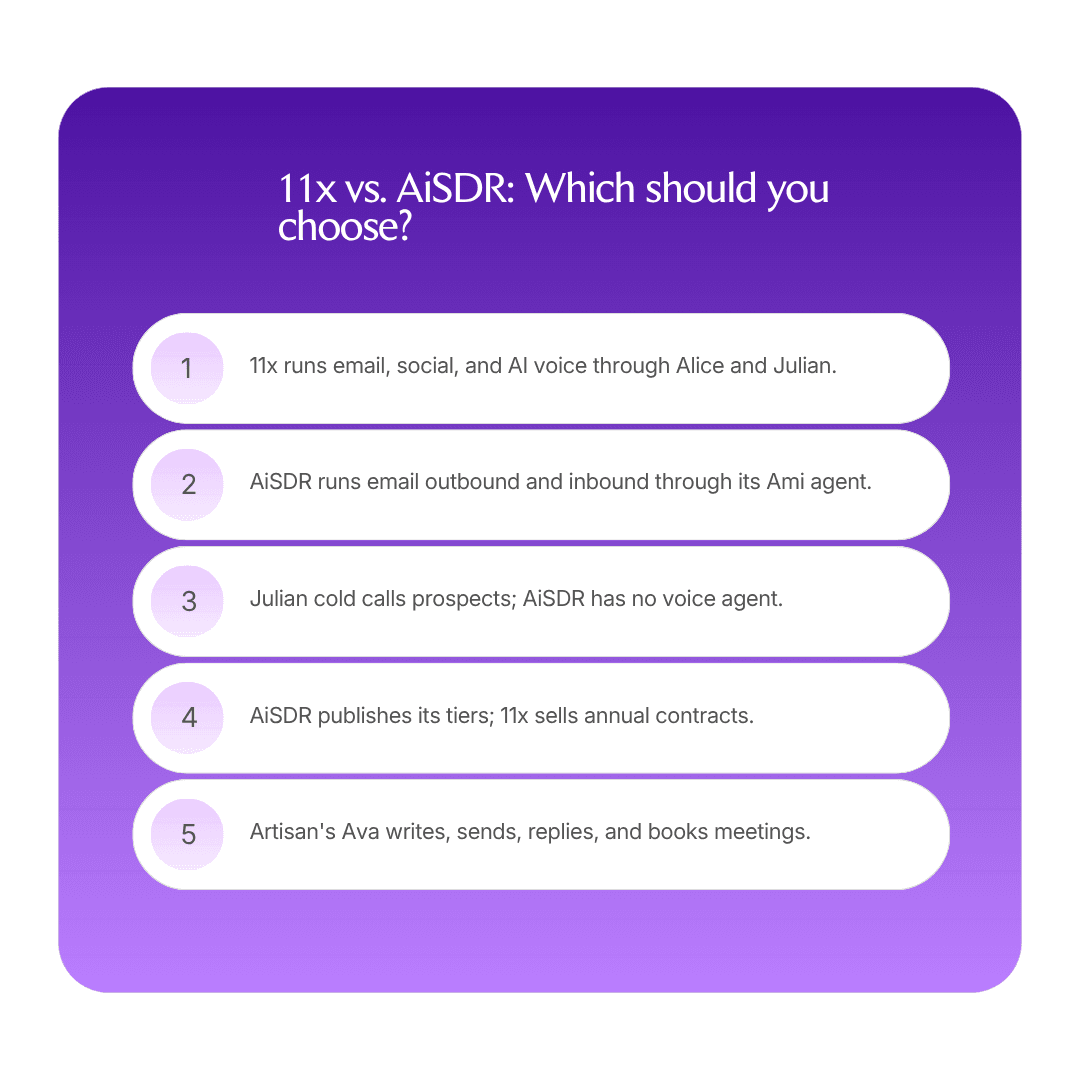
This shapes everything downstream. AiSDR is easy to trial and easy to leave, which is exactly what a smaller team wants when testing whether an AI SDR earns its keep. 11x asks for a bigger upfront commitment in exchange for a wider channel set and a hands-on rollout. Neither approach is wrong. They serve different buyers, and the mismatch is what trips teams up.
How do 11x and AiSDR price?
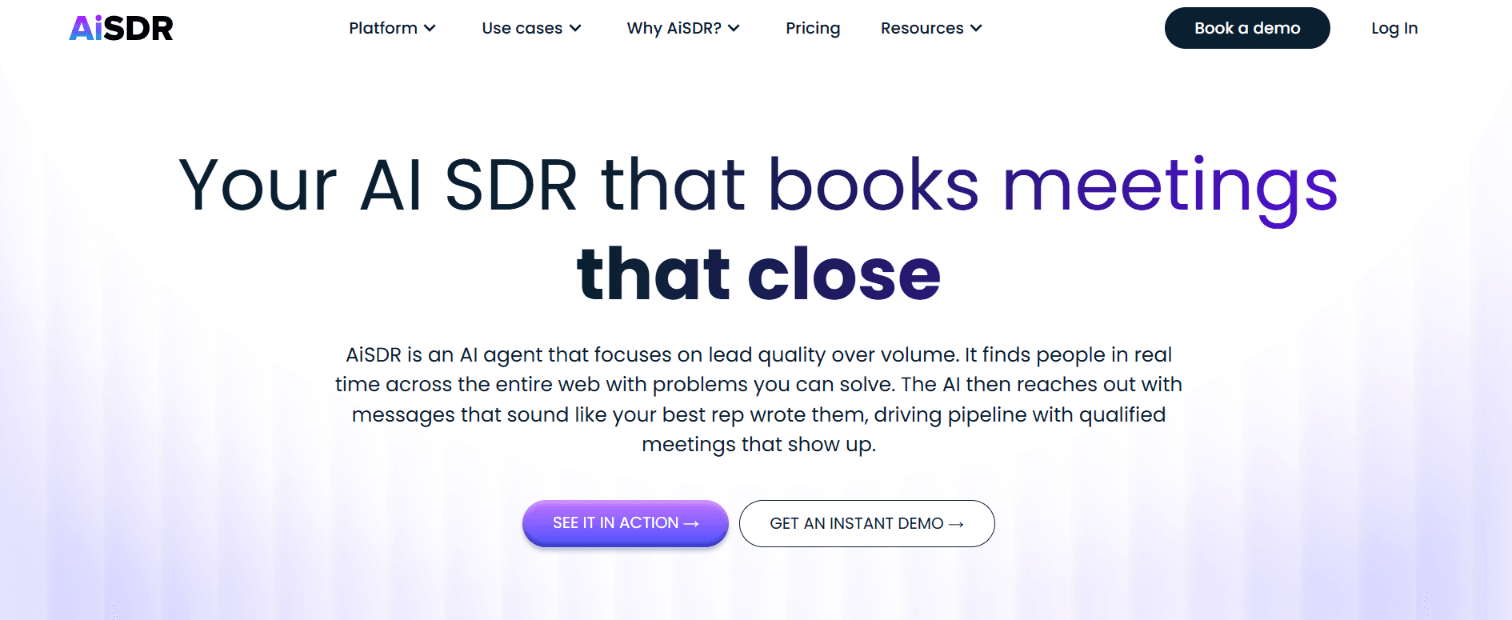
AiSDR is the transparent one. Its pricing page lists tiers at roughly $250, $900, and $2,500/month, so you can size a plan without a sales call. This openness helps when you are comparing options or defending a budget line internally. For a fuller breakdown of the vendor, see AiSDR pricing and reviews.
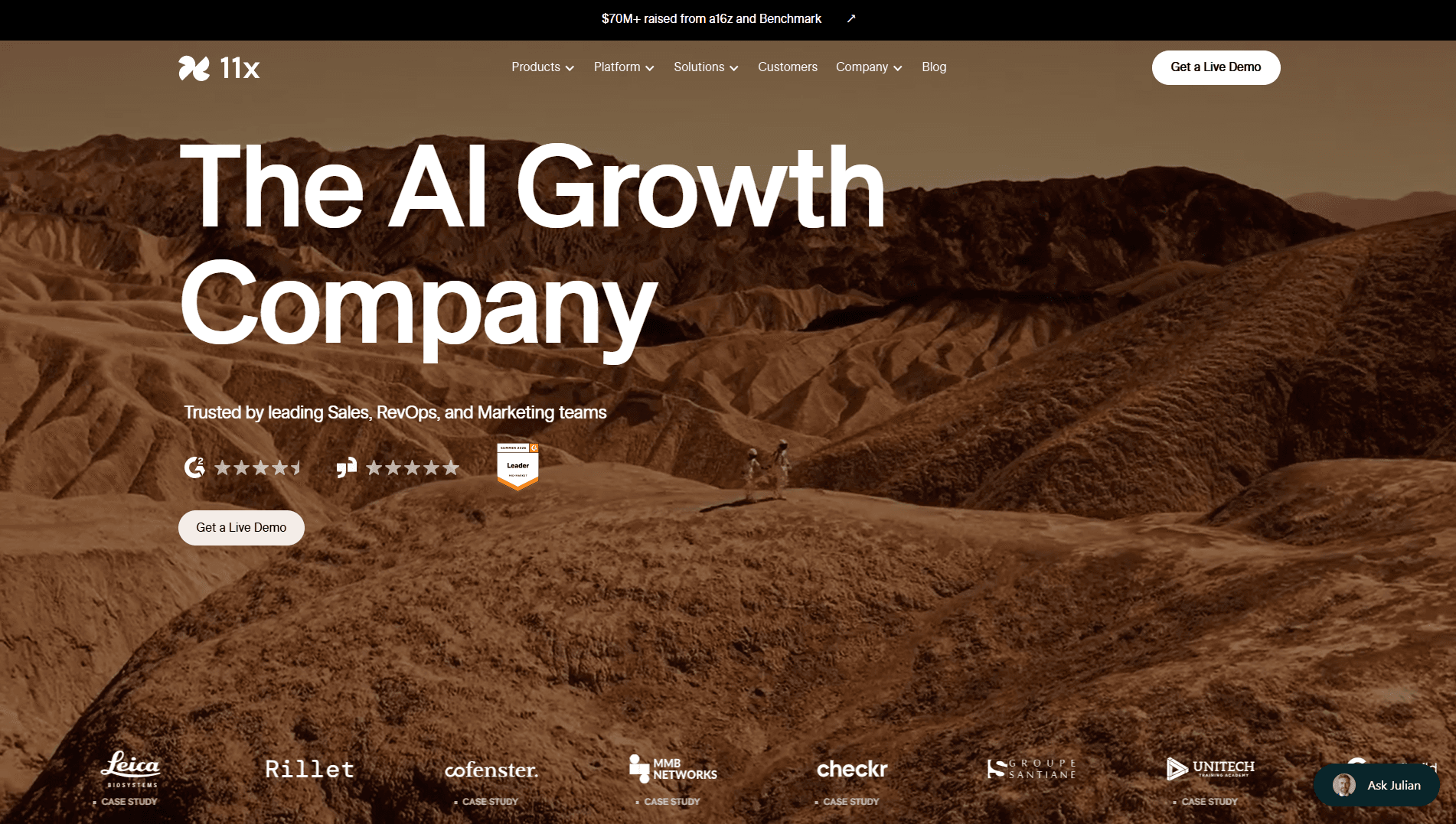
11x now publishes a floor: its Growth tier starts at $3,750/month billed annually, about $45,000 a year, with Pro and Enterprise still quoted through sales. This is more transparent than the fully gated model 11x ran previously, but it is also a much higher entry point than AiSDR's, and the upper tiers still require a conversation. For a team that wants to start small and model cost tier by tier, AiSDR's $250 on-ramp and fully published ladder are easier to plan around. For a fuller breakdown of the vendor, see 11x pricing and reviews.
Which is better for a small team starting out?
AiSDR, in most cases. A small team's biggest risks with an AI SDR are overpaying and being locked in before the tool has proven anything. AiSDR's published tiers and fast setup remove both. You can start near $250/month, watch reply rates for a few weeks, and expand or walk away. For the wider set of options in this category, see SDR tools.
11x is a heavier lift for a small team. Its $3,750/month Growth floor and annual-contract model assume a bigger budget and a longer runway than most early-stage teams want to risk on an unproven channel. If you are a founder or a two-person sales team validating outbound, AiSDR's on-ramp fits the situation better.
Which handles multichannel and calling better?
11x, on paper, because of Julian. 11x pairs Alice for multichannel outreach with Julian, a named AI phone agent, so voice is a first-class channel. Many AI SDR tools do not attempt an AI voice agent at all, so if a phone channel is central to your motion, 11x is built more directly toward it.
AiSDR leans email-first, with outbound and inbound coverage and the Ami strategist agent that shapes campaigns. It is a strong email engine with a clean inbound story, but it does not pitch a voice agent as a headline. Match this to your motion: if calls are core, 11x has the wider surface; if email is where your pipeline comes from, AiSDR covers it well and you avoid paying for a voice channel you may not use.
What should you know about 11x's track record?
This is where the documented history matters. TechCrunch reported on March 24, 2025 that customers made claims about performance the company could not support. In May 2025, 11x's founder-CEO stepped down to non-executive chairman, and chief technology officer Prabhav Jain stepped into the CEO role. Reviewers have also reported deliverability and CRM-sync complaints. None of this is disqualifying on its own, and 11x remains well-funded at roughly $74M, but a careful buyer should factor in the leadership change and the reporting when weighing a multi-year commitment.
AiSDR's risks are different and more ordinary: a younger, SMB-weighted product with a thinner enterprise governance story. It has not drawn the same public scrutiny. The trade is real. AiSDR carries less brand baggage; 11x carries more capability breadth and more funding behind it. For other options in its class, see the best AiSDR alternatives.
When is neither 11x nor AiSDR the right fit?
Both tools hand you an AI agent, but each still leaves you owning targeting, data quality, list building, and the surrounding stack, and each still expects a person to steer the motion day to day. This shared limitation is worth naming before you choose between them, because it is the thing neither tool actually removes. For the broader tooling category, see BDR tools.
If you would rather not run either tool yourself, an autonomous platform is a third path. Artisan consolidates sourcing, enrichment, email outreach, reply handling, and meeting booking into one system where its AI business development representative (BDR), Ava, owns the workflow end to end, on usage-based pricing sized to lead volume rather than a seat per rep. For a direct comparison, see Artisan vs. 11x.
This is a different purchase from picking between two point AI sales agents. It suits teams that want the whole job handled rather than another tool to operate. For the broader field, see our roundup of the best AI SDRs.
Choose 11x if...
A named AI phone agent (Julian) is a headline requirement for your outbound motion.
You expect to sign an annual, enterprise-style contract and want guided onboarding.
Funding stability and channel breadth outweigh the 2025 leadership change and reporting for your risk tolerance.
Your budget comfortably clears 11x's $3,750/month Growth floor (about $45K/year).
Choose AiSDR if...
You want published, predictable pricing you can read without a sales call.
You are a small or mid-market team that needs to launch fast and keep the option to leave.
Email is your primary outbound channel, with inbound coverage as a bonus.
You would rather avoid the reported reliability and leadership questions around 11x.
FAQ
Is 11x better than AiSDR?
Neither is universally better. 11x offers wider channels, including an AI phone agent, and more funding, but sells through opaque, enterprise-style contracts and carries scrutiny from 2025. AiSDR offers transparent pricing, faster setup, and a cleaner track record, weighted toward SMB and mid-market buyers. Match the tool to your budget, channel needs, and risk tolerance rather than looking for a single winner.
How much does 11x cost compared to AiSDR?
AiSDR publishes tiers around $250, $900, and $2,500/month on its pricing page. 11x now publishes a Growth tier from $3,750/month billed annually (about $45K/year), with Pro and Enterprise still custom. AiSDR has the lower entry point and fuller tier visibility, so for a small budget it remains the clearer choice.
Does AiSDR do cold calling like 11x?
Not in the same way. 11x fields Julian, a named AI phone agent, making voice a first-class channel. AiSDR is email-led, covering outbound and inbound with the Ami strategist agent. If a phone channel is central to your motion, 11x has the wider surface here.
What happened with 11x in 2025?
Per TechCrunch's March 24, 2025 reporting, customers made performance claims the company could not support. In May 2025, its founder-CEO stepped down to non-executive chairman and chief technology officer Prabhav Jain became CEO. Reviewers have separately reported deliverability and CRM-sync issues. 11x remains funded at roughly $74M from investors including a16z and Benchmark.
Which is easier to set up, 11x or AiSDR?
AiSDR is designed for fast, largely self-serve setup, so a small team can launch quickly. 11x uses enterprise-style onboarding without a self-serve tier, which means a longer, guided rollout. For speed to first campaign, AiSDR is the lighter lift.
Are 11x and AiSDR enterprise-ready?
Both sit below enterprise in their center of gravity. 11x sells through enterprise-style contracts but is a lower mid-market tool by capability. AiSDR is weighted toward SMB and mid-market buyers with a thinner enterprise governance story. Large teams with strict security and audit requirements should scrutinize both closely before committing.
Is there an alternative to both 11x and AiSDR?
Yes. If your goal is booked meetings rather than another agent to configure, an autonomous platform is the alternative to running either tool. Artisan's AI BDR, Ava, owns sourcing, enrichment, outreach, reply handling, and booking end to end on usage-based pricing, so you buy the outcome instead of operating the software. This is a different category from choosing between two point AI SDRs; see Artisan's AI sales agent for how the model works.
Can either tool replace a human SDR?
Both automate large parts of the SDR job, such as sourcing, sending, and follow-up, but you still own targeting strategy, data quality, and oversight. Think of them as tools that remove repetitive prospecting work so reps focus on selling, not as a full replacement for a person. See our primer on what an AI BDR does for how the roles differ.
The bottom line
Pick AiSDR when transparent pricing, fast setup, and a clean track record matter most, especially for a small or mid-market team validating outbound. Pick 11x when a named AI phone agent and an enterprise-style rollout justify the pricing opacity and the 2025 questions, and after you have run diligence on its track record. The decision comes down to how much you value transparency and speed against channel breadth and funding behind the vendor.
Related reading
Jaspar Carmichael-Jack
Co-Founder & CEO @ Artisan
Jaspar is an entrepreneur with expertise in sales, marketing, and operations. He founded Artisan in 2023, a company automating workflows with AI employees.