The best AiSDR alternatives in 2026
The best AiSDR alternatives for teams that have outgrown SMB tooling and need enterprise governance and full BDR ownership, with honest verdicts.
Key Takeaways
- AiSDR is a strong tool: transparent published pricing ($250 to $2,500 a month per its site), fast setup, and both outbound and inbound coverage.
- Teams usually leave it when they outgrow it, not when it fails: enterprise governance, central ops, and deep CRM controls are thinner than a large org needs.
- The strongest alternative is an AI BDR that owns the whole motion and carries enterprise weight, not just another SMB agent.
- Artisan runs on usage-based credits with no platform fee, so a large team's cost stays flat instead of climbing per seat.
- Over 90% of Artisan customers run Ava autonomously, and CookUnity generated pipeline at roughly $45 per lead across over 100,000 emails.
- Match the pick to your stage and stack; this page routes you by both.
The best AiSDR alternative is Artisan, whose AI business development representative (BDR), Ava, owns the full outbound job with the enterprise governance and CRM depth that small and medium-sized business (SMB) tools lack: central-ops deployment, a control dial, and a full audit trail. Amplemarket, Regie.ai, Reply.io, and Salesforce Agentforce are the other real options. This page ranks them and says who each is wrong for.
What AiSDR does well, and where teams outgrow it
Give AiSDR its due first. It solved the two things buyers hate most about this category: opaque pricing and slow setup. Its tiers are published ($250, $900, and $2,500 a month per its site), you can be up and running fast, it handles outbound and inbound, and its "Ami" strategist agent guides the motion. For an SMB or lower mid-market team, that transparency and speed are a real reason to buy, and plenty of teams are happy on it. For a fuller breakdown, see AiSDR pricing and reviews.
The reason to look elsewhere is rarely a defect; it is growth. AiSDR's center of gravity is SMB, so as a team scales into large account executive (AE) rosters, multi-region compliance, and procurement reviews, the gaps show up in the governance layer: central-ops deployment where sales ops runs the agent for reps who never log in, deep bidirectional CRM controls, audit depth, and security attestations that survive a security questionnaire. A tool that was perfect at 20 reps can feel thin at 200. This is the moment most teams start comparing alternatives, and the honest question is which one carries enterprise weight without giving up autonomy.
The best AiSDR alternatives, compared
Rank | Tool | Best for | Standout | Public pricing |
1 | Artisan | Full BDR ownership with enterprise governance | Ava runs sourcing to booking autonomously | Usage-based credits, no platform fee (pricing) |
2 | Amplemarket | Signal-based selling with a copilot | Data + engagement + Duo | ~$600/mo entry (not public) |
3 | Regie.ai | Rep augmentation on a modern stack | Sequencer + dialer + Auto-Pilot | reportedly ~$180-$499/user/mo |
4 | Reply.io | Accessible agent-run email | Jason AI on a sequencer | Sequences from $59/mo; AI SDR ~$500-800/mo |
5 | Salesforce Agentforce | Teams inside Salesforce | CRM-resident SDR agent | ~$2/conversation or Flex Credits |
6 | 11x | Multichannel with an AI phone agent | Alice + Julian agents | Growth from $3,750/mo (annual); Pro/Enterprise custom |
7 | Alta | A newer challenger | SDR agent Katie, AI calling | $25M Series A (Jul 2026) |
1. Artisan: Full BDR ownership with enterprise weight
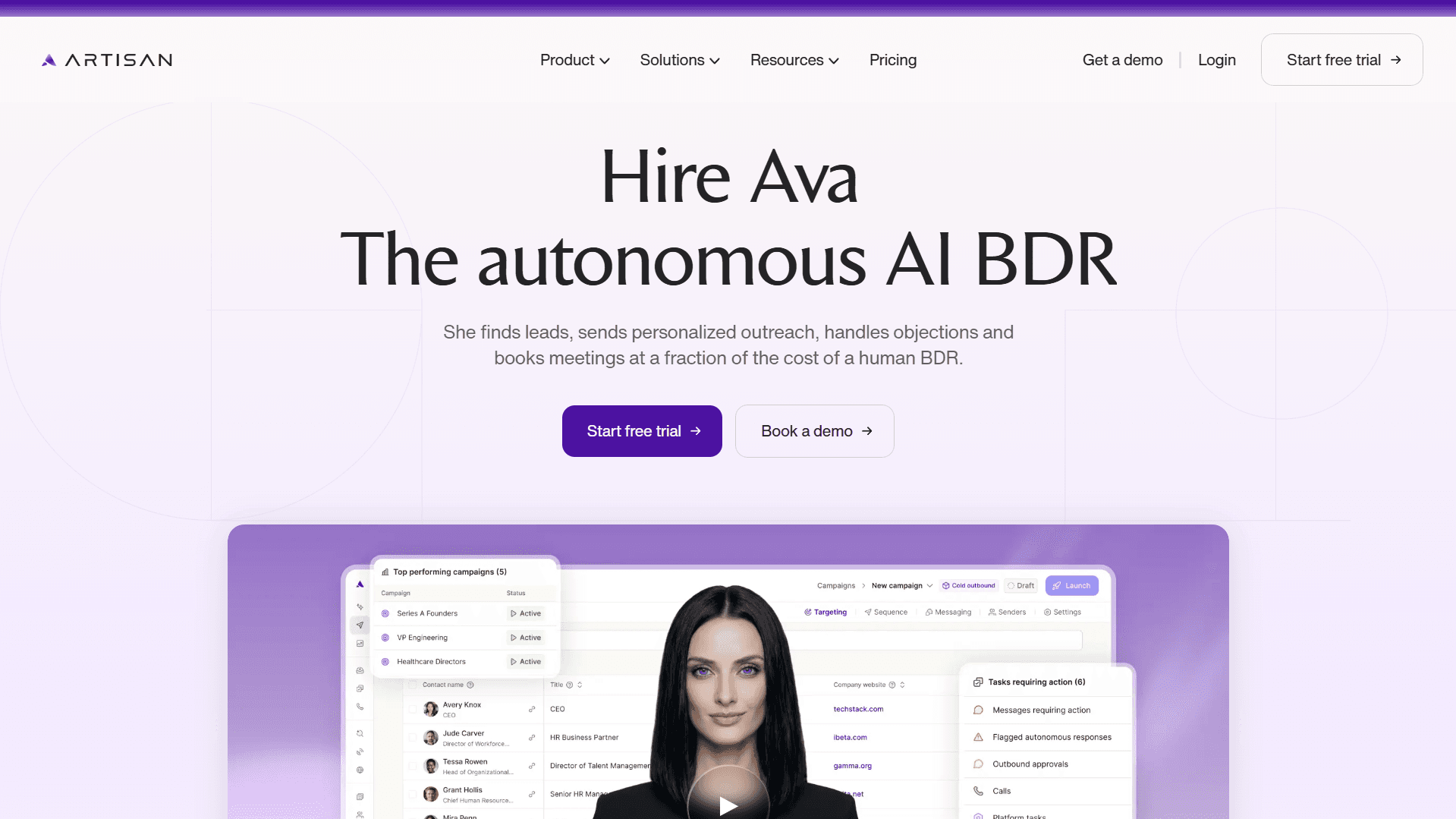
Artisan is the top AiSDR alternative because it does what AiSDR does and then keeps going into the enterprise. Ava, its AI BDR, owns the entire outbound job: she sources best-fit leads from a database of over 270M B2B contacts and over 130M local businesses, enriches and prioritizes with waterfall email and phone enrichment charged only on success, writes a distinct message per recipient, runs multichannel steps across email, social, and the dialer, handles every reply from a knowledge base, and books meetings by CRM ownership. In a legacy sequencer only the name and title change between recipients; in an Artisan campaign, two people receive two completely different messages.
Where AiSDR falls short for large orgs, Artisan is built for them. The central-ops deployment pattern is the point: sales ops runs Ava for a large AE team who never log in, with autonomy as a dial (review-and-approve, objections-only, or fully autonomous), plain-language escalation rules, and a full audit trail. CRM integration runs deep on both Salesforce and HubSpot: bidirectional sync, field-level export controls, owner mapping with a sender-assignment waterfall, and deal-based do-not-contact that blocks everyone at a company with an active deal. Artisan is SOC 2 Type II compliant, GDPR and CCPA compliant, with single sign-on (SSO) and SAML on Enterprise plans, and it survives a procurement review that an SMB tool would not. For HubSpot teams specifically, see the best AI SDR for HubSpot users.
The economics scale the right way. Usage-based credits, no platform fee, no per-seat tax, so a big team's cost stays flat instead of multiplying by headcount, and the Enterprise plan adds a forward-deployed strategist and a dedicated customer success manager (CSM). Over 90% of customers run Ava autonomously. Bruno Didier, Head of B2B at CookUnity, put it plainly: "Ava runs highly targeted outreach at a scale we could never reach with a human-only team," at roughly $45 per lead across more than 100,000 emails. Artisan has raised over $35M from investors including Y Combinator and HubSpot Ventures. For the wider cost picture, see how much an AI SDR costs compared with human SDRs.
Best for: teams that have outgrown SMB tooling and need full BDR ownership with enterprise governance, central ops, and CRM depth. Who should pick something else: a small team that only needs published tiers and fast setup and has no near-term enterprise requirements may not need the depth yet. Pricing: usage-based credits, no platform fee, free trial. See Artisan pricing.
2. Amplemarket: Signals with a human in the loop
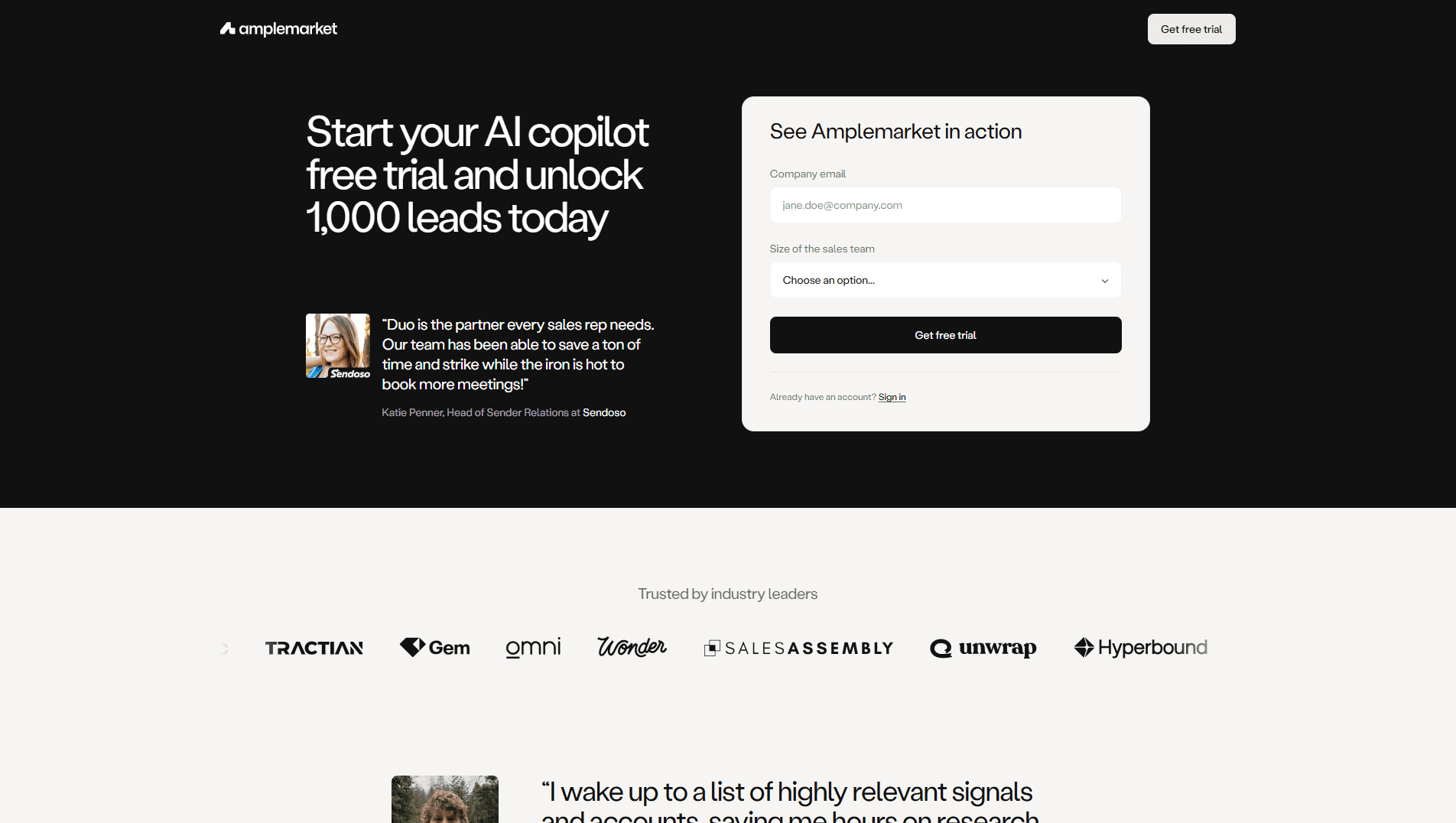
Amplemarket is the alternative for teams that want stronger signal-based selling than AiSDR while keeping a human in control. It combines data, engagement, and its Duo AI copilot into a solid all-rounder, with entry around $600 a month (not published publicly). If your reps are good and you want to point them at better signals, it is a capable step up.
The model is a copilot, so a human still runs the motion. For teams that want their reps in control, this fits. For teams that wanted the busywork removed entirely, it falls short. It sharpens reps; it does not own the job.
Best for: teams that want signal-based selling with a human still running the motion. Who should pick something else: teams that want the agent to own outbound, not assist it. Pricing: ~$600/mo entry, not public.
3. Regie.ai: Rep augmentation on a modern stack
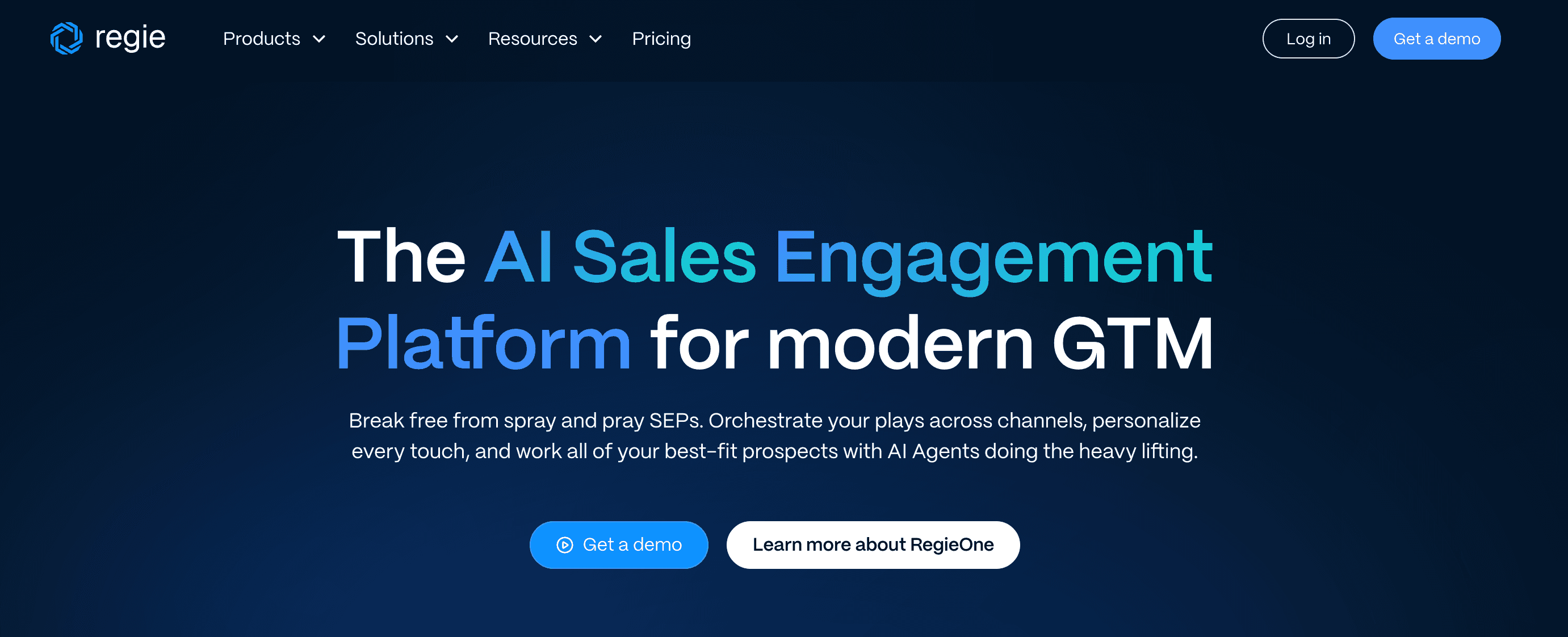
Regie.ai (its RegieOne platform) brings a sequencer, a dialer, and Auto-Pilot agents together with real enterprise credibility, priced at reportedly ~$180-$499/user/mo. Its philosophy is rep augmentation: make the reps you have faster and more consistent. For a team that wants to sharpen existing reps rather than change the motion, it is a strong pick.
The structural limit is the same one every augmentation tool hits. Reps still drive, so output per rep scales but pipeline does not scale independently of headcount. If your goal is more volume without more people, augmentation does not take you there.
Best for: teams that augment existing reps on a modern engagement stack. Who should pick something else: teams that want pipeline to scale without adding reps. Pricing: reportedly ~$180-$499/user/mo.
4. Reply.io: Accessible agent-run email
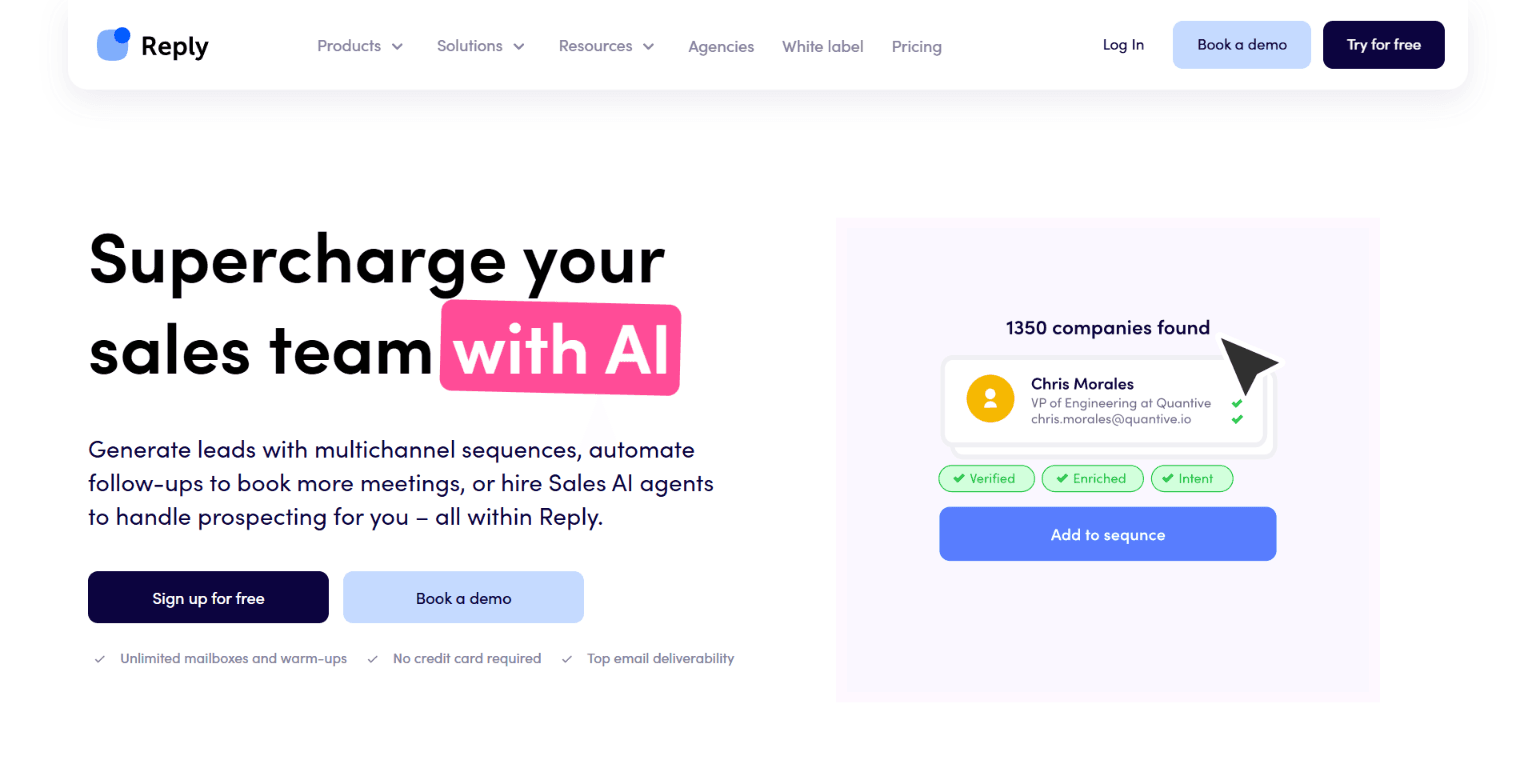
Reply.io offers Jason AI, an AI SDR layer on a classic sequencer, and it is one of the cheaper ways into agent-run email. Sequences start around $59 a month, with the AI SDR tier reported around $500-$800 a month. For a small team that wants to try automated email cheaply, the low entry is the appeal.
It is email-centric, though, and sits on a traditional sequencer, so it does not own multichannel prospecting or autonomous reply handling the way a purpose-built AI BDR does. A fine first step, a limited destination.
Best for: small teams that want a low-cost entry into agent-run email. Who should pick something else: teams that need multichannel outbound and autonomous replies. Pricing: sequences from $59/mo; AI SDR ~$500-800/mo.
5. Salesforce Agentforce: For Salesforce-first teams
If your team lives inside Salesforce, Agentforce SDR keeps the agent native to the CRM with Salesforce's security behind it. Pricing is consumption-based, roughly $2 per conversation or Flex Credits at about $0.10 per action. For a Salesforce-committed org, this residency is useful.
A few caveats apply: setup is steep, consumption pricing is still evolving, the product is young, and it works your existing CRM contacts rather than sourcing net-new leads at scale. It adds an agent to Salesforce; it does not fill the top of the funnel on its own. For an inbound comparison, see Artisan vs Qualified.
Best for: Salesforce-committed teams that want a CRM-resident agent. Who should pick something else: teams that need to source net-new pipeline, not just work existing records. Pricing: $2/conversation or Flex Credits ($0.10/action).
6. 11x: Multichannel with an AI phone agent
11x runs multichannel outbound through its Alice and Julian agents, including an AI phone agent, and it is well funded with roughly $74M raised from investors including a16z and Benchmark. If an AI phone agent is central to your motion, it is on the list.
The cautions are attributed and material. TechCrunch reported in March 2025 that some listed customers disputed claims 11x made about them, the founder-CEO stepped down on May 5, 2025 to non-executive chairman, and reviewers report deliverability and CRM-sync problems. In practice it sits in the lower mid-market while selling through enterprise-style contracts (Growth now public from $3,750 a month billed annually, with Pro and Enterprise custom), so it is neither the cheapest transparent option nor the safest enterprise one.
Best for: teams that specifically want an AI phone agent and are comfortable with the reported track record. Who should pick something else: teams that want transparent pricing or a cleaner track record and governance story. Pricing: Growth from $3,750/mo (annual); Pro/Enterprise custom.
7. Alta: A newer challenger
Alta markets an "AI GTM System of Actions" with an SDR agent named Katie and AI calling, and it raised a $25M Series A in July 2026. Its site claims SOC 2 and ISO 27001. For teams that like backing an early challenger, it is worth watching.
It is very young with a thin public track record, which is a real risk when the job is your pipeline. Treat it as early-stage, not proven.
Best for: teams comfortable adopting an early-stage product. Who should pick something else: teams that want a proven track record first. Pricing: private; $25M Series A (Jul 2026).
Stay with AiSDR if...
AiSDR is a good tool, so keep it if it still fits. Stay if you are an SMB or lower mid-market team, transparent published pricing and fast setup are what you value most, and you have no near-term need for central-ops deployment, deep CRM governance, or security attestations that survive enterprise procurement. There is no prize for migrating off a tool that is doing the job at your scale, and AiSDR's honesty on price is a genuine reason to stay when your requirements match its strengths.
The reason to move is a change in requirements, not a flaw in AiSDR. When you scale into large AE teams, multi-region compliance, or a procurement review that asks for an audit trail and SSO, this is the signal to compare a platform built for that weight. For adjacent roundups, see SDR tools and BDR tools.
How to choose your AiSDR alternative
Outgrowing SMB tooling and need full ownership with governance? Artisan.
Want better signals with a human still in the loop? Amplemarket.
Want to augment existing reps on a modern stack? Regie.ai.
Want a cheap way into agent-run email? Reply.io.
Committed to Salesforce? Agentforce SDR.
For the wider view, see the best AI SDRs and the AI BDR guide. See also the best AI BDRs, the best AI GTM platforms, and the 15 best AI sales tools.
FAQ
What is the best alternative to AiSDR?
Artisan, because it does what AiSDR does (autonomous outbound and inbound) and adds the enterprise governance SMB tools lack: central-ops deployment, deep bidirectional CRM controls, SOC 2 Type II, SSO and SAML on Enterprise plans, and a full audit trail. Ava owns the whole job from sourcing to booking. Amplemarket, Regie.ai, Reply.io, and Salesforce Agentforce are the other strong options.
Why do teams outgrow AiSDR?
Not because it is broken. AiSDR is a solid SMB tool with transparent pricing and fast setup. Teams move when they scale into large AE rosters, multi-region compliance, or enterprise procurement, where the governance layer (central ops, deep CRM controls, audit depth, security attestations) needs to be heavier than an SMB tool carries. It is a requirements change, not a defect.
What is the best enterprise alternative to AiSDR?
Artisan. It carries enterprise weight: sales ops can run Ava centrally for large AE teams who never log in, with SOC 2 Type II, SSO and SAML, a full audit trail, deep Salesforce and HubSpot controls, and per-seat economics that stay flat at scale. The Enterprise plan adds a forward-deployed strategist and a dedicated CSM, which is exactly the support model a big org expects.
How does Artisan pricing compare with AiSDR?
AiSDR publishes fixed monthly tiers ($250 to $2,500 per its site), which is great for a predictable SMB spend. Artisan uses usage-based credits with no platform fee and no per-seat multiplier, so you pay for work performed and the cost stays flat as you scale a large team rather than climbing per rep. See Artisan pricing for the model.
Is AiSDR good for enterprise?
It can work for the lower end, but its center of gravity is SMB and lower mid-market, and its enterprise governance story (central ops, deep CRM controls, audit depth) is thinner than a large org typically needs. For enterprise buyers who need those controls and a procurement-ready security posture, a platform built for that scale is the safer route.
Does Artisan do inbound like AiSDR?
Yes. Alongside outbound, Artisan runs Ava Inbound: an AI agent on your website that greets and qualifies visitors, answers from the same knowledge base as autonomous replies, and books meetings with CRM-owner routing, plus form-fill follow-ups with instant sends. So both motions run on one platform, with the outbound side owning sourcing through booking.
The takeaway
AiSDR is a good tool that teams outgrow, not one they flee. When your requirements move into enterprise governance and full BDR ownership, the right alternative is a platform built for that weight: central ops, deep CRM depth, a control dial, and a real audit trail. See how it works on the Artisan homepage, meet Ava, or read the AI BDR guide.
Related reading
Jaspar Carmichael-Jack
Co-Founder & CEO @ Artisan
Jaspar is an entrepreneur with expertise in sales, marketing, and operations. He founded Artisan in 2023, a company automating workflows with AI employees.