Artisan vs. Qualified: Which fits your team in 2026?
An honest 2026 comparison of Artisan and Qualified (Piper) for inbound, from chat to booked meeting, with real strengths on both sides.
Key Takeaways
- Artisan runs inbound and outbound as one AI rep, Ava, on one platform and one knowledge base. A visitor who chats but does not book flows straight into her outbound sequences, so the follow-up is automatic.
- Qualified's Piper is an inbound specialist. Salesforce completed its acquisition of Qualified on April 1, 2026, and the product is folding into Agentforce.
- Qualified is Salesforce-first. Artisan is CRM-agnostic and works natively with both Salesforce and HubSpot.
- Qualified sells through gated, enterprise-tier contracts (Premier, Enterprise, Ultimate), reportedly in the tens of thousands of dollars a year. Artisan's inbound agent is priced separately and available without an enterprise-only floor; you talk to sales for inbound pricing.
- Over 90% of Artisan customers run Ava autonomously, with a full audit trail and plain-language escalation rules.
- Artisan is SOC 2 Type II compliant, with single sign-on (SSO), SAML, and role-based access on Enterprise plans.
Artisan and Qualified both put an AI rep on your website, but Artisan does more of the job. Ava works inbound and outbound as one rep, on Salesforce or HubSpot, without an enterprise contract. Qualified is the polished inbound specialist, now part of Salesforce, and a strong pick for Salesforce-committed teams.
The buying question here is narrower than it looks. Qualified pioneered the AI inbound playbook: greet a visitor, qualify them, book a meeting. Artisan does this too, then keeps going, because the same AI rep also runs your outbound. This comparison walks the inbound journey stage by stage, credits what Qualified does well, and ends with honest scenarios for either one.
How the two compare
Rather than an all-checkmark grid, here is the situation-to-fit map. Find the row that sounds like you.
Your situation | Better fit | Why |
You want inbound and outbound handled by one AI rep | Artisan | Ava works the site and the outbound sequence on one knowledge base |
You run on HubSpot, or on both HubSpot and Salesforce | Artisan | CRM-agnostic, native to both |
You want a visitor who does not book followed up automatically | Artisan | Non-booked chats flow into Ava's outbound |
You are all-in on Salesforce and want it inside Agentforce | Qualified | Salesforce-native, now part of the platform |
You want the most established inbound conversion playbook | Qualified | Qualified defined the category |
You want to start without an enterprise-tier contract | Artisan | No enterprise-only floor; talk to sales for inbound |
Who greets and qualifies the visitor?
Both tools do the front-of-funnel job well. When someone lands on your site, an AI agent greets them, asks qualifying questions, and decides whether they are a fit. Qualified built its reputation here, and Piper is a mature, well-tuned version of this motion for Salesforce shops.
Artisan's Ava greets and qualifies visitors against your ideal customer profile (ICP) the same way, and answers their questions from the same knowledge base that powers her outbound replies. This shared knowledge base matters more than it sounds. Ava answers only from what she actually knows and flags gaps instead of guessing, so the inbound conversation stays as accurate as the outbound one. She also connects to Artisan's own website visitor identification, so anonymous traffic is identified and engaged rather than sitting there unnamed.
In practice, Qualified and Artisan are close on the greet-and-qualify step itself. The difference starts the moment the visitor does something other than book.
Who books the meeting, and who chases the ones who leave?
This is where the two diverge. Both agents book meetings on the right rep's calendar. Artisan routes with CRM-owner logic (deal owner, then contact owner, then company owner) and hands off to a human the instant a rep wants to take over.
The gap is what happens to the visitor who chats and then leaves without booking. In an inbound-only tool, this person is a missed conversation unless a human notices and follows up. With Artisan, every non-booked chat that captured an email flows straight into Ava's outbound sequences. The same rep who greeted them on the site now runs the follow-up automatically, on one lead timeline. Form-fill submissions receive instant follow-ups too.
This is the core of the Artisan angle. Inbound and outbound are one AI rep working one prospect from first hello to booked meeting, not two tools bolted together. Qualified, by design, owns the inbound half and hands the rest back to your reps or your outbound stack.
Which one fits your CRM?
Qualified is Salesforce-first, and after the April 2026 acquisition it is becoming part of the Salesforce and Agentforce ecosystem. If Salesforce is your system of record and you want your inbound agent to live natively inside it, that is a genuine strength, and post-acquisition it will only deepen.
Artisan is CRM-agnostic. It works natively with both Salesforce and HubSpot, with bidirectional owner mapping so outreach and bookings route to the right rep's mailbox and calendar. For a HubSpot team, or a team running both systems, this removes the Salesforce requirement entirely. You gain the inbound agent without having to standardize your whole revenue stack around one CRM. For HubSpot teams specifically, see the best AI SDR for HubSpot users.
Which is more honest about pricing?
Qualified does not publish self-serve pricing. It sells through gated tiers (Premier, Enterprise, and Ultimate) by demo, with figures reported historically in the tens of thousands of dollars a year. Treat these numbers as estimates, since the live pricing is quote-only. The point stands either way: this is an enterprise-tier purchase.
Artisan uses usage-based credits across the platform. You pay for work performed, not seats. There is no platform fee, and there is a free trial. The inbound agent is priced separately from the core outbound product, and you talk to sales for inbound pricing. What Artisan does not do is gate the inbound agent behind an enterprise-only floor. Full platform pricing is published at artisan.co/pricing. For deeper reads, see Qualified pricing and reviews and Monaco pricing and reviews.
What changed for Qualified in 2026?
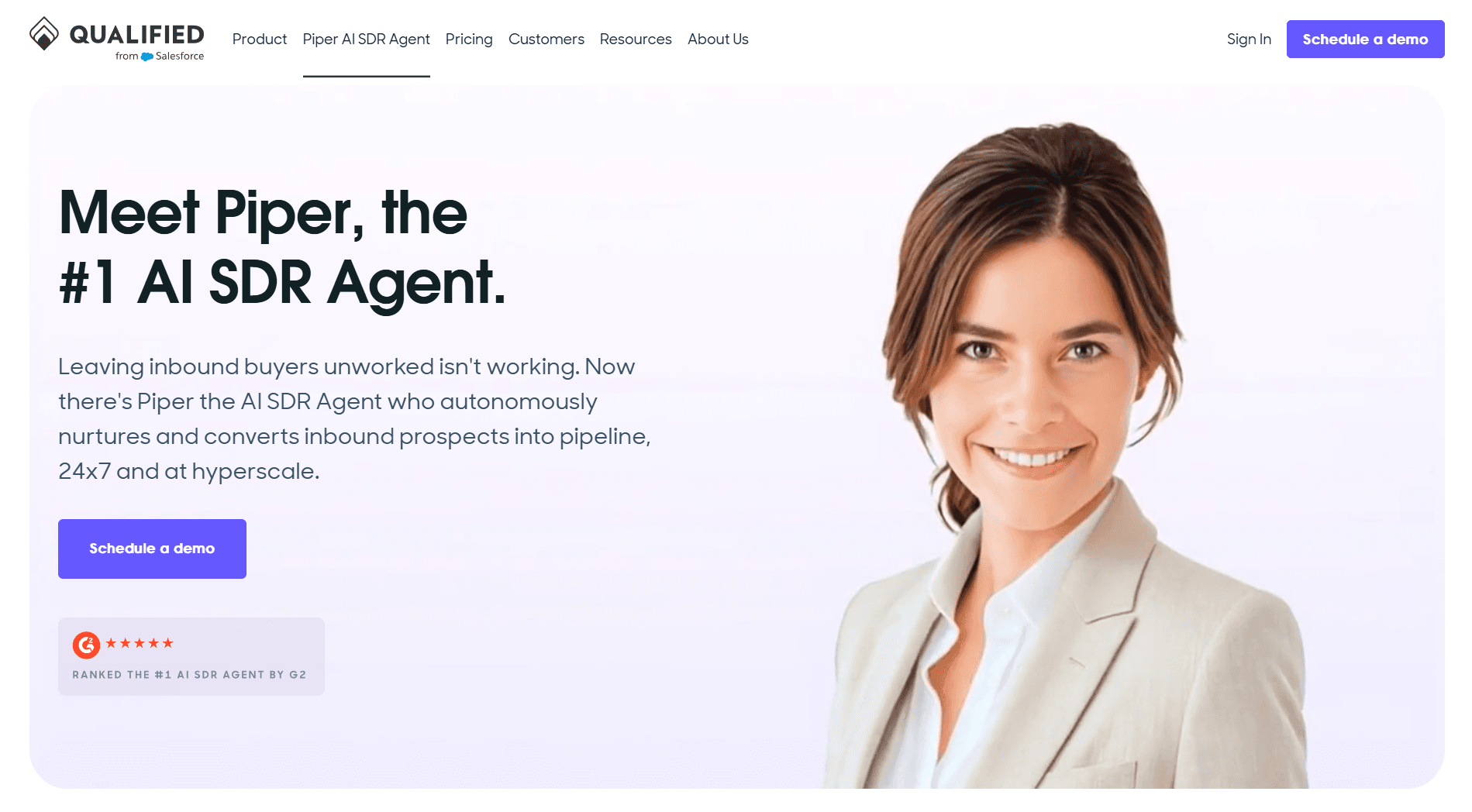
One event belongs in any fair comparison. Salesforce signed its agreement to acquire Qualified on December 17, 2025, and closed the deal on April 1, 2026. Qualified's Piper is folding into Agentforce.
For a Salesforce-committed buyer, that is arguably good news: tighter native integration and a bigger company behind the product. For everyone else, it raises fair questions. Acquisitions reshape roadmaps, pricing, and independence. If you are not a Salesforce shop, a product that moves deeper into Salesforce is a reasonable thing to weigh before signing an annual contract. Ask about roadmap continuity in your sales conversation.
Choose Qualified if...
There are real scenarios where Qualified is the sensible pick:
You are all-in on Salesforce and want your inbound agent to live natively inside Agentforce.
You want the most established inbound conversion playbook, from the team that defined the category.
Your inbound and outbound motions are owned by separate teams and tools, and you only need to solve the inbound conversion step.
You are comfortable with a gated, enterprise-tier contract and a guided rollout.
If these describe you, Qualified is worth a serious look. Go in with the Salesforce acquisition in mind and confirm how the Agentforce transition affects your timeline.
Choose Artisan if...
Artisan is the stronger default for most teams:
You want one AI rep to own the whole visitor journey, from the first chat to the booked meeting, and to follow up automatically on the visitors who leave without booking.
You run on HubSpot, or on both HubSpot and Salesforce, and do not want a Salesforce requirement.
You want inbound and outbound on one platform and one knowledge base, not two systems your reps stitch together.
You want to start without an enterprise-only contract, on usage-based pricing with a free trial.
You run outbound centrally for a large team and need CRM owner mapping, escalation rules, an audit trail, and SOC 2 Type II compliance.
Artisan's customers describe the outcome in numbers. Raise sourced over $700K of annual recurring revenue (ARR) in six months with Ava, a 20x return. This is the shape of result one AI rep, working inbound and outbound together, is built to produce. For the evidence base, see do AI SDRs actually work? What the data says.
See how Ava works as your AI sales agent, read the fuller category picture in the best AI SDRs, or weigh the field in the best Qualified alternatives. Related guides include the best AI BDRs, the best AI GTM platforms, and the 15 best AI sales tools.
Frequently asked questions
Is Qualified better than Artisan for Salesforce teams?
For a team standardized entirely on Salesforce, Qualified has a real edge: it is Salesforce-native and, after the April 2026 acquisition, is folding into Agentforce. This native residency is genuine. Artisan is CRM-agnostic and works natively with Salesforce too, plus HubSpot, and adds outbound in the same rep. If your only requirement is deep Salesforce residency for inbound, trial Qualified; if you want inbound and outbound in one place across either CRM, Artisan does more.
Does Artisan do inbound like Qualified?
Yes, and then some. Ava greets and qualifies website visitors against your ICP, answers from her knowledge base, and books meetings with CRM-owner routing and instant human takeover, which is the core Qualified motion. The difference is that Ava is also your outbound rep, so a visitor who chats but does not book flows automatically into her outbound sequences. Inbound and outbound run as one AI rep on one timeline.
What happened with Qualified and Salesforce?
Salesforce signed an agreement to acquire Qualified on December 17, 2025 and closed it on April 1, 2026. Qualified's Piper inbound agent is folding into Salesforce Agentforce. For Salesforce-committed buyers this means tighter native integration. For others it raises normal post-acquisition questions about roadmap, pricing, and independence, worth asking before committing to an annual contract.
How much do Artisan and Qualified cost?
Qualified sells through gated, enterprise-tier plans (Premier, Enterprise, Ultimate) by demo, with figures reported historically in the tens of thousands of dollars a year; treat these as estimates since pricing is quote-only. Artisan uses usage-based credits with no platform fee and a free trial across the platform; the inbound agent is priced separately and you talk to sales for inbound pricing. See artisan.co/pricing.
Does Artisan work with HubSpot?
Yes. Artisan is CRM-agnostic and works natively with both HubSpot and Salesforce, including bidirectional owner mapping so inbound bookings and outbound messages route to the right rep. Qualified is Salesforce-first, which makes Artisan the more natural fit for HubSpot teams or teams running both CRMs.
Can one AI rep really handle both inbound and outbound?
That is the whole design. Artisan's Ava runs both on one platform and one knowledge base, so the same rep who greets a visitor on your site can also source net-new prospects, run multichannel outbound, handle replies, and follow up on non-booked chats automatically. Over 90% of Artisan customers run Ava autonomously, with an audit trail and plain-language escalation rules for control. For background, see AI SDR, AI BDR, and SDR tools.
Jaspar Carmichael-Jack
Co-Founder & CEO @ Artisan
Jaspar is an entrepreneur with expertise in sales, marketing, and operations. He founded Artisan in 2023, a company automating workflows with AI employees.