Alta pricing and reviews (2026)
Alta pricing in 2026 is gated and pay-for-what-you-use, quoted by team size. Here is the honest cost picture, review themes, and who it fits.
Key Takeaways
- Alta's pricing is gated and usage-based, described as pay-for-what-you-use and quoted by team size; there are no public tiers as of 2026.
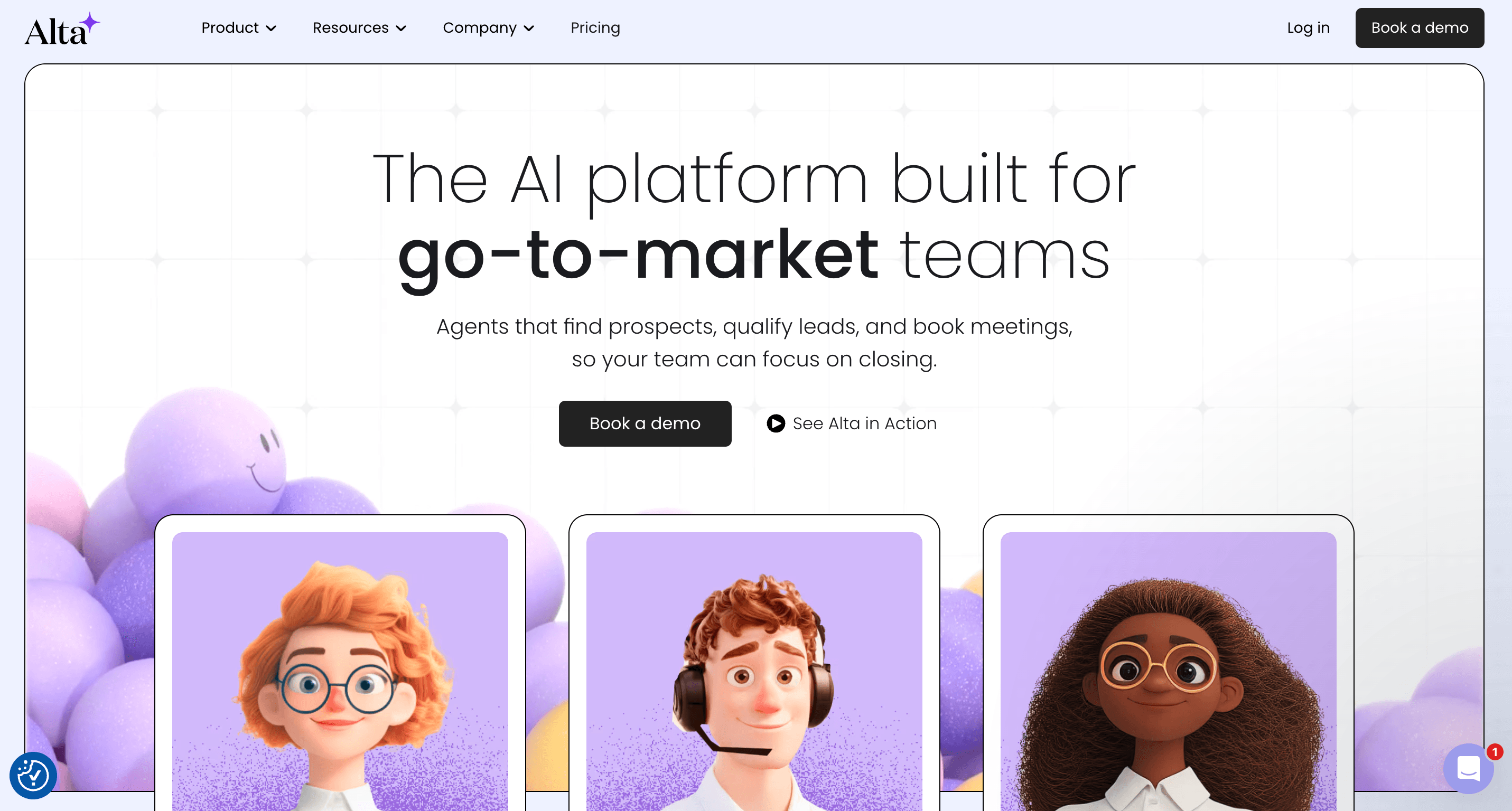
- Alta is positioned as an "AI GTM System of Actions," with an SDR agent named Katie and AI calling.
- Alta raised a $25M Series A in July 2026, so it is still an early-stage company building its track record.
- Because Alta is young, there is a limited base of independent reviews, so buyers should rely on a proof-of-concept instead of published benchmarks.
- Alta references SOC 2 and ISO 27001 on its site, but these claims are unverified independently, so enterprise buyers should ask for current attestations directly.
Alta does not publish prices. Its model is pay-for-what-you-use, quoted by team size, so the real cost depends on your volume. Alta is an early-stage AI go-to-market (GTM) platform whose sales development representative (SDR) agent is named Katie, and it raised a $25M Series A in July 2026. Reviews are thin, so treat it as promising but young.
How much does Alta cost in 2026?
Alta has no public price. It describes its model as pay-for-what-you-use and quotes each customer based on team size and volume, so you receive pricing through a demo and sales conversation. This makes a table of tiers impossible to publish honestly; below is the model and the best available estimate framing.
Plan | Price | Billing | Notes |
Usage-based | Custom, contact sales | Quoted by team size | Pay-for-what-you-use; no published tiers |
Because Alta is early-stage and quotes privately, there is no reliable third-party estimate to anchor on, unlike older vendors with a reported range. Any figure you see circulating should be treated as unconfirmed until Alta quotes your team directly. Pricing is current as of 2026.
What does Alta actually cost in practice?
With a usage-based, quoted model, the practical cost depends almost entirely on how much work you run through the platform, so the questions to ask are about the meter, not a sticker.
Find out exactly what usage is metered: contacts enriched, messages sent, calls placed by Katie, meetings booked, or some blend. Ask what a realistic month looks like at your intended volume, and whether there is a minimum commitment or an annual term underneath the pay-as-you-go framing, since many usage models carry a floor. Because Alta is new, also weigh the cost of being an early customer: less documentation, a shorter list of proven integrations, and a product still maturing, all of which can translate into your team's time during setup. None of this is disqualifying for an early-stage tool, but it belongs in the real total.
What do reviewers say about Alta?
The honest answer is that there is not much yet. Alta is early-stage, so the pool of independent, long-run reviews is limited, and buyers should be wary of drawing strong conclusions from a small sample. What is out there tends to describe an ambitious, modern product, an "AI GTM System of Actions" with an SDR agent, Katie, that runs outreach and AI calling, positioned as an agent that takes actions across the go-to-market motion instead of a passive assistant.
Reviewers report the usual early-stage trade-offs where they comment at all, with promising core capability paired against the rough edges of a young product and a short track record. The security posture is a specific thing to verify. Alta references SOC 2 and ISO 27001 on its site, but these claims are not independently confirmed, so an enterprise buyer should request current attestation reports instead of taking the website at face value. In short, treat Alta as a bet on a new entrant, and validate with a pilot instead of relying on a body of reviews that does not exist yet.
Who is Alta best for, and who should look elsewhere?
Alta suits teams that like being early adopters, groups willing to run a proof-of-concept, give feedback, and work closely with a new vendor in exchange for early access to a fresh product with recent funding behind it. A $25M Series A in July 2026 gives it runway, and the usage-based model can appeal to teams that want to pay in proportion to what they run.
It is a weaker fit for buyers who need a proven track record, published pricing they can budget against without a call, or verified enterprise security today. Risk-averse organizations, or teams that need to stand up outbound quickly with strong documentation and mature integrations, will likely want a more established platform. Anyone whose procurement requires confirmed SOC 2 or ISO 27001 should obtain these documents from Alta before proceeding.
Is Alta worth it, or is there a better-value option?
For an early adopter, Alta may be worth a pilot; the value simply cannot be judged from reviews yet, so a hands-on trial is the only honest way to decide. The broader question is whether you want to bet on a young tool or run the same job on a more established autonomous platform. For a direct comparison, see Artisan vs Alta and the best Alta alternatives.
This is where Artisan is worth weighing. Artisan's AI BDR (business development representative), Ava, owns the outbound workflow end to end. She sources leads from over 270M B2B contacts and over 130M local businesses, enriches them with waterfall email and phone enrichment charged only on success, runs personalized multichannel campaigns across email, social, and dialer steps, handles replies from a knowledge base, and books meetings on the right rep's calendar. Artisan reports that over 90% of its customers run Ava fully autonomously, on a dial from review-and-approve to hands-off, with plain-language escalation rules and a full audit trail. On security, Artisan states it is SOC 2 Type II compliant, GDPR and CCPA compliant, with regular third-party penetration testing and a Trust Center, which is the kind of confirmed posture a cautious buyer can verify.
Artisan's commercial model is also usage-based credits, so like Alta you pay for work performed instead of seats, but the platform is further along and consolidates data, outreach, dialer, and deliverability in one place with a free trial. If you are drawn to Alta's usage model but want a more proven system, it is worth pricing Artisan's usage-based approach beside it and reading our AI BDR guide. For broader roundups, see the best AI BDRs.
Frequently asked questions
How much does Alta cost?
Alta does not publish pricing. It uses a pay-for-what-you-use model quoted by team size, so you receive a figure through a demo and sales conversation. There are no public tiers as of 2026, and because Alta is early-stage, there is no reliable third-party estimate to anchor on either.
Is Alta expensive?
It is impossible to say without a quote, since Alta prices privately by usage and team size. A usage-based model can be cost-efficient if the meter matches your volume, but ask about minimums and any annual term. Compare the quote against platforms with published pricing before committing.
Does Alta have transparent pricing?
No. Alta's pricing is gated behind a sales conversation, described as pay-for-what-you-use. This is common among early-stage AI GTM tools, but it means you cannot budget without contacting Alta, unlike vendors that publish their tiers.
Is Alta a mature product?
Not yet. Alta raised a $25M Series A in July 2026 and is still early-stage, with a limited base of independent reviews and a short track record. This is a fact of timing more than a criticism; buyers should validate with a pilot instead of relying on published benchmarks.
Is Alta secure enough for enterprise?
Alta references SOC 2 and ISO 27001 on its site, but these claims are not independently verified. An enterprise buyer should request current attestation reports directly before assuming the posture is in place, and weigh this against vendors with confirmed, verifiable compliance.
What are the alternatives to Alta?
Alternatives include more established autonomous platforms like Artisan, whose AI BDR Ava owns the full outbound workflow and carries confirmed SOC 2 Type II compliance, as well as transparent-priced AI SDRs for teams that want published tiers. See our AI sales agent overview to compare. You can also browse the best AI SDRs and the best AI GTM platforms.
Related reading
Jaspar Carmichael-Jack
Co-Founder & CEO @ Artisan
Jaspar is an entrepreneur with expertise in sales, marketing, and operations. He founded Artisan in 2023, a company automating workflows with AI employees.