Artisan vs Alta: Which fits your team?
Artisan ships a proven autonomous AI BDR with named customers. Alta is a young, freshly funded AI GTM agent. Here's how to choose in 2026.
Key Takeaways
- Artisan's Ava is a shipping autonomous AI BDR: she sources leads, enriches them, runs multichannel campaigns, handles replies, and books meetings, with over 90% of Artisan customers running her autonomously.
- Alta markets an "AI GTM System of Actions" with a sales development representative (SDR) agent named Katie and AI calling, and raised a $25M Series A in July 2026. It's early, with a limited public track record.
- Artisan has named, quotable customers: SaaStr, SumUp, CookUnity, Quora, Raise. Raise sourced over $700K of annual recurring revenue (ARR) in six months with Ava, a 20x return.
- Artisan is SOC 2 Type II compliant with SSO, SAML, and role-based access on Enterprise plans; Alta's security attestations are not independently confirmed in public sources.
- Artisan's core platform is usage-based with no platform fee and a free trial; Alta's pricing is gated, quoted by team size.
- Both bet on autonomous outbound. The difference is maturity: production proof and scale today versus a recently funded newcomer.
Both sell an AI that runs outbound. Artisan ships Ava, a proven autonomous AI BDR (business development representative) with named customers and published proof points, running in production at scale. Alta is a young AI go-to-market (GTM) agent, freshly funded on a $25M Series A in July 2026, with a thin track record so far. If you want evidence over promise, that's the split.
Artisan vs Alta at a glance
Alta is early. The honest question is whether you're buying a proven engine or backing a fresh entrant.
Your situation | Better fit |
You need an autonomous AI BDR producing pipeline this quarter | Artisan |
You want to try a newly funded newcomer and don't mind a short track record | Alta |
You want named customers and published proof points before you commit | Artisan |
You're an early adopter comfortable shaping a young product's direction | Alta |
You need SOC 2 Type II and governance you can verify for an enterprise rollout | Artisan |
You want transparent, usage-based pricing you can start on with a free trial | Artisan |
What is Alta and where is it in its journey?
Alta positions itself as an "AI GTM System of Actions," with an SDR agent named Katie and AI calling capabilities. In July 2026 it closed a $25M Series A, which is a real vote of confidence and gives the team runway to build. On category thesis, Alta and Artisan are aligned: both believe an AI should take actions across the GTM motion rather than sit beside a rep as a copilot.
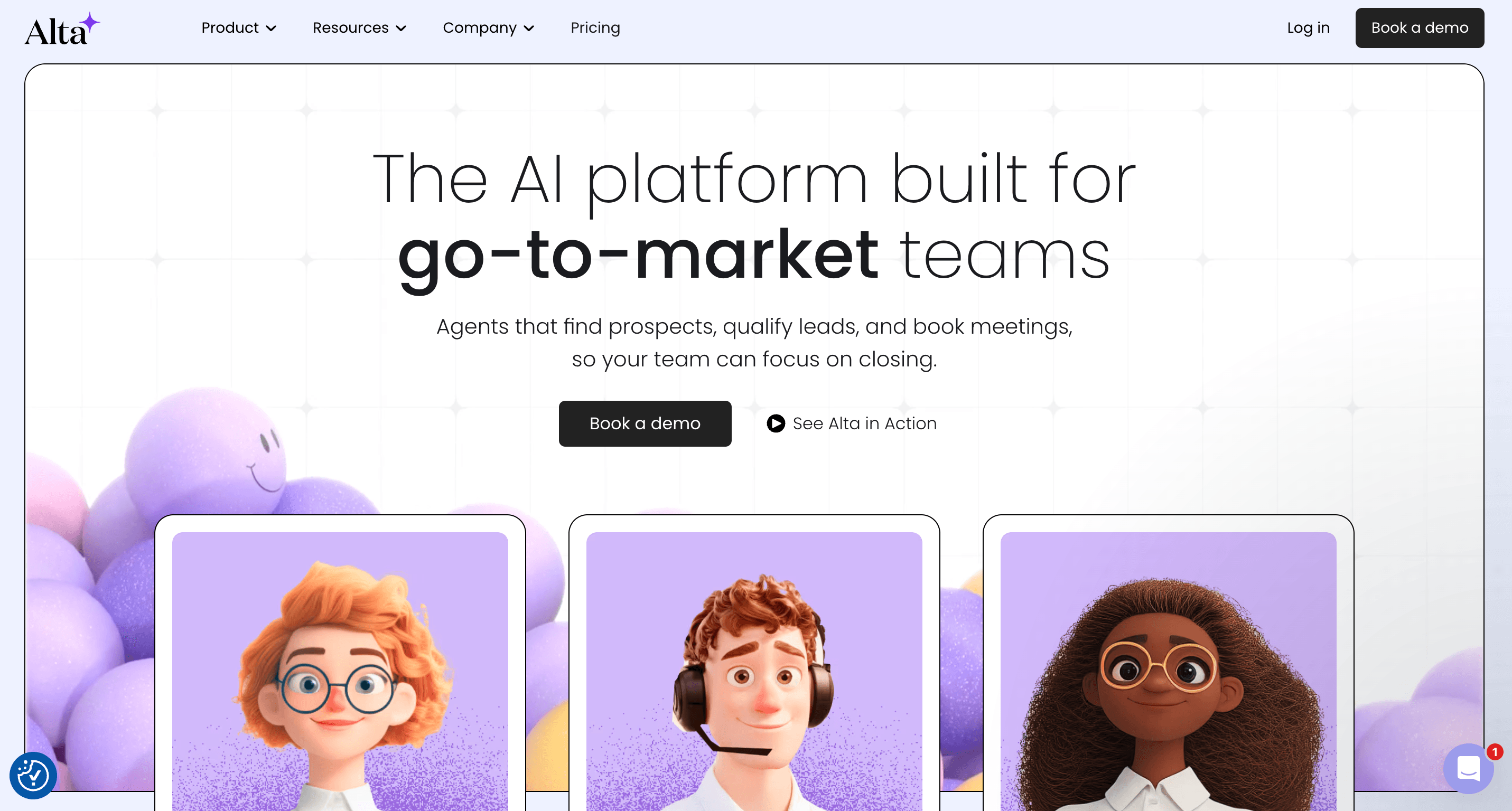
The caveats are about maturity. Alta is a young product with a limited public track record; there aren't the kind of named customers and attributed results that let you judge it before buying. Its pricing is gated, quoted by team size on a "pay for what you use" basis, so you can't evaluate cost without a sales conversation. And while Alta references security standards like SOC 2 and ISO 27001, those attestations aren't clearly confirmed in independent public sources, so an enterprise buyer should ask to see them directly. This does not make Alta a bad product, only an early one, and early products carry evaluation risk you have to price in.
What does Artisan ship today?
Artisan's Ava is a fully deployed autonomous AI BDR with a multi-year track record. She owns the BDR job end to end: she finds best-fit leads across a database of over 400M contacts with natural-language processing (NLP) search, ideal customer profile (ICP) filters, and intent signals; enriches and prioritizes them with waterfall email and phone data that charges only on success; launches personalized multichannel campaigns across email, social outreach, and dialer call steps; runs dozens of message variations and shifts volume to what converts; handles every reply by qualifying, answering objections from a knowledge base, and chasing follow-ups; and books meetings on reps' calendars with CRM-owner routing. For category context, compare leading AI SDR options and the broader landscape of SDR tools and BDR tools.
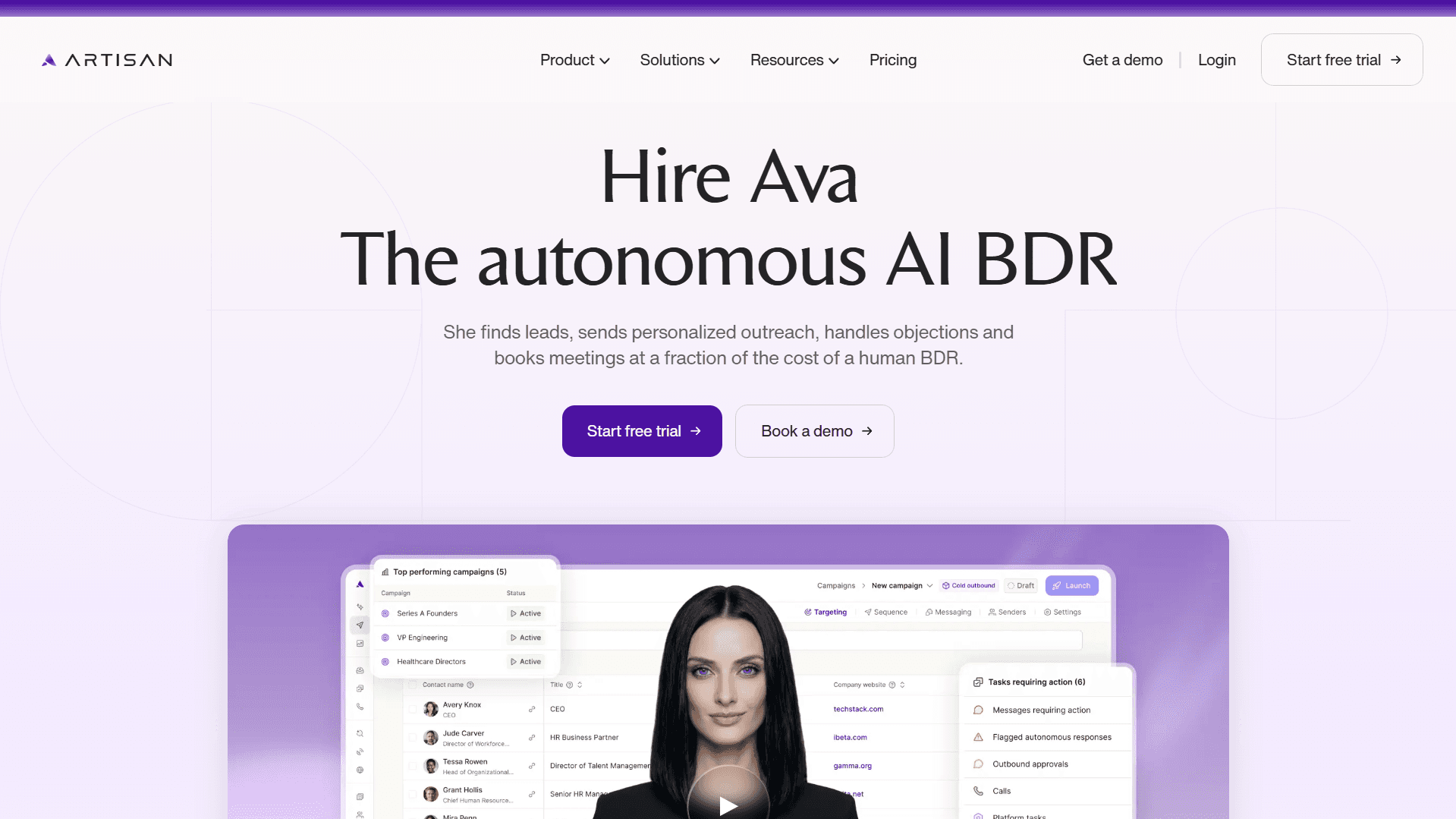
The autonomy is a dial: review-and-approve every message, objections-only replies, or full autonomy, with plain-language escalation rules and a full audit trail. Artisan reports over 90% of its customers run Ava autonomously, including global teams that run her centrally from sales ops for account executive (AE) rosters that never log in. This is in production at scale, not a preview. See our roundups of the best AI SDRs, the best AI BDRs, and the best AI GTM platforms.
Which one has the track record to bet a number on?
Artisan, clearly. This is the crux of the comparison. When you're carrying a pipeline target, you want to see what a tool has actually done for teams like yours, and Artisan publishes that. Alta, as a newly funded newcomer, hasn't accumulated that public evidence yet.
Artisan names customers and numbers. Raise sourced over $700K of ARR in six months with Ava, a 20x return. SumUp's Karlo Biuk reports a $52 cost per lead and 8 to 15 positive replies a week from previously unreachable local businesses across hundreds of thousands of emails. CookUnity's Bruno Didier says "Ava runs highly targeted outreach at a scale we could never reach with a human-only team," at roughly $45 cost per lead across over 100,000 emails. That's the kind of attributed, in-production proof a young product simply can't offer yet.
How does personalization and scale compare?
Artisan's personalization runs from light to agentic, with research-agent swarms for hard criteria, and it operates at Marketo scale with a one-to-one feel. Two people in the same Artisan campaign receive two completely different messages; in a legacy sequencer only the name and title change. That's a mature capability, tuned across large volumes of real sends and self-optimized at the component level.
Alta's agent, Katie, and its AI calling are newer and less battle-tested by definition. An early product may do impressive things in a demo, but the question for a buyer is how it holds up across thousands of live sends, edge-case replies, and deliverability realities over months. Artisan has that operating history; Alta is still building it. If you're an early adopter who enjoys shaping a product's direction, that's part of the appeal. If you need dependable output now, it's a risk.
How do they compare on pricing and security?
Artisan is usage-based: you pay for work performed, not seats, with no platform fee and a free trial, so you can start small and see results before scaling. The dialer is a flat $67/seat/month with unlimited minutes plus 1 credit per call, roughly a third of what dedicated parallel dialers charge. Alta's pricing is gated and quoted by team size, so you evaluate it through a sales process rather than a public page. See our guide to how much does an AI SDR cost? AI vs human pricing and Alta pricing and reviews.
On security, Artisan is SOC 2 Type II compliant, GDPR and CCPA compliant, runs regular third-party penetration testing, and offers SSO, SAML, and role-based access on Enterprise plans, with a Trust Center on artisan.co. Alta references SOC 2 and ISO 27001, but those claims aren't clearly confirmed in independent public sources, so verify them directly before an enterprise rollout.
Choose Alta if...
You like being an early adopter and you're comfortable backing a newly funded newcomer with a short track record.
You have the appetite to help shape a young product's roadmap rather than buy a finished engine.
You're not under pressure to prove pipeline results this quarter and can treat the deployment as a longer bet.
You want to evaluate Katie and Alta's AI calling for your specific motion and you're set up to test carefully.
Alta just raised a $25M Series A, so it has runway and momentum. If early-stage risk is acceptable to you, it's worth a look.
Choose Artisan if...
You need an autonomous AI BDR producing pipeline now, with proof it works at scale.
You want named customers and published, attributed results before committing.
You need verifiable SOC 2 Type II, SSO, SAML, and role-based access for an enterprise rollout.
You want transparent, usage-based pricing and a free trial rather than a gated quote.
What customers say
SaaStr's Jason Lemkin is blunt about the output: after reaching a 3.55% positive response rate, he says "the AI emails are actually better than what our humans produced. Consistently better." That's an attributed result from a named customer running Ava in production. It's the kind of evidence that a proven platform can point to and a young product can't yet, and it's why teams using Ava generate pipeline at roughly a fifth of the cost of a human BDR. See the best alternatives to hiring more SDRs.
FAQ
Is Alta better than Artisan?
Alta is a newly funded newcomer with a thin public track record. Artisan ships a proven autonomous AI BDR with named customers and attributed results. If you enjoy backing early products and can absorb the risk, Alta is worth a look; if you want evidence and scale now, Artisan is the stronger pick. If Alta isn't the fit, see the best Alta alternatives.
How much does Alta cost?
Alta's pricing is gated and quoted by team size on a "pay for what you use" basis, so you need a sales conversation to learn it. Artisan's core platform is usage-based with no platform fee and a free trial, so you pay for the work performed and can start small.
Is Alta SOC 2 or ISO 27001 certified?
Alta references SOC 2 and ISO 27001, but those attestations are not clearly confirmed in independent public sources, so ask to see them directly before an enterprise rollout. Artisan is SOC 2 Type II compliant, with GDPR and CCPA compliance, regular third-party penetration testing, and a Trust Center.
Does Alta have customer proof like Artisan?
Not in a comparable public form yet, because it's early. Artisan publishes named customers and numbers, including Raise's over $700K of ARR in six months, SumUp's $52 cost per lead, and SaaStr doubling open rates. For a buyer who wants evidence before committing, that track record is the differentiator.
Who's behind each product?
Alta raised a $25M Series A in July 2026 and markets an "AI GTM System of Actions" with its SDR agent Katie. Artisan was founded by Jaspar Carmichael-Jack and Sam Stallings, is a Y Combinator company, and has raised over $35M from investors including Y Combinator and HubSpot Ventures.
Which should an enterprise pick?
Artisan, if the rollout is now. It's SOC 2 Type II compliant with SSO, SAML, and role-based access on Enterprise plans, includes a forward-deployed strategist and dedicated CSM, and supports central sales-ops deployment for large AE teams who never log in. Alta's early stage and unconfirmed attestations make it a harder enterprise commitment today.
The bottom line
Alta is a fresh, well-funded entrant, and if you're an early adopter it's worth watching. But if you want an autonomous AI BDR that's proven, verifiable, and producing pipeline at scale right now, Artisan ships that today.
See how Ava the AI BDR works, explore the AI sales agent, start on the Artisan homepage, or review Artisan pricing.
Jaspar Carmichael-Jack
Co-Founder & CEO @ Artisan
Jaspar is an entrepreneur with expertise in sales, marketing, and operations. He founded Artisan in 2023, a company automating workflows with AI employees.