Apollo vs. Instantly: Which should you choose in 2026?
Apollo is a data-first all-in-one; Instantly is cold email infrastructure for volume. A fair 2026 comparison by buyer scenario, with published pricing.

Key Takeaways
- Apollo leads on data and breadth. It claims over 230 million contacts and reports use by more than 600,000 companies, with pricing from free to roughly $119/user/month per its pricing page.
- Instantly leads on sending volume and deliverability tooling. It advertises over 450 million leads and runs public tiers from about $47 to $555/month per its pricing page.
- Apollo charges per seat; Instantly charges per workspace and sending capacity. This single difference changes the math for most teams.
- Apollo bundles a database so you can prospect from zero. Instantly assumes you bring or buy your lists and focuses on delivering the mail.
- Apollo acquired Pocus in March 2026, adding signal and warm-lead scoring; reported annual recurring revenue is around $200M.
- Neither tool runs the campaign for you. You still build the ideal customer profile (ICP), write the copy, and work the replies.
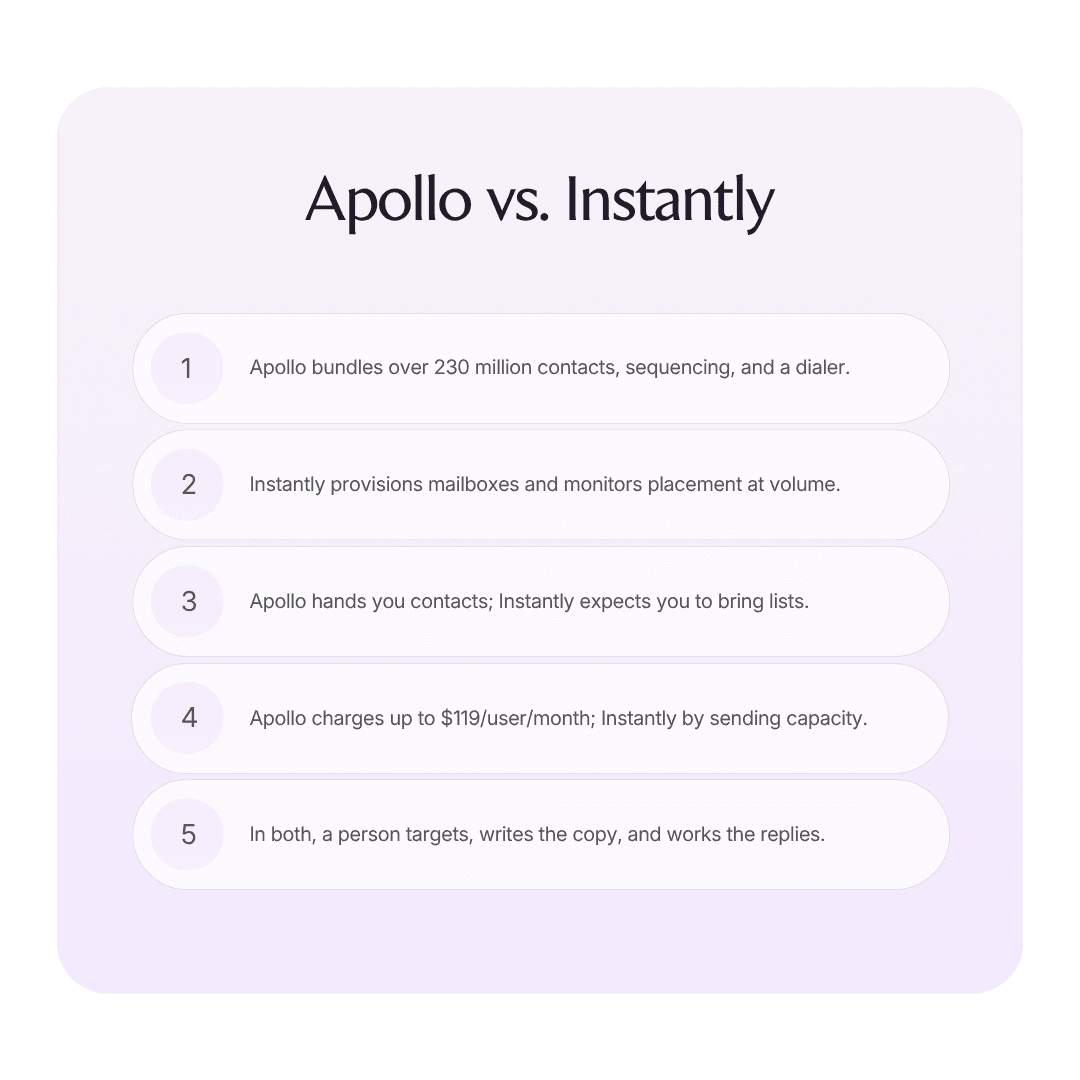
Apollo is a data-first all-in-one: a large B2B contact database with prospecting, sequencing, and a dialer bundled together. Instantly is cold email infrastructure built for sending volume and deliverability. Choose Apollo when you need leads plus a full sales stack. Choose Instantly when you already have lists and want to send at scale.
How Apollo and Instantly compare at a glance
Apollo | Instantly | |
Category | Data-first all-in-one sales platform | Cold email sending infrastructure |
Best for | Teams that need contact data and a full outbound stack in one place | High-volume senders and agencies that already have lists |
Standout capability | Database of over 230 million contacts with prospecting, sequencing, and dialer | Mailbox management, deliverability tooling, and volume sending |
Data included | Yes, native database | No native database; you import or buy leads (lead finder with over 450 million leads available) |
Pricing model | Per user/month | Per workspace and sending volume |
Published pricing | Free to ~$119/user/month (per its pricing page) | ~$47 to $555/month (per its pricing page) |
Multichannel | Email, calls, social media steps | Email-centric |
Apollo vs. Instantly: Which is better?
Neither is better in the abstract. They solve different halves of the same problem. Apollo answers "who do I contact and how do I run my whole sales motion." Instantly answers "how do I land thousands of cold emails in the inbox reliably." Many teams that outgrow a single tool end up running both: Apollo for data and pipeline management, Instantly for the raw cold email volume.
If you can only pick one, decide what you lack. If you lack a list, Apollo wins because it hands you contacts on day one. If you already have lists and your problem is deliverability and scale, Instantly wins because that is the entire product.
What is Apollo best at?
Apollo is best at giving a small or mid-sized team a database and a sales stack under one login. Its contact database (Apollo claims over 230 million records) covers prospecting, email verification, sequencing, a built-in dialer, and basic deal tracking. For a founder-led team or a lean sales development representative (SDR) group, this breadth is the draw: you can find a prospect, verify the email, enroll them in a sequence, and log the call without leaving the app. For a data-tool comparison, see Apollo vs. Lusha.
The March 2026 Pocus acquisition added product-signal and warm-lead scoring, pushing Apollo further toward intent-aware prospecting. Reported annual recurring revenue (ARR) of around $200M and adoption by more than 600,000 companies (per Apollo) make it one of the most widely used tools in the category.
Apollo's honest limit is the scope of its AI, which drafts and suggests while a human still runs the motion. Enterprises frequently treat Apollo as a data layer that feeds a more governed engagement stack instead of a system of record. And the per-seat model means costs climb with headcount. Related: apollo alternatives.
What is Instantly best at?
Instantly is best at putting large volumes of cold email into inboxes without wrecking your sender reputation. Its core is mailbox provisioning, a shared reputation-building network, deliverability monitoring, and campaign sending built to run many mailboxes at once. Agencies and high-volume outbound teams pick it because sending is the hard part at scale, and Instantly treats that as the product rather than an afterthought.
It also ships a lead database (Instantly advertises over 450 million leads) and a light CRM, so you can source and manage inside the same tool. Pricing is transparent, running from roughly $47 to $555/month per its pricing page, which undercuts per-seat data platforms for teams that send a lot from a few accounts.
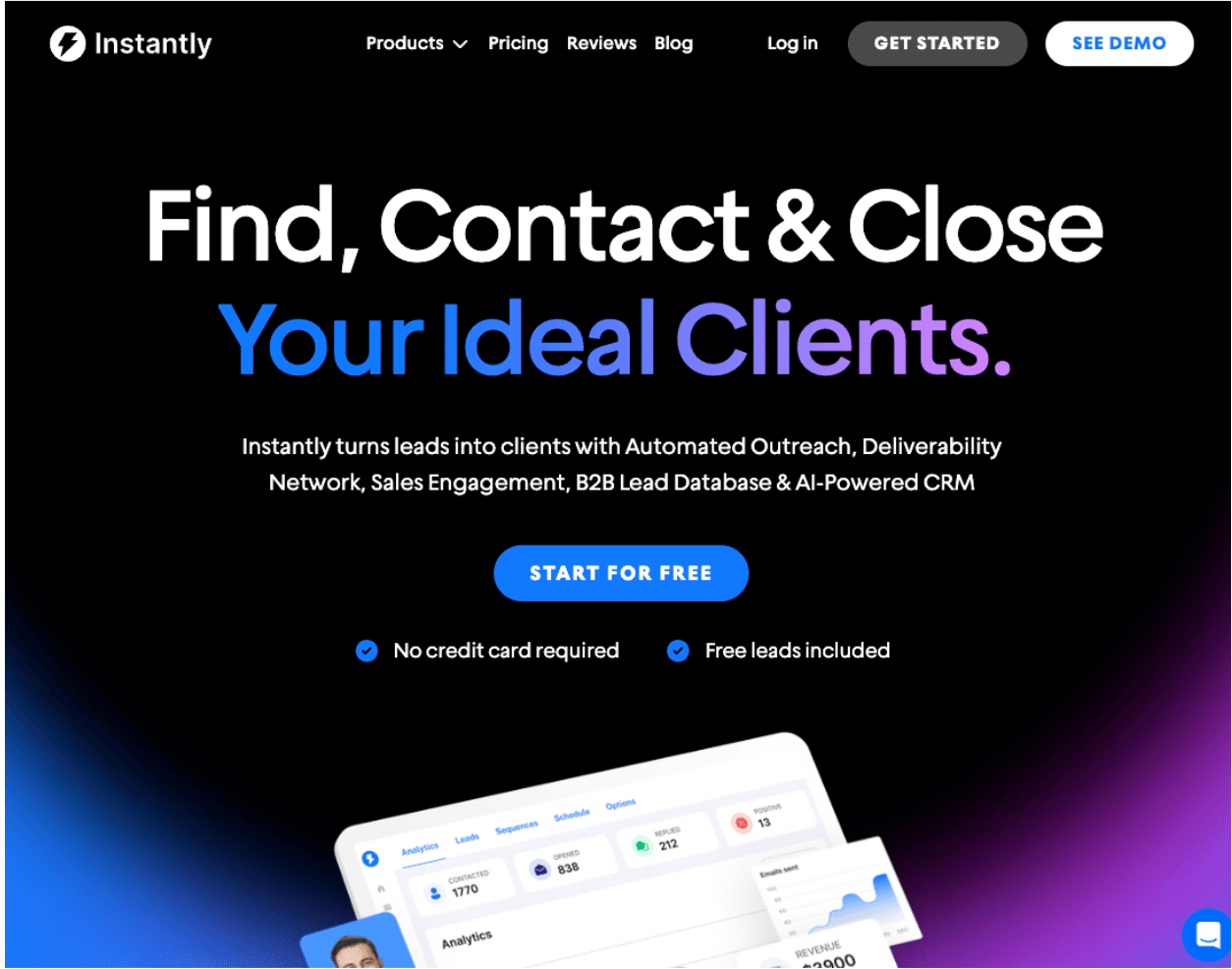
Instantly's honest limit is that it hands you infrastructure, not strategy. You still write the copy, build the targeting, and handle every reply. Its native contact data has poorer coverage than a dedicated data platform's, and its AI assistance is newer than its sending stack. Related: the best Instantly alternatives.
How does pricing compare?
The pricing models are not directly comparable, which is exactly the point. Apollo prices per seat, from free up to about $119/user/month on its higher published tier, with custom enterprise pricing above that (per its pricing page). Costs scale with the number of reps.
Instantly prices per workspace and sending capacity, from roughly $47 to $555/month across its public tiers (per its pricing page). A 3-person agency that sends from 40 mailboxes pays for capacity, not seats, which is usually cheaper for high-volume sending. A 10-rep team that needs data for each rep usually finds Apollo's bundle more economical than buying data separately and paying Instantly for volume it doesn't need.
Choose Apollo if...
You need contact data and don't want to buy a separate database.
You want prospecting, sequencing, and a dialer in one tool.
Your team is rep-driven and you value an all-in-one over best-of-breed sending.
You care about intent and warm-lead signals (strengthened by the Pocus acquisition).
Choose Instantly if...
You already have or can source your lists and your bottleneck is deliverability.
You send high cold email volume across many mailboxes.
You are an agency that runs campaigns for multiple clients.
You want transparent, capacity-based pricing rather than per-seat costs.
A third path if you'd rather not run either yourself
Both tools share the same limitation: each assumes a person drives the motion, building lists, writing copy, testing, and working replies. Apollo hands you data; Instantly hands you sending capacity. Neither runs the outreach itself, which is the job most teams actually want done.
If your goal is the outcome rather than the software, an autonomous platform like Artisan is a third path. Its AI business development representative (BDR), Ava, sources leads from a database of over 250 million B2B professionals across over 200 countries, writes and sends personalized campaigns, runs sending placement testing, and handles replies, with over 90% of customers running her autonomously. For a direct comparison, see Artisan vs. Apollo.
It is a different model from buying data (Apollo) or buying sending capacity (Instantly): you buy the job done, on usage-based pricing instead of seats or mailbox count. See the AI sales agent overview or the AI BDR primer for how this works. See also Artisan vs. Instantly.
Frequently asked questions
Can I use Apollo and Instantly together?
Yes, and many teams do. A common setup uses Apollo to source and verify contacts, then exports lists into Instantly for high-volume sending across managed mailboxes. Apollo covers data and pipeline; Instantly covers deliverability and scale. The trade-off is two subscriptions and two systems to reconcile.
Does Instantly include a contact database?
Instantly advertises a lead finder with over 450 million leads and a light CRM, so you can source inside the tool. In practice, teams that need deep, accurate firmographic and technographic data often still pair it with a dedicated data provider. Instantly's strength is sending, not data depth.
Which has better deliverability?
Instantly is built around deliverability: mailbox provisioning, a shared reputation-building network, placement monitoring, and dynamic send limits. Apollo sends too, but deliverability infrastructure is a smaller part of a much broader product. For pure high-volume cold email, Instantly is the more specialized tool.
Is Apollo good for enterprise?
Apollo scales to larger teams, but enterprises often adopt it as a data and prospecting layer rather than their governed engagement system of record. Its AI is assistive, and per-seat pricing grows with headcount. Evaluate it against dedicated enterprise sequencing and data platforms if governance and audit trails are priorities. For a sequencing comparison, see Apollo vs. Outreach.
Which is cheaper?
It depends on shape. For a few people sending high volume, Instantly's capacity-based pricing (about $47 to $555/month per its pricing page) is usually cheaper. For a larger rep team that would otherwise buy data separately, Apollo's bundled per-seat model (free to roughly $119/user/month) often wins. Map your seat count against your sending volume.
Does either of them write and send campaigns automatically?
No. Both automate mechanics like enrollment, sending, and follow-up timing, but a person still defines targeting, writes the messaging, and works the replies. Fully autonomous prospecting, where an AI owns the end-to-end BDR job, is a separate category of tool.
Is there an alternative to both Apollo and Instantly?
Yes. If you would rather not stitch a data tool to a sending tool and still run the motion yourself, an autonomous platform is the alternative. Artisan's AI BDR, Ava, combines a database of over 250 million B2B professionals with campaign writing, sending, and reply handling in one system on usage-based pricing, so the sourcing and the sending live together and the AI runs them. It is a different purchase from buying data or buying capacity; see Artisan's AI sales agent for detail.
For a wider view of the category, see our roundup of the best cold email tools, or compare approaches on the Artisan homepage. See also Apollo vs. Lemlist.
Related reading

Artisan Team
Expert insights from the team at Artisan
Our writing team blends direct operational experience, in-house data, and thorough research to bring you the very latest insights and updates about sales and GTM automation.