ZoomInfo vs. Cognism: Which should you choose in 2026?
A fair 2026 comparison of ZoomInfo and Cognism, covering US vs. EMEA data, GDPR compliance, Diamond Data, published pricing, and who each fits.
Key Takeaways
- ZoomInfo is the US enterprise data leader; Cognism is the compliance-first EMEA leader. Geography is the main decision driver.
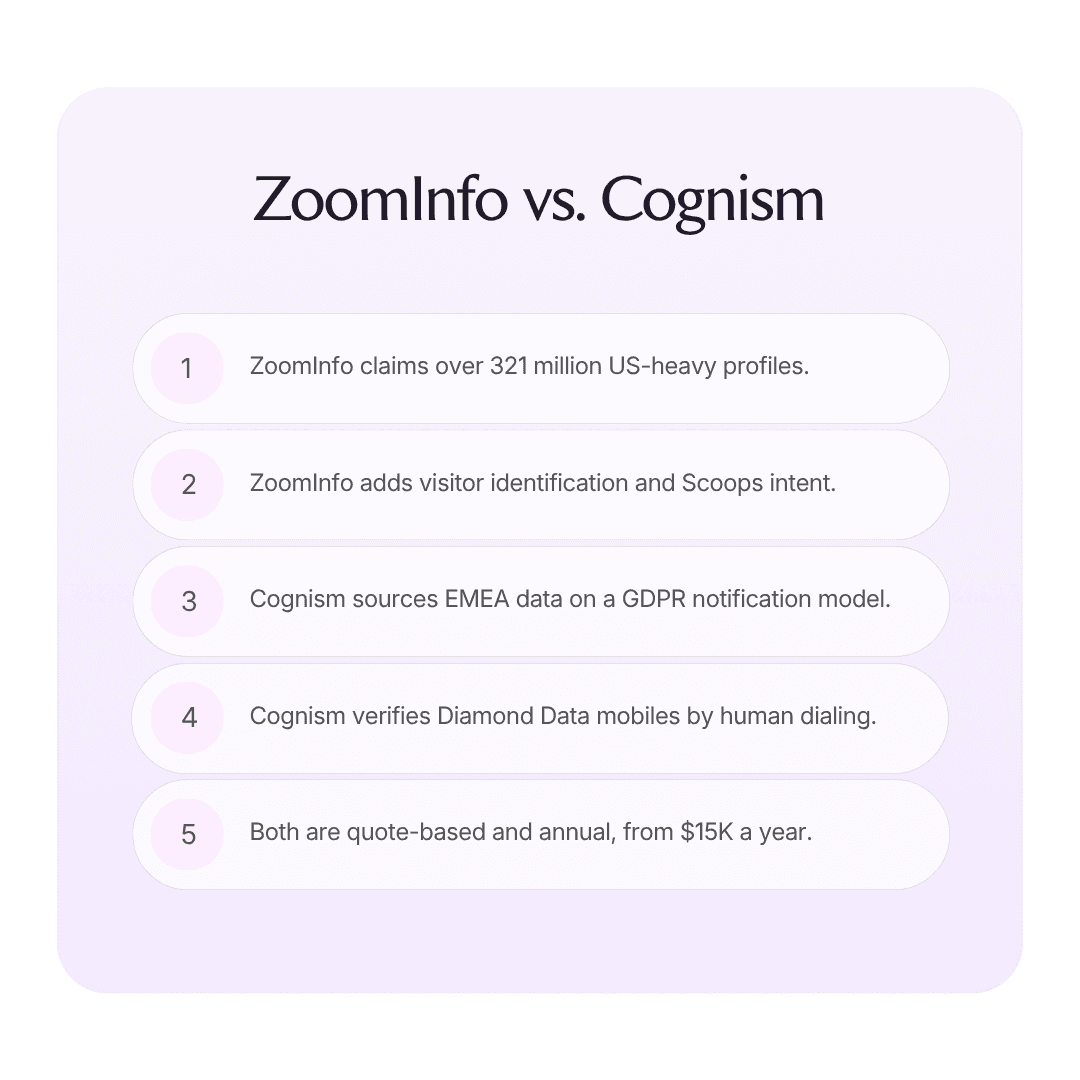
- ZoomInfo claims over 321 million profiles (a vendor figure) with WebSights visitor identification and Scoops intent; buyer-reported contracts start around $15K per year.
- Cognism's standout is Diamond Data, phone numbers verified by a human calling team, plus do-not-call (DNC) and Telephone Preference Service (TPS) scrubbing and sourcing aligned with the General Data Protection Regulation (GDPR); its pricing is gated (roughly $15K to $50K per year reported).
- Both are quote-based and annual, so budget with a full evaluation rather than a headline number.
- Cognism's Kaspr subsidiary was fined 240,000 euros by France's data-protection regulator, the CNIL, in December 2024, per the regulator; weigh it alongside Cognism's broader compliance positioning.
- Both are data-first tools. Automating the outreach that follows is a separate category, covered below.
ZoomInfo is the better fit for teams whose pipeline centers on North American accounts and who want the deepest US data plus intent signals. Cognism is the better fit for teams selling into Europe, the Middle East, and Africa (EMEA), where its compliance-first sourcing and phone-verified Diamond Data are the differentiators. The short version is US depth versus EMEA compliance.
ZoomInfo vs. Cognism at a glance
ZoomInfo | Cognism | |
Data strength | US and North America depth | EMEA coverage, compliance-first |
Best for | North America-focused teams | Europe and EMEA-focused teams |
Standout capability | WebSights, Scoops intent, data depth | Diamond Data verified phones, DNC/TPS scrubbing |
Compliance posture | US-centric, GDPR features available | GDPR-aligned sourcing, notification model |
Published pricing | Quote-based, annual (from ~$15K/yr reported) | Gated, annual (~$15K to $50K/yr reported) |
Data scale | Over 321 million profiles (vendor figure) | Large EMEA-strong database (vendor figure) |
What is the core difference between ZoomInfo and Cognism?
Geography and compliance philosophy. ZoomInfo optimizes for depth in North America; Cognism optimizes for compliant reach across Europe.
ZoomInfo is the incumbent US data platform, now positioned as the GTM Intelligence Platform and trading under the ticker $GTM. Its edge is the accuracy and richness of US enterprise data plus a signals layer, WebSights for visitor identification and Scoops for human-verified intelligence, that most rivals cannot match in this market. See ZoomInfo vs. Apollo for a head-to-head view.
Cognism was built for a different problem: selling into Europe without stepping on the General Data Protection Regulation (GDPR). It sources data with a notification-based model designed for EU compliance, scrubs against do-not-call and Telephone Preference Service registers, and centers its pitch on Diamond Data, mobile numbers verified by a human team actually dialing them. Where ZoomInfo's gravity is North America, Cognism's is EMEA, and its whole architecture reflects this. If Cognism is not the right fit, see the best Cognism alternatives.
Which has better data coverage, ZoomInfo or Cognism?
It depends entirely on where you sell. This is the rare comparison where the winner flips by territory.
For North American accounts, ZoomInfo generally leads on depth and verification. It claims over 321 million profiles (a vendor figure) and invests heavily in the US enterprise segment, which is why teams selling into North America often treat it as the default. For another provider comparison, see the best People Data Labs alternatives.
For European and EMEA accounts, Cognism is frequently the stronger source, both on coverage and on the confidence you can act on it. Diamond Data's human phone verification targets the exact pain of EMEA outbound, where mobile numbers are harder to source and compliance risk is higher. Teams with a transatlantic pipeline sometimes run both, using each where it is strongest. Our guide to the best B2B data providers compares providers by regional strength. See also Clay vs. ZoomInfo.
Which is better for GDPR and compliance?
Cognism, and it is not especially close for EMEA outbound. Compliance is the reason the product exists.
Cognism markets GDPR-aligned sourcing with a notification-based model, scrubs contacts against DNC and TPS registers, and positions compliance as a core feature rather than a checkbox. For a team dialing and emailing across Europe, this posture reduces real legal exposure and is often the deciding factor.
One honest note to weigh is that Cognism's subsidiary Kaspr was fined 240,000 euros by France's data-protection regulator, the CNIL, in December 2024, per the regulator's own reporting. It is a data point about a subsidiary, not a verdict on Cognism's core sourcing, but a careful buyer should ask about it directly. ZoomInfo offers GDPR-related features too, but its center of gravity and sourcing model are US-first, which is why compliance-heavy EMEA teams tend to prefer Cognism.
How do ZoomInfo and Cognism pricing compare in 2026?
Both are gated and annual, so neither offers the transparency of a self-serve tool. Budget for a real evaluation, not a sticker price.
ZoomInfo is quote-based and annual, with buyer-reported entry points around $15K per year that climb with seats, data volume, and add-ons like intent and WebSights. Its contract terms have a reputation buyers should go in aware of. For a deeper look, see ZoomInfo pricing and reviews.
Cognism's pricing is also gated, with reported ranges of roughly $15K to $50K per year depending on package, seats, and data access. Cognism has historically leaned on unrestricted-view or generous-credit models in some packages, which can appeal to teams that hate per-record credit anxiety, but confirm the current terms directly. Because both hide pricing behind sales, the honest advice is the same: scope your seats and data needs, then negotiate, and do not anchor on the lowest reported figure.
When should you consider a different kind of tool?
When the real goal is booked meetings, and the database is only the starting point.
ZoomInfo and Cognism both sell you data and stop there. Your reps still build the campaigns, send them, dial, and handle replies. If you would rather that motion ran itself, an autonomous platform like Artisan is a third path: it pairs a database of over 250 million B2B professionals across over 200 countries with waterfall enrichment and an AI employee, Ava, who sources leads, runs multichannel outreach, handles replies, and books meetings, so the data and the activation live in one system rather than a data vendor plus your team working behind it. See the AI sales agent page. Compare directly in Artisan vs. ZoomInfo.
This is a different purchase from either tool here. If you specifically need a data provider, ZoomInfo versus Cognism is the right comparison. If ZoomInfo is not the fit, see the best ZoomInfo alternatives.
Choose ZoomInfo if...
Your pipeline centers on North American accounts and US data depth drives revenue.
You want WebSights visitor identification and Scoops intelligence alongside the data.
You have budget for an annual, quote-based enterprise contract.
Verified US enterprise coverage is your competitive edge.
Choose Cognism if...
You sell into Europe or the wider EMEA region and compliance is non-negotiable.
Phone-verified mobile numbers (Diamond Data) and DNC/TPS scrubbing matter to your motion.
GDPR-aligned sourcing reduces real legal exposure for your outbound.
You prefer packages that ease per-record credit anxiety (confirm current terms).
Frequently asked questions
Is ZoomInfo or Cognism better for European data?
Cognism, in most cases. It was built for EMEA outbound, with GDPR-aligned sourcing, DNC and TPS scrubbing, and Diamond Data mobile numbers verified by a human team. ZoomInfo's data is deepest in North America, so European-focused teams usually find Cognism's coverage and compliance posture a better fit. Teams selling on both continents sometimes run both, using each where it is strongest.
What is Cognism's Diamond Data?
Diamond Data is Cognism's phone-verified dataset: mobile numbers checked by a human team that actually calls to confirm them, rather than relying on inference alone. The aim is higher connect rates and lower wasted dials, which matters most in EMEA, where mobile numbers are harder to source. It is Cognism's signature differentiator against providers that verify phones less rigorously.
How much do ZoomInfo and Cognism cost?
Both are gated and annual. ZoomInfo is quote-based with buyer-reported entry points around $15K per year, rising with seats and add-ons like intent and WebSights. Cognism's reported ranges run roughly $15K to $50K per year depending on package and data access. Neither publishes self-serve pricing, so scope your needs and negotiate rather than anchoring on the lowest reported figure.
Is Cognism GDPR compliant?
Cognism positions GDPR-aligned, notification-based sourcing and DNC and TPS scrubbing as core features, which is central to its EMEA appeal. One data point to weigh is that its subsidiary Kaspr was fined 240,000 euros by France's CNIL in December 2024, per the regulator. This concerns a subsidiary rather than Cognism's core sourcing, but a careful buyer should raise it directly and confirm current practices as part of due diligence.
Which has better intent data, ZoomInfo or Cognism?
ZoomInfo has the more established signals layer for the US market, including Scoops human-verified intelligence and intent data, alongside WebSights visitor identification. Cognism offers intent capabilities too, often through partnerships, but its primary differentiators are compliant sourcing and phone verification rather than a deep native intent engine. For US intent depth, ZoomInfo leads; for EMEA compliant reach, Cognism leads. See ZoomInfo vs. LinkedIn Sales Navigator for another comparison.
Is there an alternative to both ZoomInfo and Cognism?
Yes. Both are data providers: they give your reps the contacts and signals, and building campaigns, sending, dialing, and handling replies is left to your team either way. Artisan pairs a contact database and waterfall enrichment with an AI employee, Ava, who sources the leads, runs multichannel outreach, handles replies, and books meetings, so the data and the activation live in one system. It is a separate category from a data provider, covered in our guide to the AI business development representative (BDR).
The bottom line
ZoomInfo and Cognism are both premium, gated, data-first platforms, but they win in different places. ZoomInfo owns North American depth and the richest US intent signals; Cognism owns EMEA reach through compliance-first sourcing and phone-verified Diamond Data. Let geography and compliance risk decide: North America and US intent point to ZoomInfo, Europe and GDPR point to Cognism, and transatlantic teams sometimes run both. If the goal is to act on the data automatically rather than just buy it, you need a different tool. Compare models on the Artisan pricing page or start from the homepage.
Related reading

Artisan Team
Expert insights from the team at Artisan
Our writing team blends direct operational experience, in-house data, and thorough research to bring you the very latest insights and updates about sales and GTM automation.