The 12 best cold email tools in 2026
Ranked guide to cold email tools in 2026, with public pricing, deliverability rules, safe sending volumes, and honest fit verdicts.
Key Takeaways
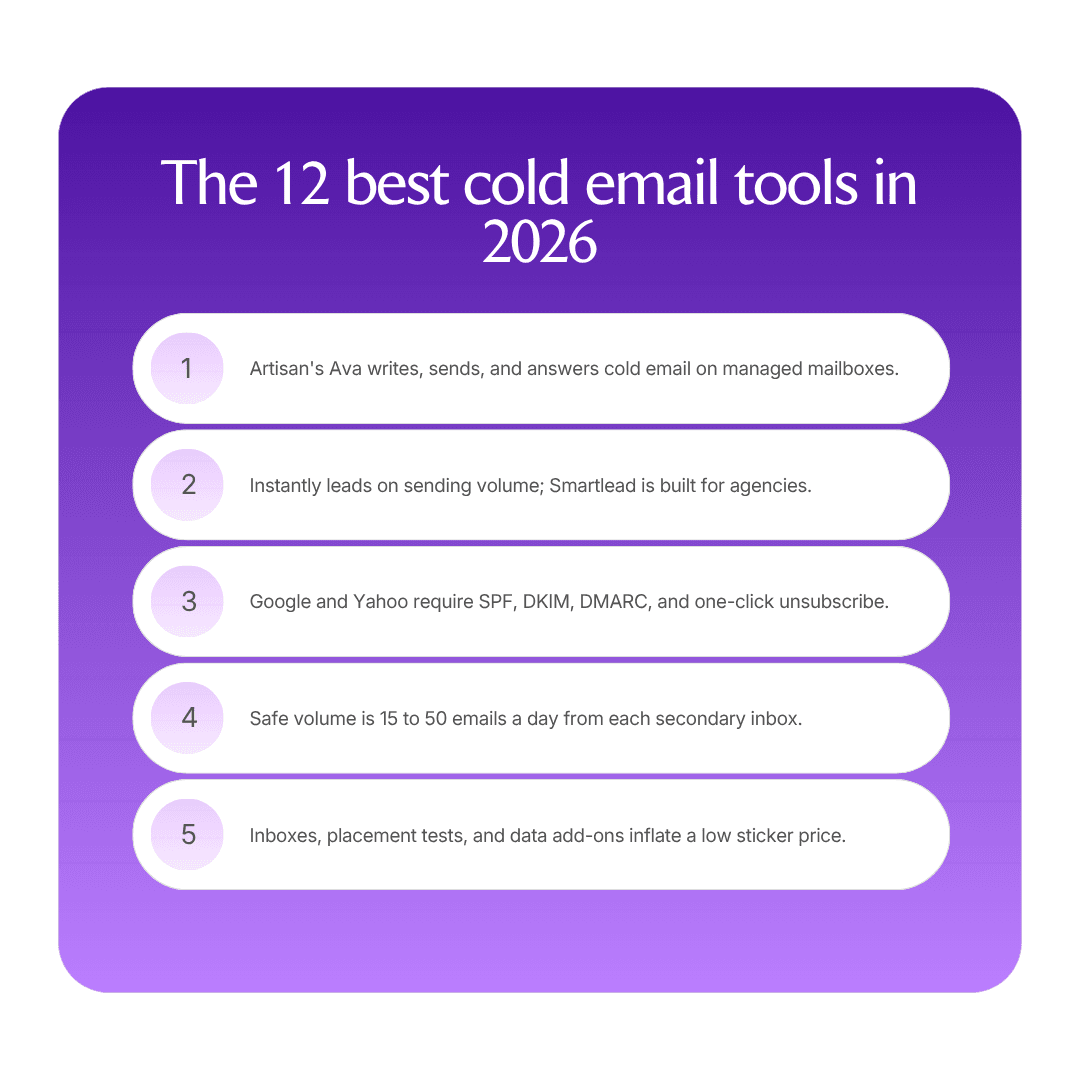
- Google and Yahoo's February 2024 bulk-sender rules made SPF, DKIM, DMARC, and one-click unsubscribe (RFC 8058) mandatory and set a 0.3% spam-complaint ceiling. Microsoft followed with similar requirements in 2025.
- Safe sending in 2026 means 15 to 50 emails per day per inbox across 3 to 8 secondary domains with 2 to 4 mailboxes each, and never your primary domain.
- Instantly is the category's volume leader, with unlimited sending accounts on every plan and over 450 million leads in its database. Plans run from $47/mo (sending-only) to $555/mo (agency), per its pricing page.
- Sticker price is rarely total price: placement testing, verification credits, lead data, and inboxes are add-ons that commonly double or triple the monthly bill.
- Artificial engagement networks have been a gray zone since Google enforced against them and cut their Gmail API access in January 2023. Apollo dropped the practice entirely in 2024 in favor of send pacing.
- SaaStr sent 6,892 emails through Ava in roughly six weeks at a 3.6% positive response rate. Per Amelia Lerutte, Chief AI Officer: "Email has always been our number one driver. Artisan is now neck-and-neck in both output and closed-won revenue."
The best cold email tool in 2026 depends on who does the work. Artisan is the best choice for teams that want cold email written, sent, and answered for them: deliverability infrastructure, AI-written per-lead messaging, and autonomous reply handling in one system. Instantly is the best pure volume sender, and Smartlead the best pick for agencies.
This guide ranks 12 tools plus the infrastructure layer underneath them, with public pricing, the post-2024 deliverability rules, and the add-on math that separates a sticker price from a real monthly bill.
Comparison table
Tool | Best for | Standout capability | Public pricing |
Artisan | Cold email written, sent, and answered for you | AI-written per-lead messaging, managed deliverability, and autonomous replies | Usage-based credits, see pricing |
Instantly | High-volume sending | Unlimited sending accounts on all plans, over 450 million leads | $47-555/mo, per its pricing page |
Smartlead | Agencies and API builders | Unlimited mailboxes, white label at $29/client | $39-379/mo, per its pricing page |
Lemlist | Personalization-first multichannel | Image and video personalization, sending ramp-up bundled | $69-109/user/month ($55-87 annual), per its pricing page |
Woodpecker | Paying for usage, not seats | $7 per 100 prospects contacted, unlimited seats and inboxes | Usage-based, per its pricing page |
Saleshandy | Budget volume with built-in lead finder | 700 million-contact lead finder attached | $25-209/mo annual, per its pricing page |
QuickMail | Agency deliverability control | Pioneered inbox rotation, automated ramp-up included | $49-299/mo, per its pricing page |
Reply.io | Multichannel sequences with an AI agent option | Jason AI agent on top of a mature sequencer | $59/mo+, Jason AI from about $500/mo, per its pricing page |
Salesforge | Cheap platform with an AI agent upgrade path | Agent Frank AI SDR at $499/mo | $40-80/mo platform, per its pricing page |
Snov.io | Finder, drips, and CRM in one credit wallet | Email finder and verifier attached to sequences | $39-738/mo, per its pricing page |
Mailshake | Simple sending for small teams | Straightforward UX, long track record | $59-99/mo, per its pricing page |
La Growth Machine | Social-first multichannel outreach | Email plus LinkedIn touches in one sequence | €60-180/identity/month, per its pricing page |
Infrastructure layer (not ranked): Maildoso ($0.49-2.50/mailbox), Inframail (flat $129-499/mo unlimited), Mailreef (dedicated server and IP, roughly $240-249/mo). See the add-on cost section below.
How we chose
Five criteria: deliverability infrastructure (mailbox provisioning, rotation, placement testing, bounce handling), personalization depth (merge tags against per-lead AI writing), what happens after the reply, total cost including add-ons, and vendor trajectory through the 2024-26 deliverability crackdown. Pricing is attributed to vendor pricing pages.
What are the best cold email tools in 2026?
1. Artisan: Best for cold email written, sent, and answered for you
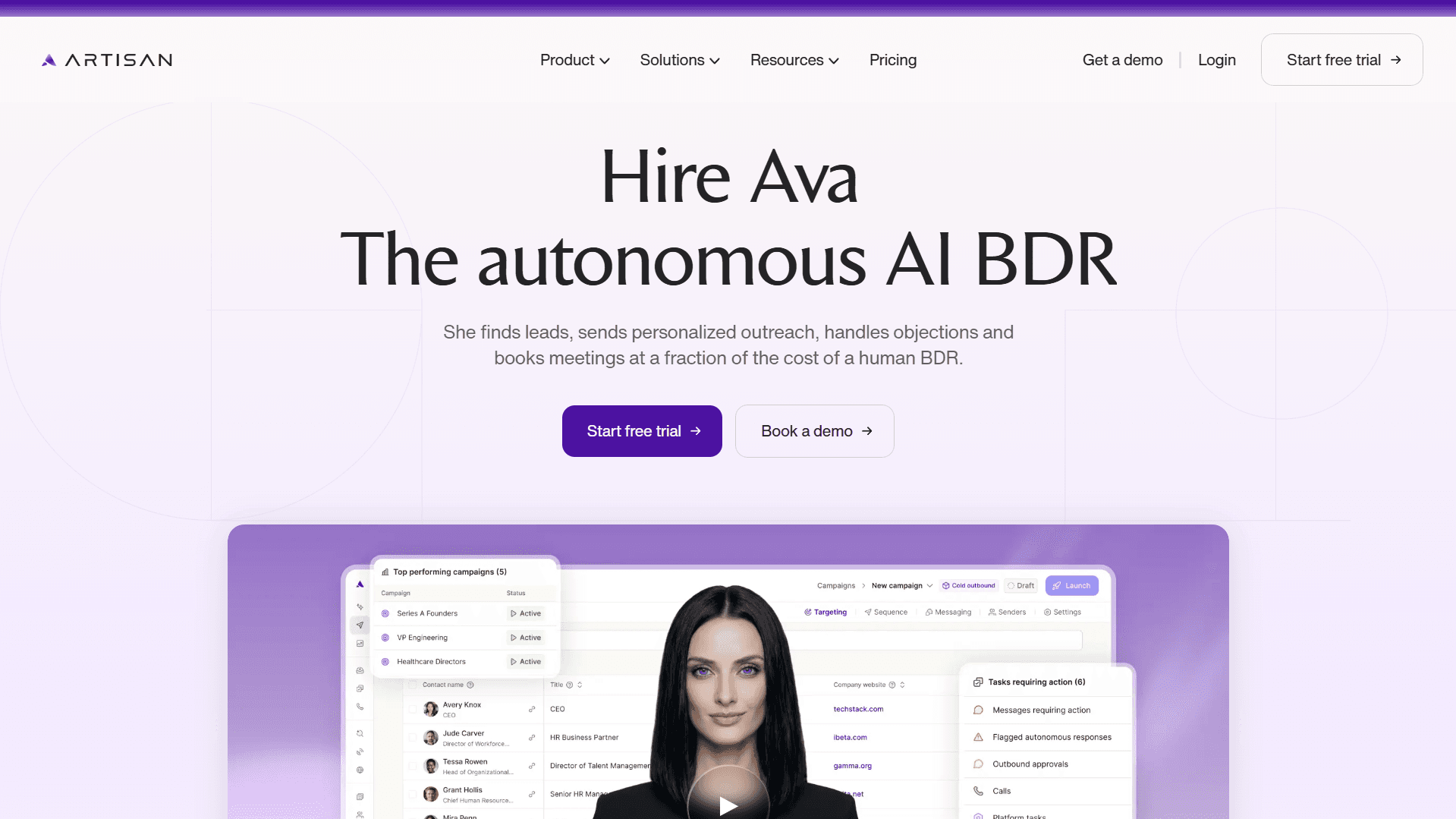
Every other tool on this list makes you faster at doing cold email. Artisan's AI business development representative (BDR), Ava, does the cold email. She sources leads from a database of over 250 million B2B professionals across over 200 countries, plus Artisan Local Data with over 250 million local businesses, using natural-language search, ideal customer profile (ICP) filters, and intent signals such as funding rounds, new executive hires, and active hiring. She enriches them with waterfall lookups across roughly a dozen providers and ranks them by likelihood of converting, writes per-lead messaging (two people in the same campaign receive two completely different emails, not the same template with a swapped first name), sends across email, social media, and dialer call steps, handles replies and objections, and books qualified meetings on reps' calendars.
The deliverability layer that specialists sell as the product is built in: managed secondary mailboxes, inbox placement testing, an SPF, DKIM, and DMARC DNS checker, mailbox health dashboards with alerts, dynamic send limits, inbox rotation, and bounce-pattern detection that auto-pauses unhealthy mailboxes. Autonomy is adjustable rather than binary: review and approve every message, restrict Ava to objection-handling, or let her run fully autonomous with plain-language escalation rules. Artisan reports over 90% of its customers run Ava autonomously. This control layer is also what carries enterprise deployments: sales ops runs Ava centrally for large teams whose reps never log in, governed by escalation rules, a full audit trail, org-level do-not-contact, and field-level CRM controls, with single sign-on (SSO) and SOC 2 Type II plus a forward-deployed strategist and dedicated customer success manager (CSM) on Enterprise plans.
The proof point: SaaStr sent 6,892 emails through Ava in roughly six weeks, 3,574 of them to net-new leads, at a 3.6% positive response rate and 49.4% acceptance on social media connection requests. Amelia Lerutte, Chief AI Officer at SaaStr: "Email has always been our number one driver. Artisan is now neck-and-neck in both output and closed-won revenue."
Pricing is usage-based: a credit-per-action model where you pay for work performed rather than seats or inbox counts, with a free trial and no platform fee (pricing).
Best for: teams that want pipeline from cold email without staffing the copywriting, sending, and inbox-management work, from founder-led teams on self-serve to enterprises that run Ava centrally from sales ops.
Who should pick something else: agencies reselling sending capacity across many client brands (Smartlead, Instantly), and solo senders who enjoy hand-tuning campaigns and want the cheapest possible per-email cost.
2. Instantly: Best volume sender
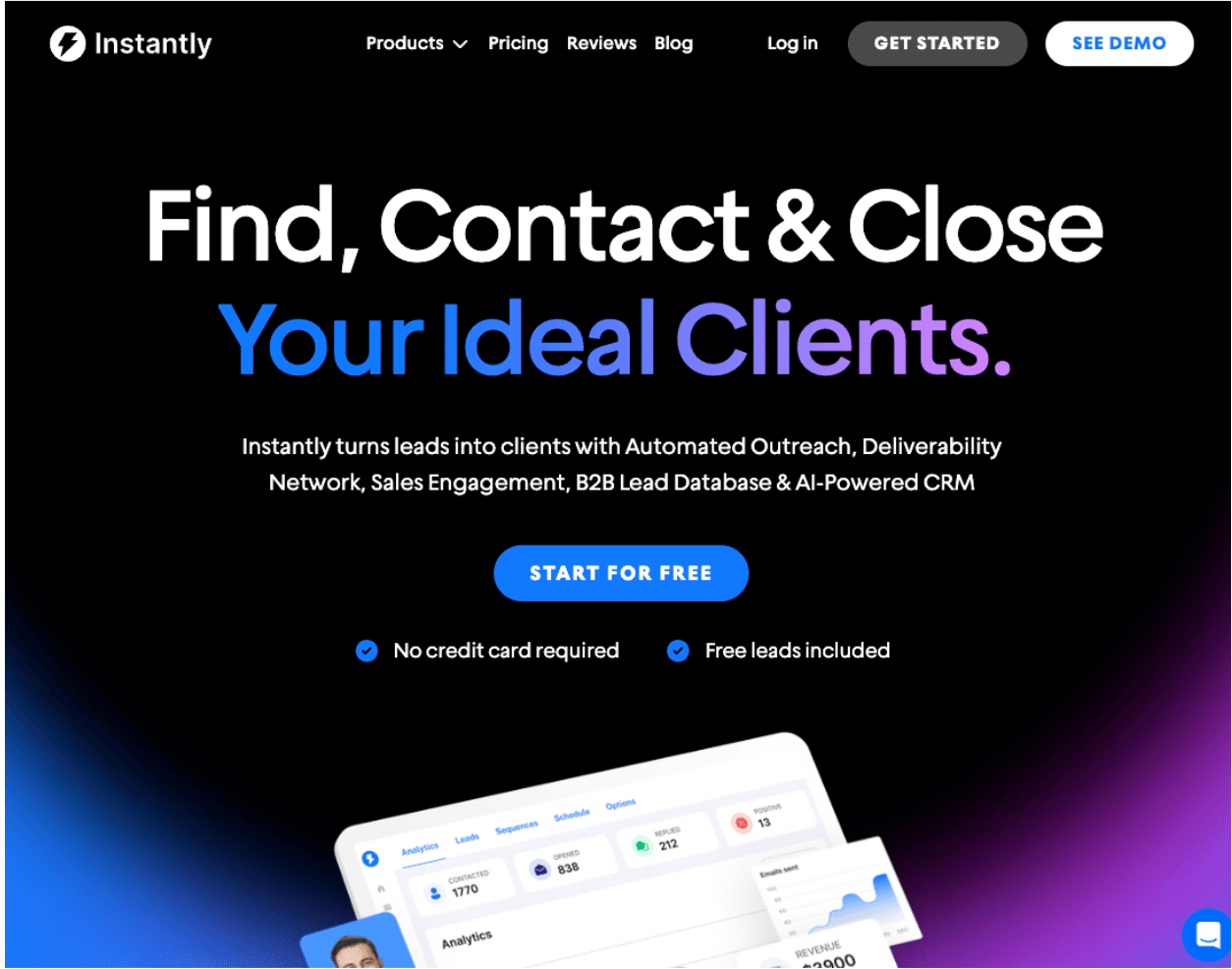
Instantly is the category's scale leader: unlimited connected accounts and automated sending ramp-up on every plan, over 450 million leads in its database, a built-in CRM, AI agents, and the Unibox shared inbox. Pricing runs from $47/mo for sending-only plans through Starter at $94 and Scale at $194 to $555/mo agency tiers, per its pricing page. For head-to-head breakdowns, see Apollo vs. Instantly and Artisan vs. Instantly.
Best for: teams and agencies that run high-volume programs across many domains and want the biggest ecosystem and community.
Who should pick something else: teams that want the writing and replies handled (Instantly makes sending cheap, but you still do the work), and buyers wary of the artificial-engagement gray zone discussed below.
3. Smartlead: Best for agencies and API builders
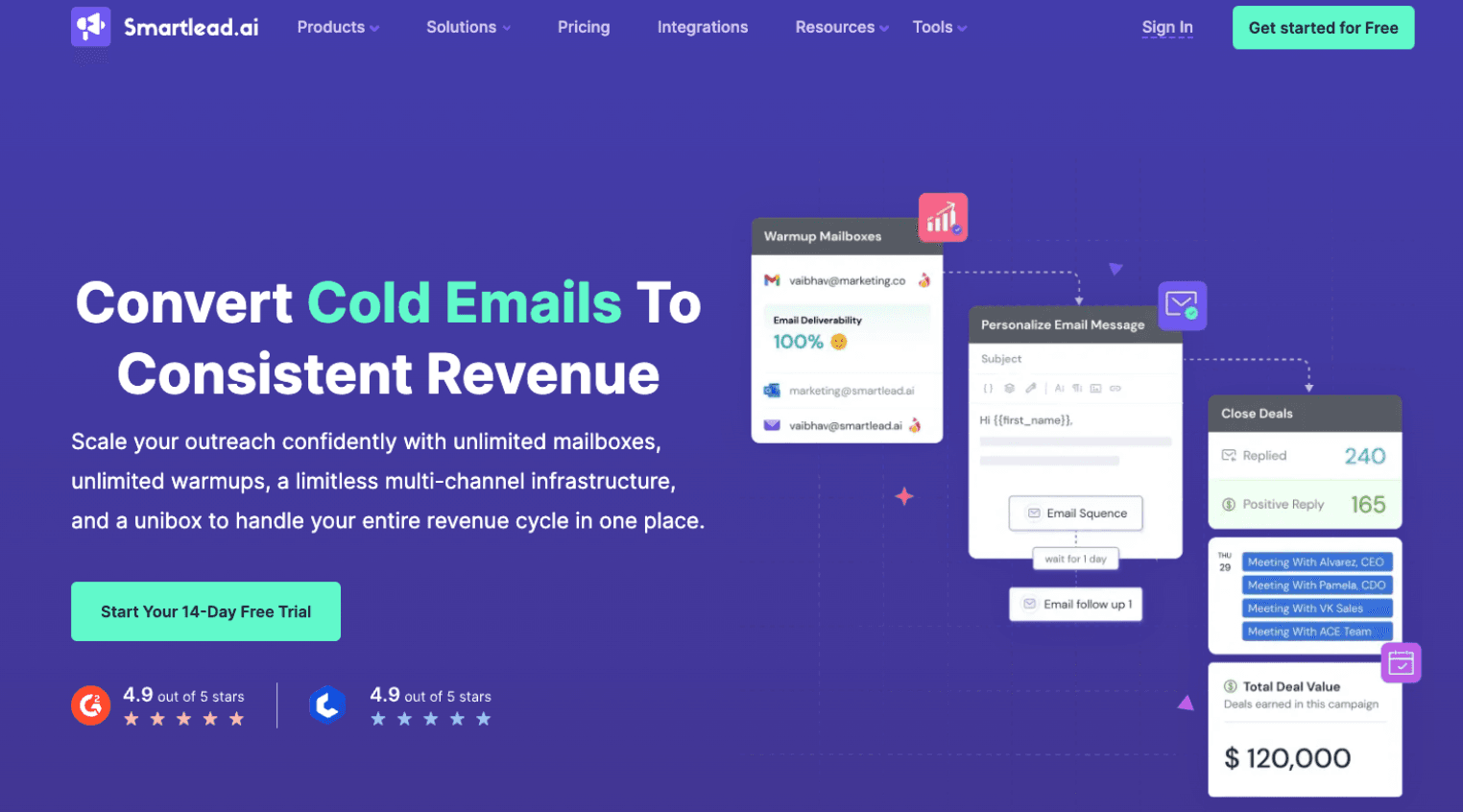
Smartlead is the agency workhorse: unlimited mailboxes, white labeling at $29 per client, an API that cold-email agencies build businesses on, and SmartDelivery placement testing as a $49-599 add-on. Plans run $39-379/mo, per its pricing page. Add-on creep is the recurring complaint: the base price is rarely the real price. For agency-specific picks, see our roundup of outbound sales tools.
Best for: agencies that manage dozens of client accounts and developers building on an API.
Who should pick something else: in-house teams that want an all-inclusive price, and anyone allergic to buying placement testing, verification, and infrastructure separately.
4. Lemlist: Best for personalization-first multichannel
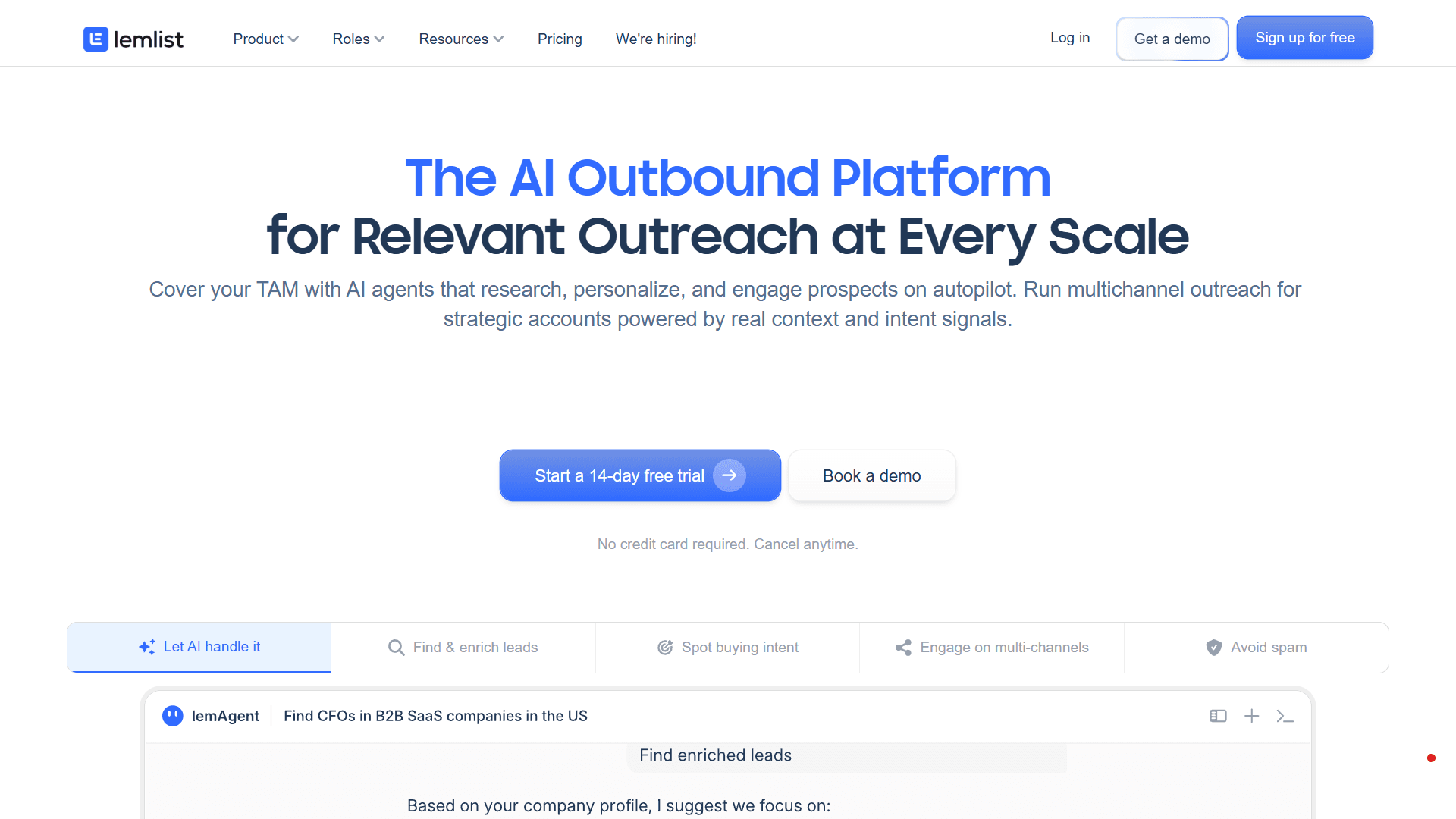
Lemlist made its name on personalized images and video in cold email and has grown into multichannel sequences with LinkedIn touches, with automated sending ramp-up bundled. Email plans are $69/mo and Multichannel $109/mo per user ($55 and $87 annual), per its pricing page. Parent lempire is bootstrapped at roughly $40M revenue and acquired video platform Claap for $25M in October 2025 to push further into AI sales assets. For deeper comparisons, see Apollo vs. Lemlist and Artisan vs. Lemlist.
Best for: small teams that win on creative personalization and want email plus LinkedIn in one sequence.
Who should pick something else: pure-volume senders. Per-user pricing punishes scale compared with Instantly or Woodpecker.
5. Woodpecker: Best usage-based pricing
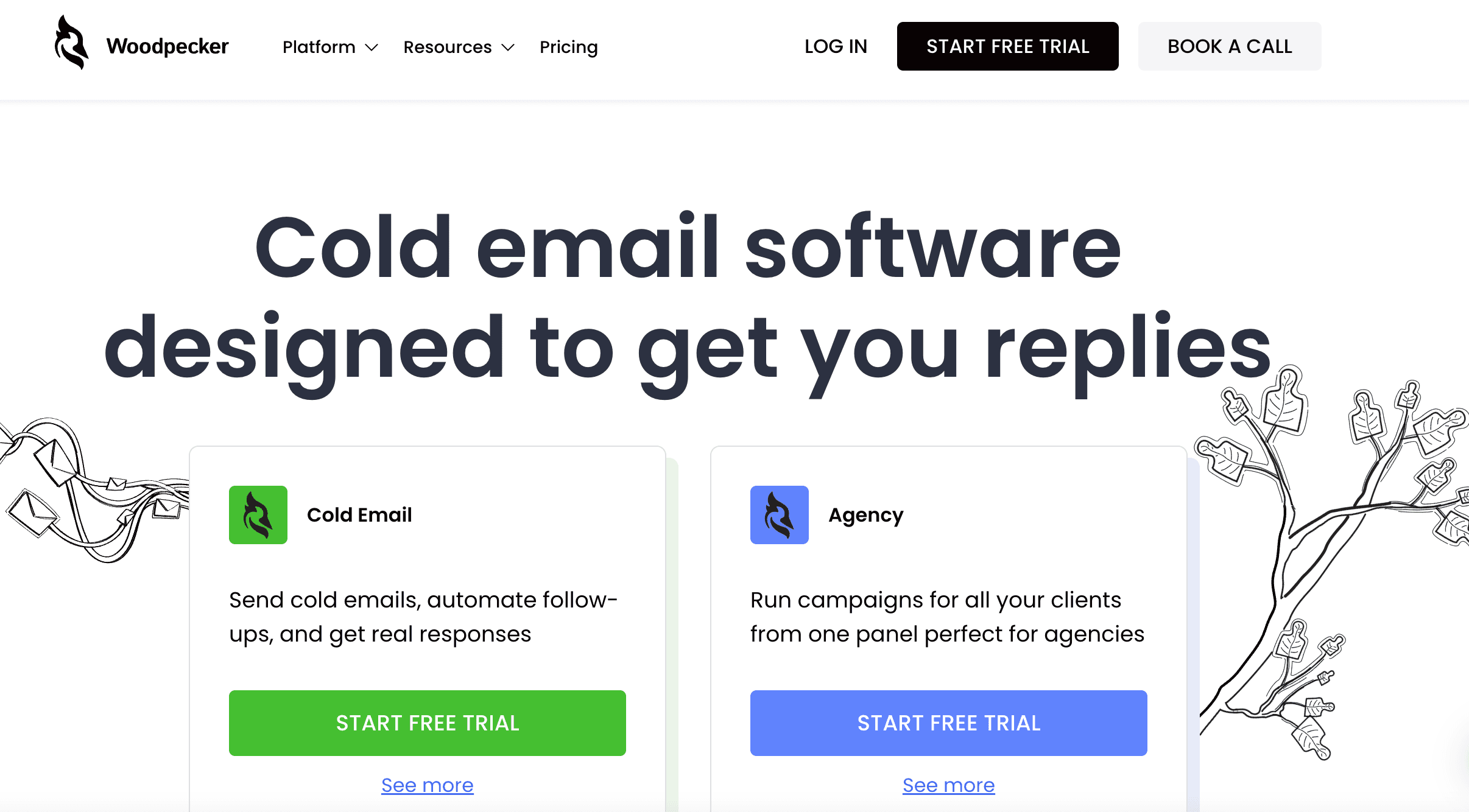
Woodpecker charges $7 per 100 prospects contacted per month with unlimited seats, unlimited inboxes, and sending ramp-up included, per its pricing page. This inverts the category's economics: you pay for prospects actually touched, not seats or theoretical capacity. It is also known for cautious, deliverability-first defaults, a good match for the 2026 rules.
Best for: teams with variable sending volume that want costs tracking usage, and agencies with many low-volume clients.
Who should pick something else: teams that want a big built-in lead database or AI agent features. Woodpecker is a sender rather than a data platform.
6. Saleshandy: Best budget pick with a lead finder attached
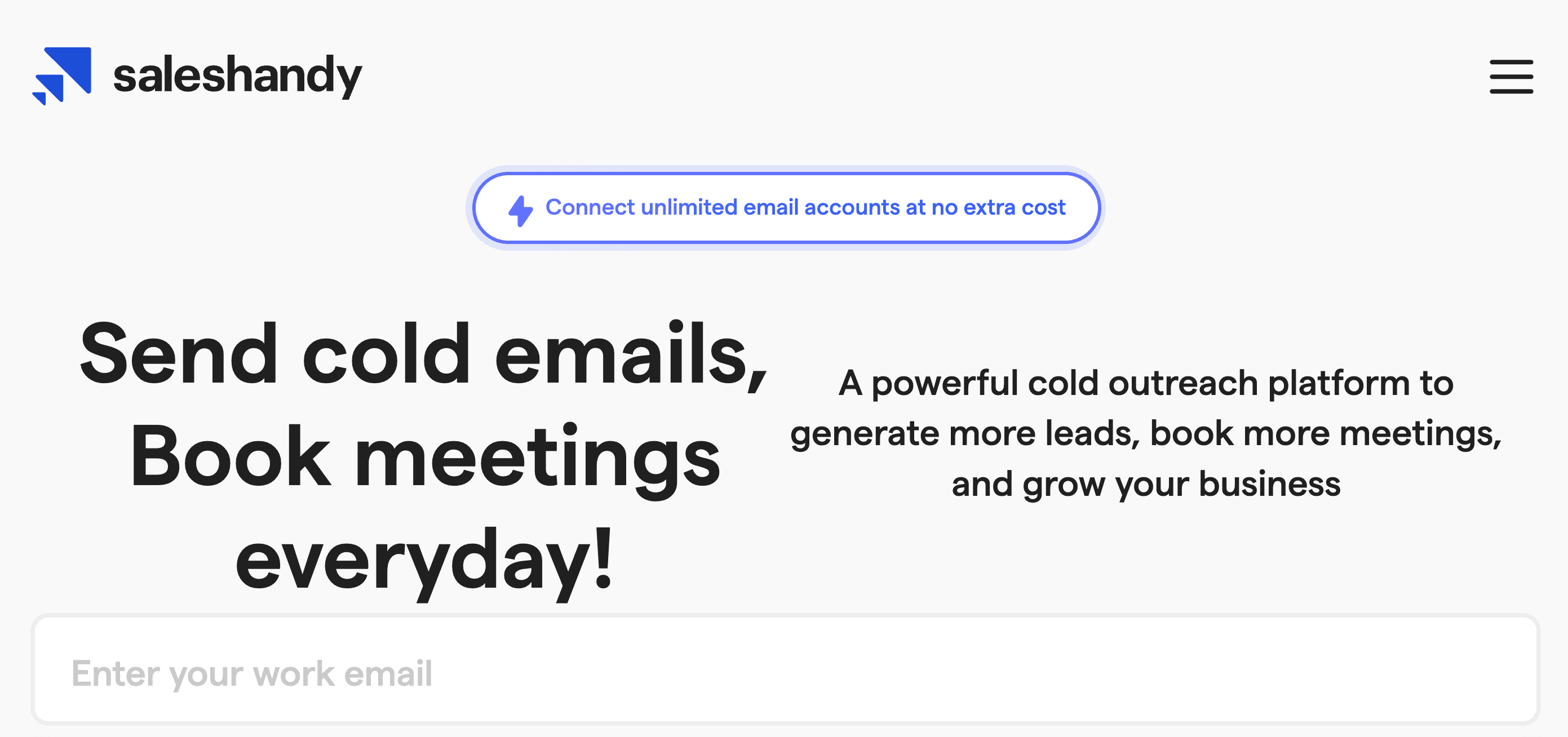
Saleshandy pairs volume sending with a 700 million-contact lead finder at $25-209/mo billed annually, per its pricing page. This is one of the cheapest paths to list-plus-sending in one tool.
Best for: bootstrapped teams that want prospecting data and sending under one low bill.
Who should pick something else: teams for whom data accuracy is critical. Bundled databases at this price point trail dedicated providers, so verify before you send.
7. QuickMail: Best for agency deliverability control
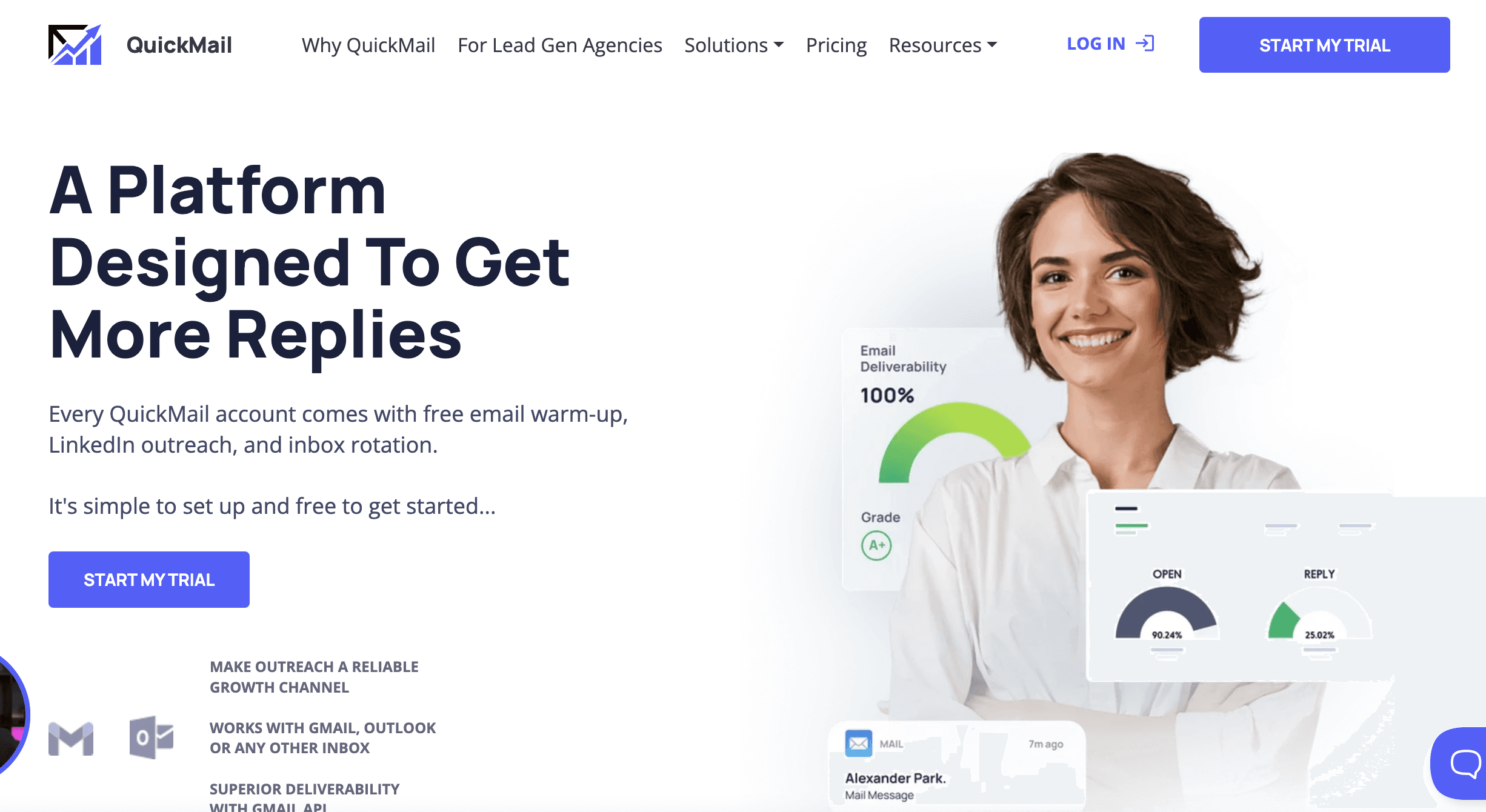
QuickMail pioneered inbox rotation (spreading a campaign across many mailboxes automatically, now a category standard) and stays deliverability-obsessed, with automated sending ramp-up included at no extra cost and unlimited senders. Plans are $49, $99, and $299/mo, per its pricing page.
Best for: agencies and advanced senders who want granular deliverability control without add-on nickel-and-diming.
Who should pick something else: beginners. The control surface assumes you know what you're doing.
8. Reply.io: Best multichannel sequencer with an AI agent option
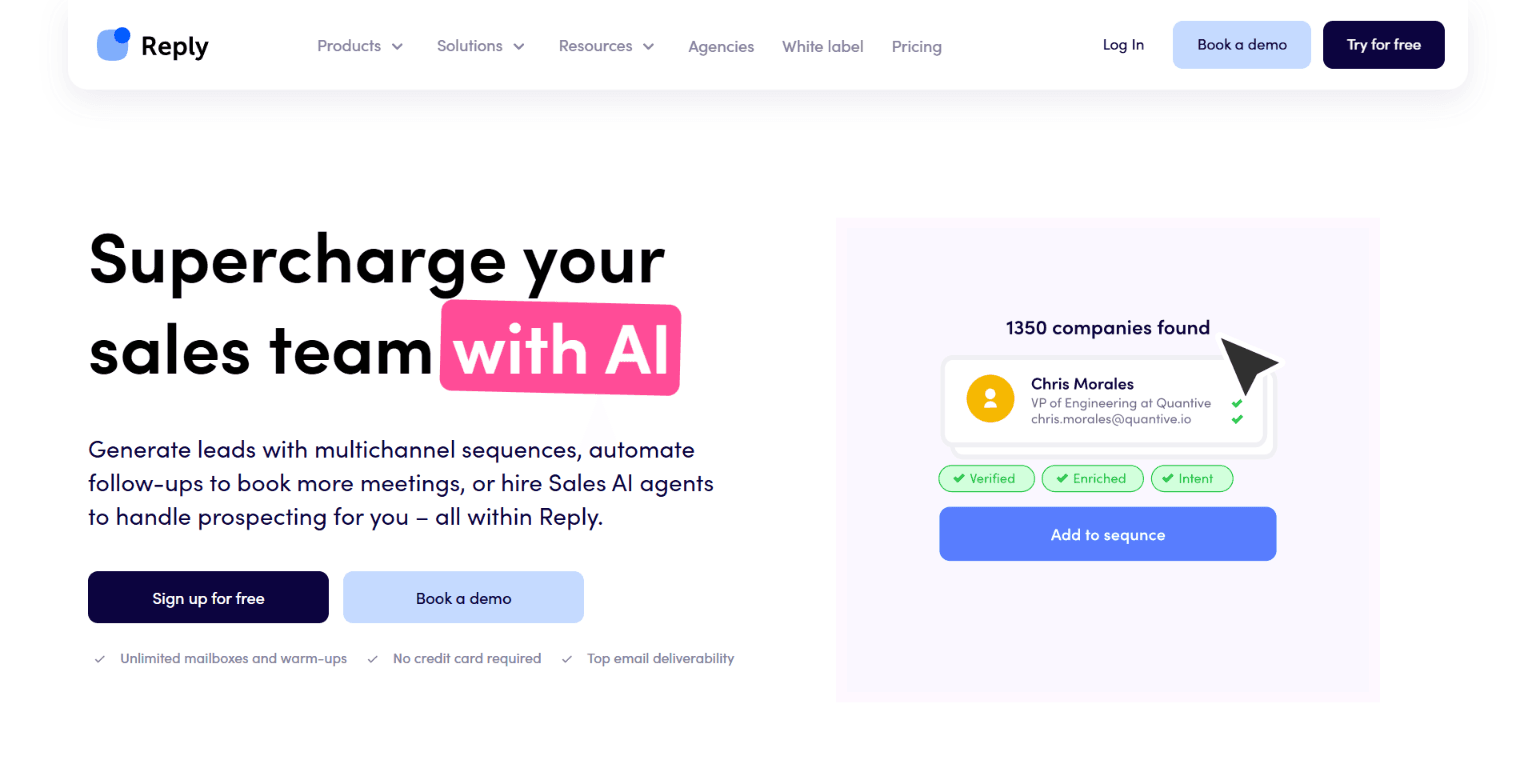
Reply.io is a mature multichannel platform, with sequences from $59/mo and multichannel plans at $89-99/user/month, per its pricing page. Jason AI, an AI sales development representative (SDR) agent, layers on top from roughly $500-800/mo. It is a credible bridge for teams moving from manual sequencing toward agent-run outreach.
Best for: teams that want a proven sequencer today with an AI agent upgrade path.
Who should pick something else: teams going straight to autonomous outreach. The agent is an add-on to a human-driven platform rather than the platform's native mode.
9. Salesforge: Best cheap platform with an agent upgrade path
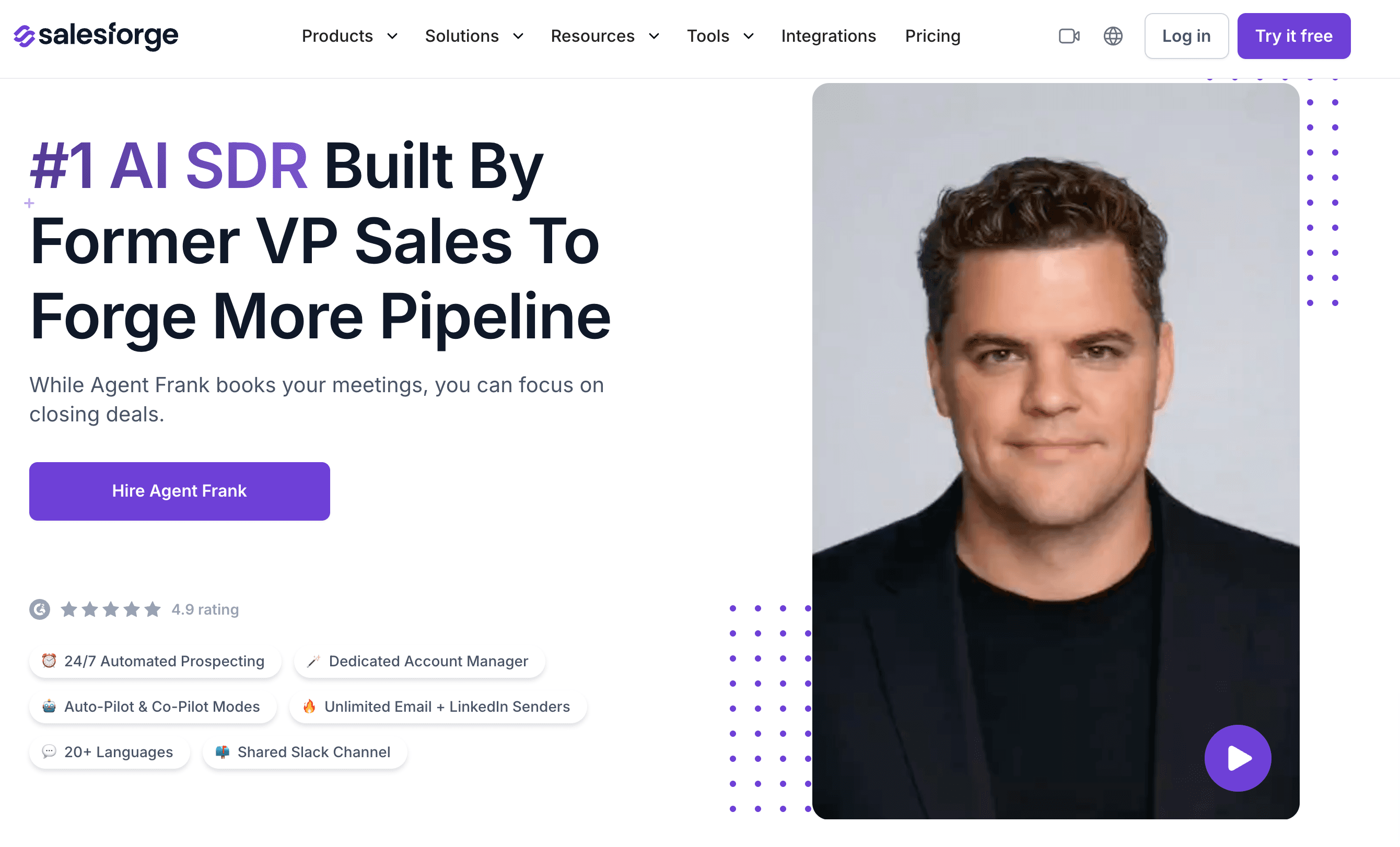
Salesforge runs $40/mo (Pro) to $80/mo (Growth) for the sending platform, with Agent Frank, its autonomous AI SDR, at $499/mo, per its pricing page. The company also operates adjacent infrastructure brands, reflecting the category's vertical-integration trend.
Best for: price-sensitive teams that want to start cheap and test an AI agent later.
Who should pick something else: enterprises that need deep CRM governance and a large support organization behind the product.
10. Snov.io: Best finder, drips, and CRM in one credit wallet
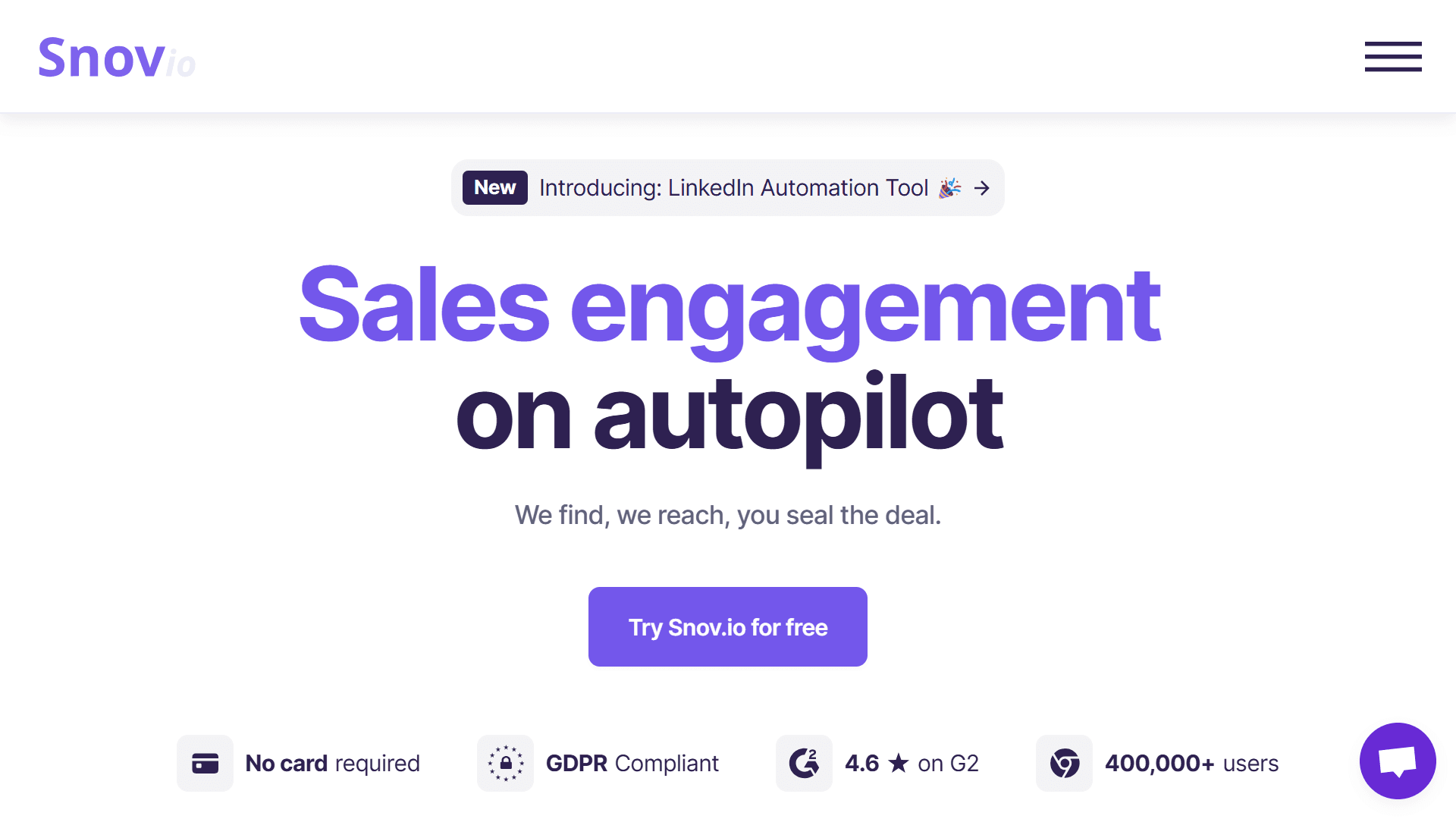
Snov.io bundles an email finder, verifier, drip campaigns, and a light CRM on credit-based plans from $39 to $738/mo, per its pricing page.
Best for: small teams and founders who want find-verify-send in one inexpensive loop.
Who should pick something else: teams scaling past roughly 10,000 sends a month, where credit mechanics and lighter deliverability tooling show strain.
11. Mailshake: Best for simple sending
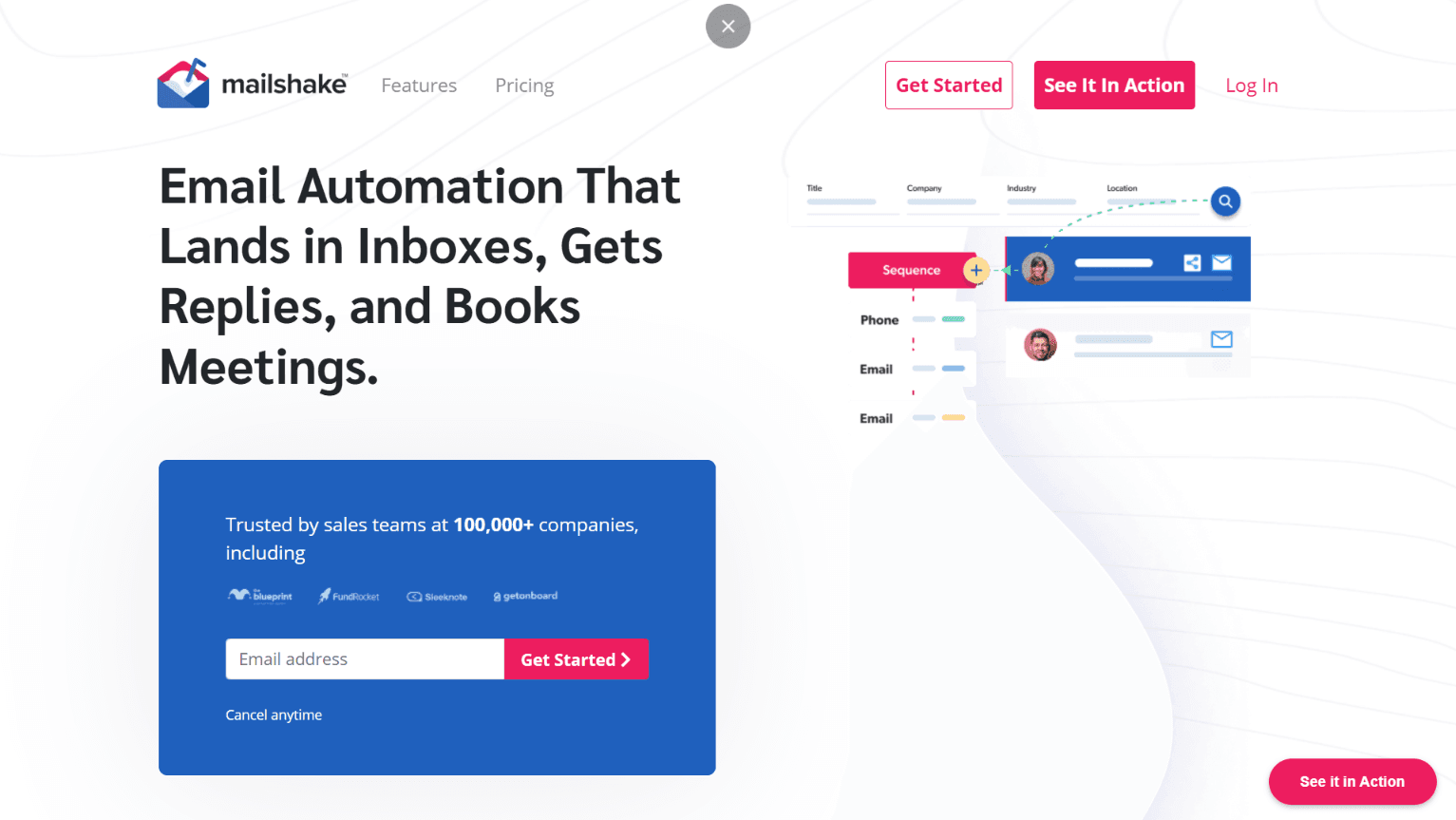
Mailshake is the straightforward veteran: clean UX and $59-99/mo pricing (Email Outreach $59, Sales Engagement $99), per its pricing page. Product velocity is slower than the category leaders', and there is no free trial.
Best for: small teams that want dependable, uncomplicated sending without an ecosystem to learn.
Who should pick something else: anyone who wants rapid feature development, AI-written messaging, or modern infrastructure management.
12. La Growth Machine: Best social-first multichannel
La Growth Machine sequences email alongside LinkedIn touches (profile visits, connection requests, and messages) at €60-180 per identity per month, per its pricing page. For motions where buyers live on social media and email is the follow-up channel, that ordering matters.
Best for: European teams and recruiters that run social-led sequences with email support.
Who should pick something else: high-volume email programs. Per-identity pricing and social rate limits cap throughput by design.
The infrastructure layer: Maildoso, Inframail, Mailreef
Underneath every sender sits a market that barely existed in 2022: cold-email inbox and domain infrastructure at $0.50 to $5 per inbox. Maildoso sells mailboxes at $0.49-2.50 each, Inframail charges a flat $129-499/mo for unlimited inboxes, and Mailreef rents dedicated servers and IPs at roughly $240-249/mo for agencies. Sequencers are now vertically integrating this layer, and Artisan's managed mailboxes make it invisible entirely. If you run Instantly or Smartlead at scale, you will almost certainly buy from this layer too. Budget for it.
How did the 2023-2025 deliverability crackdown change cold email?
For years, senders leaned on artificial engagement networks: tools exchanged automated emails between real inboxes and marked them as important to inflate sender reputation. In January 2023, Google enforced against the major networks and cut their Gmail API access, ending the practice's officially tolerated era. Then came the February 2024 Google and Yahoo bulk-sender rules: SPF, DKIM, and DMARC authentication became mandatory, one-click unsubscribe (RFC 8058) became required for bulk senders, and a 0.3% spam-complaint ceiling became a hard line. Cross it and your domain's mail stops landing. Microsoft followed with similar requirements for senders of over 1,000 daily emails in 2025. Apollo dropped artificial engagement entirely in 2024 and replaced it with send pacing, and while most of this list still bundles sender reputation tools, the center of gravity has moved to what mailbox providers actually reward: gradual volume ramp for new inboxes, clean DNS (SPF, DKIM, DMARC), low per-inbox volume, and list quality. None of it rescues bad targeting or spammy copy from a 0.3% complaint ceiling. Treat reputation tools as a supplement to authentication, list quality, and volume discipline rather than a substitute.
How many cold emails can you safely send per day?
The 2026 norm is 15 to 50 emails per day per inbox (a hard ceiling of 50, though conservative operators keep closer to 20 or 30), sent from 3 to 8 secondary domains with 2 to 4 mailboxes each, never from your primary domain. This architecture yields roughly 300 to 1,500 sends per day at safe per-inbox volumes while quarantining reputation risk away from the domain your company actually depends on. New inboxes need 2 to 4 weeks of gradual volume increase before full throughput. This is why "unlimited sending" plans are a half-truth: the software is unlimited, the inboxes are not. Artisan enforces this discipline automatically, with managed secondary mailboxes, dynamic send limits, inbox rotation, and bounce-pattern detection that auto-pauses an unhealthy mailbox before it burns a domain. Safe volume is a system default rather than an operator skill. For the full playbook, see how to send cold email at scale without hurting deliverability.
What do cold email tools really cost once you add everything up?
Run the math on a mid-market team sending roughly 30,000 emails per month before buying on sticker price:
Instantly: the Scale plan at $194/mo, per its pricing page, plus mailboxes and secondary domains bought from the infrastructure layer, plus verification and lead credits.
Smartlead: $94-174/mo for the tier most teams land on, plus SmartDelivery placement testing as a $49-599 add-on, plus inboxes, plus white label for agencies. This is the add-on creep the category is known for.
Woodpecker: pure usage at $7 per 100 prospects contacted. Around 2,000 fresh prospects a month, plus infrastructure.
Artisan: one usage-based bill. Credits for work performed, with mailboxes, placement testing, enrichment, and reply handling inside, and no platform fee (pricing).
The pattern is consistent: specialist tools price the software low, and the operating stack (inboxes, domains, placement tests, verification, data) accumulates around it, before counting the human hours to write copy and work replies. Consolidated platforms price the whole job. Compare on total monthly cost per booked meeting rather than per subscription.
What changed in the cold email category in 2025 and 2026?
Microsoft joined the crackdown in 2025, applying Google and Yahoo-style authentication and unsubscribe requirements to senders of over 1,000 daily emails, closing the last major loophole.
lempire (Lemlist) acquired Claap for $25M in October 2025, pushing AI video and sales assets into cold outreach.
The inbox-infrastructure market ($0.50 to $5 per inbox: Maildoso, Inframail, Mailreef, Hypertide) matured and began being vertically integrated by the sequencers themselves.
AI agents became the category's upgrade path: Instantly shipped AI agents, and Reply.io's Jason AI and Salesforge's Agent Frank ($499/mo) moved from novelty to standard offering, converging the category toward the autonomous model Artisan started with.
Sending economics kept shifting from seats to usage. Woodpecker's per-prospect pricing and credit models across the category echo the industry-wide move away from per-seat licensing.
Frequently asked questions
What is the best AI cold email tool?
Artisan, for teams that want AI doing the job end to end: research, per-lead writing, sending on managed infrastructure, and reply handling, with autonomy you dial up or down. Reply.io's Jason AI and Salesforge's Agent Frank are credible agent add-ons on cheaper platforms, and Instantly's AI features assist high-volume senders. The dividing line is simple. Most "AI cold email" features draft text you still operate. Artisan's Ava owns the workflow.
What is the best cold email tool for startups and small businesses?
For founders doing their own sending on a budget, Saleshandy (from $25/mo annual) and Snov.io (from $39/mo) bundle data with sending cheaply, and Woodpecker's $7-per-100-prospects pricing tracks tiny volumes. For startups that would rather spend founder hours elsewhere, Artisan's free trial and usage-based model deliver the whole motion without hiring for it, and the same platform scales to enterprise deployments run centrally from sales ops. SumUp reached local businesses at a $52 cost per lead with 8 to 15 positive replies a week, targeting from Artisan Local Data.
What is the best cold email tool for B2B sales teams?
Mid-market B2B teams should shortlist Artisan (the work done for you, CRM-native logging to Salesforce and HubSpot), Instantly (volume economics), and Lemlist (multichannel personalization). Enterprise teams should weigh governance (suppression lists, domain-level do-not-contact, audit trails), where consolidated platforms like Artisan are stronger. See our guide to AI SDRs and how they work.
What are the best tools for personalized cold email at scale?
True per-lead personalization at scale requires research plus generation rather than merge tags. Artisan writes each email from AI research on the individual lead, so two prospects in one campaign receive two different messages. Lemlist personalizes creative assets (images, video), and Clay-style enrichment feeding a sequencer is the DIY route. Template-with-variables tools personalize the first line at best. Buyers in 2026 recognize the pattern immediately.
Is cold email still legal under the 2024-2026 rules?
Yes. B2B cold email remains legal in the US under CAN-SPAM (with honest headers, an unsubscribe path, and a physical address) and is workable in Europe under legitimate-interest rules applied carefully. The 2024 Google and Yahoo requirements are deliverability standards rather than laws, but they function as hard rules: break the 0.3% complaint ceiling and your domain is filtered regardless of legality. Compliant unsubscribe handling and suppression lists are table stakes. Artisan builds both in.
Instantly vs. Smartlead: Which should I pick?
Instantly for in-house teams and community-driven operators: built-in lead database, simpler packaging from $47/mo, and the category's largest user community. Smartlead for agencies and developers: unlimited mailboxes, $29/client white label, and the stronger API, if you accept add-on costs like SmartDelivery ($49-599). Both make you the operator. Neither writes per-lead copy or works your replies for you.
Do I need a separate inbox infrastructure provider?
At scale on a specialist sender, usually yes. Buying 10 to 30 mailboxes across 3 to 8 secondary domains from Maildoso ($0.49-2.50/inbox), Inframail (flat $129-499/mo), or Mailreef (roughly $240/mo dedicated) is standard practice. Some sequencers now resell inboxes directly. On Artisan, no: managed secondary mailboxes, inbox rotation, and placement testing are part of the platform, which removes an entire vendor from the stack.
How is a cold email tool different from an AI SDR?
A cold email tool is software you operate: you supply lists, write or template the copy, monitor deliverability, and answer replies. An AI BDR like Ava owns those steps (sourcing, enrichment, writing, sending, and reply handling) with human oversight where you want it. Adjacent reading: our guides to outbound sales software and the best outbound dialer tools for the other outbound channels.
What deliverability features actually matter in 2026?
Five things: correct SPF, DKIM, and DMARC records on every sending domain, one-click unsubscribe, per-inbox volume caps (15 to 50 a day) with a gradual increase for new mailboxes, bounce and complaint monitoring that pauses trouble automatically, and inbox placement testing so you know when you've slipped to spam. Sender reputation tools are a supplement rather than a foundation. Any tool missing automated pause-on-bounce-spike should be treated as a manual system with good marketing.
Can a large sales org run cold email through one platform safely?
Yes, if governance is enforced centrally rather than left to each operator. On Artisan, sales ops sets suppression lists, org-level do-not-contact, and escalation rules once, every message Ava sends is audit-trailed, CRM sync is controlled per field, and volume discipline (per-inbox caps, dynamic send limits, auto-pause) is enforced automatically across every mailbox. SOC 2 Type II, GDPR and CCPA compliance, and SSO on Enterprise plans cover the security review, with a forward-deployed strategist and dedicated CSM for rollout. Specialist senders leave those controls to whoever is driving the tool.
Put cold email on autopilot
Every tool above can send email. The question is who does the rest of the job: the research, the writing, the volume discipline, the 6 a.m. replies. Artisan's answer is Ava, an AI BDR who runs the whole motion on managed infrastructure, with as much human review as you want and no platform fee. Start a free trial at artisan.co or see how usage-based pricing works.
Related reading

Artisan Team
Expert insights from the team at Artisan
Our writing team blends direct operational experience, in-house data, and thorough research to bring you the very latest insights and updates about sales and GTM automation.