Apollo vs. Lemlist: Which should you choose in 2026?
Apollo vs. Lemlist compared on data, personalization, channels, and pricing. An honest 2026 buyer's guide with published prices and real trade-offs.

Key Takeaways
- Apollo bundles data and execution: a native database it claims holds over 230 million contacts, email sequencing, a dialer, and assistive AI, all in one per-seat login.
- Lemlist leads with personalization and multichannel sending (email plus social media steps), with lighter first-party data that many teams supplement from another source.
- Apollo publishes plans from free to $119/user/month, per its pricing page (annual, three-seat minimum). Lemlist publishes Email at $69/month and Multichannel at $109/user/month, with lower annual rates.
- Apollo is used by over 600,000 companies (over 100,000 paying), reported roughly $200 million in annual recurring revenue, and acquired the buyer-intent product Pocus in March 2026.
- Lemlist is bootstrapped by lempire to a reported $40 million in annual recurring revenue and acquired the video tool Claap in October 2025.
- Whichever you pick, you still write, send, and reply. Automating that motion is a separate category, covered below.
Apollo is an all-in-one platform with its own database of over 230 million contacts, email sequencing, and a dialer, priced per seat from free to $119/user/month. Lemlist is a personalization-first, multichannel outreach tool with lighter native data, priced from $69/month. Pick Apollo for data plus execution in one seat, Lemlist for high-personalization campaigns.
Apollo vs. Lemlist at a glance
Apollo | Lemlist | |
Category | All-in-one prospecting platform | Personalization-first outreach tool |
Best for | Teams that want data plus sequencing and a dialer in one seat | Teams that want deep personalization across channels |
Native database | Claimed over 230 million contacts | Lighter; often paired with external data |
Standout capability | Data, email, and dialer bundled per seat | Custom personalization at scale, multichannel steps |
Published pricing | Free to $119/user/month (annual, 3-seat min) | Email $69/month; Multichannel $109/user/month |
Dialer | Native | Not a core focus |
Pricing above is from each vendor's published pages; re-check before you buy, since both run promotions.
How we compared them
We weighed four things a buyer actually feels: how much data and execution ship in the box, how good the personalization and channel coverage are, what it costs at real usage, and who each tool is really built for. Apollo and Lemlist overlap on email sequencing, but they start from opposite ends: Apollo from an owned database and a full toolkit, Lemlist from message quality and channel flexibility. The right pick depends on which of those you are short on.
What is the core difference between Apollo and Lemlist?
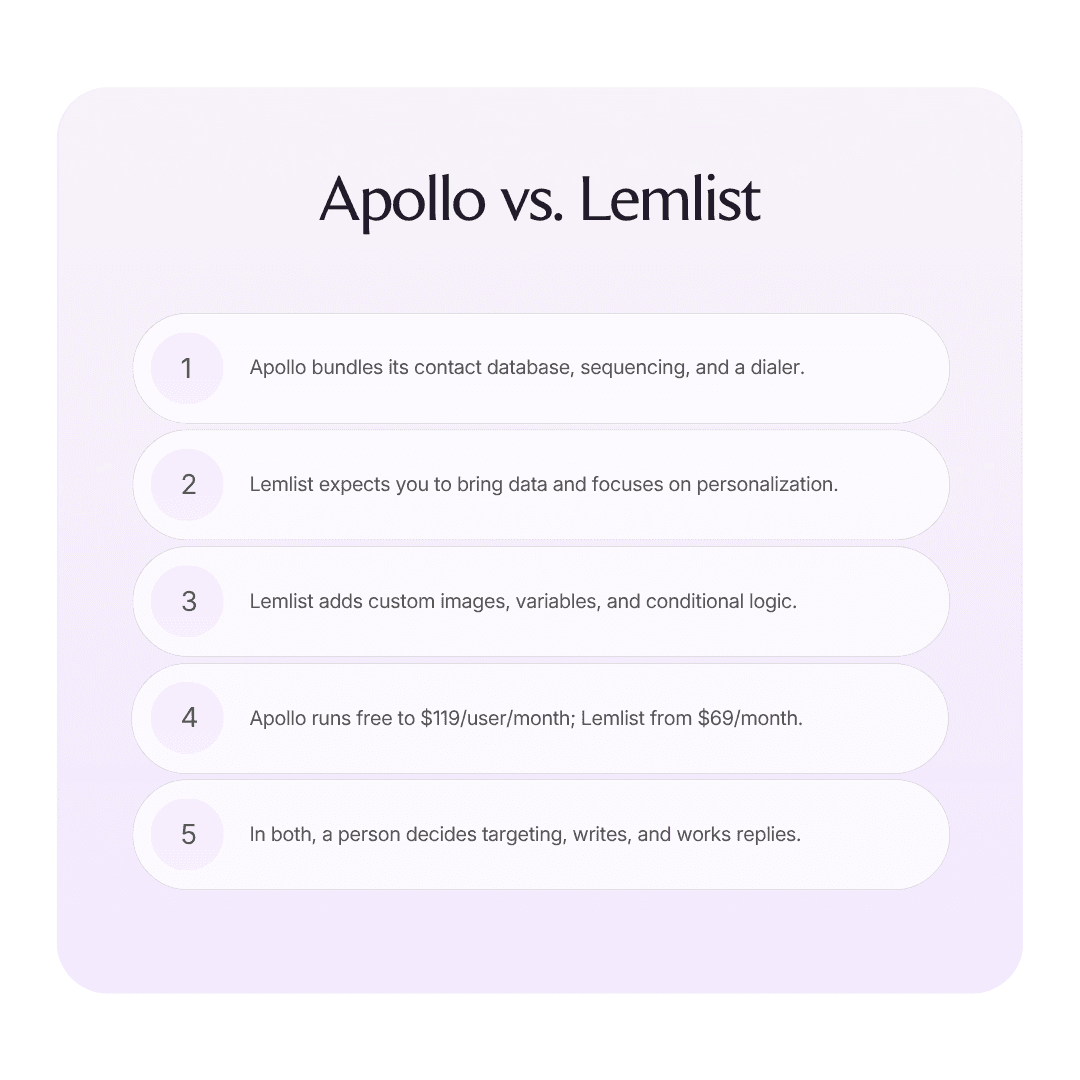
Apollo sells you the whole prospecting stack; Lemlist sells you the best possible outreach layer and assumes you bring the data.
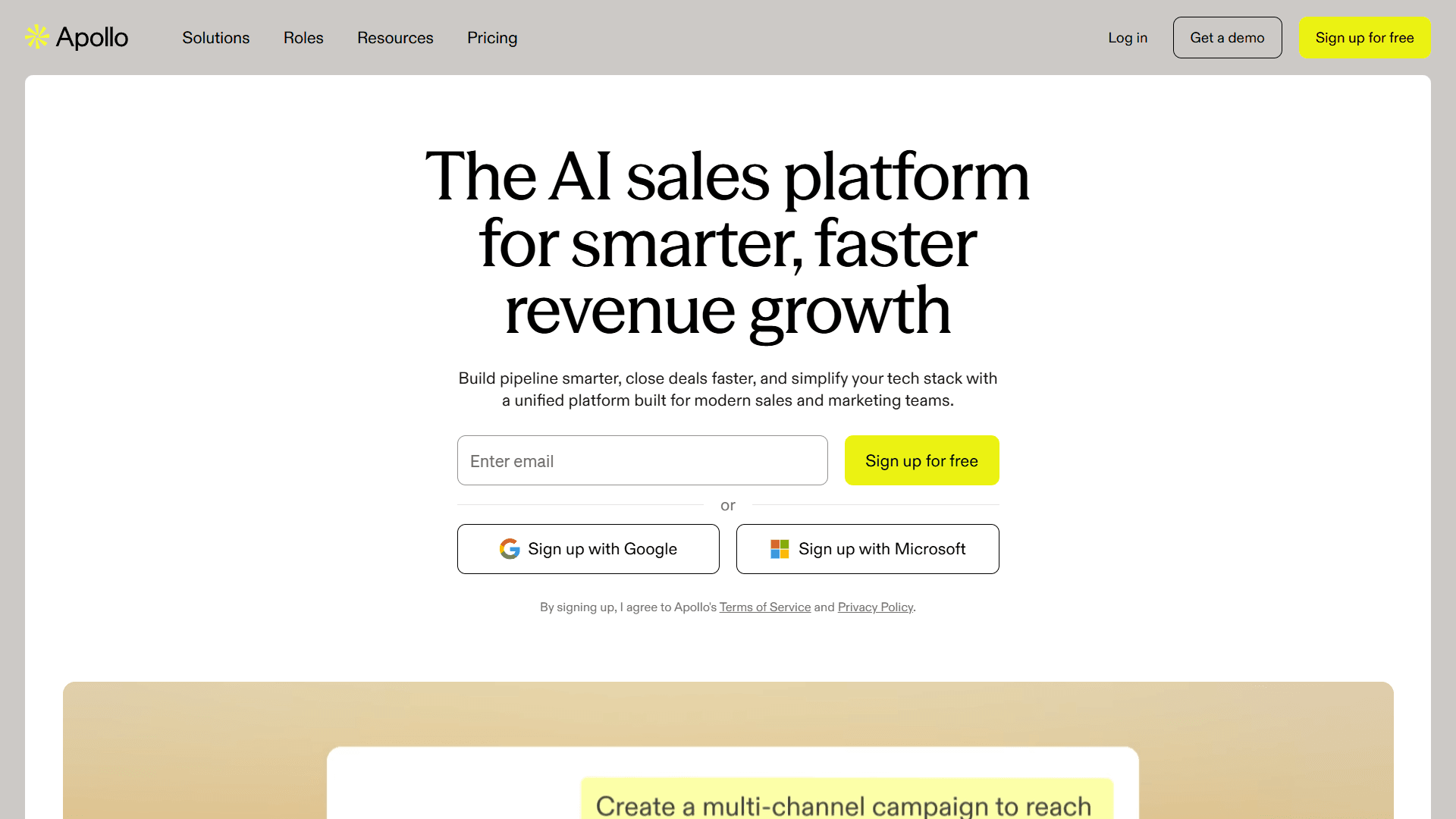
Apollo is a destination. You log in, search its native database, build a list, then sequence email or dial from the same place. It bundles contact data, email sending, a dialer, deal management, and assistive AI into one per-seat product, which is why smaller teams like it: one tool, one bill, minimal setup. It strengthened its signals by acquiring Pocus in March 2026 and reports roughly $200 million in annual recurring revenue (ARR). For how Apollo compares with other all-in-one senders, see Apollo vs. Instantly, Apollo vs. Outreach, and apollo alternatives.
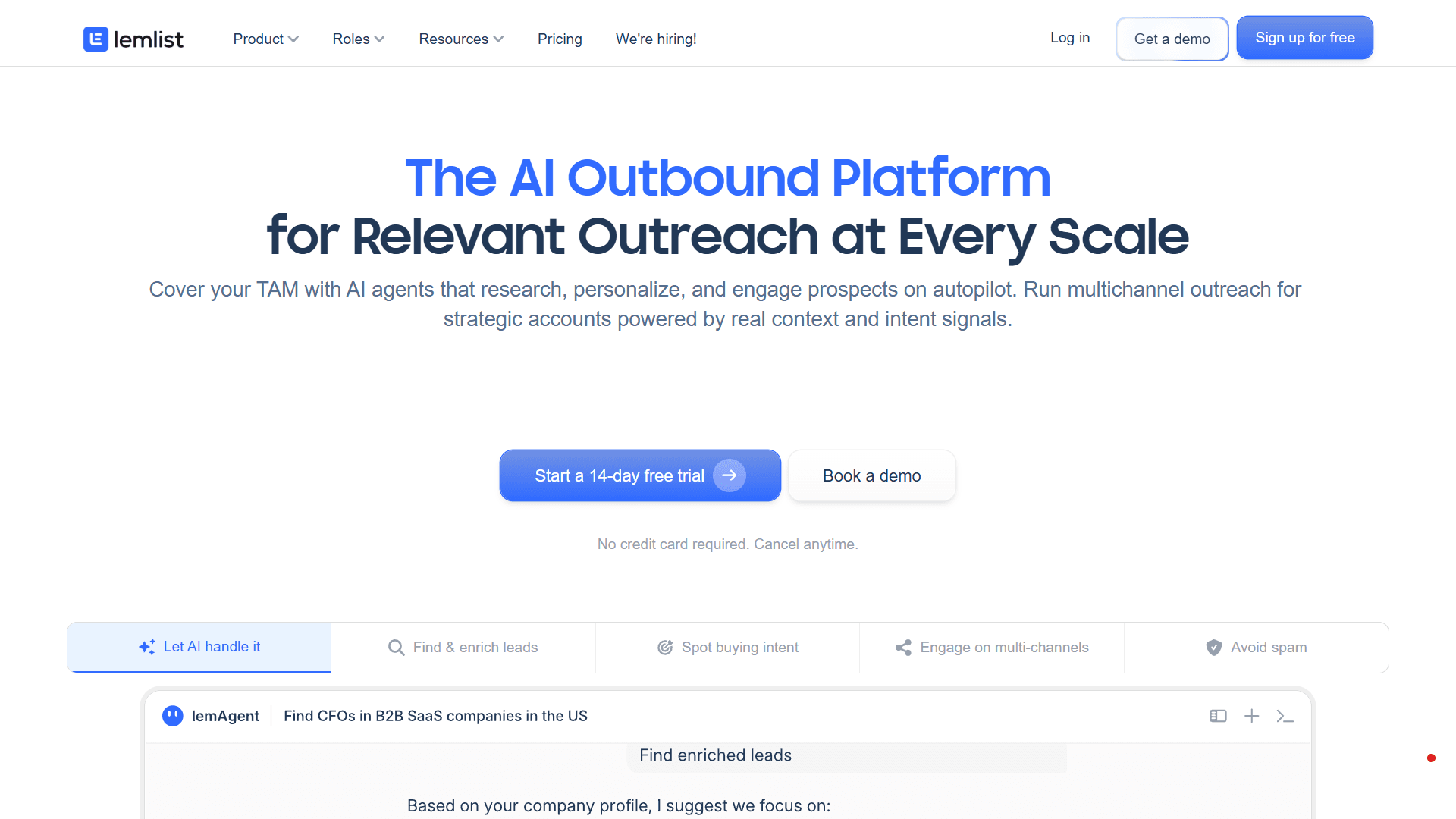
Lemlist is a layer. Its first-party data is lighter, so many teams pair it with a dedicated database, but its personalization and multichannel sequencing are its reason to exist: custom images and variables, liquid-syntax logic, and email plus social media steps in one campaign. It is bootstrapped by lempire to a reported $40 million in ARR and acquired the video tool Claap in October 2025 to deepen its personalization story.
Which has better data, Apollo or Lemlist?
Apollo, clearly, if you want data in the box. Its whole model is a large native database, claimed at over 230 million contacts, that any rep can search without configuration.
For quick, broad prospecting across North American and common B2B segments, Apollo is often enough on its own, which is exactly why teams adopt it as a low-cost data layer even when they run outreach elsewhere. Lemlist's native data is lighter and not its selling point; it expects you to bring a list from a dedicated provider or an enrichment tool. If sourcing contacts is your gap, Apollo answers it directly. If you already have good data and want to send it beautifully, Lemlist plays to a different strength. For how Apollo's data compares with other providers, see Apollo vs. Lusha, apollo vs. zoominfo, seamless vs. apollo, and ZoomInfo vs. LinkedIn Sales Navigator.
Which is better for personalization and channels?
Lemlist, by design. Personalization at scale is its founding pitch, and its multichannel sequencing goes deeper than Apollo's on message craft.
Lemlist lets you insert custom images, dynamic variables, and conditional logic so that two prospects in the same campaign can receive materially different messages, then string email and social media touches into one sequence. Apollo does personalization and sequencing competently, but it is one feature among many in an all-in-one tool rather than the core obsession. If your reply rates depend on messages that feel individually written, Lemlist gives you more room to engineer that. If you want solid sequencing bundled with everything else, Apollo covers it. If Lemlist is not the fit, see the best Lemlist alternatives and Artisan vs. Lemlist.
How do Apollo and Lemlist pricing compare in 2026?
Both are transparent and affordable, but they price different things. Apollo charges per seat for a full stack; Lemlist charges for outreach capability, with data assumed separate.
Apollo publishes a free tier and paid plans up to $119/user/month, per its pricing page, billed annually with a three-seat minimum, and credits govern exports and enrichment. Lemlist publishes Email at $69/month and Multichannel at $109/user/month, with lower annual rates. On headline price they are close, but remember the scope: Apollo's fee includes its database and a dialer, while a Lemlist deployment often adds the cost of a separate data source. Compare total stack cost, not just the sequencing line.
Which is easier to set up?
Both are self-serve, but Apollo takes you further on day one because the data comes with it. You can search, build a list, and start sending inside one tool without wiring anything up.
Lemlist is quick to set up as a sender, but you have to feed it contacts first, so the practical start depends on where your data comes from. Neither has a steep learning curve. The difference is that Apollo is a complete on-ramp from search to send, while Lemlist is the polished sending half of a stack you assemble. If you want the fastest path from zero to a live campaign with no other tools, Apollo wins on convenience.
What is the shared limitation of both Apollo and Lemlist?
You still run the sending and the replies. Both automate steps of outbound; neither owns the job.
Apollo sequences and dials, but a person decides the targeting, writes the messages, and works every reply. Lemlist personalizes and sends across channels, but a person still builds the campaign and handles what comes back. This is the honest limit they share: they make a rep faster, but pipeline still scales with rep hours. If your real constraint is the human time required to prospect, message, and manage responses, adding either tool speeds the work without removing the bottleneck.
Is there a third option beyond Apollo and Lemlist?
Yes, and it is a different kind of purchase. If what you want is for the sourcing, messaging, and reply handling to run without a person babysitting them, that is an autonomous platform rather than a sequencer.
Artisan pairs its own contact database and waterfall enrichment with an AI employee, Ava, who finds best-fit leads, writes and runs multichannel outreach across email, social media, and a dialer, handles replies from a knowledge base, and books meetings. Personalization runs from light to fully agentic, so two people in the same campaign receive very different messages instead of the same template with a swapped first name.

What you are buying is different: the outcome, delivered. Ava runs the motion as review-and-approve or fully autonomous, with plain-language escalation rules and an audit trail, and the model is usage-based. See how it works on the AI sales agent page. If you specifically need an all-in-one prospecting seat or a best-in-class personalization sender, Apollo versus Lemlist is still the right comparison. For a direct look, see Artisan vs. Apollo.
Choose Apollo if...
You want data plus sequencing and a dialer in one low-cost, self-serve seat.
Sourcing contacts is a gap and you would rather not buy a separate database.
You are a startup or mid-market team and price transparency matters.
You want the fastest path from search to sent without assembling a stack.
Choose Lemlist if...
Personalization is your edge and you want to engineer messages that feel individually written.
You already have a data source and need the strongest outreach layer to run it through.
You want multichannel sequencing (email plus social media) with deep customization.
You prefer a focused sending tool over an all-in-one you may not fully use.
Frequently asked questions
Is Apollo or Lemlist better for a startup?
Apollo, in most cases, because its plans from free to $119/user/month bundle data, sequencing, and a dialer, so an early team can prospect and send without buying a separate database. Lemlist is a better fit for a startup that already has good data and competes on message quality, since personalization is its strength. If you are short on contacts, Apollo answers more of the problem in one bill.
Which has more accurate data, Apollo or Lemlist?
Apollo, since it is the one built around a native database, claimed at over 230 million contacts. Apollo's accuracy varies by region and segment, which is common at its price, but it is broad enough for most prospecting. Lemlist's first-party data is lighter and not its focus; teams usually bring a list from a dedicated provider, so on Lemlist the data quality is really your source's quality.
How much do Apollo and Lemlist cost?
Apollo publishes tiers from free to $119/user/month, per its pricing page, billed annually with a three-seat minimum. Lemlist publishes Email at $69/month and Multichannel at $109/user/month, with lower annual rates. They look similar on the headline, but Apollo's price includes a database and dialer, while a Lemlist stack often adds a separate data cost. Compare total stack spend.
Does Apollo replace Lemlist?
For some teams, yes. Apollo's sequencing and personalization are good enough that a team that wants one affordable tool can run outbound entirely inside it. Teams that compete on message craft, though, often find Lemlist's personalization and multichannel depth worth keeping, sometimes pairing Lemlist for sending with Apollo purely as a data layer. It depends on how much personalization drives your reply rates.
Do Apollo or Lemlist run outreach for you?
Not autonomously. Apollo sequences and dials; Lemlist personalizes and sends across channels. In both, a person decides targeting, writes messages, and works replies. Neither manages the outbound motion end to end. That autonomous model, where an AI employee runs the workflow, is a separate category covered in our guide to the AI BDR.
Is there an alternative to both Apollo and Lemlist?
Yes, if your goal is booked meetings rather than a faster sending tool. Artisan is an autonomous platform where an AI employee, Ava, sources leads from its own database, writes and runs multichannel outreach, handles replies, and books meetings, from review-and-approve to fully autonomous. Instead of buying data and a sequencer and running the work yourself, you buy the outcome on a usage-based model. Compare it on the Artisan pricing page.
Can you use Apollo and Lemlist together?
Yes, and some teams do. A common pattern is Apollo as the affordable data layer and Lemlist as the high-personalization sender, exporting contacts from one into the other. This works, but it means two bills, two tools to manage, and manual handoffs between them. Weigh that against a single all-in-one seat, or against a platform that runs sourcing and sending together.
The bottom line
Apollo and Lemlist both help you run outbound email, but they start from opposite strengths. Apollo is the all-in-one: a native database, sequencing, and a dialer in one transparent, low-cost seat, best when sourcing data is part of your gap. Lemlist is the personalization specialist: deeper message customization and multichannel sending, best when you already have data and compete on message quality. Choose Apollo for data plus execution in one place; choose Lemlist for outreach that feels individually written. And if the goal is to automate the whole motion rather than send faster, that is a different tool. Start from the Artisan homepage to see what that looks like.

Artisan Team
Expert insights from the team at Artisan
Our writing team blends direct operational experience, in-house data, and thorough research to bring you the very latest insights and updates about sales and GTM automation.