The best QuickMail alternatives in 2026
QuickMail alternatives for 2026, ranked. Artisan writes, sends, and answers cold email for you, plus Smartlead, Instantly, Woodpecker and more.

Key Takeaways
- QuickMail is a deliverability-focused cold email sender with inbox-rotation heritage. You still write the copy, pick the targets, and handle every reply.
- Artisan is the top alternative when you want the work done: Ava writes personalized cold email, manages deliverability end to end, and answers replies autonomously. Artisan reports over 90% of customers run Ava autonomously.
- Smartlead runs $39 to $379 per month with placement testing as a $49 to $599 add-on; Instantly's public tiers run $47 to $555 per month; Woodpecker charges roughly $7 per 100 prospects contacted.
- Lemlist runs $69 to $109/user/month on annual billing.
- CookUnity sent over 100,000 personalized emails with Ava at roughly a $45 cost per lead.
- If deliverability discipline is your priority and your team writes and replies well, staying with QuickMail is a defensible call.
The best QuickMail alternative for most teams is Artisan, because it does the part QuickMail leaves to you: Ava, Artisan's AI business development representative (BDR), writes the cold email, sends it with managed deliverability, and answers the replies autonomously. QuickMail's inbox-rotation heritage keeps mail landing. It does not write the mail or work the inbox.
QuickMail helped invent inbox rotation, the practice of spreading sends across mailboxes to protect sender reputation, and this deliverability discipline is still its calling card. For a team that values landing in the inbox and is happy to run its own campaigns, it holds up. Rotation only addresses how mail is sent. Teams shopping for an alternative usually want the copywriting, targeting, and reply-handling lifted off their plate, or they want deliverability infrastructure at a scale a focused sender was not built for. This guide ranks both directions. For the wider landscape, see the best email outbound tools.
QuickMail alternatives compared
Rank | Tool | Best for | Standout capability | Public pricing |
1 | Artisan | Teams that want cold email written, sent, and answered for them | Ava, an autonomous AI BDR with managed deliverability | Usage-based credits, no platform fee, free trial |
2 | Smartlead | Agencies that run many client inboxes | Unlimited mailbox rotation, deep API | $39-379/mo (placement testing extra) |
3 | Instantly | High-volume senders that want deliverability infrastructure | Mailbox rotation at scale, large lead database | $47-555/mo |
4 | Woodpecker | Small teams that want usage-based sending | Pay-per-prospect pricing, unlimited inboxes | About $7 per 100 prospects contacted |
5 | Saleshandy | Budget-conscious teams starting cold email | Lead finder bundled with sending | Published per-tier pricing |
6 | Lemlist | Personalization-first multichannel sequences | Custom images and variables in outreach | $69-109/user/mo (annual) |
How we chose
Four criteria, weighted for a buyer whose deliverability is handled but whose workload is not:
1. How much of the job the tool does. Inbox rotation moves your words reliably. The differentiator is whether the tool also writes and replies.
2. Deliverability at scale. Inbox placement testing, SPF, DKIM, and DMARC checks, sender reputation monitoring, dynamic send limits, and automatic pausing of unhealthy mailboxes, going beyond rotation alone.
3. Pricing transparency. Published tiers beat quote-on-request, and we flag add-ons that inflate the real cost.
4. Deployment fit. Whether one operator can run it, or whether it needs a dedicated cold email specialist.
Why do teams look for a QuickMail alternative?
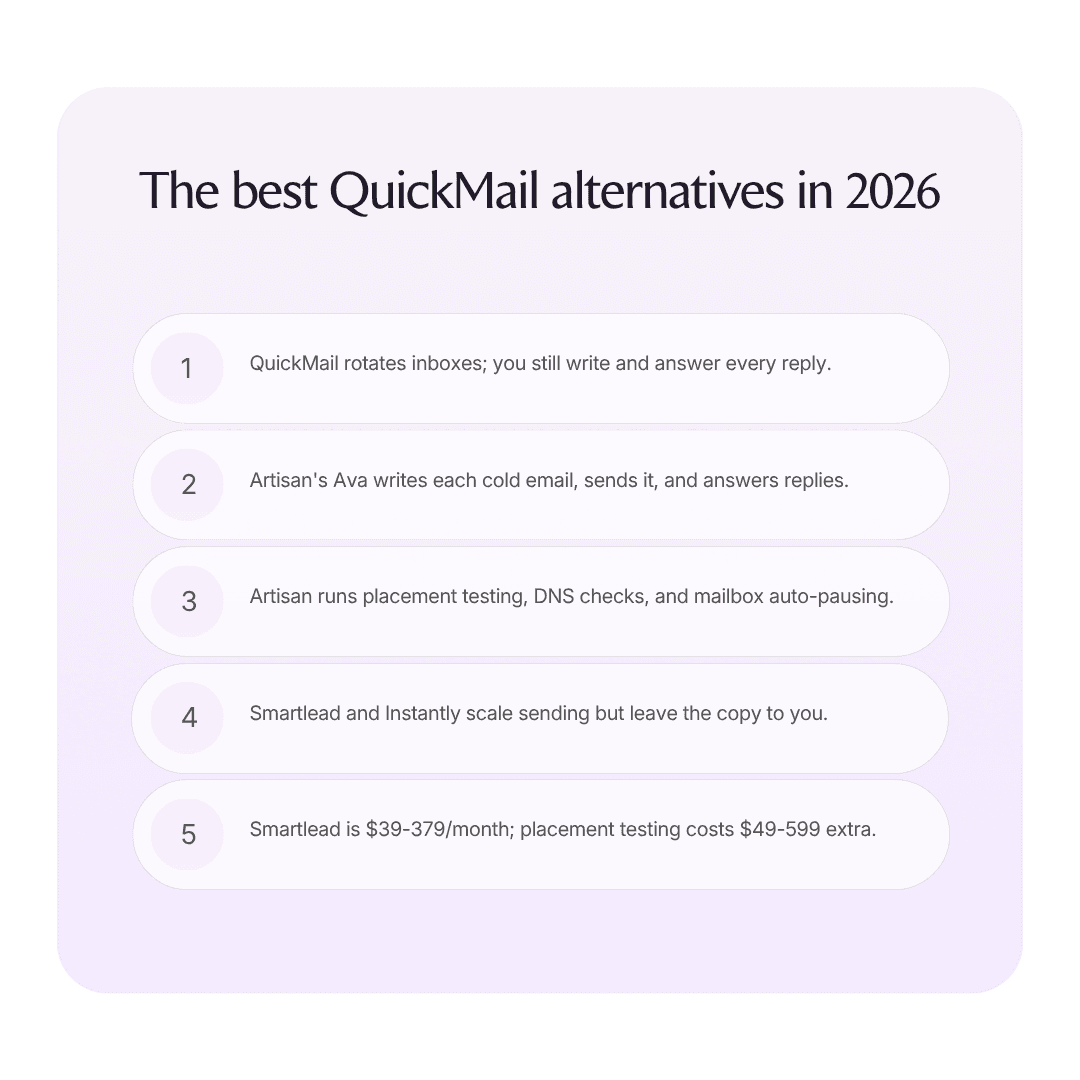
Most switch because QuickMail solves deliverability, and deliverability is one problem out of several. Inbox rotation is useful, spreading volume across mailboxes so no single sender burns out its reputation. Once your mail is landing, though, the writing, targeting, and reply-handling are still entirely manual, and rotation does nothing to lift that. A team that has mastered inbox placement often finds the remaining bottleneck is human hours, not deliverability.
The triggers we hear most:
The workload does not move. Rotation keeps mail landing, but you still write every variant, choose every target, and answer every reply by hand.
Deliverability tooling stops at rotation. QuickMail is strong on inbox rotation, but a full managed-deliverability stack (placement testing, DNS checks, health monitoring, auto-pausing) is a larger job than rotation alone.
Scaling needs infrastructure. Teams pushing serious volume across many domains often want the agency-grade sending architecture QuickMail's focused product does not aim to be.
None of this makes QuickMail a weak tool. It makes it the wrong tool for a team whose problem is the manual load, not the inbox.
The best QuickMail alternatives in 2026
1. Artisan: The AI BDR that writes, sends, and replies

Artisan is the alternative for teams that want the outbound job owned, not just delivered. Instead of a sending tool you feed, Artisan gives you Ava, an autonomous AI BDR. Ava finds best-fit leads from a database of over 250 million B2B professionals across over 200 countries, writes personalized cold email where two people in the same campaign receive two different messages, sends it with managed deliverability, and handles the replies: qualifying, answering objections from your knowledge base, chasing follow-ups, and booking meetings on your reps' calendars. Campaigns run across email, social media, and dialer call steps in one sequence, so Ava dials the calls and a rep takes the conversation.
Deliverability goes well past rotation. Artisan provisions and manages mailboxes, tests inbox placement, checks SPF, DKIM, and DMARC, rotates inboxes, watches mailbox health with dynamic send limits, and auto-pauses senders when bounce patterns spike. QuickMail's rotation is one technique inside this broader managed system, and with Artisan you tune none of it. Control is adjustable rather than binary: review and approve every message, restrict Ava to objection-handling only, or let her run fully autonomous with plain-language escalation rules and a full audit trail. Artisan reports over 90% of customers run Ava autonomously.
For larger teams, sales ops can run Ava centrally for an account executive (AE) team whose reps never log in, with cross-channel do-not-contact enforcement and CRM owner routing so outreach comes from the right rep's mailbox. Artisan is SOC 2 Type II compliant, GDPR and CCPA compliant, with SSO and role-based access on Enterprise plans. Pricing is usage-based, so you pay for the work Ava performs rather than per seat.
"Ava runs highly targeted outreach at a scale we could never reach with a human-only team," said Bruno Didier, CEO of CookUnity Business, whose team sent over 100,000 personalized emails at roughly a $45 cost per lead.
See Artisan pricing for the current model.
Best for: startups through enterprise that want cold email written, sent, and answered autonomously, with deliverability managed for them.
Who should pick something else: teams whose only need is a focused, reliable sender they operate themselves with strong in-house writers.
Pricing: usage-based credits, no platform fee, free trial. See artisan.co/pricing.
2. Smartlead: The agency and API workhorse
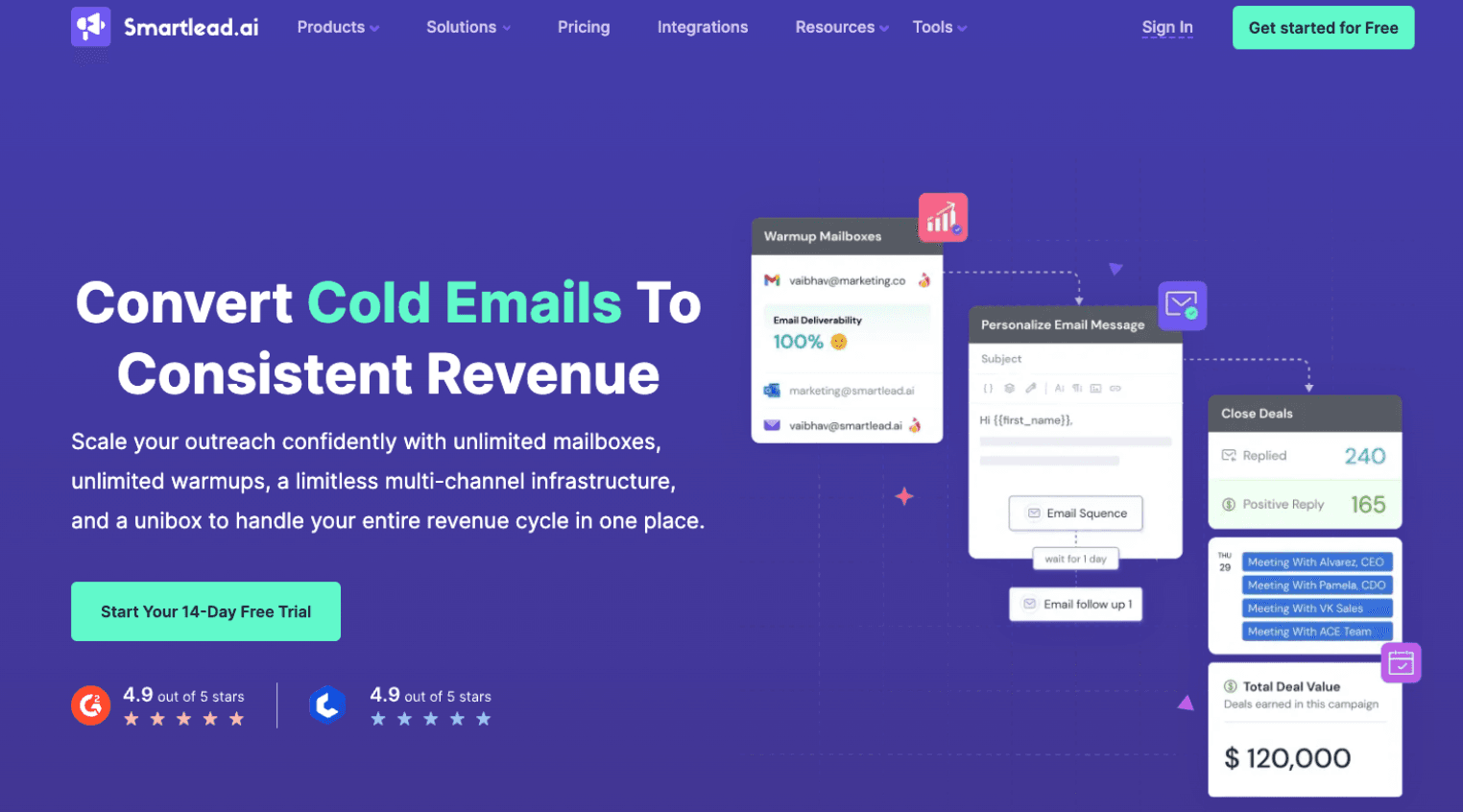
Smartlead is the closest deliverability-minded rival for teams that outgrow QuickMail's focus, especially agencies. Unlimited mailbox rotation, a deep API, and a master inbox for many client accounts extend the rotation idea QuickMail pioneered to a shop running dozens of sending domains at once. For a broader look, see the best outbound tools for agencies.
The cost math needs a note: core tiers run $39 to $379 per month, but placement testing is billed separately at $49 to $599, so the effective price climbs once you turn on serious-sender features. And like QuickMail, Smartlead is infrastructure. You still write and reply.
Best for: agencies and API-first teams that scale rotation across many inboxes.
Who should pick something else: teams that want the work handled or dislike add-on surprises.
Pricing: $39-379/mo core; placement testing $49-599 extra, per Smartlead's pricing page.
3. Instantly: Volume sending infrastructure
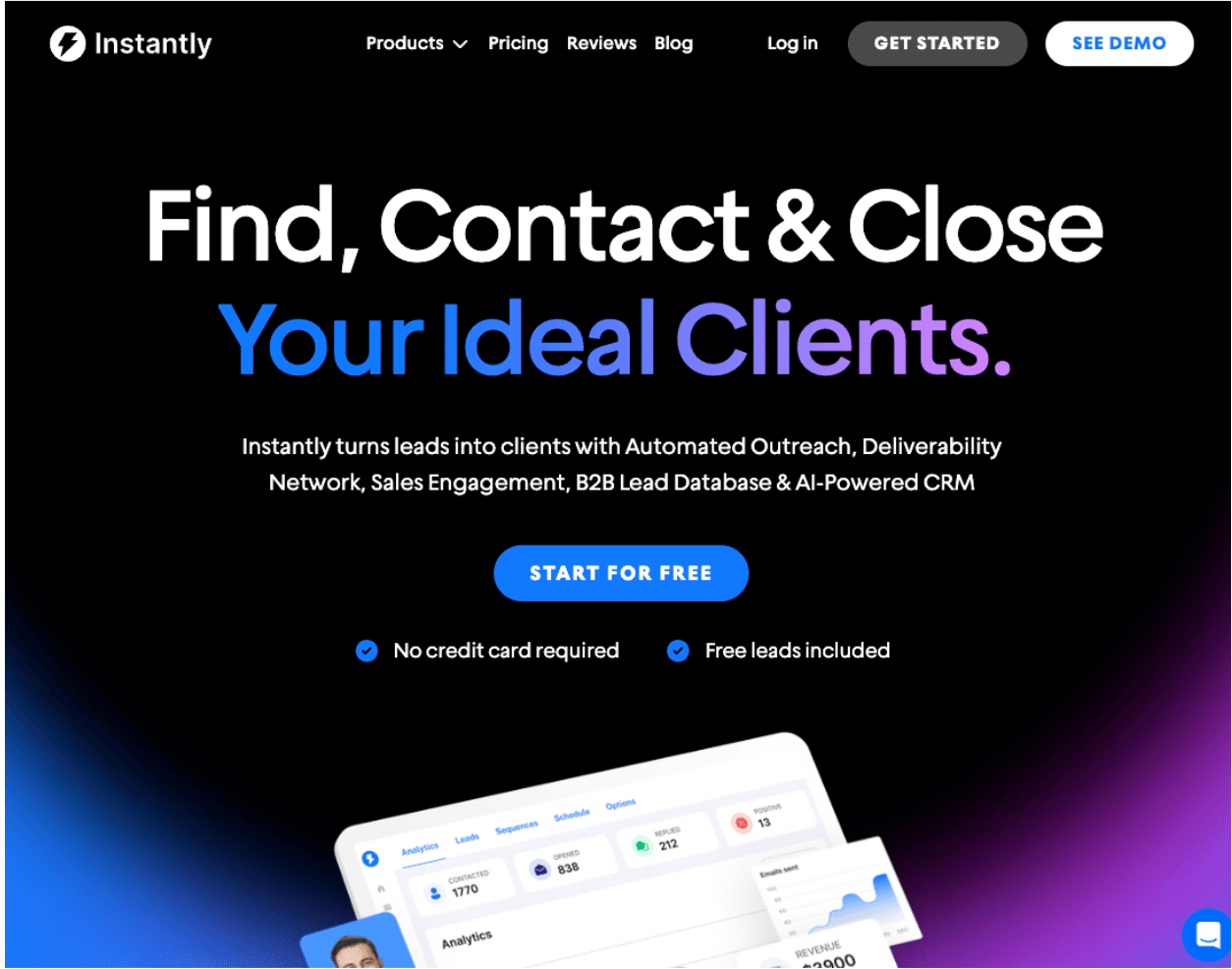
Instantly is the pick when the priority shifts from deliverability discipline to raw sending scale. It built the category's biggest sending engine, with mailbox rotation, deliverability infrastructure, and a large lead database. For teams whose next bottleneck is capacity, it is the volume-first upgrade path from a focused sender.
The trade is that Instantly is infrastructure-first, so copywriting, targeting, and reply-handling stay yours, and reviewers report its AI features arrived later than the sending tools. Public tiers run $47 to $555 per month, per its pricing page. Compare it directly in Apollo vs. Instantly and Artisan vs. Instantly.
Best for: high-volume senders that want deliverability infrastructure they operate themselves.
Who should pick something else: teams that want the copy and replies handled.
Pricing: $47-555/mo, per Instantly's pricing page.
4. Woodpecker: Simple usage-based sending
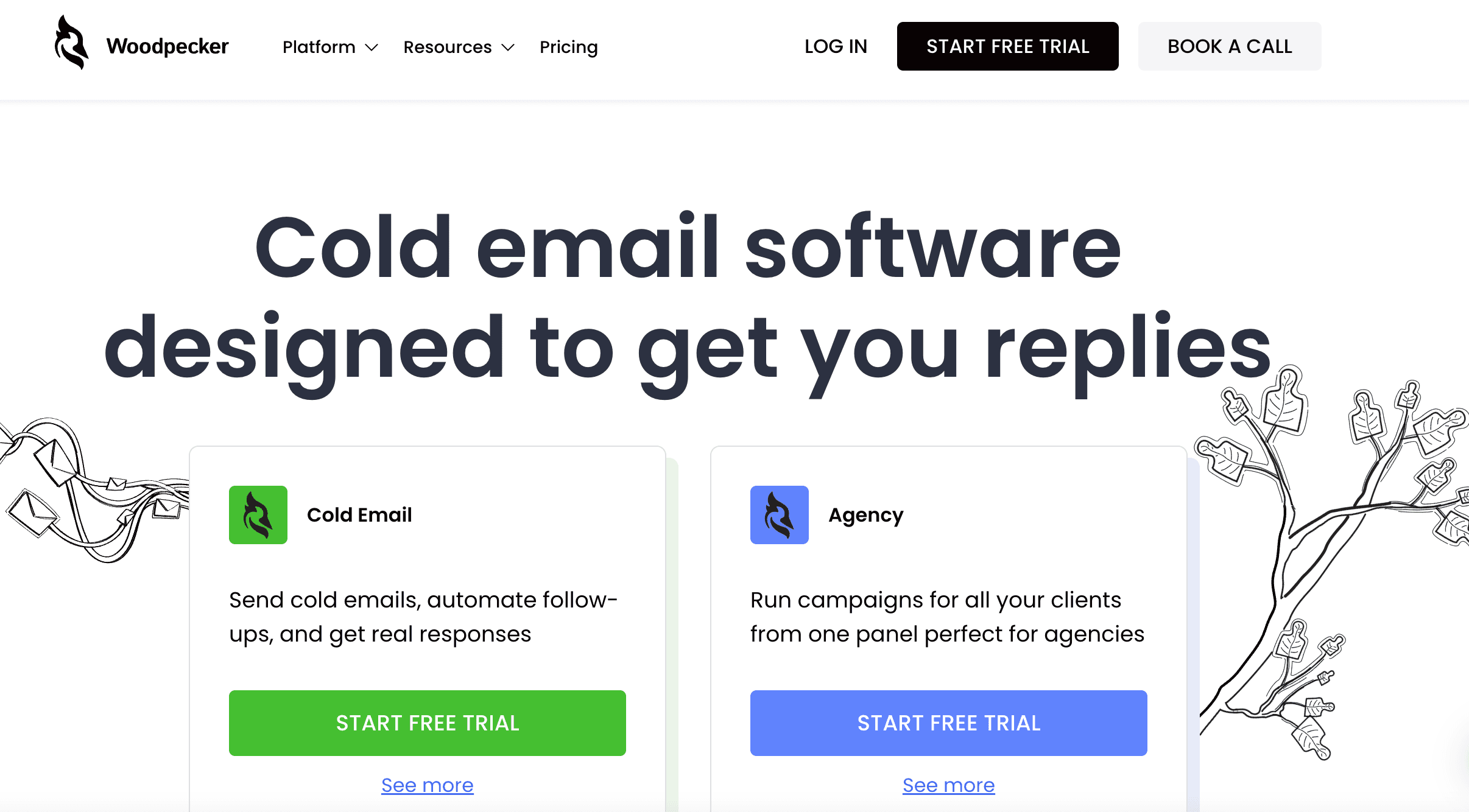
Woodpecker is the pick for small teams that want predictable pricing and unlimited inboxes without a per-seat model. It charges roughly $7 per 100 prospects contacted, friendly to spiky or seasonal volume, with solid deliverability tooling and a clean interface. Like QuickMail, it takes inbox health seriously in a focused package.
Woodpecker is deliberately narrow, lighter on multichannel and AI. For a small team that mostly wants reliable, affordable email with sane pricing, this focus is a feature.
Best for: small teams that want usage pricing and unlimited inboxes.
Who should pick something else: teams that need heavy volume infrastructure or the work done for them.
Pricing: usage-based, roughly $7 per 100 prospects contacted, per Woodpecker's pricing page.
5. Saleshandy: The budget entry point
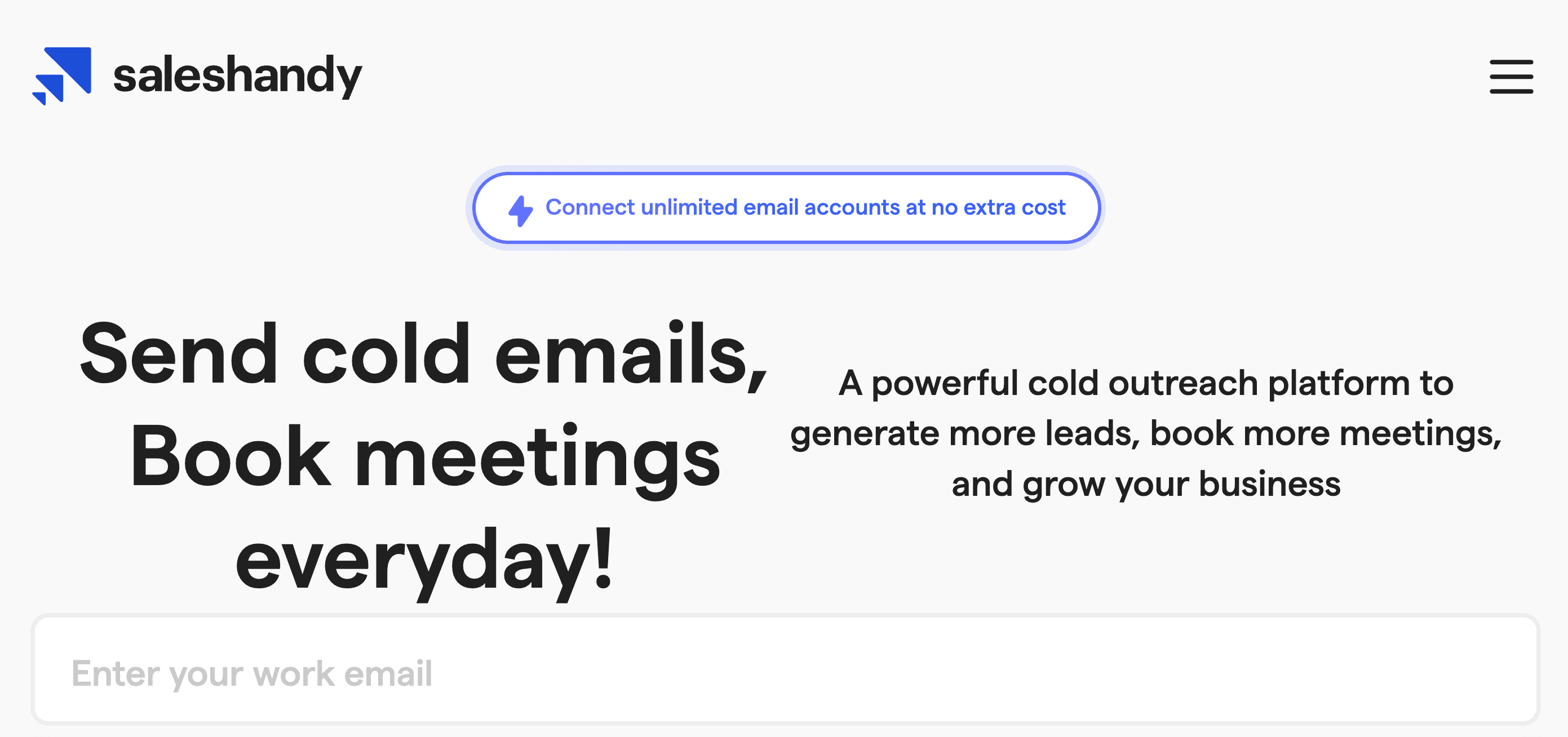
Saleshandy is the value pick for teams starting cold email on a tight budget. It bundles a lead finder with sending and sequencing at published, low per-tier prices, so you can prospect and send from one place without stitching in a separate lead source. For a first outbound motion, this consolidation is useful.
The ceiling is the manual model. Saleshandy sends what you write and leaves the replies for you to handle, and its deliverability tooling is lighter than QuickMail's rotation pedigree. It is a fine starting rung teams tend to outgrow.
Best for: budget-conscious teams launching a first cold email motion.
Who should pick something else: teams that need deliverability depth or autonomous writing and replies.
Pricing: published per-tier pricing, per Saleshandy's pricing page.
6. Lemlist: Personalization-first multichannel
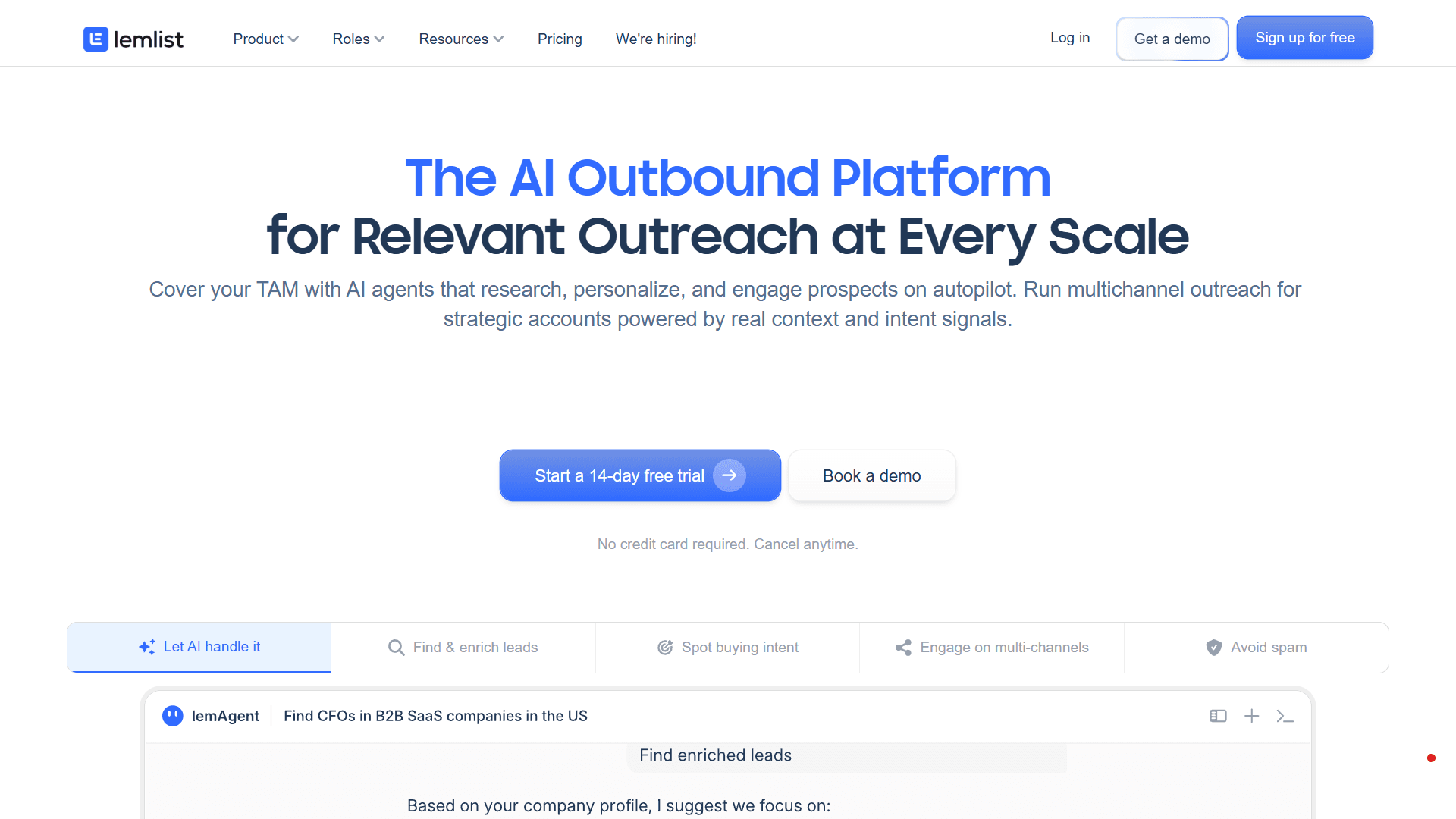
Lemlist is the alternative for teams that want their outreach to stand out rather than just land. It pioneered custom images and dynamic variables inside cold email and runs multichannel sequences. Bootstrapped to roughly $40M in revenue and having acquired the video tool Claap in October 2025, it is a serious independent company.
The trade is that Lemlist's personalization is powerful but manual: you build the tokens, images, and logic. It scales creativity, not headcount. Pricing runs $69 to $109/user/month on annual billing, per its pricing page. Compare it directly in Apollo vs. Lemlist and Artisan vs. Lemlist.
Best for: teams that want visually personalized multichannel sequences and will build them by hand.
Who should pick something else: teams that want personalization generated for them at scale.
Pricing: $69-109/user/mo on annual billing, per Lemlist's pricing page.
Stay with QuickMail if...
QuickMail is the right call for a specific profile. Keep it if:
Deliverability discipline is your top priority and inbox rotation is central to how you protect sender reputation.
Your team writes strong copy and enjoys managing the inbox, so the manual work is a fit.
Your volume is served well by a focused sender and you do not need agency-grade infrastructure or autonomous replies.
Switching tools to solve a writing-and-reply problem that QuickMail was never built to solve is a mistake. If the manual load is the bottleneck, that is the signal to move to an autonomous AI BDR instead.
Frequently asked questions
What is the best alternative to QuickMail? For teams that want cold email written, sent, and answered for them, Artisan is the strongest alternative, because Ava runs the full outbound job autonomously with deliverability managed end to end. For a like-for-like sender that scales inbox rotation, Smartlead is the closest direct rival, especially for agencies.
What is the best enterprise alternative to QuickMail? Artisan. It adds central sales-ops deployment for large AE teams, cross-channel do-not-contact governance, CRM owner routing, an audit trail, and SOC 2 Type II compliance on top of managed deliverability. QuickMail's focused sender is built for hands-on operators, not governed at-scale deployment.
Is Smartlead better than QuickMail? For agencies scaling rotation across many client inboxes, often yes: unlimited mailbox rotation and a deep API fit that workflow. Both are infrastructure tools with the same limit, though. You still write and reply, and Smartlead's placement testing is a $49 to $599 add-on on top of its $39 to $379 core tiers.
How much does QuickMail cost? QuickMail publishes per-tier pricing on its site, from $49 to $299 per month, scaling with sending volume and prospects contacted. Because it is a focused sender, the sticker price is modest, but it prices only the sending layer, not the writing or reply-handling.
Does inbox rotation replace managed deliverability? No. Inbox rotation spreads sends to protect reputation, but full managed deliverability also covers mailbox provisioning, inbox placement testing, SPF, DKIM, and DMARC checks, dynamic send limits, health monitoring, and auto-pausing unhealthy mailboxes. An AI sales agent like Ava runs all of this as part of the job instead of leaving rotation as the main lever.
Can I replace QuickMail with an AI SDR? Yes, if you want the job done and not only the sending delivered. An autonomous AI sales development representative (SDR) sources leads, writes personalized email, manages deliverability including rotation, and answers replies, covering QuickMail's function plus the manual work it leaves to you. Compare the field in the best cold email tools.

Artisan Team
Expert insights from the team at Artisan
Our writing team blends direct operational experience, in-house data, and thorough research to bring you the very latest insights and updates about sales and GTM automation.