The best Reply alternatives in 2026
The best Reply.io alternatives in 2026, from an autonomous AI BDR to Klenty, Apollo, Instantly, Smartlead, and Lemlist, with who each is right for.

Key Takeaways
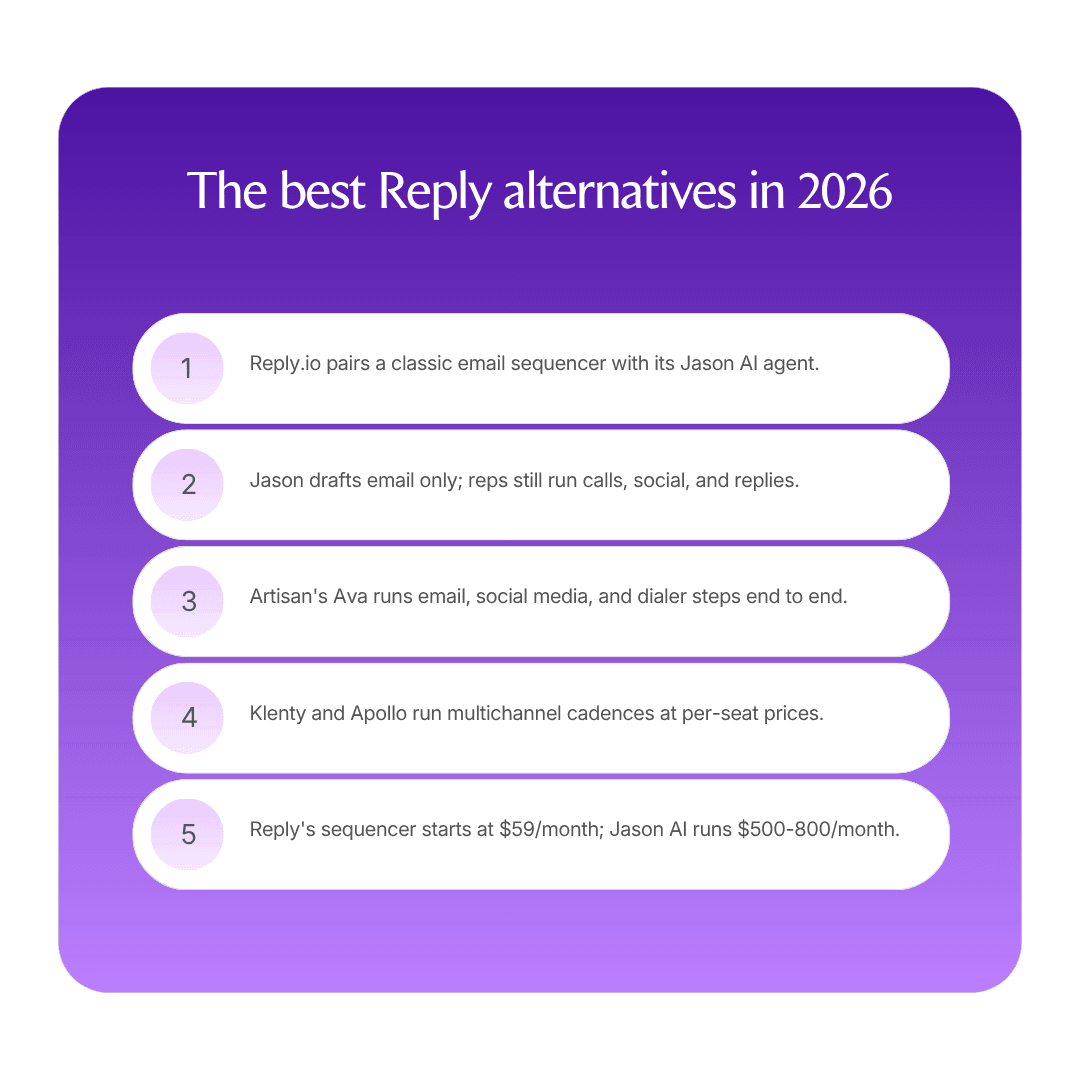
- Reply.io pairs a low-cost sequencer, from about $59 per month, with its Jason AI agent, roughly $500 to $800 per month, an accessible entry into agent-run email.
- Jason's scope is email-centric; underneath it is a classic sequencer where reps still drive the rest of the motion.
- Artisan replaces the agent-on-a-sequencer model with Ava, an autonomous AI business development representative (BDR) who runs email, social media, and dialer steps end to end under a set autonomy level.
- Klenty and Apollo are the closest value peers; Instantly, Smartlead, and Lemlist cover cold-email volume and personalization.
- Instantly claims over 450 million leads with tiers from $47 to $555 per month; Lemlist runs $69 to $109/user/month annually.
- Over 90% of Artisan customers run Ava autonomously, with escalation rules and a full audit trail.
The best Reply.io alternative is Artisan: instead of bolting an AI agent onto a classic email sequencer, Ava runs the whole motion autonomously, finding leads, writing, sending, calling, replying, and booking. Klenty and Apollo are the closest value peers, while Instantly, Smartlead, and Lemlist cover cold-email volume and personalization. Reply's Jason AI sits on a sequencer, not the whole job.
Reply.io built a reasonable bridge: a low-cost sequencer with an AI agent, Jason, layered on to add prospecting. For a small team it is an accessible way to try agent-run email. The reasons buyers look elsewhere are consistent. Jason's scope is email-centric, so it is not a true multichannel motion. And the base is still a classic sequencer, which means for anything beyond the agent's lane, the reps write, send, and reply themselves. If you want the software to own the whole job instead of assisting with part of it, that is a different category.
Comparison table
Rank | Tool | Best for | Standout capability | Public pricing |
1 | Artisan | The AI running the whole motion | Ava owns find, send, call, reply, book | Usage-based credits, no platform fee, free trial |
2 | Klenty | Value multichannel sequencing | Multichannel cadences at per-seat pricing | Published per-user tiers |
3 | Apollo | Value all-in-one with data included | Large database plus sequencing | Free to $119/user/mo |
4 | Instantly | Cold-email volume at low cost | High-volume sending infrastructure | $47-555/mo public tiers |
5 | Smartlead | Agency and API cold email | Multi-inbox rotation, API workflows | $39-379/mo, add-ons extra |
6 | Lemlist | Personalization-first multichannel | Dynamic personalization at scale | $69-109/user/mo annual |
How we chose
We weighted four things for a team leaving Reply.io. How much of the motion the software runs versus assists a rep with, since Reply's agent assists but does not own the job. Channel coverage, because Jason is email-centric and many buyers want true multichannel. Price and value, since Reply sits in the accessible bracket and a replacement has to justify itself. And deliverability at scale, the thing cold-email teams break on. Each tool receives credit for its strength and a plain verdict on who it is wrong for.
What is the best alternative to Reply.io?
The best alternative depends on what you want the software to do. To have the AI run the whole motion, Artisan. To stay in a value sequencer, Klenty or Apollo. For cold-email volume or personalization, Instantly, Smartlead, or Lemlist. Here is the ranking. Related: the best Saleshandy alternatives.
1. Artisan: The AI runs the whole motion
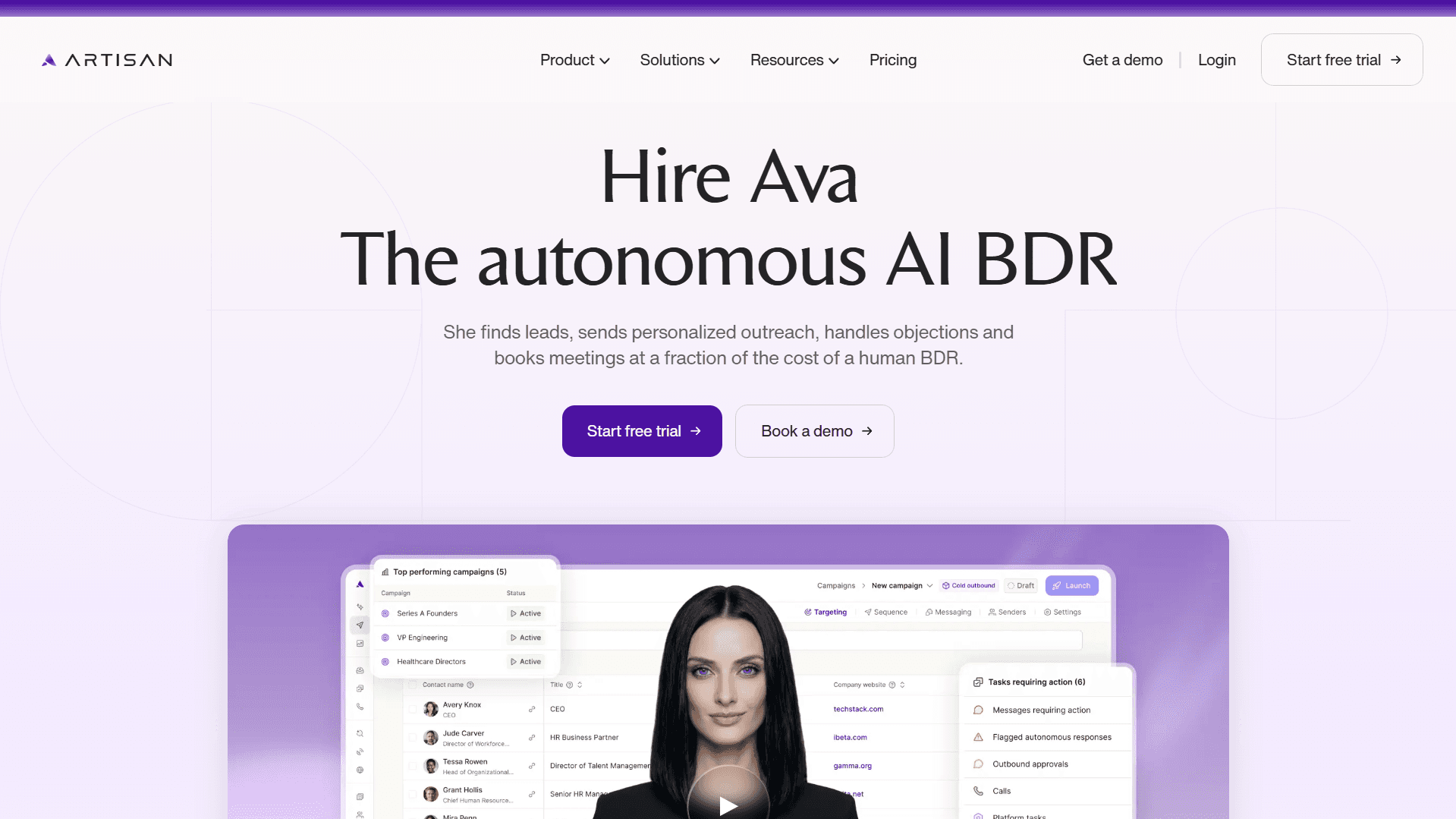
Artisan leads because it owns the job Reply's agent only assists with. Jason adds AI email prospecting on top of a sequencer; the rest of the motion still runs on reps. Artisan's Ava runs all of it. She finds best-fit leads across over 250 million B2B professionals in over 200 countries, plus Artisan Local Data with over 250 million local businesses, enriches them with waterfall email and phone lookups, writes personalized messages one to one, runs the sequence across email, social media, and dialer call steps, handles every reply from a knowledge base, and books meetings on the right rep's calendar with owner routing. Ava dials the calls herself and a rep takes the live conversation.
The scope difference is the point. Reply's agent lives in email; Ava runs a true multichannel motion and does the reply handling, the objection answering, and the follow-up chasing that a sequencer leaves to a person. The one-to-one personalization is the tell: two prospects in the same campaign receive two entirely different messages, because Ava writes each from research instead of swapping a name into a template. She also runs dozens of message variations and shifts volume toward what converts.
For teams that want control, the autonomy dial is the mechanic: review-and-approve every message, objections-only replies, or full autonomy, with plain-language escalation and a complete audit trail. Artisan is SOC 2 Type II compliant, GDPR and CCPA compliant, with SSO, SAML, and role-based access on Enterprise plans, and deep two-way Salesforce and HubSpot sync, all things a low-cost email agent does not carry.
Amelia Lerutte, Chief AI Officer at SaaStr, described the result: "Email has always been our number one driver. Artisan is now neck-and-neck in both output and closed-won revenue." Her team sent 6,892 emails through Ava in roughly six weeks, 3,574 of them to net-new leads, at a 3.6% positive response rate and 49.4% acceptance on social media connection requests.
Best for: teams from startup to enterprise that want the AI to run the whole multichannel motion, not just assist with email.
Who should pick something else: small teams that only want an AI email agent on a cheap sequencer and nothing more.
Pricing: usage-based credits, you pay for the work Ava performs rather than seats, no platform fee, free trial. See artisan.co/pricing.
2. Klenty: Value multichannel sequencing

Klenty is the alternative for a Reply team that wants true multichannel cadences, spanning email, calls, and social media, at value pricing instead of an email-centric agent. It has published per-seat tiers and a clean, affordable multichannel model, which is a better fit than Reply for teams whose motion is not email-only.
It is a sequencer in the classic sense: it coordinates rep activity, with no autonomous agent owning the motion. You gain broader channel coverage than Reply's base product; you keep the human-driven model. For a deeper comparison, see Reply vs. Klenty.
Best for: value teams that want multichannel cadences instead of an email-first agent.
Who should pick something else: teams that want autonomous execution or enterprise governance.
Pricing: published per-user tiers, per its site.
3. Apollo: Value all-in-one with data included
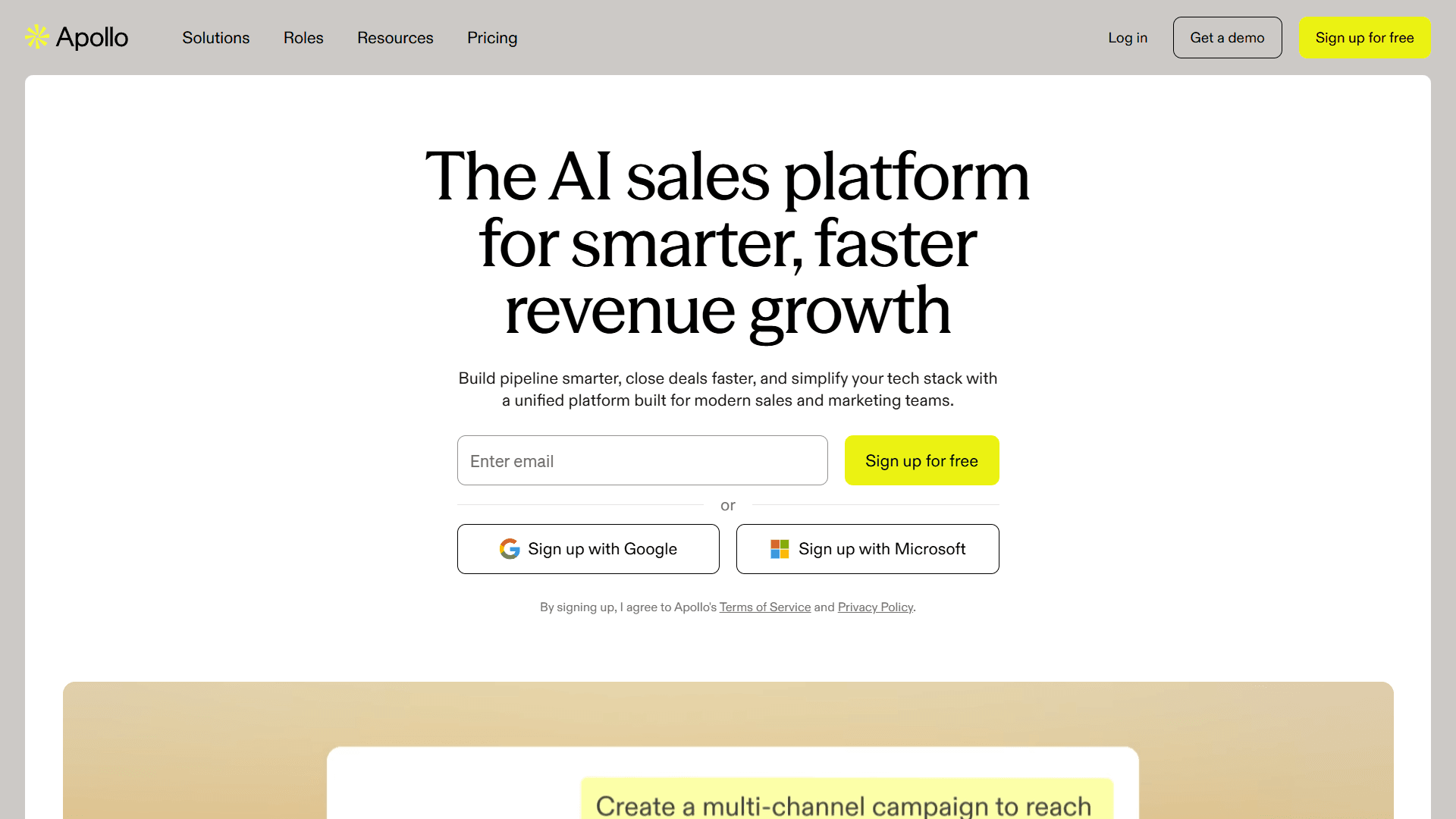
Apollo is the alternative for a Reply team that also wants a database in the box. It bundles a large contact database, over 230 million contacts claimed, with a sequencer and light dialing, from free to about $119/user/month, and it is used by more than 600,000 companies (over 100,000 paying). Where Reply leans on you for data, Apollo gives you leads and cadence in one cheap tool.
The AI is assistive and the model is per-seat, so like Reply's base product, the reps still drive. You gain a bundled database at similar value; you do not gain autonomous execution. Related: Apollo vs. Instantly.
Best for: cost-sensitive teams that want data and sequencing in one affordable tool.
Who should pick something else: enterprises that need governance, or teams that want the AI to run the motion.
Pricing: free to $119/user/mo, per its pricing page.
4. Instantly: Cold-email volume at low cost
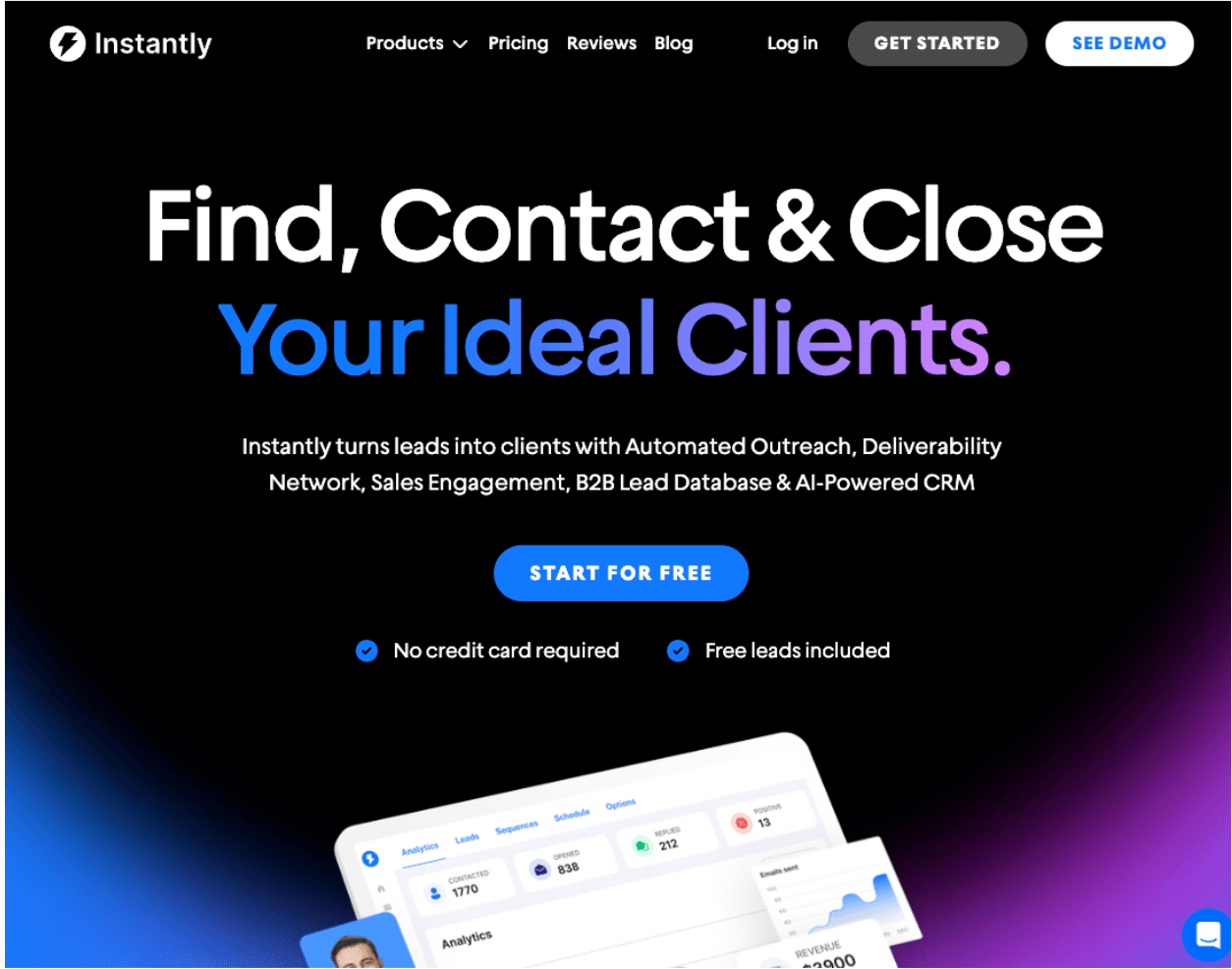
Instantly is the alternative for a Reply team whose real need is high-volume cold email. It is the volume leader, with over 450 million leads claimed and public tiers from $47 to $555 a month, and it has the largest customer base in the category. For pure sending scale and deliverability infrastructure at a low price, it is hard to beat. Related: best cold email marketing software.
The tradeoff is that you still write, target, and reply yourself; its AI features are newer. It is a volume infrastructure play, not an agent that runs the motion. See also the best cold email tools.
Best for: teams whose motion is high-volume cold email at low cost.
Who should pick something else: teams that want multichannel autonomy or reply handling done for them.
Pricing: $47-555/mo public tiers, per its site.
5. Smartlead: Agency and API cold email
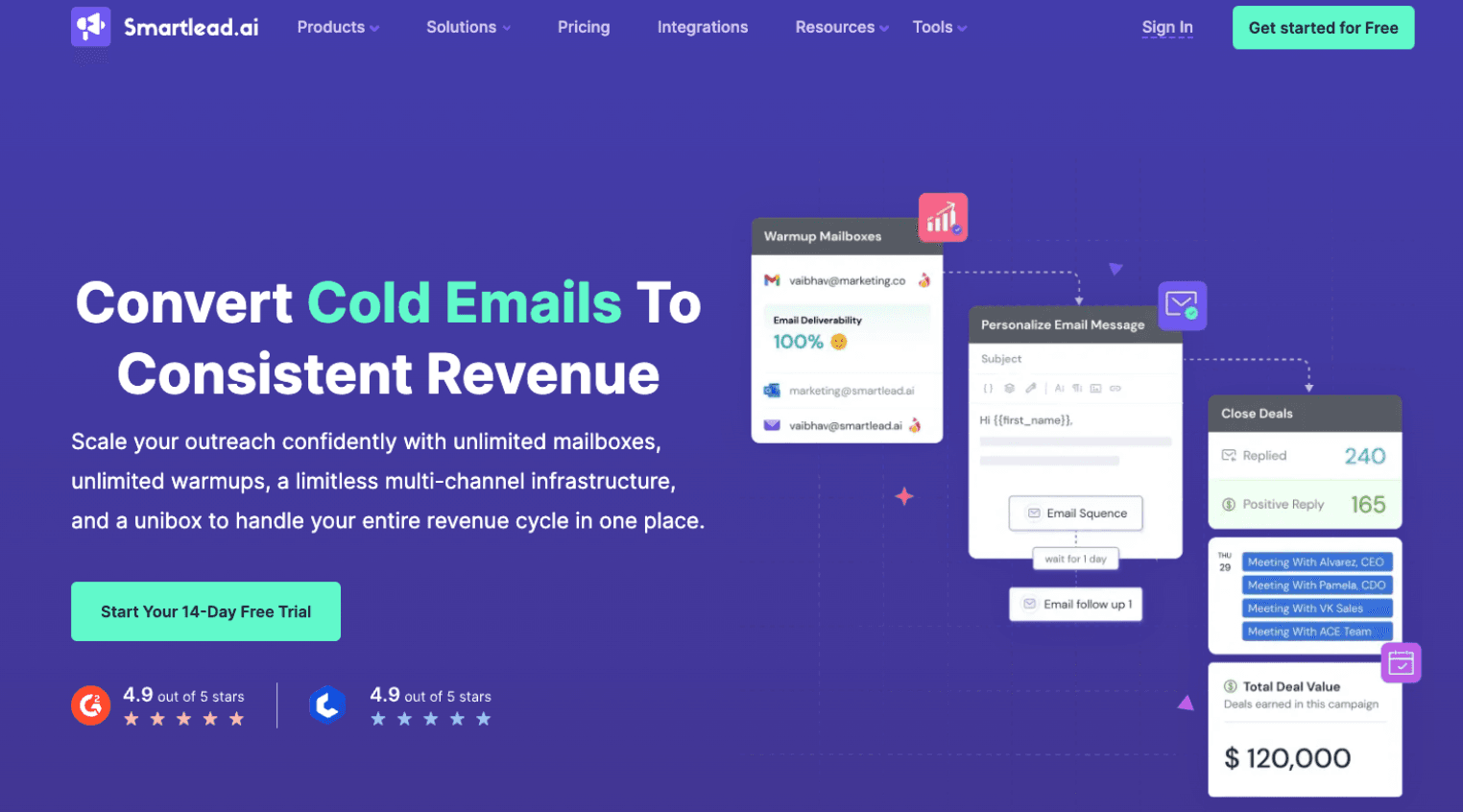
Smartlead is the alternative for agencies and technical teams running cold email at scale across many inboxes. It offers multi-inbox rotation and strong API workflows from $39 to $379 a month, though add-on costs accumulate, with placement testing at $49 to $599 extra, so the real bill is higher than the headline. For an agency managing many clients programmatically, it is a workhorse. Related: best email outbound tools.
Like Reply, it is a sending tool you operate; there is no autonomous agent, and the model rewards technical setup. You gain API depth and inbox rotation; you keep doing the writing and replying. For agency-focused options, see the best outbound tools for agencies.
Best for: agencies and API-driven teams that run high-volume cold email.
Who should pick something else: teams that want an agent that runs outreach, or a simple all-in-one.
Pricing: $39-379/mo, with placement testing and other add-ons extra.
6. Lemlist: Personalization-first multichannel
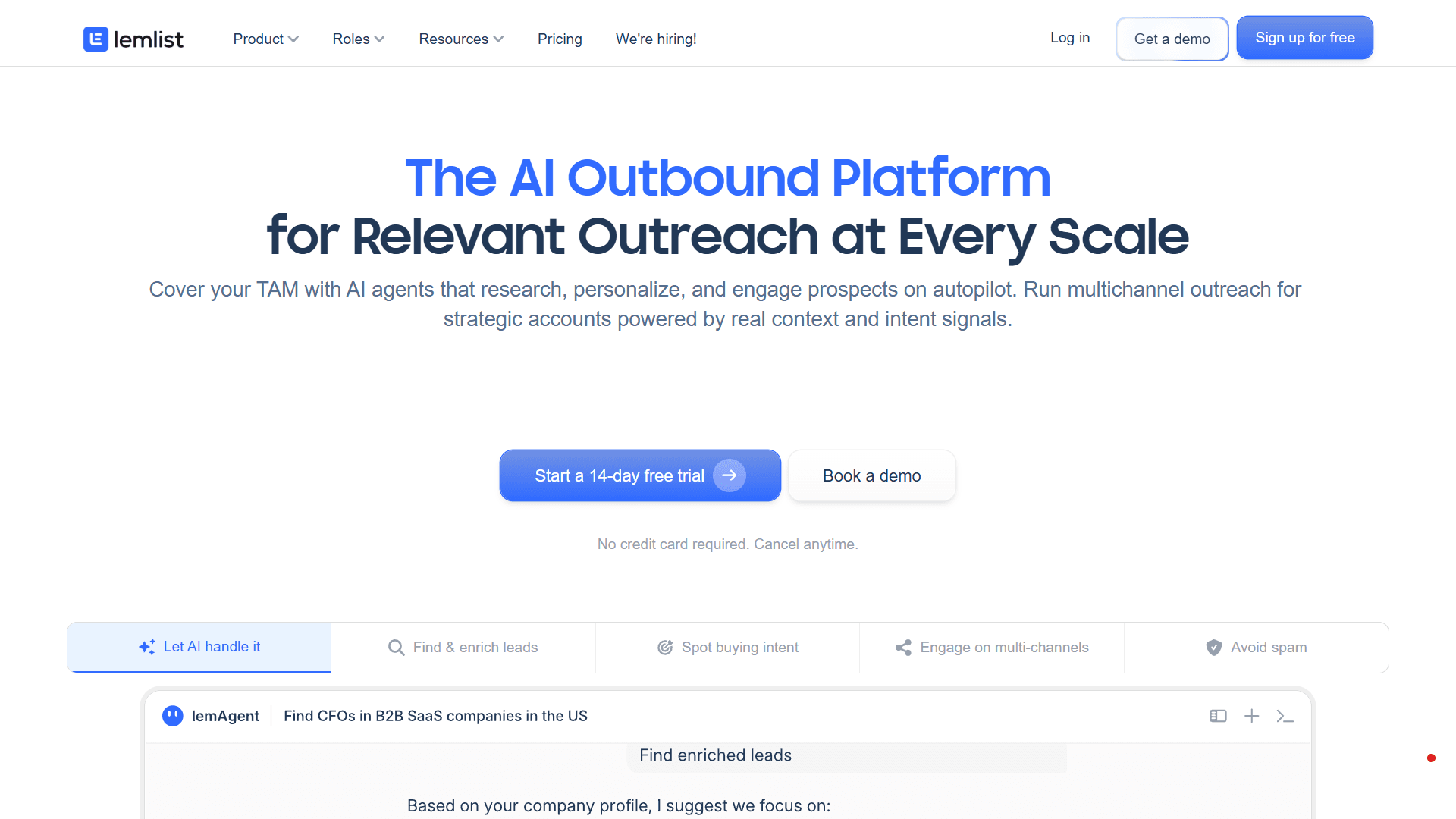
Lemlist is the alternative for a Reply team that cares most about personalization. It is personalization-first and multichannel, from $69 to $109/user/month on annual billing, bootstrapped to around $40M in revenue, and it acquired Claap in October 2025 to add video. For teams whose edge is craft in the message, its dynamic personalization is a draw.
It is still a sequencer you drive, with the personalization aids in your hands instead of an agent's. You gain personalization tooling; you keep the human-driven model. Related: Apollo vs. Lemlist.
Best for: teams that compete on message personalization across channels.
Who should pick something else: teams that want autonomous execution or enterprise governance.
Pricing: $69-109/user/mo annual, per its site.
What is the best enterprise alternative to Reply.io?
For enterprise, the best alternative to Reply.io is Artisan, because Reply's agent-on-a-sequencer model was never built for enterprise scope in the first place. Reply is an accessible entry into agent-assisted email; it does not carry the governance, security posture, or multichannel autonomy a large org needs. Artisan is the structural change: it consolidates data, sequencing, dialing, and reply handling into one platform where Ava runs the motion, with governance built in, org and campaign-level do-not-contact across every channel, per-field controls, SOC 2 Type II, SSO and SAML, and central-ops deployment where a small team runs Ava across a large account executive (AE) org. Our guide to the best AI SDRs maps the full field.
Why do teams leave Reply.io?
Two reasons lead. Scope is the first: Jason AI is an email-centric agent on top of a classic sequencer, so teams that want a true multichannel motion, or that want the software to handle replies, calls, and follow-ups instead of assisting with email, find the model too narrow. The second is the ceiling. Reply is priced and built as an accessible tool, which is a strength for a small team but means it does not carry the enterprise governance, security, or central-ops deployment a growing org needs. Teams that want the AI to own the whole job, at any scale, look at a different category.
Stay with Reply.io if...
Keep Reply.io if you are a small team whose motion is mostly email and you like having an optional AI agent on a low-cost sequencer. For this profile, Reply is a sensible, accessible choice, and Jason gives you a taste of agent-run prospecting without an enterprise contract. Switching for its own sake buys little. The case to move sharpens when you need true multichannel autonomy, when you want replies and calls handled for you instead of by reps, or when you outgrow an accessible tool and need enterprise governance.
Frequently asked questions
What is the best Reply.io alternative?
For most teams, Artisan, because Ava runs the whole multichannel motion, finding, writing, sending, calling, replying, and booking, instead of assisting with email on top of a sequencer. Klenty and Apollo are the closest value peers, while Instantly, Smartlead, and Lemlist cover cold-email volume and personalization.
Is Reply's Jason AI a full AI SDR?
Jason AI adds AI-driven email prospecting on top of Reply's sequencer, so it automates part of the email motion, but its scope is email-centric and the base product is a classic sequencer reps still drive. A fully autonomous AI BDR like Artisan's Ava owns the whole job across email, social media, and dialer steps, including reply handling and booking.
What is the best enterprise alternative to Reply.io?
Artisan, because Reply is built as an accessible email tool instead of an enterprise platform. Artisan has Ava execute the motion end to end with governance built in: SOC 2 Type II, SSO and SAML, per-field controls, org-level do-not-contact across channels, and central-ops deployment. It is the pick when you outgrow an entry-level agent and need enterprise depth.
Which Reply.io alternative is best for cold email volume?
Instantly leads on volume, with over 450 million leads claimed and tiers from $47 to $555 a month, and Smartlead is the agency and API workhorse from $39 to $379 a month with add-ons extra. Both are sending tools you operate. Artisan handles high-volume sending too, but adds an agent that writes, targets, and replies for you. Related: the best QuickMail alternatives.
Is Reply.io cheaper than the alternatives?
Reply's sequencer starts around $59 a month, similar to Instantly and Klenty, though its Jason agent runs $500 to $800 a month. Artisan uses usage-based credits with no platform fee, so cost tracks the work Ava performs instead of seat count, which can be more efficient for teams that want more pipeline without adding reps. See artisan.co/pricing.
Can an AI BDR replace Reply.io and Jason AI?
For many teams, yes. An autonomous AI BDR like Artisan's Ava replaces both the sequencer and the email agent, since she runs email, social media, and dialer steps end to end, handles every reply from a knowledge base, and books meetings, all under a defined autonomy level with a full audit trail.
Ready to see the AI run the motion? Explore the AI sales agent or start on the Artisan homepage.

Artisan Team
Expert insights from the team at Artisan
Our writing team blends direct operational experience, in-house data, and thorough research to bring you the very latest insights and updates about sales and GTM automation.