Reply vs. Klenty: Which should you choose in 2026?
An honest 2026 comparison of Reply.io and Klenty across multichannel cadences, the Jason AI agent, deliverability, and pricing.

Key Takeaways
- Klenty is a value multichannel sequencer with published per-seat tiers, running cadences across email, calls, and social outreach with a human rep driving.
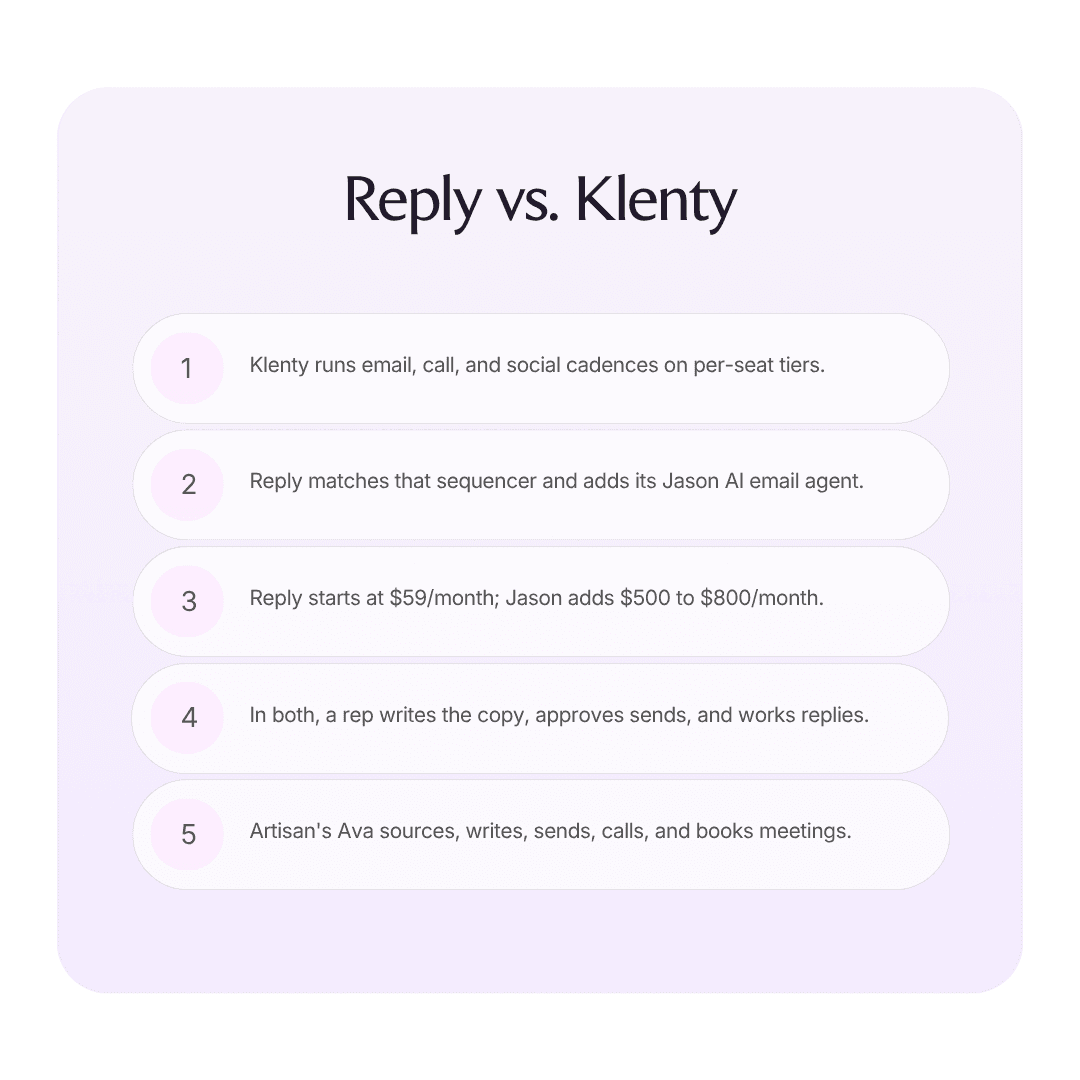
- Reply.io pairs a low-cost sequencer, from about $59 per month, with its Jason AI agent, roughly $500 to $800 per month, an accessible on-ramp to agent-run email prospecting.
- The core sequencer capability is close; the deciding factor is whether Reply's Jason agent earns the step up in price.
- Both are per-seat, human-driven tools: a rep still writes the strategy, approves messages, and works replies.
- Klenty tends to appeal to teams that want clean, affordable cadence execution; Reply appeals to teams that want a taste of AI prospecting inside the same budget bracket.
Reply.io and Klenty are both multichannel sequencers for small and mid-market teams. Klenty is the cleaner, cheaper cadence tool with published per-seat pricing. Reply matches it on the sequencer, from about $59 a month, and adds Jason, an AI agent for email prospecting at $500 to $800 a month. The choice turns on whether you want that agent layer.
Both tools do the same core job well: run multichannel cadences across email, calls, and social outreach without the enterprise weight or price of big engagement platforms. If your motion is outbound at a reasonable scale and you want a human rep at the wheel, either one can run it. Where they diverge is the AI story on top and how each handles the details of sending. Here is the fair breakdown. For the broader category, see best email outbound tools.
How Reply and Klenty compare
Reply.io | Klenty | |
Best for | Teams that want a value sequencer plus an AI agent option | Teams that want clean, affordable multichannel cadences |
Sequencer | Multichannel cadences from about $59/mo | Multichannel cadences, published per-seat tiers |
AI agent | Jason AI, roughly $500 to $800/mo for email prospecting | No dedicated agent layer |
Channels | Email, calls, social outreach | Email, calls, social outreach |
Model | Per-seat, human-driven | Per-seat, human-driven |
Public pricing | Sequences from $59/mo; Jason roughly $500 to $800/mo | Published per-seat tiers, per its pricing page |
What is the difference between Reply and Klenty?
At the sequencer level, they are peers. Both run multichannel cadences, both are priced for teams that do not want an enterprise contract, and both keep a rep in control of the outreach. If all you need is a clean cadence tool, you would be happy with either.
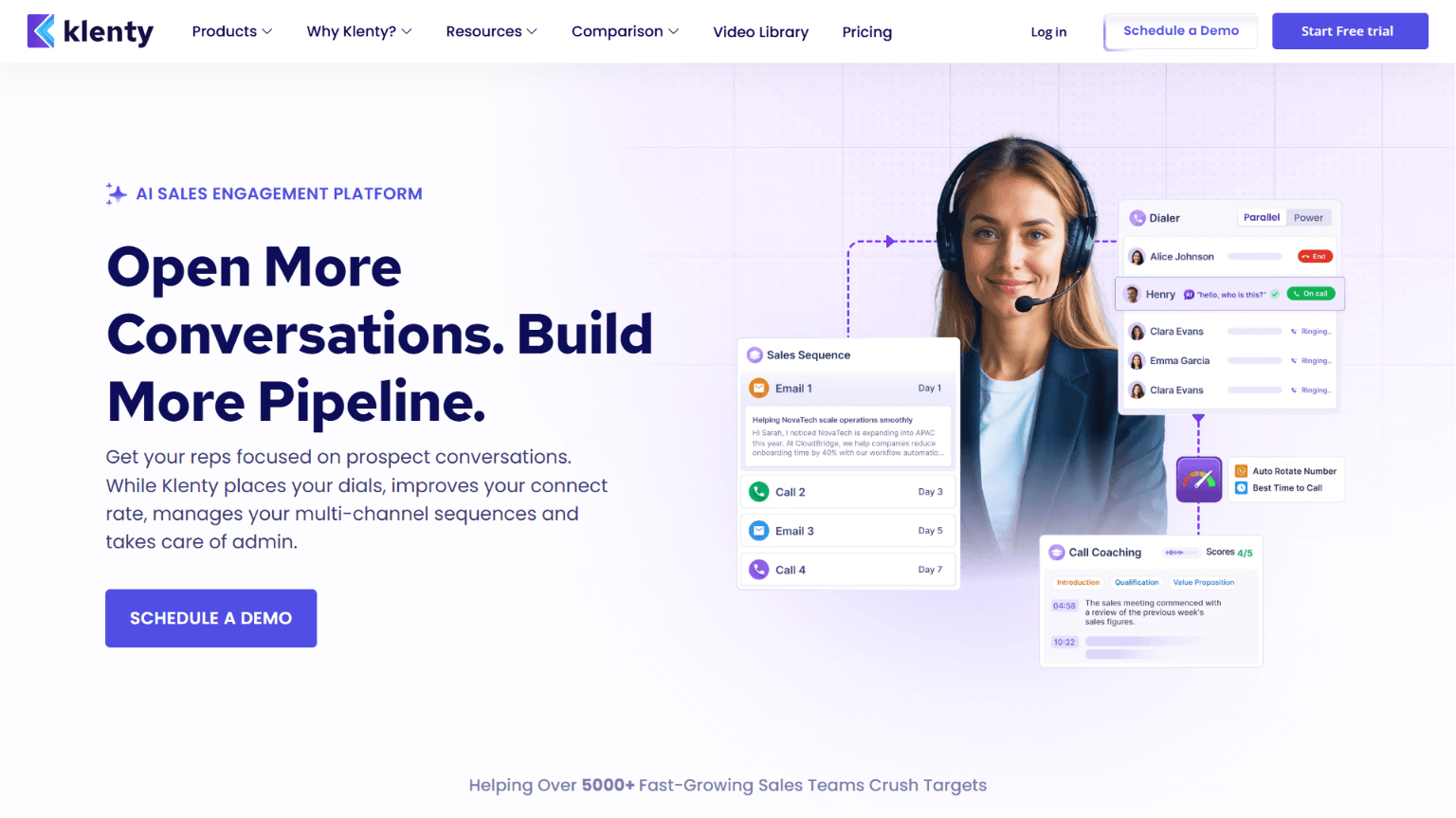
The split is the AI agent. Reply layers Jason, an AI agent for email prospecting, on top of its classic sequencer, which is what pushes some buyers to Reply over Klenty. Klenty does not offer a comparable agent; it stays focused on being a strong, affordable multichannel sequencer. So the real question is whether you want an agent option inside your value sequencer, or whether you would rather keep it simple and cheaper. For broader options, see the best Reply alternatives.
Which is better value for multichannel cadences?
For pure cadence execution, Klenty is the tighter value pick. Its published per-seat tiers are built around clean multichannel cadences, and there is no agent premium baked in. A team that just wants email, call, and social steps running reliably tends to find Klenty does that without paying for capabilities it will not use. For related comparisons, see Apollo vs. Instantly and Apollo vs. Lemlist.
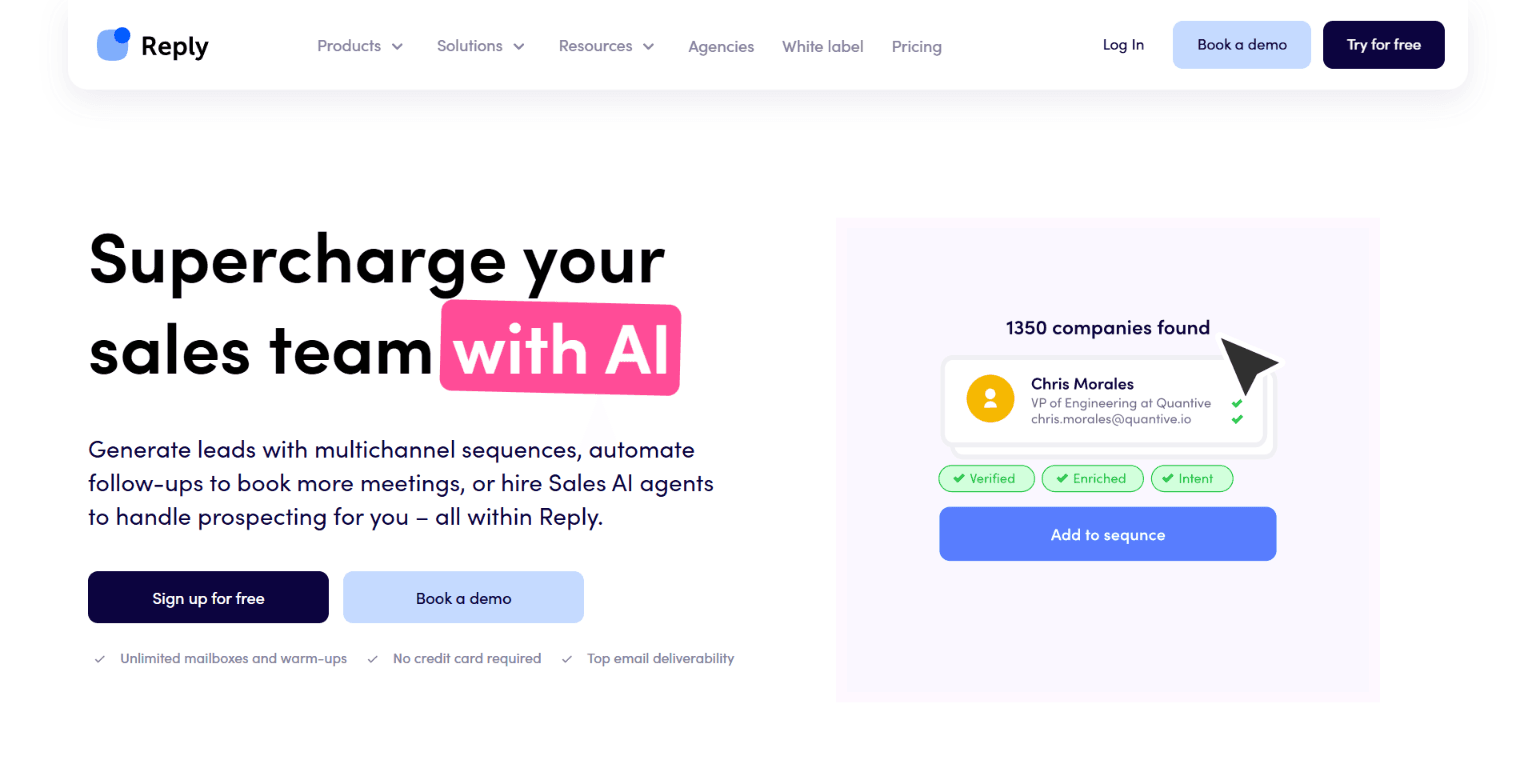
Reply's base sequencer starts around $59 a month, in the same value bracket, so on the sequencer alone the two are comparable. The cost difference appears only if you add Jason. If you never turn the agent on, Reply and Klenty are close on price; if you do, Reply's total bill jumps by the $500 to $800 a month the agent costs. Match the tool to whether you will actually use the agent. For wider roundups, see the best cold email tools and best cold email marketing software.
Does Reply's Jason AI agent justify the step up?
It depends entirely on how much email prospecting you want to hand off. Jason brings AI-driven email prospecting on top of the sequencer, which is a real capability Klenty does not have, and for a team that wants to test agent-assisted outbound without buying a dedicated AI sales development representative (SDR) platform, it is an accessible entry point at $500 to $800 a month.
The honest caveat is scope. Jason is an email-centric agent that sits on top of a classic sequencer. It does not run the whole outbound job across channels: it helps with email prospecting, but it does not source, call, and book across a full multichannel motion on its own. If email assistance is what you want, it can earn its price. If you expect it to run the entire motion, set expectations accordingly. For agency-focused picks, see the best outbound tools for agencies.
Which has better deliverability and sending?
Both tools invest in the fundamentals of email delivery, and neither has a decisive edge that would settle the choice on its own. Klenty and Reply each offer sending controls, inbox rotation options, and health features you would expect from a modern sequencer in this bracket.
The practical advice is the same for both: run a hands-on trial against your own domains before committing, watch inbox placement on your real sending pattern, and confirm the CRM sync behaves the way your process needs. Deliverability is domain-specific and reputation-specific, so a general claim about either vendor matters less than what you see on your own mailboxes during a trial.
A third option to know about
Both Reply and Klenty keep a rep running the motion. A person writes the strategy, approves messages, and works replies. Reply's Jason helps with email, though it stays email-centric rather than covering the whole job. Whichever you pick, a person still owns the outbound.
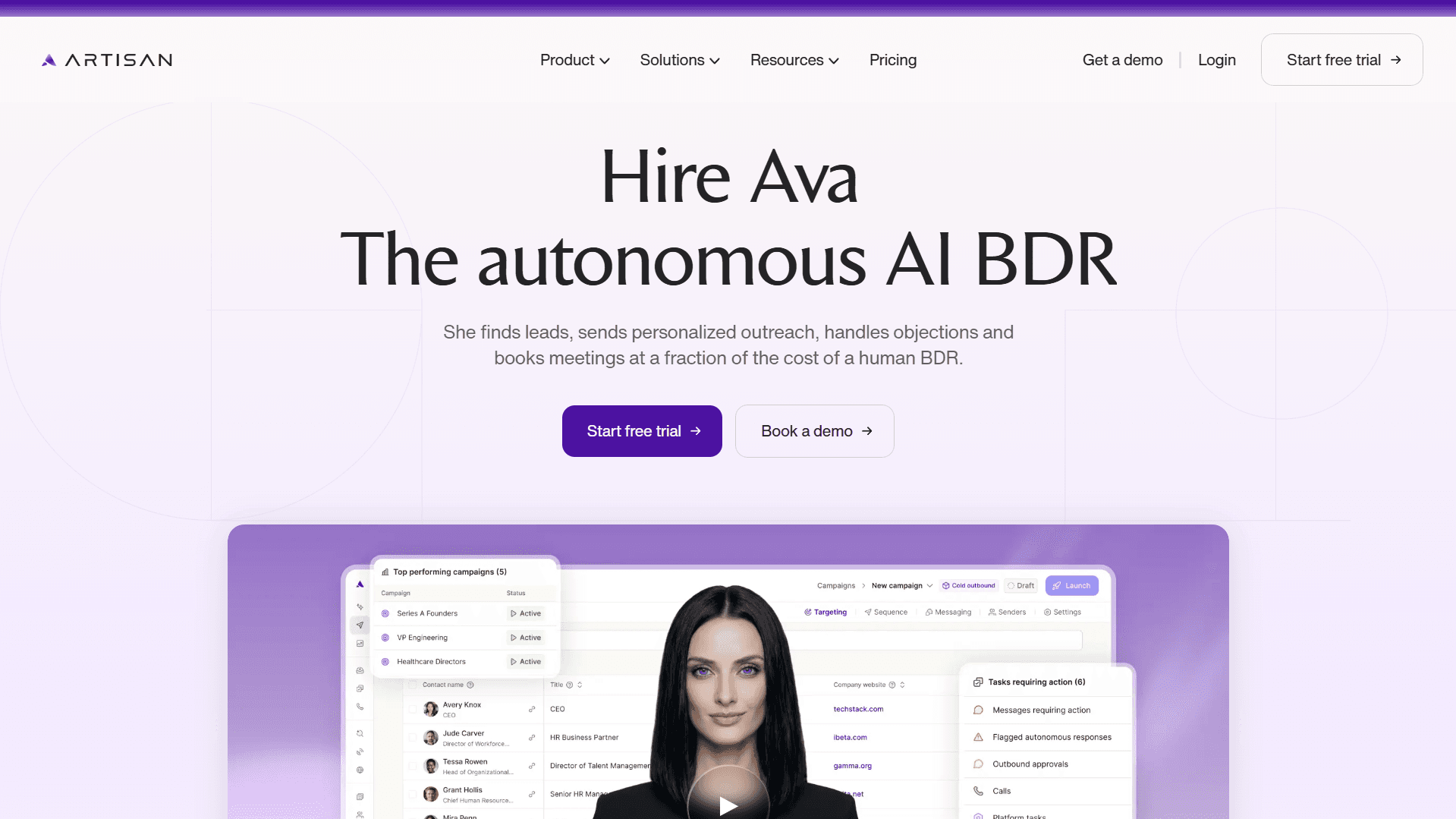
If you would rather the software own the motion end to end, an autonomous platform is a third path. Artisan built Ava, an autonomous AI business development representative (BDR), to source, write, send, call, reply, and book on her own across email, social media, and dialer steps, priced on work performed instead of per seat. That is a different purchase from a value sequencer with an agent add-on, and it fits teams that want the outcome instead of a tool to drive. See artisan.co/pricing for the model.
Choose Reply if...
You want a value sequencer with the option to add an AI email-prospecting agent.
Jason's agent-assisted email fits how you want to test AI outbound without a full AI SDR platform.
You are comfortable with the step up to $500 to $800 a month when you turn the agent on.
You want an accessible on-ramp to agent-run email inside a familiar sequencer.
Multichannel cadences from about $59 a month cover your base needs.
Choose Klenty if...
You want clean, affordable multichannel cadences without paying for an agent layer.
Published per-seat pricing and predictable costs matter to you.
Your motion is human-driven and you want a rep at the wheel by design.
You found bigger engagement platforms overbuilt for your needs.
Email, call, and social steps running reliably is the whole ask.
Frequently asked questions
Is Reply or Klenty cheaper?
On the base sequencer, they are close. Reply's sequences start around $59 a month, and Klenty publishes comparable per-seat tiers. The gap opens only if you add Reply's Jason AI agent, which runs roughly $500 to $800 a month. So if you use only the sequencer, expect similar costs; if you want Jason, Reply becomes meaningfully more expensive. Match the choice to whether you will actually use the agent.
What does Reply's Jason AI agent do that Klenty cannot?
Jason adds AI-driven email prospecting on top of Reply's sequencer, a capability Klenty does not offer. It helps generate and run email prospecting with less manual work. The limit is scope: Jason is an email-centric agent on a classic sequencer, and it does not run a full multichannel motion autonomously. If email assistance is what you want, it is a real advantage; do not expect it to own the whole job.
Which is better for multichannel cadences?
Both run email, call, and social outreach cadences well, so this is close. Klenty is the tighter value pick if you want clean multichannel execution without an agent premium. Reply matches the multichannel base and adds the Jason option. For pure cadence execution at the lowest predictable cost, Klenty tends to win; for cadences plus an AI email option, Reply does.
Are Reply and Klenty good for enterprise teams?
Both are value sequencers aimed at small and mid-market teams instead of large enterprises. They lack the deep governance, permissions, and reporting depth that dedicated enterprise engagement platforms offer. A large, disciplined sales org usually needs more control than either provides. For a smaller team that wants affordable multichannel cadences with a rep in charge, both fit well.
Is there an alternative to both Reply and Klenty?
Yes. Both are human-driven: a rep writes the strategy, approves messages, and works replies, and Reply's Jason agent only assists with email. If you want the software to own the outbound job end to end, Artisan's Ava is an autonomous AI BDR that sources, writes, sends, calls, replies, and books across channels on her own, priced on work performed instead of per seat. It is a different category than a value sequencer, suited to teams that want the motion run for them instead of assisted.
Should I trial both before deciding?
Yes. Because the base sequencers are close and deliverability is domain-specific, a hands-on trial on your own mailboxes is the best tiebreaker. Test inbox placement on your real sending pattern, confirm CRM sync fits your process, and if you are considering Reply, evaluate whether Jason's email prospecting justifies the added cost before you commit to it.
Related reading

Artisan Team
Expert insights from the team at Artisan
Our writing team blends direct operational experience, in-house data, and thorough research to bring you the very latest insights and updates about sales and GTM automation.