How to pitch retailers and get your product in stores
Meta description: Ready to sell your product in retail stores? This step-by-step guide breaks down everything you need to know to start small and scale smart.

Retailers want to see a proven record of strong sales, healthy margins, and reliable distribution.
If you can demonstrate these three things, your chances of persuading retailers to stock your products will increase exponentially.
In this guide, you’ll learn how to understand your target retailers, create a persuasive pitch, and reach them with targeted outreach.
What Is a Retail Pitch?
A retail pitch is a presentation—usually delivered in person—to a retail buyer (or panel of retail buyers) responsible for deciding which products a store will stock. Shelf space is highly valuable and sought after, and the aim of a pitch is to demonstrate that a product can drive long-term profitability.
If you are a product manufacturer, whether an independent artisan or the owner of a consumer goods brand with global ambitions, knowing how to deliver a retail pitch is an essential skill. Though effective research and outreach are important, a well-delivered pitch is often the deciding factor in whether or not a store will stock your items.
What Retail Buyers Actually Want to See
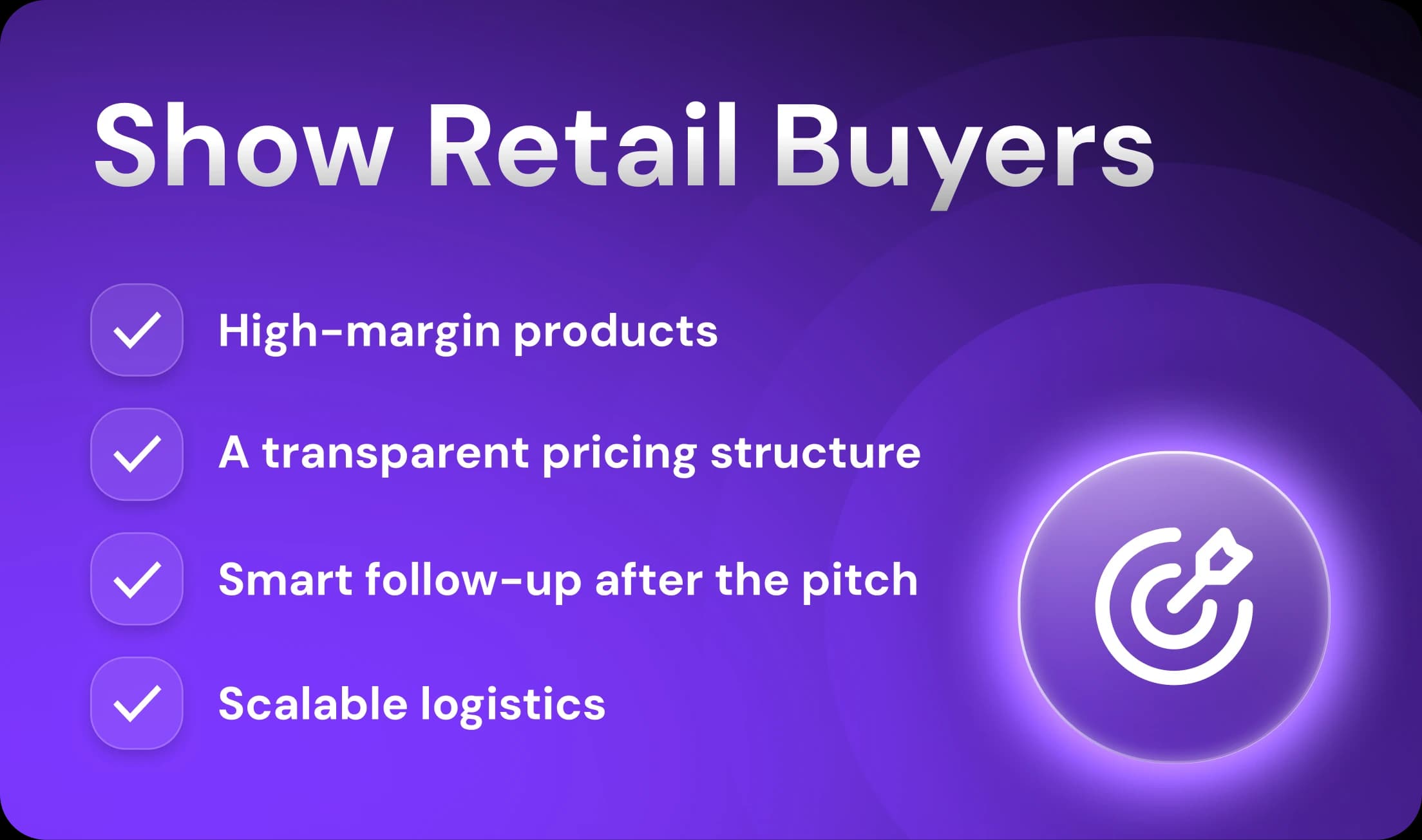
Before you deliver a single pitch, your product, pricing, and packaging should be ready to go. First and foremost, retailers want to see a product that will sell well and generate high returns.
Products That Sell Themselves
Even the best pitch in the world won’t convince retailers to buy the wrong product. That’s why careful selection from your catalog is an essential first step in convincing retailers to stock your items.
Here are the product features that retailers want to see:
High-margin: As a rule, retailers expect margins of between 30 and 50%.
High-demand: Suggest products that sell quickly or have strong brand awareness before items that are less popular.
Unique selling points (USPs): Products must offer something different from the retailer's current stock. Perhaps your product is sustainable or provides a higher margin than competitors.
Presentation: Your product and packaging must appeal to the retailer’s target market. Stay away from easy-to-print but unprofessional sticker labels.
Marketing: Sharing a proven marketing strategy will reassure retailers that your product will boost footfall. It’s worth detailing how your influencer strategy or paid promotions have worked in the past, either for retailers or on your own website.
Always back claims with data. If you say the Gen Z demographic loves your products, for example, highlight your 90% five-star reviews on your website from that age group. Where possible, compare data with industry benchmarks and competitors to convince retailers to choose you.
A Clear, Realistic Price Structure
When shoppers enter a store, they expect clear price points. Retailers expect the same.
Your pricing must be transparent, protect retailer margins, and leave enough room for your own profit.
Create a clear pricing sheet—that shows the cost of goods, margins, and expected delivery—and make it accessible to retailers.
A Follow-Up That Feels Personal
Buyers are busy. If you fail to follow up, you risk being forgotten.
After your initial pitch, you should send two to three follow-ups to boost your chances of a response. It’s best to deliver the first message within 48 hours and then wait 3 to 4 days before reaching out again to avoid bombarding the buyer.
In every message, you should add value by sharing testimonials, reviews, and case studies. This can become operationally complex, so consider B2B sales automation tools that make it easy to stay in contact with multiple retailers at once.
A Logistics Partner That Can Scale
When you’re pitching to a local business, quantities are small and logistics isn’t usually an issue. But as you move up to larger retailers, expectations change. These retailers typically want to know you can handle higher production volumes and deliver on time, often across multiple locations.
To ensure you can scale without overwhelming your operations, consider partnering with a reliable distributor to manage logistics, warehousing, inventory, and distribution on your behalf.
Step-by-Step Guide to Getting Your Product in Stores
So, how should you prepare for pitching and distributing to retailers? It’s worth following a plan from pre-pitch to follow-up that ensures you make the best impression at every step.
1. Make Sure You’re Ready to Go Retail
You'll lose retailers’ trust if you pitch—or worse, sign a deal—before your products, packaging, and distribution are ready.
Here’s what you need to be retail-ready:
Barcodes: You’ll need a globally standardized (GS1) barcode to sell your product in-store or online with traditional retailers such as Amazon or Walmart. Each product and variation should have its own barcode to allow restocking of exactly what's selling. For example, a t-shirt seller should create unique barcodes for each size and color variation.
Packaging and labels: Ensure items are easy to identify (with clear product and brand names), look professionally made, and include all required information—size, barcode, use-by date, ingredients, materials, and country of manufacture.
Compliance: Your product and labels must comply with industry standards for your jurisdiction. If you sell food products, for example, disclose ingredients, allergens, and nutritional information.
Distribution and logistics are another consideration. Jesse Singh is the founder of Maadho, one of the leading vertically integrated suppliers of disposable products. He has found that preparation is essential for successful retail distribution:
“Product founders must have operational control over their supply chain to make sure that they can sustain orders after the initial retail placement. In my own practice, failure to achieve consistent, vertically integrated manufacturing and logistics results in more than 60% of small brands failing to make it through their first major retail contract, because they are unable to meet volume demands without a major drop in quality.”
2. Find Strong-Fit Retailers to Pitch To
During the prospecting phase, you should look for stores that serve a similar audience to yours and share your positioning (at least partially).
To increase your distribution as much as possible, you should also aim to stock your product in a mix of the store types—local shops, ecommerce retailers, chain stores, and distributors.
Create profiles of your ideal store across all of these categories using the following criteria: target customers, store category, average price point, location, and brand adjacencies (brands that are similar to yours but not direct competitors).
Here’s a breakdown of the main retailer types:
Local shops: These are small, independent stores. Sometimes, they might be part of a small chain. They won’t move the same volume as large retailers, but they’re typically easier to book a meeting with, and you can see sizable revenue if you stock a large number of local shops.
E-commerce retailers: Online retailers range from small sites to large platforms with a global presence. They often stock more items than physical retailers, and the barrier to entry is lower, but they require high-quality product images and speedy fulfillment.
Chain stores: These are large, multi-location retailers that place a strong emphasis on professionalism and your ability to fulfill expected orders.
Distributors: These buy wholesale from you and resell to retailers on your behalf. They often have large rosters of retailers. They reduce your direct sales workload but will also limit your margins on products.
Armed with profiles for each type, you’re ready to start prospecting. Use a combination of tool filters in prospecting tools (like company size and industry) and your own qualitative judgment to do this. You will need to use your judgment because it’s not always possible to filter mechanically by criteria like “similar brands stocked.”
Use the following methods to find retailers that match your ideal store profiles:
Dedicated prospecting solutions like Artisan, Apollo, and ZoomInfo
LinkedIn Sales Navigator
Online retail directories
Trade association listings
Google shopping results (sellers of similar products to yours)
Industry publications
By the end of this process, you will have a list of prospective retailers that you can reach out to via email, telling them a little about your product and asking for a formal meeting to pitch it.
3. Refine Your Pricing and Profit Margins
Buyers love a good brand story. But they’ll only place an order if the numbers make sense. Making sure your figures are clear and compelling is a key preliminary before you design your pitch.
Here’s how to structure your pricing so buyers feel confident saying yes:
Clarify your terms: Define your minimum order quantity (MOQ), payment terms, shipping costs, and delivery timelines upfront.
Stay transparent: Retailers are more likely to move forward when you’re open about your pricing logic, lead times, and production limits. Transparency removes friction and signals professionalism.
Adjust your wholesale price for larger orders: The cost for bulk buys should reflect economies of scale. Larger orders should be cheaper and easier to fulfill.
Profit margins: As a rule of thumb, your manufacturer’s suggested retail price (MSRP) should be roughly double your wholesale price to give stores enough room to make a profit and discount products during sales.
Where possible, boost your impact by visualizing data with graphs, charts, and images showing previous retailers’ profits, margin comparisons with competitors, and the benefits of bulk orders.

Automate your outbound with an AI BDR
Meet Ava—your AI BDR who handles prospecting, outreach, and follow-ups, so your team can focus on closing.
4. Create a Strong Sell Sheet and Product Samples
A sell sheet and product samples give retailers an immediate snapshot of your product. You’ll share it during (or sometimes before) your pitch so that retailers have a clear document they can reference that covers all key product particulars.
Here are the details your sell sheet should include:
High-resolution photos of your product from different angles and in use.
Key product specifications covering ingredients, materials, colors, sizes, ranges, etc.
Testimonials and reviews that prove consumers, especially those in the retailer’s target market, value your products
Contact information section with your name, email, phone number, and address
Always use brand colors, consistent fonts, and clean visuals. A polished sell sheet signals professionalism.
In addition, provide physical product samples alongside the sell sheet. There’s no substitute for actually handling a product. You don’t need to include every variant. But give a representative sample of sizes, designs, ranges, and so on.
5. Start Small with Local Retailers or Pop-Ups
Pitching a big box retailer, perhaps one you’ve dreamed about since day one, feels exciting. But to excel in that high-pressure environment, you need plenty of practice.
Warm up for bigger pitches by creating distribution channels with smaller retailers. You'll gain valuable pitching experience, but these early sales will also give you real performance metrics, including sell-through rate, units sold, customer feedback, and regional sales patterns.
These insights help you fix pricing gaps, refine logistics infrastructure, and sharpen your packaging and brand marketing.
Here are the lower-risk retailers you should pitch to before big box retailers:
Local boutique stores
Small-chain retailers
Pop-up stores
Finding small businesses to stock your product gives you the sales history to convince larger retailers that your products generate profits. You can also use the opportunity to start growing your community, collecting reviews, and encouraging customers to post social media content you can reshare—yet more power for later pitches.
6. Pitch Strategically to Retail Buyers
Things are moving. Your products are ready. You’ve understood who your ideal retailers are and have a list of targets. You also have a clear, attractive sell sheet and compelling data visuals. Now it’s time to prepare your pitch and reach out to retail buyers.
Here is an outline for structuring your pitch:
Opening (one minute): Hook buyers with a clear outline of the market opportunity.
Solution (two to three minutes): Explain what you're offering and why it's better than alternatives. Use visuals and reference your product samples.
Evidence (two to three minutes): Back claims with data—market research, sales figures, customer testimonials, case studies. This is where your data visualizations come in.
Ask (one minute min): Be specific about what you want—minimum order quantities, shelf space, number of lines stocked, etc.
Close (thirty seconds): Reiterate how much stock you anticipate the retailer will see and invite questions.
Keep slides minimal (one idea per slide) and avoid text-heavy content. Use high-quality visuals and charts, and keep the pitch focused on tangible outcomes. Finally, make a list of all possible objections—especially around pricing and demand—and a solution you can offer for each. For example, if a buyer says that your product is similar to others on the market, you can reiterate your core unique selling points (USPs).
Here are guidelines for identifying and approaching buyers:
Collect buyer contact details: For smaller stores, the owner’s details may be on their website or accessible by calling the store. But for larger retailers with hundreds or thousands of employees, you’ll need a dedicated prospecting tool to find the right buyer for your industry.
Take a multi-channel approach: Increase your chances of generating a reply by using a mix of email, LinkedIn, and phone outreach.
Start with a sales email: Multi-channel works, but email is the least intrusive channel for the first contact.
Opt for in-person: Don’t be afraid to visit smaller stores in person. This allows you to build a relationship more quickly, present your product, and show you’re willing to put effort into the retail partnership. Call first to check that the store owner is present.
Track behavioral triggers: If buyers are interested in your products, they may visit your website, search online for similar products, or post on social media that they’re in-market for new products. Use this intent data to prioritize leads.
7. Follow Up and Stay on Their Radar
Just because you haven't had an immediate yes, this doesn't mean the deal is lost. You now have a chance to overcome any doubts and put the focus on the positives with a follow-up strategy that adds value.
Here's a follow-up cadence to engage retailers and add value:
Follow-up 1 (the recap): At around 24 to 48 hours after the pitch, send a message thanking the retailer. Include a quick recap of the pitch, the top product benefits, and the next steps.
Follow-up 2 (the value add): Approximately a week (5 to 7 days) after the pitch, encourage the retailer not to miss out by sharing relevant case studies, testimonials, and reviews.
Follow-up 3 (the final update): Between 10 and 14 days after the pitch, send a final message. Say you’ll be checking out for now, but they’re welcome to get in touch whenever they want.
If none of your messages receive a response, stop pushing for the sale. Continuing to pressure buyers will only annoy them.
Instead, add them to a lead list and send relevant updates every couple of months. For example, reach out if a new product sample is available, your brand won an award, or you received a shining testimonial from a similar business. This keeps you on buyers’ radars without going overboard.
8. Scale with Trade Shows, Distributors, and Major Retailers
Once you’re an expert at pitching to smaller and medium retailers, you can start looking at bigger opportunities.
Here are three opportunities to consider when you’re ready to grow your retail business:
Trade shows: Industry events are an excellent place to network and secure sales. Check out the event as a guest before committing to a stall, as they typically cost between $1,000 and $50,000. Reach out to people you want to speak to and set times to talk to them before attending.
Distributors: When you expand into new territories, your supply chain and logistics become more complex. Distributors are often a cost-effective option for scaling warehousing and transportation. If you do choose to go with a distributor, monitor KPIs, check in regularly, and diversify your distributors to prevent dependency forming.
Big retailers: When you’re ready, you can start reaching out to the retail giants. You must have everything set up: EDI, logistics, and a well-functioning supply chain. Many retailers, like Walmart, require sellers to complete forms covering insurance, tax, and projected revenue.
Marketing and Sales Strategies to Support Retail Growth
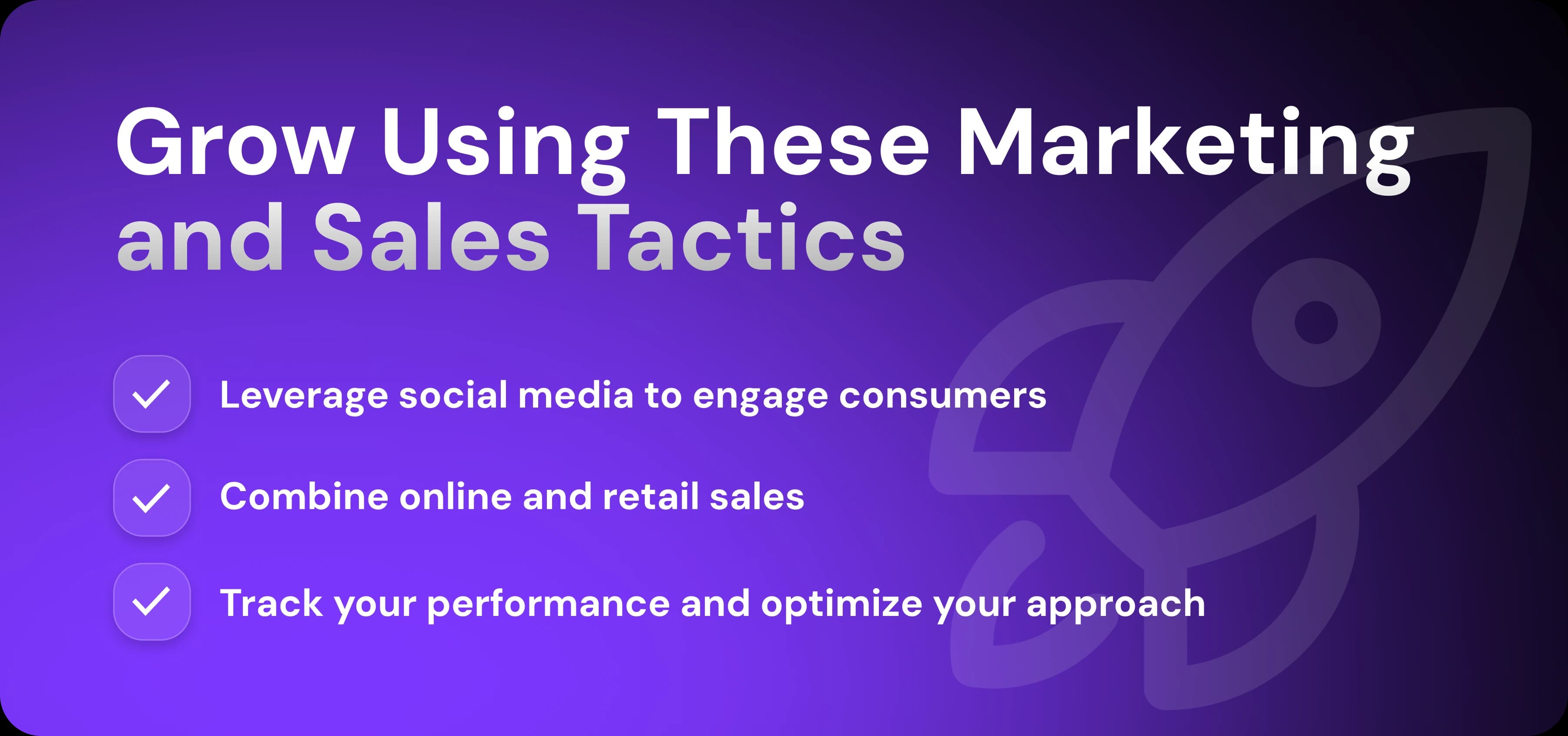
It’s best practice to create demand before you start reaching out to retailers. This shows that your product resonates with your target market and that store footfall is a strong likelihood for retailers.
Use Social Media and Content to Drive Demand
Social media helps you reach potential customers, create communities, and develop a deep well of social proof.
Here’s how to create buzz on social media:
Sponsor influencers to develop promotional content about your brand.
Start an affiliate scheme that allows influencers to earn a commission on promotional content.
Gift influencers free products or event invites to encourage them to talk about your brand, but keep in mind that not everyone will create content in exchange for gifts.
Develop share-worthy packaging, marketing campaigns, and brand hashtags that encourage users to create unpaid user-generated content (UGC) about your brand.
Post regularly on your own social media account, including reposting customer content, sharing employee content, and uploading professional product snapshots and tutorials.
Combine Ecommerce and Retail (Multi-Channel Growth)
Selling products online through your own ecommerce site—also called direct-to-consumer (DTC) sales—creates a growth loop when combined with retail.
Your DTC activity builds demand and generates data you can use to improve your products. This makes retail shelf space easier to secure because you have persuasive sales data. In turn, retail stores increase visibility and scale by stocking your products, driving more customers to your DTC store.
Track and Optimize Performance
Retailers will often ask for your sales history. The more data you collect, the easier it becomes to prove your value and secure bigger purchase orders.
Here are the core metrics every brand should track from retailers (plus what they actually mean):
Sell-through rate: The percentage of inventory sold within a set period. High sell-through shows strong demand, which reduces risk for retailers.
Reorder rate: How often retailers place repeat orders. This is one of the fastest signals that your product is performing well on the shelf.
Profit margin: The percentage of revenue left after costs. Strong margins give retailers confidence that the product is worth carrying long-term.
Inventory turnover: How quickly inventory sells and is replenished. High turnover means your product is moving.
Regional sales performance: This is how consumers in different cities, states, or regions purchase. This helps you tailor marketing efforts and identify expansion opportunities.
Return rate: How often customers return each item. A low return rate signals quality and consumer satisfaction.
You should also regularly check in with your retailers to ask how your product is performing, which SKUs are moving fastest, and any consumer feedback they’re receiving.
Once you spot a trend, act fast. Maybe a cookware retailer in Arizona tells you that a specific hot-pot pan is flying off the shelves. Instead of celebrating quietly, you can boost visibility with location-based marketing for that product, activate local influencers, and pitch nearby retailers using that regional success as proof.
How Tools Like Artisan Help You Land and Scale Retail Partnerships
If the thought of managing multi-channel cadences and researching dozens of retailers seems overwhelming, modern AI tools like Artisan might be the solution. Let’s look at how it can help you find, land, and scale retail partnerships.
Automate Retail Buyer Outreach
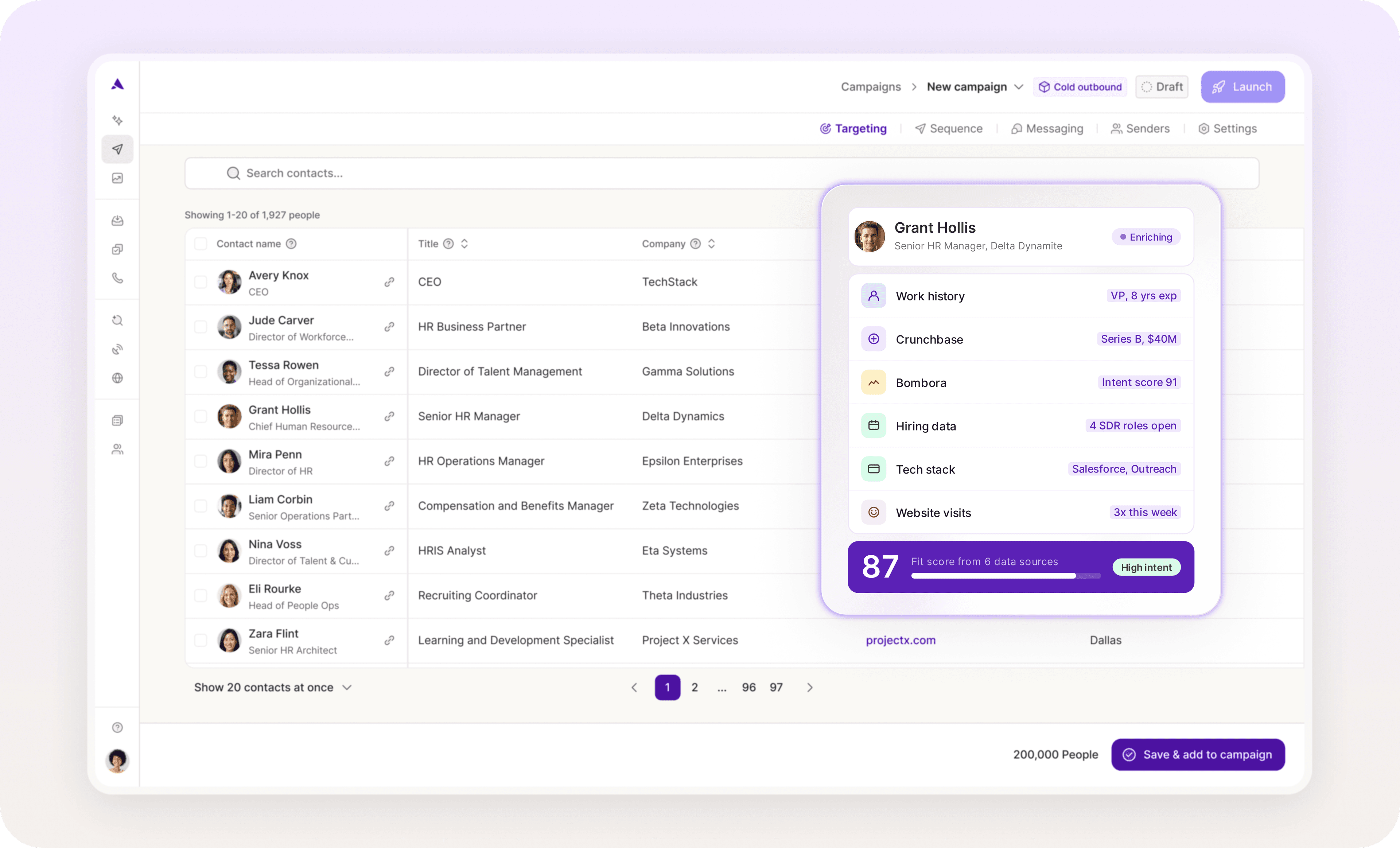
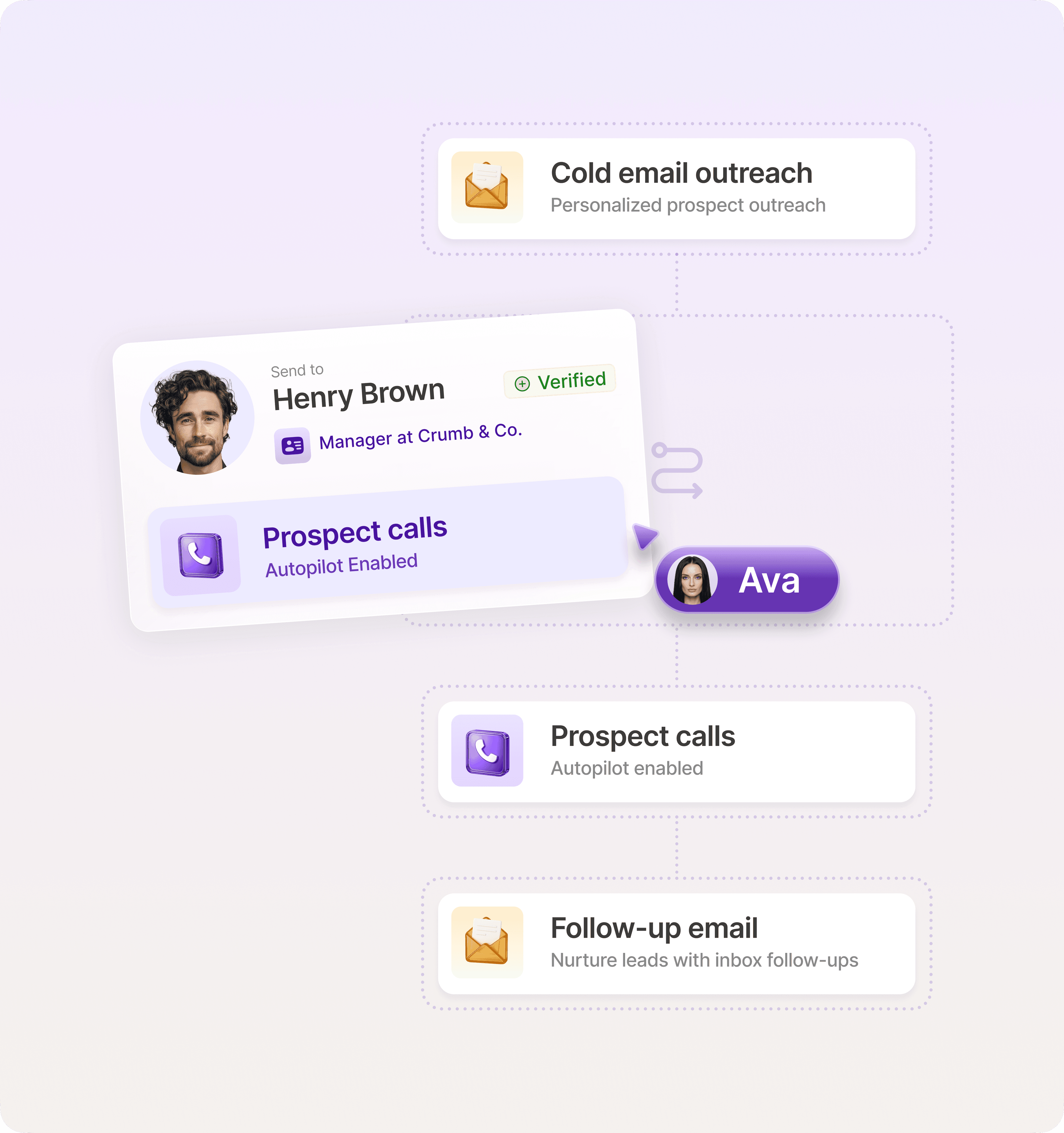
As an AI-first outbound platform, Artisan works like an additional team member. AI BDR Ava researches leads, pinpoints the most relevant retailers, and reaches out to decision-makers across social media and email. This means you have time to work on your pitch while being sure you’re sending messages consistently.

Personalize Pitches at Scale
Artisan’s extensive database of local, ecommerce, and B2B leads allows you to populate retailer profiles with the insights you need to get your messages noticed, including company size, recent news, and information about decision-makers. Ava will tailor every message to the buyer, whether it’s a start-up willing to take a risk on innovative products or an established mom-and-pop store that values consistency and predictability.
Track Performance and Scale Smart
Want your social media and email sequences to keep improving, without spending hours on analysis? Artisan will assess who opens, clicks, or replies to messages and then adjust its approach in real time. It turns retail prospecting into a repeatable and automated sales system that is constantly self-optimizing.
You Don’t Need More Hours, Just Better Systems
Your retailer pitch is important. It’s the main factor that will determine whether or not retailers stock your product. It has to be precise, persuasive, and targeted.
However, a well-designed outreach and follow-up system is what gets your foot in the door. It also ensures no leads slip through the net after the pitch.
With Artisan, you can automate this initial outreach and follow-up while ensuring it’s personalized and relevant. AI BDR Ava acts like a human member of your team. The only difference is that she can do the work of ten reps, not one. This gives you more time to focus on the vital human tasks of pitching and securing deals.
Automate your outbound with an AI BDR
Meet Ava—your AI BDR who handles prospecting, outreach, and follow-ups, so your team can focus on closing.

Marsha Dunn
SME @ Artisan
Marsha Dunn is a writer helping businesses connect with customers and build credibility. She specializes in B2B thought leadership rooted in expertise.