SaaS sponsorship email template and follow-ups
Learn how to write effective sponsorship follow-up emails with templates, timing strategies, and subject line tips to boost response rates
SaaS growth rates have been slowing across the board, which means companies are hunting harder for new revenue channels and partnership opportunities.
If you're running an event, podcast, or newsletter that can drive qualified leads for SaaS brands, now's the perfect time to reach out for sponsorship.
In this guide, we'll show you the templates, frameworks, and tools that work, with real tips from Jimmy Daly at Superpath, who has successfully landed some huge partnerships.
What Is a Sponsorship Email Template, and When Should You Use One?
A sponsorship email template is your repeatable framework for landing sponsorship partnerships. It’s a great way to capitalize on what works while personalizing individual messages for prospects.
You might have seen formal sponsorship packets before—detailed PDF letters that nonprofits send out asking for donations. But SaaS sponsorship is different. Emails work a lot better for initial outreach because they're conversational, trackable, and built for business partnerships, not charity asks.
Whether you’re launching a conference, hosting a webinar, starting a podcast, or building a newsletter, you’d better lead with an email template.
Core Elements of a High-Converting Sponsorship Request
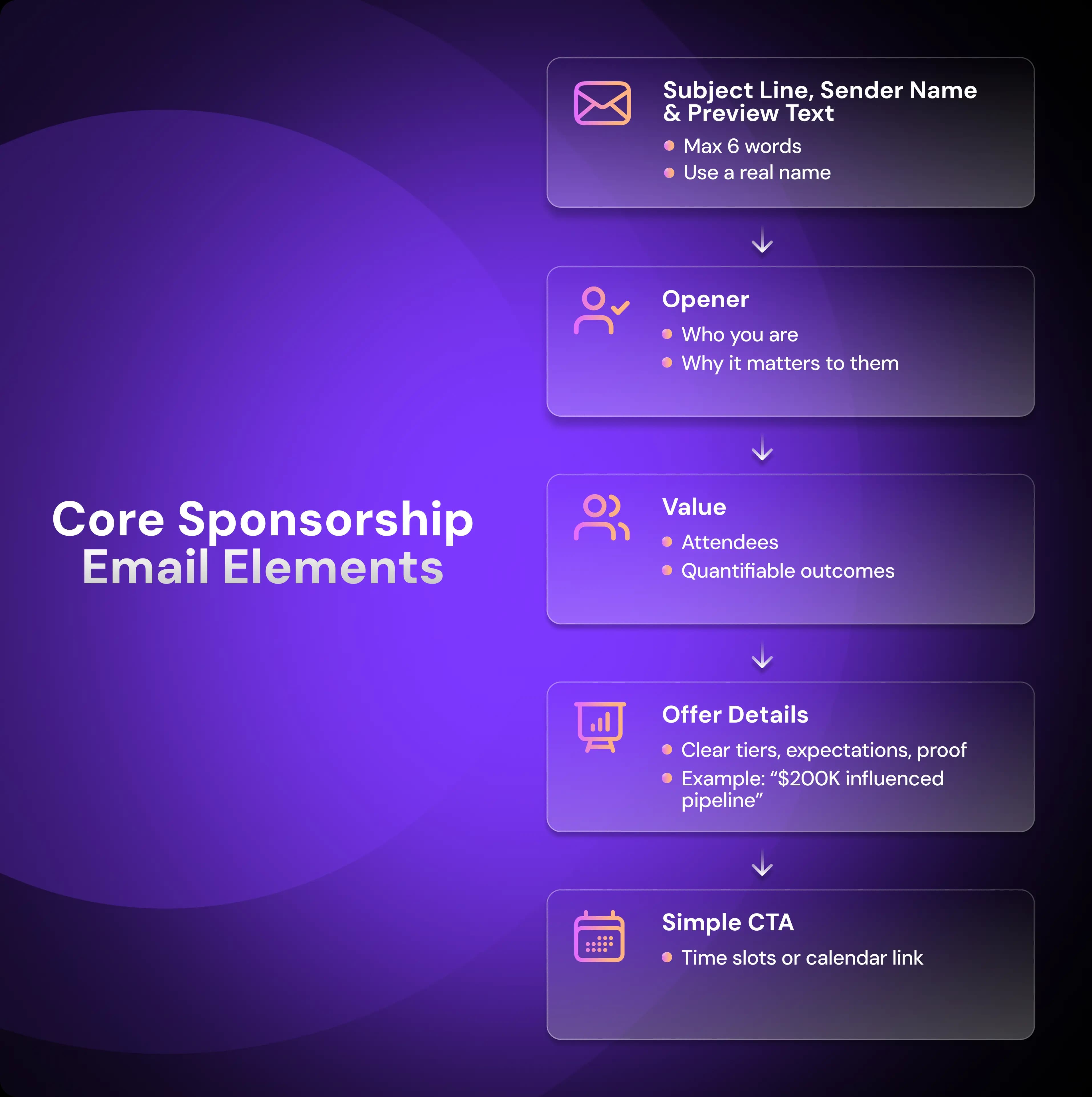
All effective cold emails share the same basic components, and sponsorship requests are no exception. Master these elements and you'll have a framework that works across different partnership types and audience segments.
Subject Line and Preview Text
Your subject line needs to be descriptive with a touch of urgency.
"Partnership opportunity: DevCon 2025" works better than "Sponsorship request." A/B test two to three variants and keep it tight: six words is ideal.
There’s an important point to keep in mind, however.
A great deal of research, including fresh data from Mailgun, shows that sender name matters much more than the subject line. Nearly two-thirds of respondents (65.2%) said recognizing the sender name or brand name was very important, with another 29.3% calling it somewhat important—that's over 94% who prioritize sender recognition.
So your sender name needs to look trustworthy—use an email address associated with your real name, not a generic company one like partnerships@company.com.
Lastly, don’t neglect the preview text. It should add context that complements your subject line. If your subject mentions "DevCon partnership," your preview might say "800+ SaaS leaders, March 15-16 in Austin" instead of repeating the same words.
The Opener (Who You Are and the Opportunity)
Move straight into context in your opener. Briefly cover your event or other sponsorship opportunity and why it matters to the recipient’s partnership goals.
You could open with something like:
"I'm hosting SaaS Growth Summit in March—800 marketing leaders from Series A+ companies. Given [Company]'s focus on customer acquisition, I think you could really benefit from a partnership.
The Value (What’s in It for the Sponsor)
Be clear about what your event or newsletter offers to potential sponsors. And be specific. Don’t make them do the math themselves.
Instead of "booth space and logo placement," lead with "reach over 500 qualified prospects and generate an average of 40 SQLs per event."
Give details about your audience, including their titles, geographic spread, company sizes, and expected attendance. Quantify the reach wherever possible and connect it directly to the business goals of potential sponsors.
Offer Details: Levels, Benefits, ROI
Your opening should have caught the interest of potential partners. Now it’s time to make it crystal clear what you're offering and what's expected from both sides.
Add the following details after your opening:’
Explain what exactly the partnership involves. Is it event sponsorship, co-hosting a webinar series, or joint content creation?
Be upfront about your expectations. Whether you need funding, speaker participation, or product demos, spell it out clearly.
Break down your sponsorship tiers. If you offer multiple levels, explain what each one includes and what sponsors get in return.
End with proof if you have it, for example, "Last year's sponsors averaged 60 new leads and $200K in new pipeline."
Jimmy Daly runs Superpath, a content marketing community with a Slack group and newsletter sponsored by companies like Ahrefs and Brevo.
Here's what works for him when laying out sponsorship details:
“For an ideal target sponsor, I'll put together a potential package and even some mockups so they can visualize what it would look like. I also name-drop a lot. I love to mention other companies we've worked with (we have some great logos), and I find that social proof is very effective.”
CTA that Reduces Friction
End your message with a clear next step by inviting recipients to a further conversation via email or in a call.
If you're suggesting a call, offer a few time slots or just drop in your calendar link (e.g., Calendly) and let them pick what works for their schedule.
Many users are cautious about clicking links from unknown senders. While calendar links are convenient, try A/B testing specific time slots like “Tuesday 2pm or Wednesday 10am?" versus a booking link.

Automate your outbound with an AI BDR
Meet Ava—your AI BDR who handles prospecting, outreach, and follow-ups, so your team can focus on closing.
How to Write a Sponsorship Email for SaaS (Step-by-Step)
Understanding the core elements of an email template is one thing. But how do you take that template to create emails that resonate with potential sponsors? Let’s look at how to do exactly that.
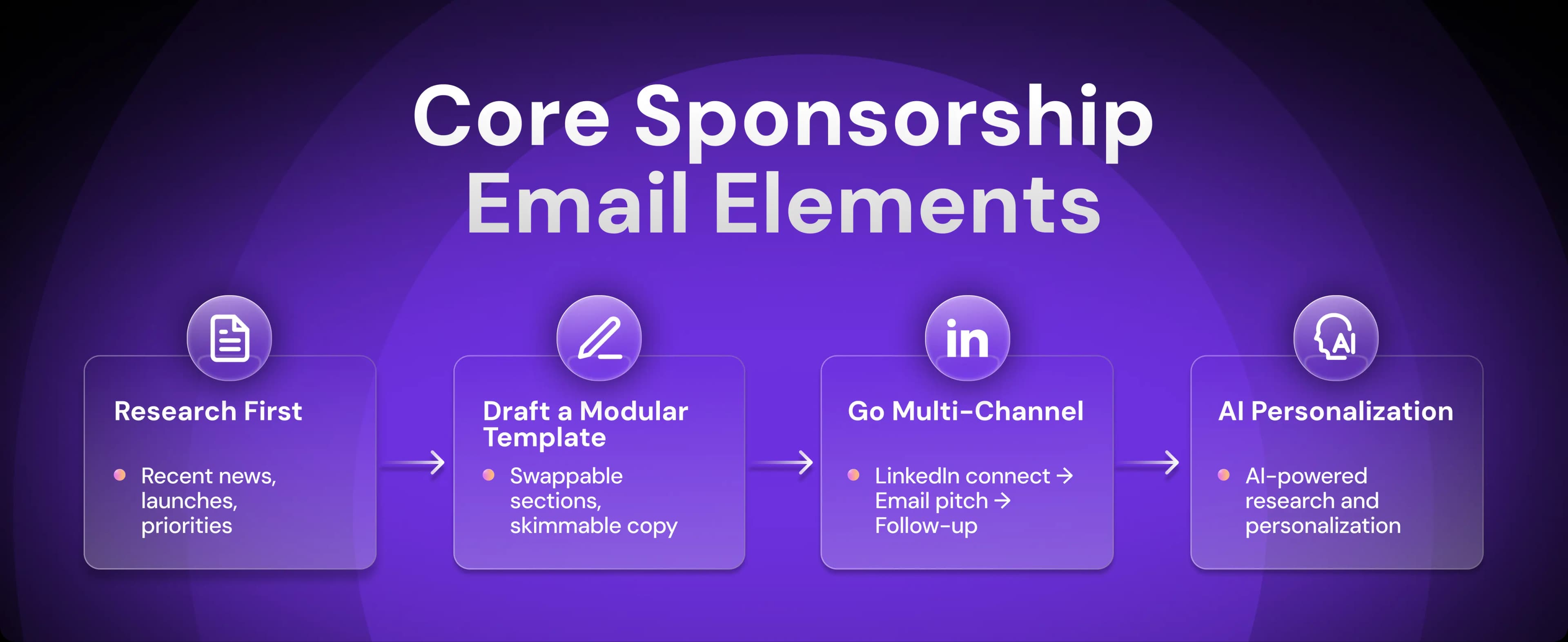
Research the Sponsor (and Person) First
Before you begin drafting your email, spend five to ten minutes researching your prospect. Check their recent campaigns, press releases, and LinkedIn posts to see what they're focused on right now.
Use this research to personalize one to two lines in your email. Reference their recent product launch, mention a mutual connection, or tie your event to their current business priorities.
You can also use AI to speed up the research and analysis, like Jimmy of Superpath does: "I use Claude to analyze all of our audience data, which allows me to create an interactive artifact that I can share as a URL. It's awesome because it's very comprehensive, and it looks great."
Draft with a Modular Template
Follow these best practices when drafting your sponsorship email:
Make it modular: Build your template in swappable sections that you can mix and match based on your prospect. Create different intro options, value prop angles, and CTAs so you can replace blocks without hurting the integrity of the rest of the email.
Keep it between 150 and 220 words: Any longer and you risk losing their attention; any shorter and you probably haven't provided enough value or context.
Use bullets for benefits: They're easier to scan than dense paragraphs, especially on mobile devices.
Test different versions: Create two to three variations so you can A/B test what works best for your audience.
Channel Fit: Email vs. LinkedIn
Research by Hunter shows that the majority of decision-makers prefer to be contacted by email. At the same time, LinkedIn gets higher response rates, according to Expandi’s State of LinkedIn Outreach report.
So what should you do? Simple—use both.
Start with a LinkedIn connection request, send your main pitch via email, then follow up with a LinkedIn message a few days later. You’ll cover multiple touchpoints without being pushy, which will increase your chances of getting a response.
Personalization at Scale (with AI)
Manual research and personalization can eat up hours of your time without necessarily giving you the insights you need to craft compelling messages. AI-powered personalization solves both problems—it's fast and often more effective at finding relevant details.
If you're worried your recipients won't appreciate AI-driven email content, don't be. The research by Hunter mentioned earlier shows that over two-thirds of respondents say AI-assisted emails don't bother them. They care more about relevance than whether a human or AI wrote it.
Artisan scrapes data about recipients, such as recent posts, company news, funding rounds, and job changes, and automatically incorporates relevant details into your email templates. AI BDR Ava then sends and follows up on these emails without any human input required.
Sponsorship Email Template Examples
Ready to get started building your own templates? Use these examples as starting points and customize the details to match your specific case.
Event Sponsorship Email Example
This event sponsorship email template is perfect for conferences, trade shows, and industry events.
Subject: Partnership opportunity: SaaS Growth Summit 2025
Hi John,
We at Happy SaaS Widgets are hosting SaaS Growth Summit in Austin this March—800 marketing leaders from Series A+ companies. Given your focus on customer acquisition, I thought you'd want to hear about our lead sponsorship opportunity.
What you get:
- 15-minute keynote demo slot to 800+ qualified prospects
- Lead capture forms with full attendee contact details
- Post-event report with engagement metrics and follow-up leads
- Co-marketing through our 12K newsletter and social channels
What we need: $15K sponsorship and your head of growth for the keynote.
Last year's lead sponsor generated 67 qualified leads and $180K in pipeline.
Does Tuesday 2pm or Wednesday 10am work for a 15-minute call?
Best,
Adelina
Podcast/Webinar Sponsorship Request Example
This podcast sponsorship request is ideal for ongoing content series where you can offer flexible packages and test opportunities.
Subject: Sponsor opportunity: SaaS Founders Weekly (12K listeners)
Hi Jane,
Our podcast, SaaS Founders Weekly, reaches 12K+ startup founders and operators each month. Your recent product launch seems like a perfect fit for our audience of early-stage SaaS leaders.
Here are the partnership details:
- Host-read 60-second ad placement (sounds natural, not salesy)
- Audience: 70% founders/C-suite, 85% North America, avg. company size 20-50 employees
- Test package: 4 episodes for $2K to prove ROI before committing long-term
- Available dates: March 15, 22, 29, and April 5
We track click-through rates and can provide detailed attribution for your trials/demos.
Interested in seeing our media kit with listener demographics?
Adelina
SaaS Partner Showcase Invitation Example
This partner showcase template is a good fit for product launches or when you want to create exclusive buyer experiences.
Subject: Exclusive: Demo [Product] to 50 hand-picked SaaS buyers
Hi John,
I'm hosting an invite-only SaaS Partner Showcase next month—50 curated buyers from companies like Stripe, Notion, and Airtable. Each partner gets a 15-minute demo slot to showcase their solution.
Here's what makes this different:
- Highly qualified audience: all have $50K+ software budgets and active buying intent
- Direct lead handoff with contact details and follow-up notes
- Joint case study development for standout partnerships
- Co-marketing through our network of 8 SaaS communities
Investment: $5K for demo slot + marketing collaboration
Next step: Reply "YES" and I'll send the full attendee list and partnership deck.
Adelina
Nonprofit Tech Sponsorship Email Example
This nonprofit tech sponsorship email template is great for mission-driven partnerships.
Subject: Partnership opportunity: TechForGood Summit 2025
Hi Jane,
TechForGood Summit brings together 400 nonprofit leaders focused on digital transformation. Given your company’s commitment to social impact, this could be a meaningful partnership opportunity.
Here’s how we can help you further your mission:
- Support 400+ nonprofits implementing new technology solutions
- Showcase your platform to organizations with $20K+ annual tech budgets
0 CSR impact: Help nonprofits serve 2M+ beneficiaries more effectively
Sponsorship also includes:
- 20-minute workshop slot on nonprofit-specific use cases
- Recognition across all event materials and social media
- Post-event impact report showing your partnership's reach
Last year's sponsors helped nonprofits adopt new technologies that reached 1.8M people.
Want to have a quick call?
Best regards,
Adelina
General Outreach Sponsorship Template
This email template offers a versatile framework you can adapt for cold outreach to potential sponsors across any industry or event type.
Subject: Partnership opportunity: [Event Name] - [Key Benefit]
Hi [Name],
Would [Company] be interested in reaching [X number] qualified [target audience] who are actively [relevant behavior/need]?
I'm [Your role] at [Company/Event], hosting [Event/Series Description] on [Date/Timeframe]. Our audience includes [specific demographics and titles] from companies like [2 to 3 recognizable names].
What’s in it for [Company]:
- Direct access to [X] prospects in your ideal customer profile
- [Specific outcome]: Last sponsors averaged [concrete metric]
- [Unique differentiator]: Unlike typical industry events, we [what makes you different]
Here are our partnership options:
1. [Tier 1]: $X for [top 3 benefits]
2. [Tier 2]: $Y for [top 3 benefits]
3. Custom: We're flexible on format and investment
Interested in learning more? I can send our partnership deck or jump on a 15-minute call this week.
[Calendly link or two specific time options]
Thanks,
[Your name]
Tools & Workflows That Increase Replies
Perfect templates won't save you if you're contacting the wrong people or your messages get lost in crowded inboxes.
You need the right tools to find the best potential partners, personalize messages without spending hours on research, and get responses instead of crickets.
Lead Discovery and Enrichment
You need clear criteria for potential sponsors. This allows you to prospect at scale and prevents time from being wasted on leads that are a poor fit later in the sales cycle.
Use a research tool that allows you to search by the following criteria:
Firmographics (company size, industry, revenue)
Technographics (what software they use)
Behavioral signals (recent hiring, funding, product launches)
But your research shouldn’t stop here.
Alongside finding relevant companies for your partnership, look for the right person (or people) within each.
Identify specific roles that might benefit most from your sponsorship opportunity. For a SaaS conference, that might be VPs of marketing, growth directors, or CMOs. For a podcast sponsorship, you're looking for brand managers or marketing directors.
“I find that the person managing sponsorships is sometimes really obvious (like a head of partnerships), but it can also be almost anyone on the marketing team, too,” says Jimmy of Superpath.
Having clear ICPs for every project helps you focus on prospects who actually have budget authority and strategic interest in what you're offering.
Personalization Engine
Hunter's research shows that individual outreach campaigns sent to fewer than 50 people perform nearly three times better than those sent to more than 1,000.
Smaller batches force better segmentation, which enables more relevant messaging. When you're only reaching 30 SaaS CMOs instead of 500 mixed prospects, you can craft messages that speak directly to their specific challenges around customer acquisition costs or pipeline generation.
Tools like Artisan let you target specific personas with separate campaigns. AI BDR Ava prospects potential sponsors on autopilot and then sends personalized messages and follow-ups, alerting you when leads show interest.
Multi-Channel Outreach (Email and LinkedIn)
Multi-channel sequences work because they account for how people actually consume information. Your initial email might get buried in their inbox, but a LinkedIn connection request puts you in their notifications.
Create a multi-channel cadence that progresses logically:
Your first email introduces your sponsorship opportunity and key benefits.
A LinkedIn connection includes a brief note referencing your event.
Your second email shares a case study or testimonial from a similar sponsor.
Your second LinkedIn message mentions your previous outreach and adds a gentle nudge about timing.
Your third email provides a clear deadline or final call to action.
Most importantly, each touchpoint should clearly tie back to your original sponsorship proposal so recipients immediately understand what the follow-up is about.
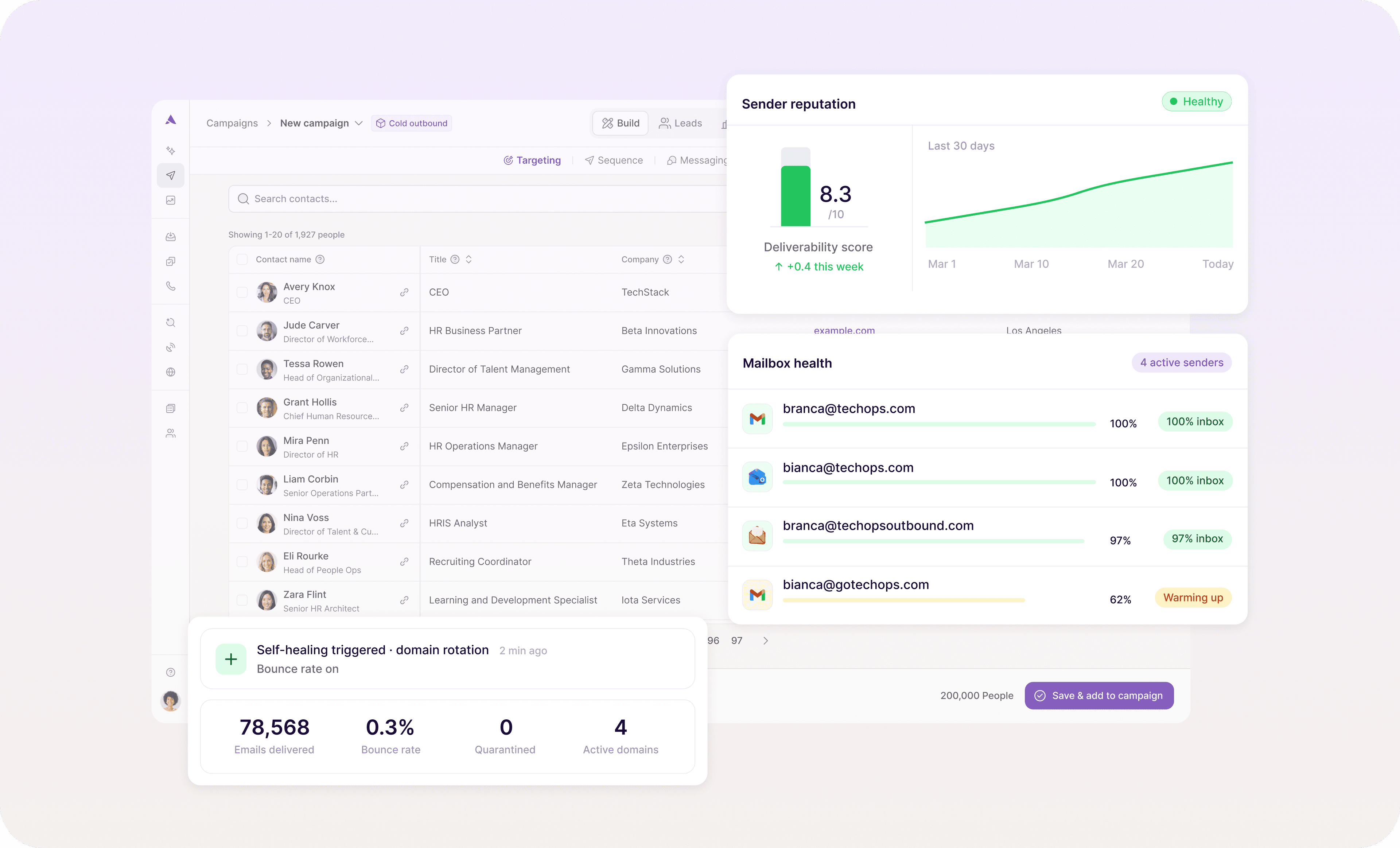
Deliverability & Warm-Up
All the personalization in the world won't help if your emails land in spam folders. You need software that will protect your sender reputation with proper warm-up sequences, bounce testing, and inbox placement monitoring.
Artisan includes built-in deliverability features, such as email warm-up, domain health monitoring, and smart sending limits that adapt based on your reputation.
Follow-Up, Measurement, and Iteration
Performance tracking gives you the data you need to iterate on templates, ICPs, and channel mixes to improve results with every campaign.
Follow-up Cadence (Two to Three Touches)
Hunter’s research shows reply rates increase with the first two or three follow-ups. After that, unsubscribe rates spike. Stick to two to three strategic follow-ups after the initial message, spaced three to five days apart.
If you're working with a highly targeted list, you might find even fewer follow-ups work better. Jimmy Daly keeps it simple: “I'll send one to two follow-ups asking if they'd like to start with our smallest package, or if they can direct me to the right person to chat with.”
What to Track and How to Interpret Results:
Maybe your messaging needs tweaking, maybe you should double down on LinkedIn—you'll only know if you track the performance of your campaign: opens, reply rates, meeting attendance, and actual conversions.
Once you’ve got the data in, here’s how to respond to common scenarios:
Reply rates below 5%: Try tighter audience segmentation or test different value propositions in your opening lines.
Good open rates but low replies: Your subject lines work, but your message content needs work. Test shorter emails, clearer CTAs, and different benefit positioning. If nothing helps, you could be reaching the wrong audiences, or your subject line might be deceptive.
High reply rates but low meeting bookings: It could be that your prospects are interested, but your CTA isn't pulling its weight. Try specific time slots instead of calendar links, or lower the commitment with a "quick 10-minute call."
Channel performance: If a certain channel, such as LinkedIn, consistently outperforms others for your audience, increase how often you’re using it to reach out to potential sponsors.
Strong Outreach Is About Relevance, Not Volume
Generic doesn’t cut it anymore. Targeted, tailored messages are the future of outreach for SaaS sponsorship.
Artisan gives you a powerful edge with advanced automation, AI-powered personalization, and built-in deliverability optimization.
AI BDR Ava finds, connects with, and persuades leads on autopilot and at scale. Which frees you up to focus on building human connections with potential sponsors that are already interested in what you’re offering.
Automate your outbound with an AI BDR
Meet Ava—your AI BDR who handles prospecting, outreach, and follow-ups, so your team can focus on closing.

Adelina Karpenkova
SME @ Artisan
Adelina Karpenkova is a writer helping businesses tap into AI's potential and clear up misconceptions. She works with B2B teams on latest industry knowledge.