9 uses of AI in sales: Real examples that turn leads into deals
Learn how sales teams use AI tools to streamline workflows, personalize outreach, and boost conversion rates with real-world examples.
Sales leaders are uncertain about AI.
When implemented correctly, AI generates qualified leads, scales prospecting, cuts admin work, and finds the messaging that resonates with leads.
Get it wrong, however, and you’ll simply add an unnecessary layer of tooling onto your existing process.
How AI is changing the rules of the old AI sales playbook
AI assistance provides well-defined, proven benefits to sales teams.
The average rep spends a whopping 60% of their time on non-selling tasks, according to Salesforce's 2026 State of Sales report. That's data entry, CRM updates, scheduling meetings, and chasing down information that should already be in the CRM.
Generative AI doesn't just speed these tasks up. It removes them entirely. Reps that use AI are 3.7 times more likely to meet quota, according to Gartner.
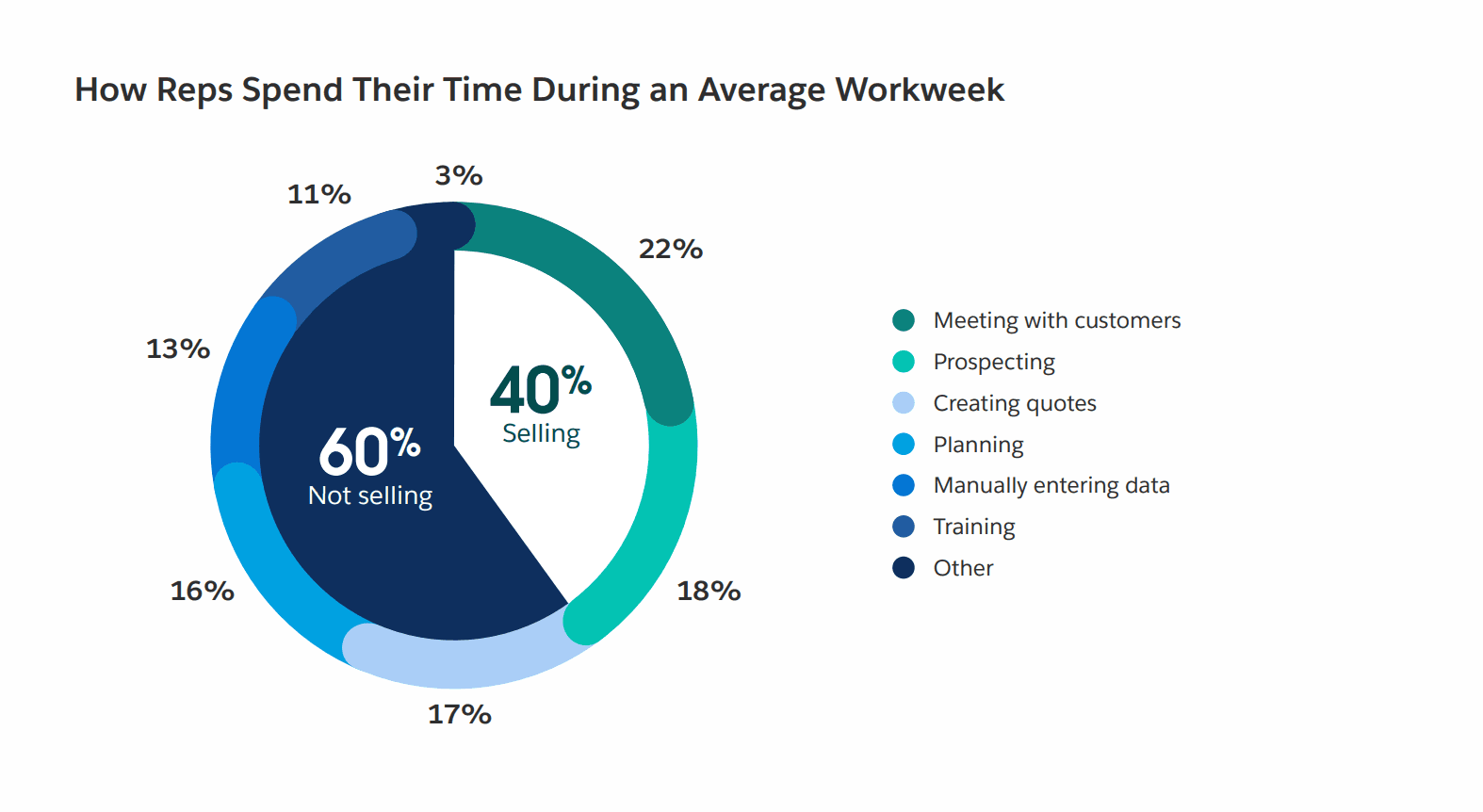
Moreover, sales teams cite AI and AI agents as their primary growth tactic for 2026 (Salesforce), with top performers 1.7 times more likely to use AI agents than underperforming teams. This gap will only widen, so sales teams simply cannot afford to remain manual.
This doesn't mean, however, that every AI deployment works. In a McKinsey survey of enterprise leaders across a range of functions, 39% of respondents reported no impact on earnings before interest and taxes (EBIT).
As you’ll see from the real-world examples below, AI creates value when companies redesign workflows around it, not when they layer it on top of broken processes.
9 AI in sales examples that actually drive pipeline
AI in sales is no longer confined to one narrow use case. It now drives prospecting, lead scoring, message generation, call summaries, forecasting, coaching, and post-meeting follow-up. It has applications at nearly every stage of the modern sales and marketing cycles.
1. AI-powered lead scoring that tells you who to chase
Lead scoring works best when it combines recent behavior with firmographics that point to ICP-fit. This type of in-depth qualification carries a significant manual burden and, as such, can be very time-consuming for marketers and reps.
Machine learning models can analyze all the following prospect data points:
Firmographics and technographics
Historical behavior
Conversion patterns
Engagement depth
This broad account context, which AI regularly updates, allows for automated lead prioritization and gives reps all of the information they need to conduct meetings effectively when the time comes.
2. Automated prospecting that finds leads for you
AI prospecting tools identify potential customers by scanning company databases, social media threads, job postings, and funding announcements. All at a scale and with a level of contextual understanding that is impossible with manual scraping.
These new accounts can then be enriched automatically with verified emails, direct dials, and technographic and firmographic data.
Can salespeople trust prospects sourced this way? The data is favorable. Salesforce reported that 55% of sales professionals said they already use AI for prospecting, and 92% of sellers with AI agents said the technology benefits their prospecting efforts.
3. Personalized outreach that doesn't feel automated
Sales teams know personalization matters. They also know that AI can help with it. But after seeing so much AI slop, the idea of handing personalized lead-nurturing or cold outreach campaigns to a model can feel risky.
Reps who do succeed with AI personalization tend to choose platforms they can actually train.
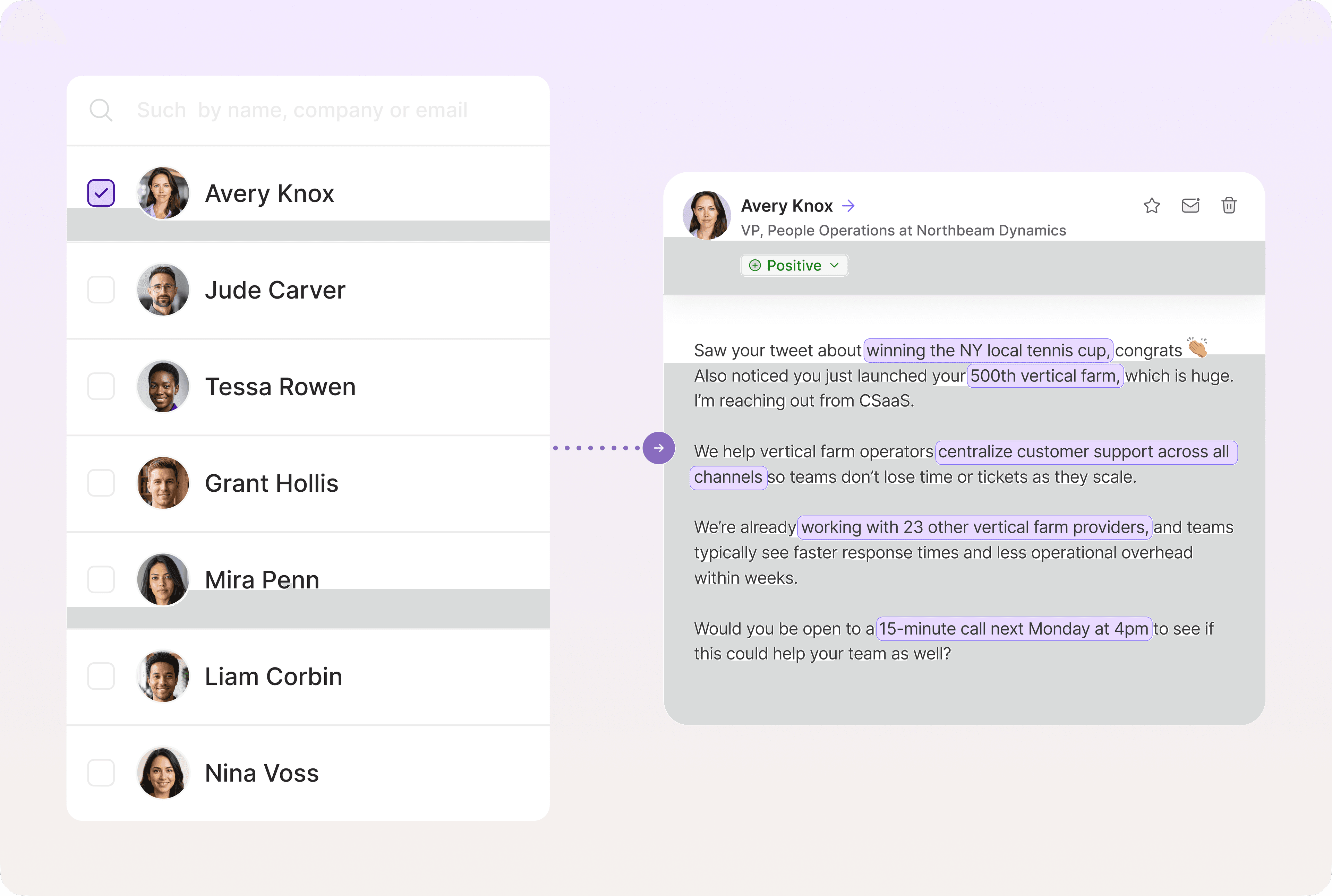
For example, Artisan follows brand and messaging guidelines closely, allows for manual adjustment of specific email components (like subject lines and CTAs), and auto-optimizes based on positive and negative responses.
Here’s an example of an auto-generated email written by Artisan’s AI BDR, Ava:
4. Follow-ups that happen at the perfect time
The median B2B lead response time is 42 hours, 504 times slower than the optimal 5-minute window, according to Artemis GTM. Only 7% of B2B companies consistently hit that benchmark, making follow-ups one of the “leakiest” parts of the sales journey.
Follow-ups cover all outreach messages (across social media and email) after the first touch. They also include the messages reps send after calls and meetings.
AI can take account of all of the following conditions when drafting follow-up messages:
Location and time zones
Previous responses
New intent signals
Personalization points not referenced in the initial email
Alternative pitches that may
Human reps that are already balancing multiple priorities often deprioritize follow-ups to lower-value leads. AI tools don't forget. When trained properly, they send the right message at the right time.
5. Call intelligence that turns conversations into insights
Sales call transcripts are valuable sources of coaching information. The power of AI lies in its ability to analyze large volumes of natural language text and turn it into meaningful guidance for reps.
AI can extract all of the following from sales transcripts:
Objections raised and how they were handled: Which responses worked and which didn’t.
Keywords or phrases related to closed deals: What top performers say differently from everyone else.
Buying signals and commitment language: Language that indicates when to push for next steps instead of continuing to pitch.
Competitor mentions: Which competitors come up most and how reps position against them.
Segment-specific pain points and use cases: Which messaging resonated with which segments.
This information is useful for refining call templates, internal sales models, and objection handling. AI goes beyond simply extracting data and generates insights and action points based on it.
Companies using AI in sales coaching see more than three times the year-over-year growth in sales quota attainment, according to ValueSelling and Aberdeen Strategy and Research. But don’t rush to hand over sales coaching to artificial intelligence alone. Machines are good at sentiment analysis and pattern recognition, but they can’t (yet) match human expertise in sales. What AI does is analyze huge chunks of data that a human can’t process.
6. AI chatbots and virtual sales assistants that qualify leads 24/7
AI bots qualify leads around the clock by asking qualifying questions, routing high-intent visitors to the right rep, and booking meetings directly into calendars. All without human intervention.
Here’s an example of an AI-assisted qualification workflow:
A target-account visitor lands on a high-intent page.
An AI agent identifies the account through website visitor tracking.
It scores the lead in real time.
High-intent leads are routed to reps immediately.
Lower-intent leads enter the right nurture path.
Klarna deployed an AI chatbot across 23 markets and over 35 languages. It resolved queries in under 2 minutes (vs. 11 minutes previously) and operated 24/7. The result was nothing short of remarkable: a $40 million increase in profit, equivalent to the work of 700 full-time agents, and a 25% drop in repeat inquiries.
7. Forecasting that actually predicts revenue
It’s impossible to forecast effectively if your model relies on incomplete CRM data and rep optimism. Predictive analytics (including AI forecasting) requires real-world signals from customer engagement patterns, deal velocity, rep behavior, and historical win rates.
Your forecasting model should incorporate a mix of the following historical data points:
Deal size
Stage progression
Sales cycle length
Lead source
Segment
Rep activity
Buyer engagement
Win or loss outcomes
Over time, the model will get better at identifying the patterns that show up before a deal closes and adjust probabilities. It will also flag deals that are at risk.

Automate your outbound with an AI BDR
Meet Ava—your AI BDR who handles prospecting, outreach, and follow-ups, so your team can focus on closing.
8. CRM automation that cleans your data for you
High-quality CRM data supports lead scoring, pipeline forecasting, and sales coaching. But let’s be honest, no sales rep on the planet consistently logs customer data with the timeliness and accuracy required to ensure the best possible level of accuracy.
AI keeps CRM data clean by doing all of the following:
Captures call notes automatically
Updates deal stages based on buyer activity
Enriches contact and account records
Flags missing fields and data conflicts
9. Multi-channel outreach that runs itself
AI-coordinated multi-channel outreach runs email, social media, and follow-up sequences in a single automated workflow. It decides which channel to use, when to send, and what message to deliver based on how a prospect has engaged so far.
AI tools can handle the following multi-channel outreach jobs:
Lead discovery
Intent monitoring (including social media)
Social signal tracking
High-intent lead prioritization
Website visitor identification
Account enrichment
Message personalization
Subject line, email structure, CTAs, and tone of voice testing
Objection handling
Meeting booking
CRM activity logging
How to actually put AI to work in your sales process
AI for sales is only as good as the workflows it powers. Buying a tool and expecting it to magically close deals is a direct path to wasted budget. The key to making AI work for outbound sales is knowing how to integrate it into your existing sales strategy.
1. Start with your biggest bottlenecks
Don't try to automate everything at once. Look at where your reps are spending the most non-selling time.
If they're losing hours building lists, start with AI prospecting. If they're drowning in CRM updates, deploy an AI meeting assistant. Fix the biggest bottleneck first, then move to the next.
2. Plug AI into your existing workflows (don't rebuild everything)
Look for AI sales tools that enhance your current processes rather than forcing your team to adopt entirely new ones. Adding another complex system on top of an existing workload risks breaking your sales motion.
The biggest gains come when companies redesign workflows around AI, not the other way around.
3. Track what matters: Pipeline, not activity
Don't judge AI by how much content it drafts or how many tasks it automates. More volume with the wrong messaging just accelerates undesired outcomes. Track clear business metrics like conversion rates, response rates, saved hours, and sales performance to prove the effectiveness of AI adoption.
Where AI delivers the biggest competitive edge
Some AI-powered platforms only offer insights. They tell sales leadership what might matter, who might be interested, or which deal might be at risk.
This definitely helps, but it doesn't close the gap between knowing and doing. The real advantage comes from tools that trigger action automatically.
The best AI sales tools take care of all of the following tasks at scale:
Lead scoring: Analysis of firmographics, intent signals, engagement depth, and conversion patterns to prioritize leads automatically.
Prospecting: Automated search of company databases, job postings, and funding announcements to find and enrich new accounts, usually with a direct CRM sync.
Personalized outreach: Generation of individualized messaging for every prospect in a sequence that is continuously auto-optimized based on positive and negative responses.
Follow-ups: Email delivery that factors in time zones, previous responses, and new intent signals, closing the gap between the optimal five-minute response window and the 42-hour median most teams actually hit.
Call intelligence: Extraction of objections, buying signals, competitor mentions, and segment-specific pain points from sales transcripts for practical coaching points.
Volume and velocity in these areas are the true benefits that AI sales tools provide. No human can manually keep up with real-time enrichment, multi-channel outreach, and campaign optimization at the same time.
In addition, the best AI sales tools consolidate disconnected parts of the sales workflow. Fragmented tools create handoff problems, duplicate work, and stale context even if they wear the “AI-powered” label. That is one of the big reasons that end-to-end, AI-native execution platforms like Artisan are gaining traction.
Stop gluing tools together, and let AI run your outbound
The era of manual sales prospecting and fragmented sales stacks is ending. The teams that thrive will be the ones that use AI assistants to automate busywork and scale outreach.
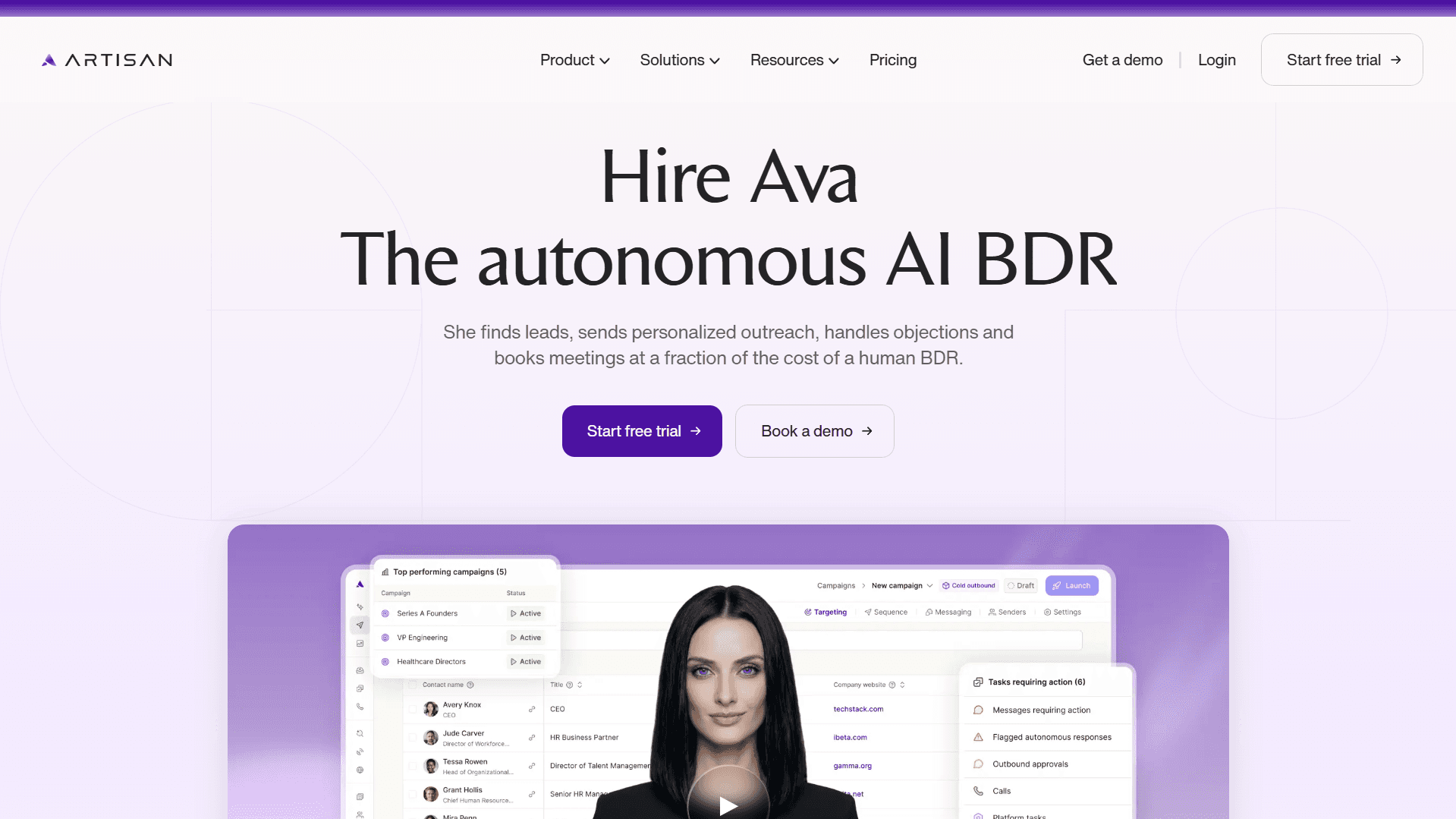
Artisan has been built to provide powerful AI functionality without prohibitive setup or onboarding costs. Its AI BDR Ava handles end-to-end outbound on a single platform that replaces the patchwork of point tools most teams still rely on.
For sales leaders ready to start with AI execution rather than just AI insights, this consolidation is where true productivity gains will come from.
Automate your outbound with an AI BDR
Meet Ava—your AI BDR who handles prospecting, outreach, and follow-ups, so your team can focus on closing.

Jenny Romanchuk
SME @ Artisan
Jenny creates senior-level content for sales, SEO, and marketing professionals. She also leads partnerships at the District #1 Charitable Foundation.