The AI sales org chart: who owns what in 2026
How midmarket and enterprise sales teams are splitting work between AI and humans, and the five roles that make the new org chart work
The AI sales org chart: who owns what in 2026
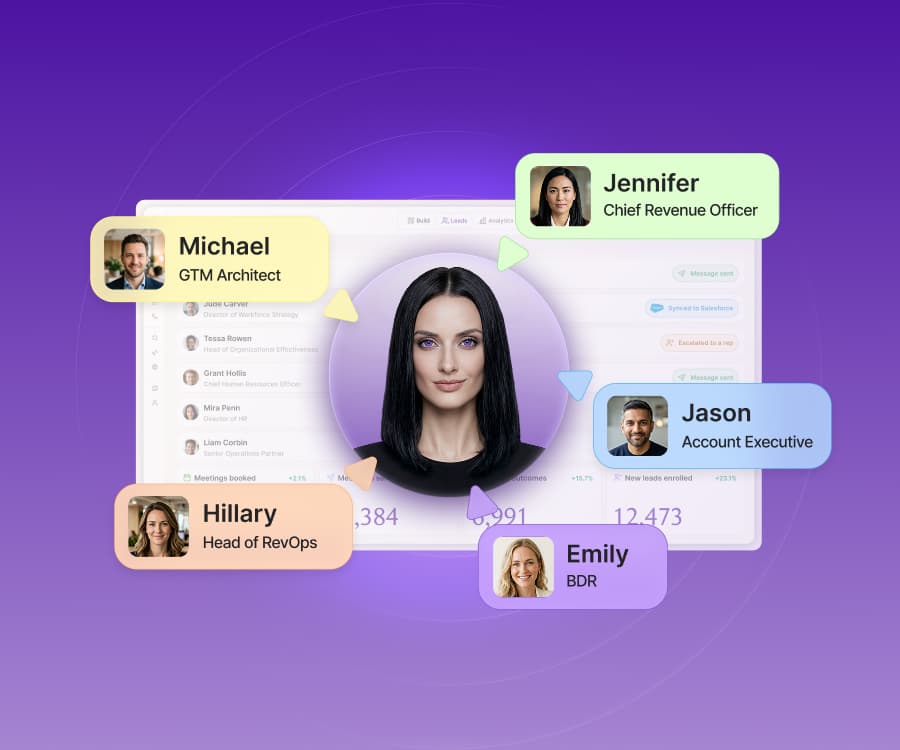
The sales orgs winning with AI are not splitting the work down the middle, they are redesigning it. Software does what software is good at. Humans do what humans are good at. AI absorbs the infinite and repetitive. Humans keep judgment, trust, and the constraints the AI runs inside. A new role, the GTM architect, connects the two.
What your rep's week looks like today
Take an honest inventory of a rep's calendar. Salesforce's State of Sales puts non-selling work at 60% of a rep's time. 6sense's B2B BDR Benchmark finds BDRs put 68% of their hours into outreach itself. The specifics are familiar to anyone who has sat next to a rep: building lists, researching accounts, drafting first touches, chasing follow-ups nobody answered, logging all of it in the CRM, fighting over calendars.
Now price it. A US BDR costs $60K+ in base and $120K-200K fully loaded, ramps for 3-6 months, and stays about 14-18 months. At enterprise scale, multiply that across divisions and regions, each with its own ICP and its own version of the same lost hours.
And the work still does not get done. Every org carries coverage debt: revenue you lose purely because no human had the hours. A long tail of accounts nobody has touched in a year. A closed-lost list nobody reactivates. Inbound that sits until morning. None of that is a judgment problem. It is an arithmetic problem, and arithmetic is what machines are for.
What it should look like
The bottleneck is no longer headcount, it is org design. Most teams bolt AI onto a structure built for humans and then wonder why nothing changed. The fix is not AI doing the rep's job. It is a different org chart, where the infinite and repetitive work moves to AI employees, and every human hour goes where a person changes the outcome.
Role | Owns | Hands off to | Measured on |
GTM architect | Campaign portfolio, signal library, ICP definitions, the guardrails the AI runs inside | RevOps, for CRM, comp and territory design | Pipeline sourced by the system, coverage of the account base |
RevOps | CRM, data hygiene, routing, territories, comp, forecasting, security and access | The GTM architect, for campaign strategy and messaging | Data integrity, forecast accuracy, cycle time |
AE | Discovery, multi-threading, negotiation, the relationship, every deal above $5K ACV | The system, for prospecting, research and follow-up | Closed revenue, win rate |
BDR | Cold calls, in-person, events, the top accounts that deserve a person from first contact | The system, for long-tail coverage and volume follow-up | Meetings booked by phone and in person |
AI employees | Signal monitoring, enrichment, full outreach sequences, reply handling, inbound response, the full cycle below $5K ACV | AEs above $5K, BDRs for the call queue, a human on every escalation trigger | Pipeline sourced, speed to lead, coverage of the account base |
Sales leadership | Budget caps, exclusion lists, escalation thresholds, approval mode, brand and tone | The architect and the system, for day-to-day execution | Whether the whole system compounds |
Where to draw the line
What to automate
AI owns work that is infinite, repetitive, and indifferent to who performs it. Reading every account in your market every day and noticing the one that changed. Enriching and prioritizing. Writing and sending every touch in the sequence. Running follow-up nobody has the discipline to run. Answering replies at a volume no team can staff for.
Move these first:
Inbound, end to end. Chat that answers in seconds at any hour, qualifies against your ICP, handles product questions from your knowledge base, and books the meeting on the right rep's calendar. Most inbound is lost to latency, not to bad answers.
Monitoring account signals: reading every account daily and flagging the ones that changed.
Enrichment and prioritization across the whole account base.
Full outreach sequences and message testing at a volume no team can run by hand.
Follow-up sequences and reply handling.
Closed-lost and dormant-account reactivation.
Scheduling, routing, and CRM logging.
The full sales cycle below $5,000 in ACV, run by an AI AE.
This is where Ava, our AI BDR, runs: finding best-fit leads across 250M+ B2B contacts and a 200M+ local-business database, launching multichannel campaigns across email and dialer steps, testing dozens of message variants, handling every reply, and booking meetings on the right rep's calendar with CRM-owner routing.
What to keep human
Humans own the work that only succeeds because a person did it, and the constraints the machine operates under.
The cold call where someone is defensive and you can hear it in the first four seconds. The room where an enterprise deal actually gets decided. Multi-threading across a buying committee. Negotiation. The moment a customer tells you the thing they were not going to tell you. Knowing which rule to break.
Keep these human, deliberately:
Discovery and the room, on every deal above $5,000 in ACV.
Multi-threading the buying committee.
Negotiation, procurement, and the executive relationship.
The calls. The system lines up the queue and a person picks up the phone.
Events, in-person, and the named accounts that get a human from first contact.
The guardrails: what the AI may spend, who it may never contact, when it must stop and ask.
The last bullet matters more than most teams realize. Humans set budget caps, exclusion and do-not-contact lists, escalation rules in plain language, sending windows and tone. The AI executes inside that box. Over 90% of Artisan customers run Ava autonomously, and they do it because the box is well drawn, not because they stopped caring.
We are not neutral on this and we are not theoretical about it either. We are hiring our first human BDR this year, and we built a dialer inside Artisan because some of the highest-value work in sales still happens on a phone with a person on both ends.
The decision rule
If a mistake in a conversation costs you the account, a human runs it. If a delay costs you the account, AI runs it. Most inbound fails the delay test long before it fails the judgment test.
For deal ownership, the cleanest place to draw the line is $5,000 in ACV. Below it, the economics cannot support human hours, and the buyer does not want a relationship, they want an answer. That is the job of the AI AE: it qualifies against your ICP, runs a live demo, answers from your knowledge base, and works the deal through to close. Above the line, discovery is where the deal is won, and your AEs should spend their week there and nowhere else. Your line may sit higher than $5,000. The point is that it exists, it is written down, and both sides of it are staffed.
The new org, day to day
GTM architect
The GTM architect owns the system that produces pipeline. Not a territory, not a quota, the machine itself: the campaign portfolio, the signal library, the ICP definitions, the knowledge base the AI answers from, and the guardrails it runs inside. In the deployment pattern that works best at scale, they run it centrally: campaigns send on behalf of AEs and BDRs who never log in. The largest deployments run exactly this way. We run one today across more than a thousand reps, and some of the biggest companies in the world deploy Artisan the same way. The pattern that fails is letting every rep run their own campaigns, which produces inconsistent messaging, duplicate outreach to the same accounts, and no way to learn anything.
The day to day:
Reads the week's results and kills or scales plays, reallocating volume before anyone has to ask.
Decides which plays run against which segments, divisions and regions.
Defines the custom signals worth watching and cuts the ones that will not fire often enough to earn their cost.
Maintains the knowledge base and messaging library the AI answers from.
Tunes escalation rules against what actually came back.
Reports pipeline sourced and coverage of the account base to leadership.
They are measured on pipeline sourced by the system and on coverage of the account base, not on activity. Sellers who partner with AI are 3.7x more likely to hit quota, per Gartner, but only when someone is accountable for the system rather than the tool. It is the highest-leverage seat on a modern revenue team, and most orgs have not filled it yet. The right profile is closer to a technical marketer than a sales manager: someone who thinks in segments and tests, is comfortable in data, and has enough commercial instinct to know what a good message sounds like. At midmarket scale it is one person, often a strong ops or demand gen hire. At enterprise scale it is a small team, usually one architect per business unit or region.
RevOps
RevOps does not go away and it does not become the GTM architect. The cleanest line: RevOps owns the pipes and the truth, the GTM architect owns the plays that run through them. When AI enters the picture, three parts of the job get bigger: governance, attribution, and comp design.
The day to day:
Keeps the CRM the system of record: hygiene, deduplication, routing, territory design.
Governs the AI: who may send on whose behalf, what data it may personalize with, what it may never touch, with do-not-contact enforcement as policy rather than a setting.
Owns the attribution definition, agreed before the first comp dispute rather than after.
Maintains quota and comp plans as activity profiles change.
Runs forecasting, security and access review, and the audit trail of everything the system sent.
RevOps governs what the architect is allowed to do. It does not build campaigns.
AE
An AE in this org consumes what the system produces instead of producing it themselves. Fuller calendar, less pipeline anxiety, and a week spent on the deals that deserve human hours, which means every deal above $5,000 in ACV. The honest version: the job moves closer to actual selling, and that raises the bar. Reps who were good at the selling part become materially more valuable, and reps who were carried by activity volume have a different craft to learn.
The day to day:
Runs discovery and demos on meetings the system booked, arriving with the trigger, the research, and the thread already on one timeline.
Multi-threads the buying committee on every account that deserves it.
Runs negotiation, procurement, and legal through to close.
Owns the executive relationship on strategic accounts.
Feeds objections and intel back to the architect, so the system's next thousand conversations get sharper.
BDR
There is still a BDR role, and it is a better job than it was. The BDR stops being a list-working machine and becomes the human-touch layer of the system: the calls, the events, the accounts that get a person from first contact. What changes is the ratio. Where an org once needed twenty BDRs to cover a market, it now needs a handful of strong ones pointed at the accounts that repay a human touch, with the long tail covered by the system. The argument is not that the system is cheaper than people. It is that the system never sleeps on the market, so every human hour goes where a person actually changes the outcome.
The day to day:
Works the call queue the system lines up, prioritized by signal. Ava decides who to call next, the BDR makes the call.
Makes the cold calls into the accounts where the phone still works.
Runs events and in-person, and takes first contact on the top named accounts.
Hands every call's follow-up back to the system.
Passes what the market said on the phone back to the architect as signal.
Sales leadership
Leadership owns the box the whole system runs inside. Not the day-to-day execution, the constraints.
The day to day:
Sets budget caps, exclusion lists, sending windows, brand and tone.
Defines escalation thresholds and reviews the escalations that actually fired.
Moves the autonomy dial as trust builds, from review-everything to fully autonomous.
Redesigns quota and comp with RevOps as activity profiles change.
Owns whether the whole system compounds.
What your rep does with the hours back
They walk into conversations already knowing why now. That is the part a partition model misses: the value is not that two parties split the work cleanly, it is what each side can do because the other one did its part.
A concrete version. The system notices an account hired its first head of revenue operations last week, checks it against your ICP, enriches the contacts, and opens the conversation. A reply comes back with a question about your data coverage. The rep picks up a thread that is already three exchanges deep, with the trigger, the research, and the objection sitting on one timeline, and spends their preparation time on the buying committee rather than on finding out who to call.
Run that across a whole territory and the rep is not doing a smaller job. They are doing a bigger one, on accounts they would never have reached, with context they would never have had time to assemble. The teams running this pattern at scale see the same thing: output per rep multiplies, and the team does not shrink.
That is the actual promise, and it is worth being precise about it. The goal is not AI that seems more human. The goal is a team with the time to be human.
The transition
The gap between the org chart above and the one you run today closes in seven moves:
Name the GTM architect. Hire the seat, or make it part of a strong ops or demand gen person's role until it earns a full-time hire.
Collapse inbound to one rep. The AI runs inbound end to end. Most teams need exactly one human on it: monitoring the system, dialing inbound leads the moment they arrive, and taking the escalations. Everyone else moves to outbound.
Rewrite the outbound BDR day. The AI takes over sequencing for 95% of accounts, everything except the most strategic, relationship-driven names, with campaigns managed centrally by the architect. The day becomes the phone: 300-400+ dials into a queue the system prioritizes.
Cover the whole TAM. Nobody is spending the day writing emails anymore, so every account in your market gets touched, across email and phone. This is the coverage debt from the top of this piece going to zero.
Put BDRs on LinkedIn. Connecting, commenting, building relationships they later nurture in person at conferences. This is uniquely human work, and it is now what the role has time for.
Send on behalf of AEs. Outbound runs autonomously under each AE's name. If you do not want AEs in the tool, their escalations and dial tasks route to the BDRs.
Promote from within. If the new ratios leave you with more BDRs than the phones need, your most senior BDRs step up to AE. The system is already sourcing the pipeline to feed them.
The first 90 days
The sequence that works inside large orgs runs division by division, and it looks like this.
Days 1-30: one team, one motion, constraints first.
Name the GTM architect on day one, even if it is someone's second hat.
Leadership writes the constraints before anything sends: budget caps, exclusion and do-not-contact lists, sending windows, tone, and escalation rules in plain language.
RevOps connects the CRM, cleans the pilot segment's data, and agrees on routing and ownership rules. Security review starts here, in parallel, not at the end.
Build the knowledge base the AI answers from.
Point the system at the one motion with the clearest coverage debt, usually inbound speed to lead or closed-lost reactivation, and record the before number.
Exit criteria: a clear lift over the before number, the audit trail reviewed line by line, zero do-not-contact violations.
Days 31-60: widen and tune.
Add cold outbound against the signal library, one segment at a time.
Tune escalation rules against what actually came back, not what you guessed would.
Run a weekly kill-or-scale review on every play. This is where the architect earns the seat.
Exit criteria: pipeline sourced by the system beats the pilot team's baseline, and AEs want more of the meetings, not fewer.
Days 61-90: roll out and redesign.
Expand from the pilot by division or region, each with its own ICP and signals. The pilot's numbers are how you win the manager who is sure their team is the exception.
Rewrite AE expectations and comp against the new activity profile.
Point BDRs at the call queue and the named accounts.
RevOps locks the attribution definition before it becomes an argument.
Exit criteria: the org chart above is real in your CRM and your comp plan, not just in a deck.
Most failures happen because teams do the last phase first, or never do it at all.
Hire the architect
If you take one action from this piece, take this one: name the seat. We believe in the seat enough to hire it ourselves. The forward deployed version of this role, embedded inside our largest customers' sales orgs, is open now.
The org that wins the next few years is not the one that automates the most. It is the one that is clearest about which hours belong to people, and then buys those hours back. Be more human.
Artisan consolidates the stack into one platform where Ava, our AI BDR, owns outbound end to end and inbound chat runs without a human in the loop, with the governance an enterprise deployment needs. The AI AE is next. See how Ava works or pricing.
Jaspar Carmichael-Jack
Co-Founder & CEO @ Artisan
Jaspar is an entrepreneur with expertise in sales, marketing, and operations. He founded Artisan in 2023, a company automating workflows with AI employees.