How to build and optimize your B2B lead generation funnel
Build and optimize your B2B lead generation funnel with proven strategies, real examples, and automation tactics that scale pipeline.
It’s not uncommon for a prospect to download an ebook from a company’s website and immediately qualify as a marketing-qualified lead (MQL).
If they open their first nurture email, there’s a good chance they will become a sales-qualified lead (SQL). A rep will receive a notification to follow up immediately.
Scenarios like this aren’t as outlandish as you might think. Somewhere along the way, a gated asset and a five-email sequence became the default definition of a lead generation funnel.
Fortunately, you don’t need to follow the same outdated playbook.
Why your funnel isn’t built to convert
For most teams, lead generation looks the same way: a gated content asset, a landing page to promote it, and a form that captures contact details in exchange for the download.
This “funnel” usually leaves you with a list full of people who have only limited interest in your product or service.
Typical lead generation funnels often share the same set of mistakes:
Treating lead generation as a solely inbound marketing motion and over-relying on gated content
No shared understanding between marketing and sales of what qualifies a lead as an MQL or SQL
Failing to understand the target audience
Casting the net too wide with the lead magnet
Not having a qualification framework to segment incoming leads
Adding every lead to the same nurture flow or slapping them with a pitch and never following up
An average of 13 people are involved in a typical B2B buying decision, according to research by Forrester. Each stakeholder takes their own path through to an offer. They start researching different times, consume different content, and form opinions based on completely different interactions with a brand.
That's not a linear buyer journey, and it exactly why most traditional funnels don't work. They follow a rigid path, target one person, and fail to support the multiple touchpoints that characterize how B2B buying actually happens.
What TOFU, MOFU, and BOFU need to drive conversions
Each stage of the funnel serves a prospect at a different point on their path to purchase. The content, channels, and messaging need to reflect where they are and give them what they need to move forward.
TOFU: capturing attention and generating demand
The top of the funnel (TOFU) is where you generate awareness among the right audience. Prospects here are either problem-aware or not yet aware of your solution.
The following channels and assets create awareness at the top of the funnel:
SEO and GEO content that captures anyone researching your problem category through search or AI tools before they've formed a vendor shortlist
LinkedIn ads targeted by role, seniority, and company size to reach the buying committee directly
Organic social that builds category authority over time
Lead magnets, like reports, calculators, and templates, that offer enough standalone value to earn a form fill
MOFU: nurturing interest and building trust
The middle of the funnel (MOFU) is where prospects are actively evaluating options, consuming product-related content, and starting internal conversations about potential solutions.
These tactics will help you stay visible and demonstrate fit at the middle of the funnel:
Email nurture sequences mapped to prospect evaluation stages
Webinars and live content that let prospects see your expertise in action
Whitepapers and case studies that give product champions something to share internally with stakeholders you haven't reached yet
Retargeting ads that keep you visible to anyone in your buying group who has already interacted with your brand
Signal-based sales follow-up timed to engagement that indicates intent
BOFU: turning intent into revenue
The bottom of the funnel (BOFU) is where decisions get made. Prospects are comparing vendors, building business cases, and navigating internal approval processes.
The following assets will help you convert buyers at the bottom of the funnel:
Clear pricing pages that answer the questions a late-stage prospect is actually asking
Testimonials and case studies from customers who match the prospect's profile (i.e., same industry and same use case)
Demos and trials that let prospects validate fit on their own terms
ROI proof the buying group can take into internal meetings without a rep in the room
Direct CTAs that make the next step obvious and frictionless
How to build a funnel that brings in the right people
Building a funnel that brings in the right people starts with clarity. You first need to know who you're targeting, where you'll reach them, and what you'll say at subsequent stages of consideration.
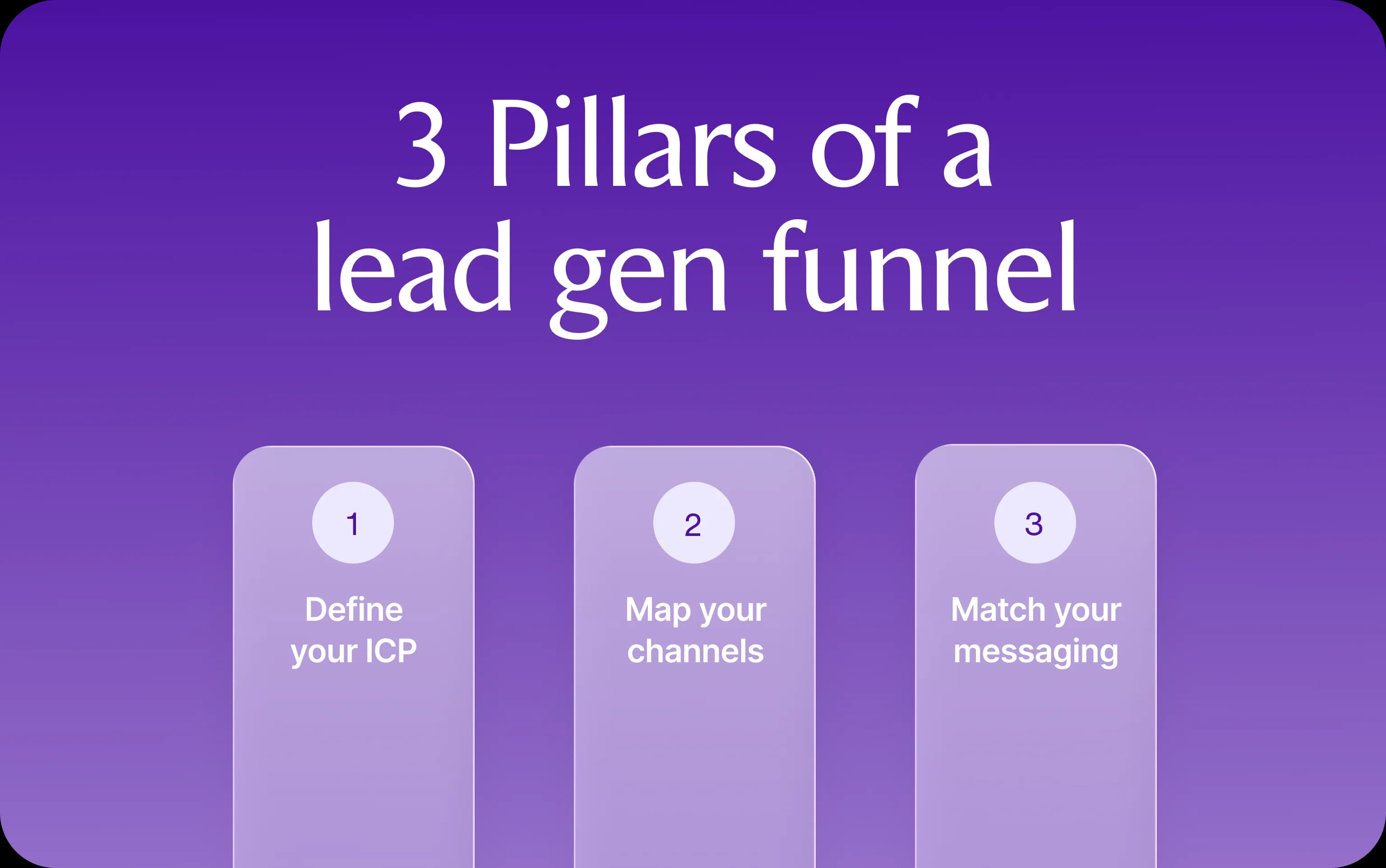
1. Start with your ICP and target audience
Who are you building this funnel for?
Start by defining two types of buyers. Champions are the individuals who will use your product day to day and have the most to gain from it. Decision-makers care more about the business outcome the purchase drives. They don't use the tool, but they sign off on buying it.
You can't target both with the same message. Start by building your funnel around the champion: their pains, their role, and the channels they use to research and solve problems. Through them, you reach the decision-maker.
You can sharpen your targeting further by factoring in signals that indicate champions and decision-makers are likely to act soon.
Here’s an overview of the most common buying signals:
Hiring drives
Funding events
Tech stack changes
Leadership changes
Engagement with your content
Tools like Artisan monitor these signals automatically and alert reps when relevant behaviors are tracked.
Buyer characteristics backed by the right signals help you drive higher-quality leads into your funnel. These MQLs won’t sit at the back of your CRM forever and have a realistic chance of becoming SQLs.
2. Map your funnel across channels and touchpoints
Your funnel will span more than one channel. For example, if your entry point is email, you'll need LinkedIn outreach and strong website resources (at minimum) to move leads through it.
Here is a quick example of how touchpoints can map across the funnel:
Outbound sequences create the opening, triggered by buying signals.
Retargeting ads extend reach to the broader buying committee.
SEO and GEO content captures prospects doing independent research.
Email nurture keeps the champion engaged and gives them material to share internally.
Your goal at this stage is to create one cohesive ecosystem with the channels in your arsenal. If you don't have the resources to connect multiple channels, don't spread yourself thin. Instead, focus on direct touchpoints like outbound outreach and precise retargeting.
3. Match messaging to each stage of the funnel
Mixing messages across stages is one of the most common mistakes marketers and reps make when building B2B lead gen funnels.
Pitching new leads in the first cold email? Retargeting pipeline prospects with a top-funnel article? Running commercial PPC ads against informational intent queries?
Unless you want to burn your budget, do none of these things.
Meet prospects where they are. Don't rush to a pitch with someone who is early in the research phase, and don't linger with educational content when someone is ready to buy.
4. Ensure alignment on MQL and SQL definitions
MQL-to-SQL transitions should never be arbitrary. They require shared criteria that both marketing and sales agree on upfront. Definitions should cover role, company size, engagement signals, and timing indicators that make a lead worth a rep's time.
There are three components marketing and sales should work on together:
Agree on the SQL definition upfront. Document what role, company size, engagement level, and intent signals make a lead worth a rep's time.
Build a handoff workflow. When a lead hits the SQL threshold, automatically assign them to a rep with full context. The handoff should be automatic, but it needs to carry everything the next person needs to pick up where the previous account owner left off.
Close the feedback loop. Review MQL-to-SQL conversion rate regularly and adjust scoring criteria accordingly.
Many teams would rather build a complex workflow than have a conversation about what an SQL means to both sides. Don’t make this mistake
The channels that drive B2B lead generation today
Content marketing, outbound, and email aren't the only B2B lead generation channels, but they're the ones that consistently drive qualified pipeline across every funnel stage.
Content captures prospects actively searching for a solution, outbound reaches the right accounts before they find you, and email keeps them moving once they’ve entered your funnel.
Content that capture high-intent demand
Content marketing is the practice of creating and distributing valuable, relevant content to attract and convert a clearly defined audience.
Here’s an overview of different content assets and which funnel stages they serve:
Organic social media (top of funnel) builds awareness and keeps your brand in front of people who aren't searching yet.
SEO-focused blog posts (top to middle of funnel) capture informational and problem-aware searches ("how to reduce churn," "what is X").
Competitor comparisons (middle to bottom of funnel) target high-intent "X vs. Y" and "X alternative" searches.
Whitepapers (middle of funnel) offer depth for prospects who are evaluating an approach and need to build an internal case.
Case studies (bottom of funnel) provide social proof for prospects in the decision stage.
Technical documentation (bottom of funnel and post-sale) reassures technical buyers that your product does what you claim and integrates with their stack.
Video demos (middle to bottom of funnel) show the product in action for prospects who want to see it work before booking a call.
LinkedIn and outbound for targeted outreach
Unlike content, outbound doesn't wait for prospects to find you. You reach out to them directly.
Here's what an outbound workflow looks like in practice:
Identify target accounts based on company-level criteria, like industry, company size, and tech stack.
Build a contact list of champions and key stakeholders within those accounts whose role and seniority match your buyer profile.
(Optional) Layer in intent signals like funding rounds, job postings, or website behavior to prioritize accounts and sharpen your timing.
Trigger an outreach sequence across social media and email once your criteria are met.
It’s possible to run an entire outbound flow on autopilot. Artisan is an AI-first platform that handles all stages of outreach from prospecting to meeting scheduling without any manual input. You simply need to define your ICP and buying signals, and AI BDR Ava, an autonomous AI employee, will take care of the rest.
Email marketing and follow-up that close gaps
Email marketing is how you stay in contact with prospects between touchpoints. In B2B, it does two distinct jobs depending on where the lead came from.
For inbound leads, it takes the form of a nurture sequence: a series of automated emails that pick up where a prospect's last action left off. A nurture sequence feeds interested prospects with relevant content, surfaces the ones showing buying signals, and filters out those who never engage.
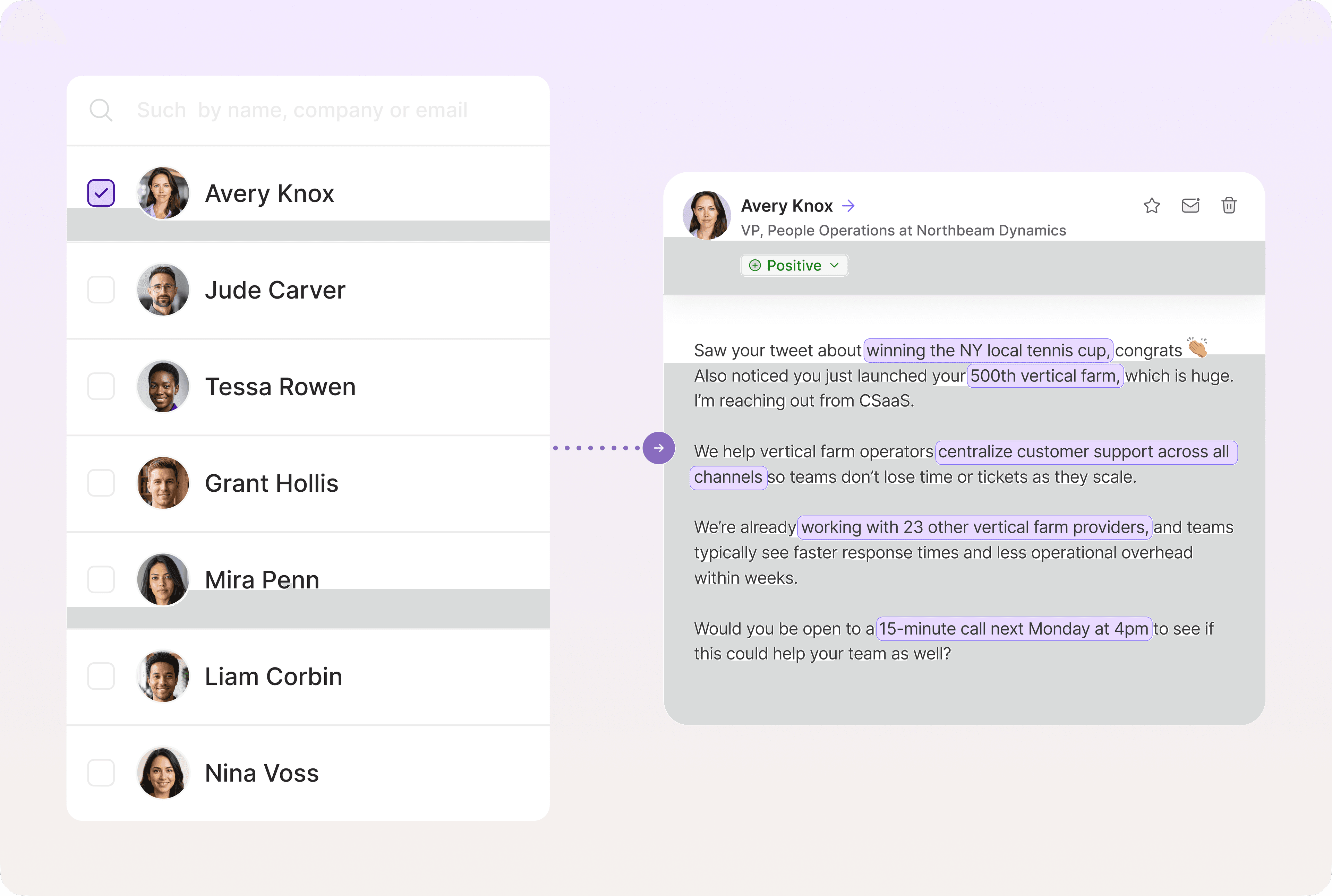
For cold outbound leads, follow-up is what drives results. A follow-up is a second or third message to someone who didn't reply the first time, each adding a fresh angle or proof point rather than just nudging them again.
What makes either work is how they respond to lead behavior. Your messaging should adjust based on each behavioral signal, like an email open or a click.
Turning traffic into pipeline with better conversion paths
Pushing traffic into your funnel is only part of the challenge. Converting leads into qualified sales pipeline requires the right infrastructure at every stage, from the landing page a prospect hits first to the marketing to sales handoff that leads to a sales conversation.
High-converting landing pages and lead magnets
Landing pages play a central role in turning traffic into leads. Every channel above, be it an SEO article, a cold email, a LinkedIn message, or a nurture sequence, eventually has to send the prospect to a landing page—a standalone page built around a single offer, like a demo, a whitepaper, or a free trial.
Here’s how to optimize your lead generation landing pages for conversions:
One page, one offer, one CTA: Remove navigation, secondary links, and anything that gives a visitor a reason to leave without converting.
Match the message to the source: A visitor coming from a cold email about churn reduction should land on a page about churn reduction, not your homepage.
Keep forms short: Name, work email, and company size are enough; you can ask for more on a sales call.
Add fast loading speed, and you have a high-converting page. If you got the targeting right, of course.
Smart lead capture, scoring, and CRM workflows
Your lead capture, scoring, and CRM workflows are the infrastructure that keeps your lead generation funnel moving.
Put the following in place before leads start coming in:
Sync new records with your CRM automatically: Every new lead should create a new contact without manual data entry.
Automate CRM actions: New and updated contacts should trigger relevant actions automatically, from task assignment to segment changes.
Score leads: Assign an initial score the moment a lead comes in, based on the lead magnet they converted on and their firmographics. As they engage with your emails or website, their score rises, and once it crosses a set threshold, an MQL becomes an SQL.
Prioritize outreach by score and signals: Reps should work the highest-scoring leads first; automated sequences should handle the rest.
Examples of B2B lead generation funnels
Each of these funnels works because they string together multiple coordinated touches into one repeatable motion. Pick the one that matches your go-to-market and run it consistently before adding complexity.
Product-led funnel for inbound demand
A prospect finds your product comparison article in search results.
From there, they take an interactive demo of the product.
Demo behavior triggers a targeted sales nurture sequence.
Sales steps in when signals indicate a real opportunity.
Webinar funnel for mid-funnel engagement
A prospect registers for a webinar targeting their specific role or pain point.
They attend the live event or engage with the recording.
A personalized follow-up sequence reaches engaged attendees with BOFU assets.
Sales steps in for prospects who have responded.
Outbound-led funnel for fast pipeline
A target account matches your ICP and shows a buying signal.
A personalized sequence launches across email and social media.
Engagement with outreach determines follow-up.
Respondents are booked for a demo.
How Artisan runs your funnel in the background
AI is changing how sales teams build their funnels, especially when it comes to cold outreach. It's allowing them to reach more leads without increasing headcount.
Artisan is an AI-first outreach platform built around an autonomous employee called Ava, who is capable of automating the whole outbound workflow right up until the point a meeting is booked.

Ava automates all of the following parts of the lead generation workflow:
Identifies accounts that match your ICP and finds contact data for the right stakeholders
Enriches accounts with firmographic, technographic, and intent data
Tracks funding events, job postings, and on-site behavior
Launches personalized email and social media outreach once a contact meets your defined criteria
Sends and adjusts follow-up messages based on prospect behavior
Logs interactions and updates CRM records based on lead responses
When a prospect responds, Ava keeps the conversation going until the meeting is scheduled. Your reps enter the picture only when a rep is ready to talk, allowing them to focus on real, human conversations, not busywork.
Build a funnel that prints pipeline, not just leads
A B2B lead generation funnel is much more than a single landing page and a nurture sequence. It's a system built around a precise ICP, mapped to how your buyers actually make decisions, and supported by the right content, channels, and automation infrastructure at every stage.
Artisan allows reps to automate all of the early and middle stages of their outbound funnel. AI BDR Ava identifies your best-fit accounts and launches personalized sequences across email and social media. She then books meetings directly into your rep's calendar.

Automate your outbound with an AI BDR
Meet Ava—your AI BDR who handles prospecting, outreach, and follow-ups, so your team can focus on closing.

Adelina Karpenkova
SME @ Artisan
Adelina Karpenkova is a writer helping businesses tap into AI's potential and clear up misconceptions. She works with B2B teams on latest industry knowledge.