Best cold calling scripts (with templates)
Learn cold calling scripts that get results. Templates, tips, AI tactics, and automation workflows for founders, SDRs, and sales leaders.
What separates successful cold calling teams from struggling ones isn’t usually the charm of their top sales reps. It’s the relevance and effectiveness of their cold calling scripts.
When you provide your team with scripts that reliably intrigue leads and position your company as an industry problem-solver, you’re bound to generate meetings from dials.
Why Most Cold Calls Don’t Work (And How to Fix That)
Most cold calls fail to generate a booked meeting. In fact, according to Cognism’s State of Cold Calling Report, the average success rate of cold calls is only 2.3%.
Here are the reasons most cold calls fail:
Irrelevant intros that don’t show the lead you’ve done your homework on them
Vague value propositions that don’t get specific about the problem you solve
Too much “feature talk” and not enough pain point exploration
No clear CTA at the end of the call
The key to a higher success rate is often a better script—one that builds rapport and interest quickly and provides value to the lead. Anatomy of a Cold Calling Script That Converts
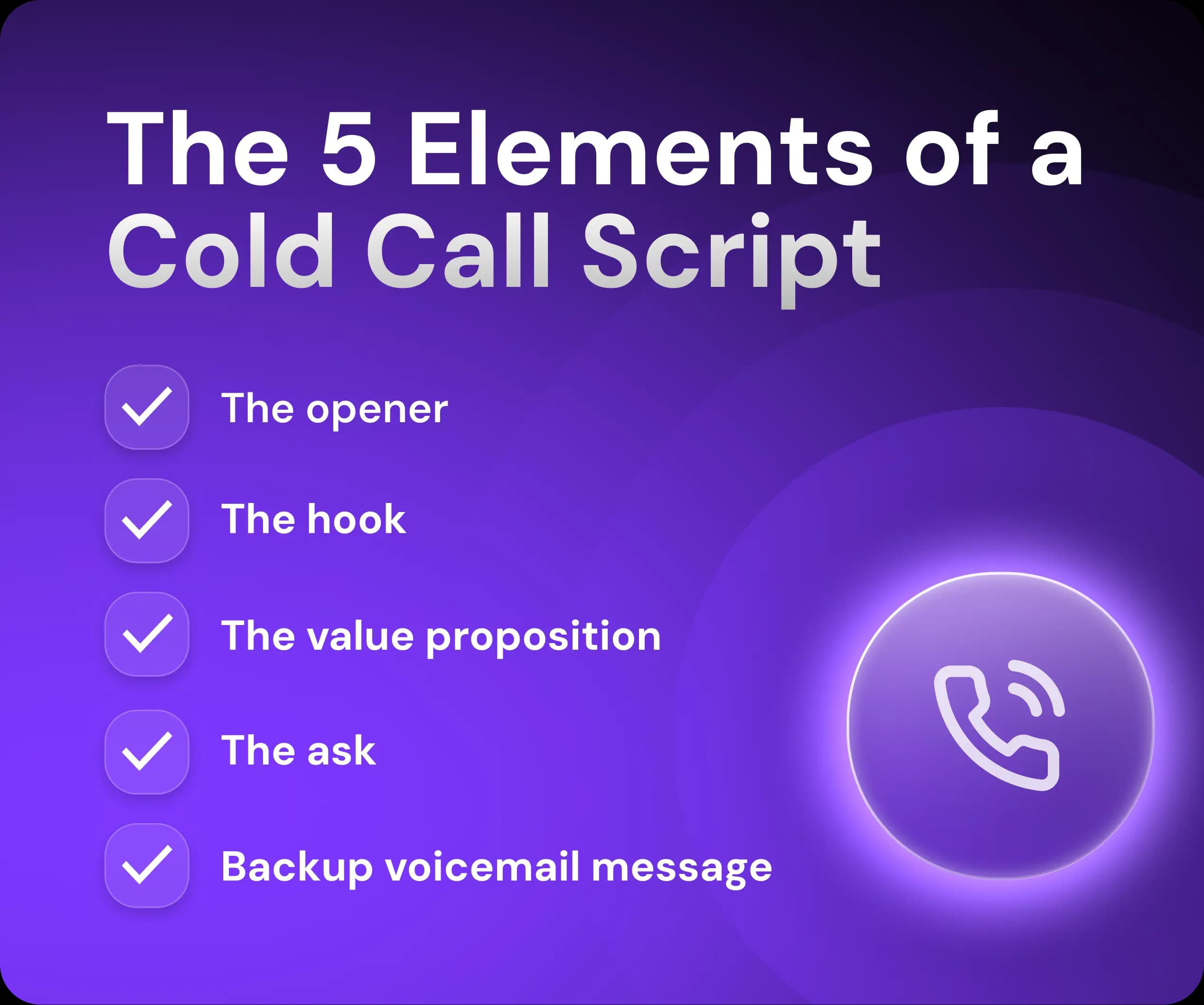
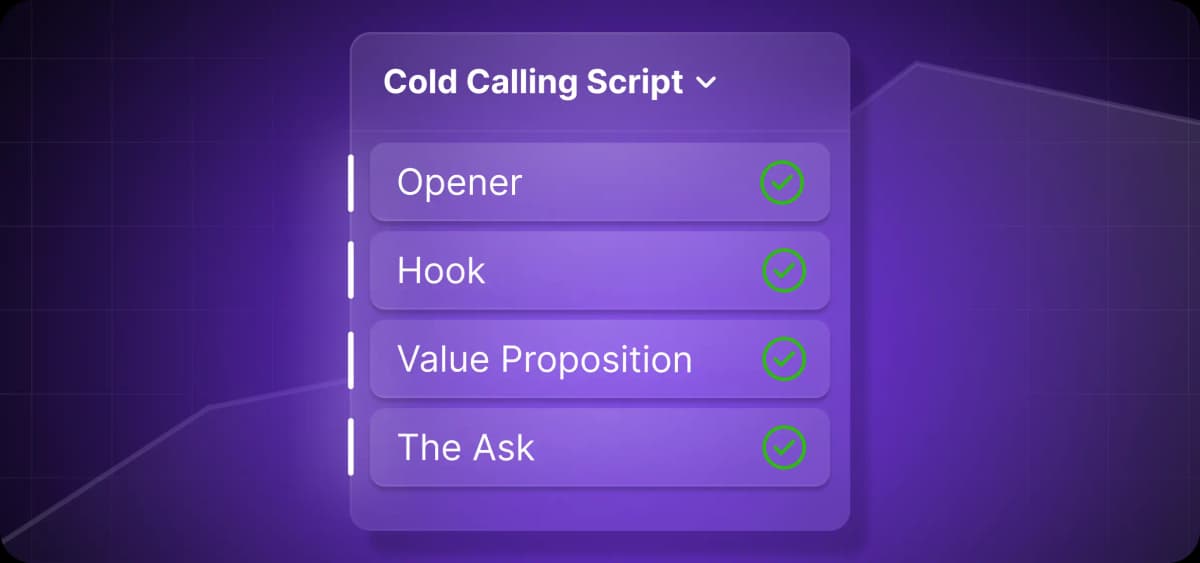
There are five main components to a cold call script:
Opener
Discovery hook
Value prop
Main ask
Voicemail message (if no one answers)
By covering the most critical moments of a cold call, from the first 15 seconds to the close, you’ll boost both SDR confidence and the average number of meetings booked per rep.
1. The Opener That Buys You 15 Seconds
Craft an opening line that quickly establishes you as credible and states your purpose for calling.
Include these key components in your opener:
Intro: Your name, your company name, and a quick value prop.
Context and credibility: Mention a few big names in the lead’s industry you’ve helped.
Ice breaker: Ask, “Heard our name tossed around?” According to Gong’s cold call data, openers containing this question had the best success rate.
Example: Hey [name], this is Alex from Artisan—we’ve helped [reputable company 1] and [reputable company 2] automate 80% of outbound without adding headcount—heard our name tossed around?
2. The Discovery Hook (Open-Ended Questions)
You’ve won their attention. Now it’s time to spark a conversation about a pain point they’re experiencing.
Include the following in your discovery hook:
Reason for calling: Mention their role, team size, or a trigger event (promotion, expansion, funding, etc.) that led you to contact them. Then state relevant core pain points that they are likely experiencing.
A short, pointed question that uncovers a need or blocker: Ask a question about their process to see if they’re struggling with any of the pains you cited.
Example: The reason for my call today, [name], is I saw you were recently promoted to VP of Sales. A lot of sales leaders from companies like yours are coming to us, sick of manual outbound that’s costing them hundreds of leads per month because it’s so hard to scale. I’m curious—how are you currently managing outbound lead gen?
3. The Value Prop That Lands
Once you’ve identified a lead’s pain point, state how you can help them solve it and how that will benefit their business (or help them do their job more effectively).
When crafting your value proposition, keep these tips in mind:
Quickly restate their major pain point or blocker.
Keep it short, specific, and relevant to the role.
Mention outcomes over features.
Share customer success stories, if possible.
Example: So it sounds like you’re pretty fed up with the limitations of manual outbound. One of our clients doubled their booked meetings by using an AI SDR to handle lead research and follow-ups. Would it be fair to say that this would help you reach your revenue targets while cutting expenses?
4. The Ask (What Happens Next)
Once the lead shows a sign of interest, ask for the meeting. Strike while the iron is hot.
According to Gong’s cold call data, the average length of a successful cold call is just shy of six minutes. There’s usually no need to make it longer. If a lead has stayed on the phone with you for this length of time, they should be willing to attend a meeting—so ask.
When it’s time for the CTA, use these strategies to increase success rates:
Ask an open question: “Is your calendar open?” I used this line when I was an SDR, and it was a natural way to segue into the CTA.
Ask a negative question: People are much more hesitant to say yes than no. So ask a question where the response you’re trying to produce is “No” (see the example below).
Example: Is your calendar open? Would a quick 15-minute call next week be a terrible idea?
Also, include language in your script for what reps should say in response to a “No thanks.” They’re bound to get some.
Example: What about a shorter meeting? Whether or not we end up being a good fit, you’ll come away with new insights into how companies like yours are using AI tools to automate their outbound sales process and boost revenue.
5. Voicemail Version (When No One Picks Up)
When a lead doesn't answer, leave a voicemail and then follow up with them via email or LinkedIn. Keep the voicemail short and value-driven, and be sure to leave your name and number.
Example: Hi [name]. This is Alex from Artisan. I’m calling because I saw you recently [an update you saw on their LinkedIn or website] and had an idea on how we could help you achieve [outcome], as we’ve done for [similar company] and [similar company]. If interested, give me a call back at [phone number]. I also sent you an email with info. Thanks!
Cold Calling Scripts by Scenario
Every outbound sales team needs tailored cold call scripts for different buyer personas, scenarios, and the lead’s level of warmth. This level of specificity can have a significant outcome on your booked meetings rate.
Cold Leads (No Prior Contact)
Here’s a script you can use to cold call new leads—people who have never communicated with your business before.
The Opener
Hey [name], this is [your name] from [company name]—we’ve helped [similar company] and [similar company] achieve [outcome]. Heard our name tossed around?
The Discovery Hook
The reason for my call is I saw [trigger event]. A lot of [role] at [company category] are coming to us frustrated with [pain point] and fed up with [pain point]. So I wanted to ask—how are you currently handling [relevant process]?
The Value Prop
It sounds like you’re struggling [pain point]. I get it—that’s why companies like you come to us. They were able to achieve [outcome] with [solution].
The Ask
Is your calendar open, [name]? Would you be open to a quick 15-minute call this week to explore how we might be able to help you achieve [outcome]?
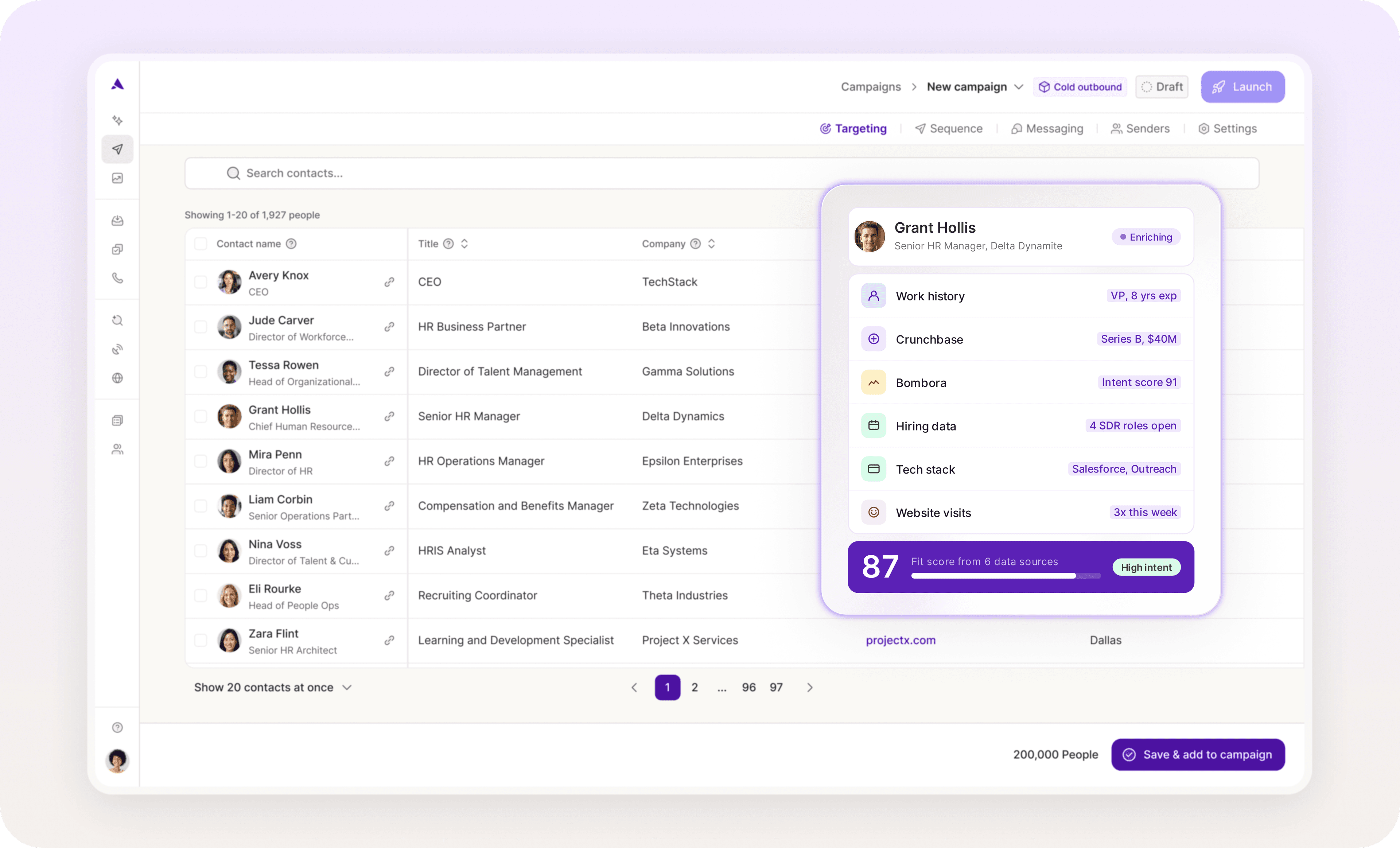
Looking for a source of cold leads? Artisan uses your ideal customer profiles (ICPs) to prospect from a database of over 300 million entries and then pushes enriched profiles to your CRM. It also supplements cold outreach with automated and deeply personalized email and social media messages.
Warm Leads (Prior Visit, Content Download, etc.)
Here’s a script to use on leads who visited your site, used to be customers, or downloaded a piece of content.
Make sure to tailor it to the lead’s specific needs. For instance, if they downloaded an ebook about workflow optimization, ask about their current bottlenecks.
The Opener
Hey [name]. This is [your name] from [company name]. I noticed you downloaded/visited/used our [relevant asset].
How have you been?
The Discovery Hook
I wanted to ask what inspired you to do this?
The Value Prop
I took a look at your company and found [reason they’re a good fit]. Our [product or service] has helped a lot of [job title] like you achieve [outcome], and I bet we can do the same for you.
The Ask
Would a quick 15-minute demo to learn more about how it works be a terrible idea?
Referral or Social Proof Scripts
This script template variation is the same as the one above, only with a different opener. In this case, the opener is designed to capitalize on your mutual connection.
Opener
“Hey [name]. It’s [your name] from [company name]. I’m calling because [name of mutual connection] said you’d be the right person to discuss helping you achieve [value proposition]. Were they wrong in pointing me to you?”
Voicemail and Callback Templates
Here are two effective voicemail scripts for cold calling. While they should help you boost callback rates irrespective of your industry, always test them to see which works best for your specific audience.
Direct Value Proposition Template
Hi [name], this is [your name] from [your company].
I’m calling because a lot of businesses like yours have been reaching out lately about [pain point]. I have a few ideas about how we can help you achieve [value proposition].
My number is [your phone number]. I think it’d be worth a quick conversation if you’re open to it.
Show Them You Know Them Template
Hey [name], it’s [your name] from [your company]. I was looking at your [company website or lead’s social profile] and noticed [observation about their role or business that makes them a good fit for your solution].
It reminded me of a client in a similar situation who saw [outcome] from our [one-sentence product description]. I’d love to share what worked for them if you think it’d be helpful.
My number is [your phone number]. Call any time.
Cold Calling Tips From Reps Who Actually Do It
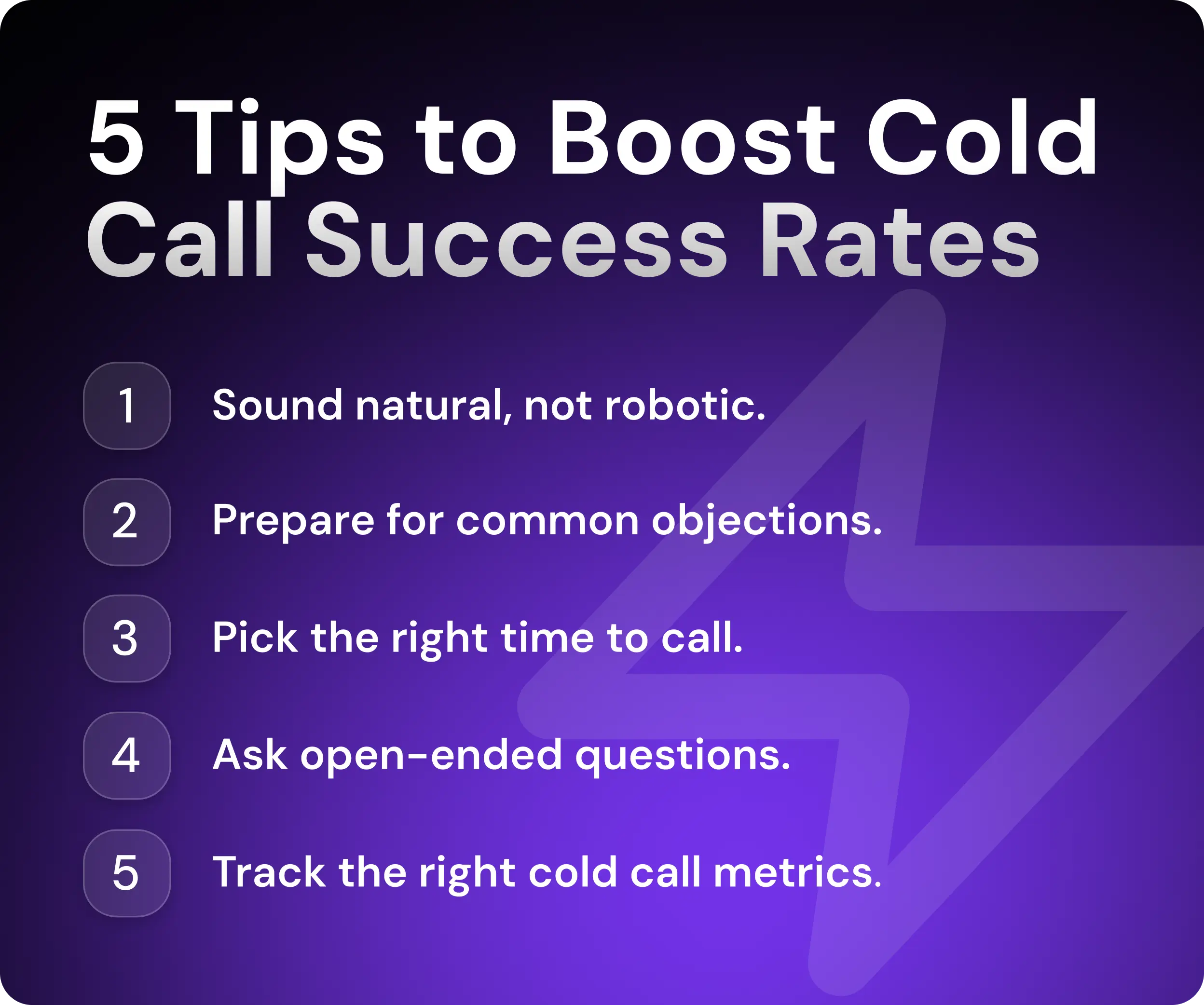
When I was an SDR, there were certain insider tricks successful reps knew about cold calling. These tactics will help you sound natural on the phone, overcome concerns, and boost connect rates.
Don’t Sound as if You’re Reading From a Script
Scripts are a guide, not a teleprompter. The easiest way to annoy a lead is to sound like a robot.
Be human. Write a script that matches how you speak, and use common everyday phrases like “sick of” and “fed up with” when bringing up pain points.
Also, make sure you only script the core moments of a cold call—the opener, discovery hook question, value prop, the ask, and objection rebuttals.
The rest you should improvise based on the lead’s responses and your knowledge of their industry and situation. In addition, memorize the script so you aren't reading it while talking on the phone. This will help you sound natural.
Prepare for Objections (They’re Inevitable)
In your script, write rebuttals to the objections you hear time and time again from leads. Then commit them to memory so you’re always prepared.
Here are four common cold call objections and responses that overcome them:
“Not interested”: “I hear you. All 145 of our happy clients started uninterested. Would you give me 10 minutes on a call to prove to you why it’s interesting?”
“Send me info”: “Makes sense if you want to learn more through reading. What are your major questions about our solution? That’ll help me figure out what to send you.”
“No time for this”: “I get it. [Job title] is one of the busiest jobs. That’s actually what inspired us to build this tool. What’s keeping you so busy all the time? Maybe we can save you a couple of hours a day, as we have for [company 1] and [company 2].”
“We have a solution already”: “Gotcha. Which solution are you currently using?” After they answer, hopefully, you know the competitors and can ask a question that reveals a common problem with that competitor, e.g., “Do you find the lack of an inspection app annoying?”
Time of Day and Frequency Hacks
The best day and time to cold call depends on your industry. That said, there are generally accepted guidelines for when to call that will likely boost connection rates and act as a basis for further testing.
Here are the best times to place cold calls:
Tuesday, Wednesday, and Thursday mornings
4 to 5 PM (most people have finished their hard work by then)
Often, your first attempt to connect will fail. Don’t give up. Have a follow-up strategy. For example, you might make 3 to 5 calls staggered over two weeks. At the same time, you can also reach out on LinkedIn and via automated email follow-up sequences.
Ask Open-Ended Questions, Be Quiet, and Listen
Open-ended questions get leads talking. They inspire leads to reveal information about their business and day-to-day problems, which you can then use to spin up an enticing pitch. Open-ended questions also prolong the conversation, which gives you more time to build trust.
Here are examples of strong discovery questions to ask on a cold call:
What’s your biggest roadblock when it comes to [relevant goal]?
Can you walk me through what happens when [relevant scenario]?
How are you managing [relevant process]?
Which KPIs matter to you most right now?
How is [industry trend or issue] impacting you right now?
Track the Right Metrics
The best SDRs track key metrics and use them to adjust their cold calling processes and scripts based on what is and is not working.
Here are five critical cold calling metrics to track on your dashboard:
Connect rate: Percentage of dials that end in a conversation with the lead
Voicemail callback rate: Percentage of voicemails that result in a callback
Meetings booked per 100 conversations: Number of qualified appointments set per 100 conversations (not dials)
Average call duration: Average length of connected cold calls
Objection frequency by type: Number of times you encounter a specific objection
How to Build a Cold Calling Script Fast
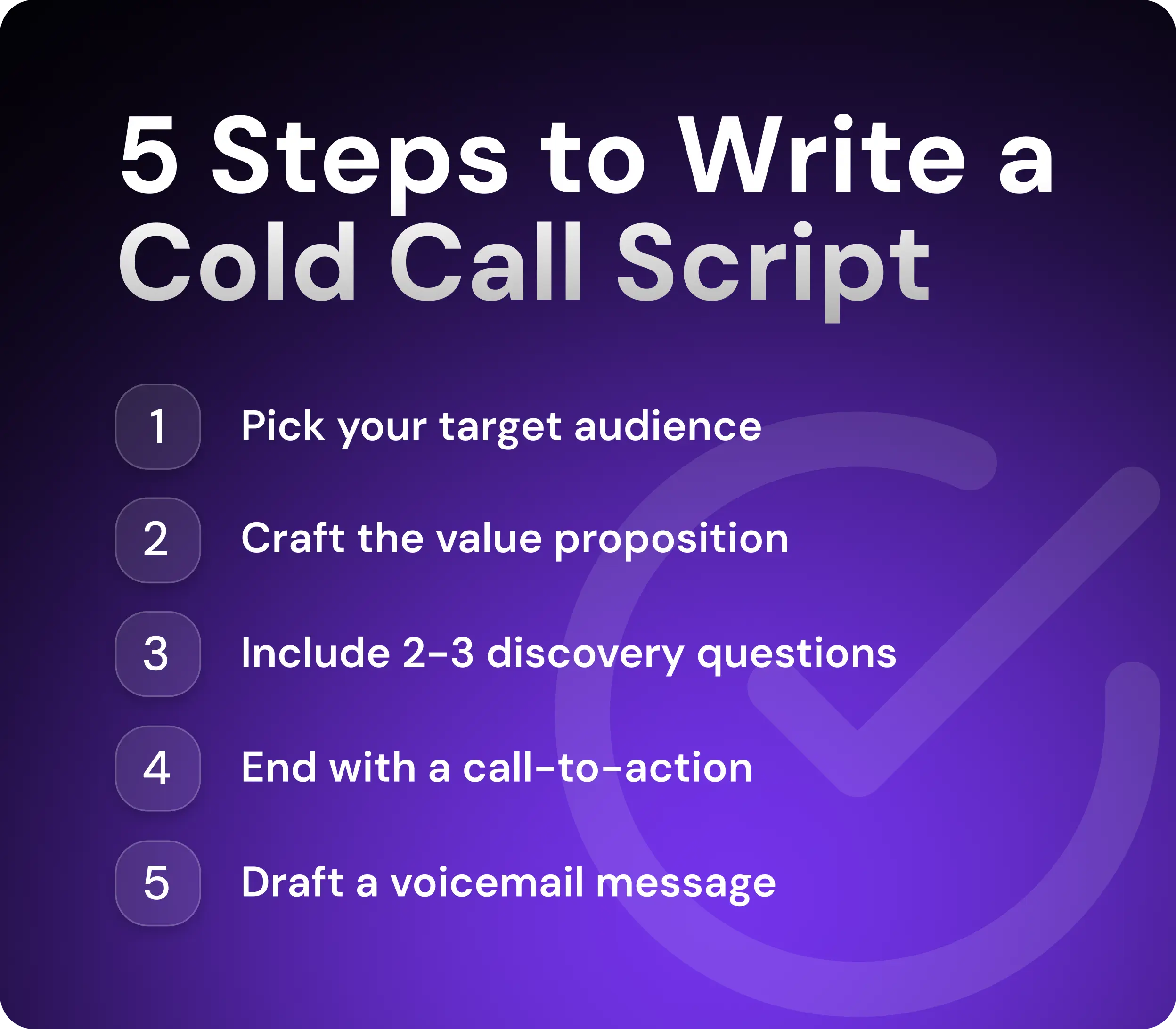
A cold call script doesn't take weeks to build. You can create an effective one in a single day. Collecting feedback and refining it takes time. But the drafting of your first version can be done in five easy steps.
Step 1: Clearly Define Your ICPs
Defining your ICPs—which should correspond to different market segments—will ensure your messaging matches their specific interests, challenges, and needs.
Include all the following details in ICPs:
Industry
Company size
Job titles
Buying authority
Key pain points
Goals and desired outcomes
Budget range
Tech stack
Buying triggers
Sales cycle length
Common objections
Geography
Once you have a well-defined set of ICPs, pick the one you’re going to create a script for. You should have separate scripts for each ICP, so you will likely need to repeat this process several times.
Step 2: Clarify Your Value Proposition in 1 to 2 Sentences
Write a short statement of your solution’s value. You'll use this to open cold calls and provide context about who you help and how.
In the sentence, include a painful problem, your solution, and the positive results.
Here’s an example from my days selling a proptech solution to building owners and operators in NYC.
“Building owners often make violations that turn into fines because they have no simple way to track them. Our compliance monitoring software tracks your violations and helps you stay compliant, reducing government fines dramatically.”
Notice how I don’t really talk about features at all. I describe the software category—compliance monitoring software—but don’t go into how it works or all its other useful features. Save that for the demo. Just pique interest so you can ask for a meeting.
Step 3: Write 2 to 3 Conversation-Starting Questions
Draft two to three conversation-starting questions about pain points, processes, and blockers.
For example, I used to ask, “How are you currently tracking building violations?” Usually, the lead would have a terrible process for doing this, so pitching my product was an easy next step.
Including multiple questions in your script, rather than one question, enables SDRs to use the question that makes the most sense with each specific lead.
Step 4: End With a Simple CTA
Craft a call to action that feels like an easy, low-stakes commitment.
Here are three examples:
“Are you open to a 15-minute intro meeting to cover how we could help you achieve [outcome]?”
“Are you open to a short demo with our product expert?”
“How about a 20-minute consultation to see if we’re a good fit?”
Step 5: Draft the Voicemail Version
Create a 20-second variation of your core message to use as a voicemail message in case the lead doesn’t answer the call—which will happen often.
Include your name, your company name, why you’re calling, your value prop, and a callback number. We shared two voicemail scripts in the “cold calling scripts by scenario” section of this article—check them out.
How Great Sales Teams Approach Cold Calls
Top sales managers don’t just send their sales reps out there with scripts. They document sales outcomes, automate busywork like lead research and follow-ups, and continue refining the script over time.
They Document and Test Scripts
The best teams document their cold call interactions in their CRM and other tools in a way that allows them to learn from past cold calls and optimize their scripts.
There are two main ways to track cold calls and refine your process:
Call recordings: Record and regularly review calls with your team, paying attention to moments where the call took a turn for the worse or the better. Ask why this happened. Was it something you said or failed to say?
Conversation analytics: Tools like Gong and Clari can analyze all your team’s cold call interactions and identify patterns around best practices, providing script-enhancing insights like “Calls where you open with X line succeed 50% more than when you use Y.”
They Automate Selectively
Cold calling involves a lot more than dialing numbers and having conversations.
Sales reps have to build targeted prospecting lists, research leads, send follow-up emails and LinkedIn messages, and track cold call performance.
These tasks—that don’t involve speaking with leads—are best understood as cold calling "overheads." Smart teams automate them with sales tools like Artisan.
Artisan’s AI BDR Ava automatically finds leads that fit your ICP and enriches CRM records with valuable lead data. Reps can then tailor their scripts with specific details—like company size and recent online behavior. Ava also builds and runs multichannel follow-up sequences, reaching out to leads who didn’t take your call.

They Treat the Script as a Living Asset
Your sales script isn’t set in stone. It’s meant to be tweaked and improved based on regular reviews, testing, and lead feedback.
Here’s how to optimize your script over time:
A/B test openers, hooks, value propositions, and CTAs.
Use conversation analytics software to gain visibility into script effectiveness.
Review all successful cold calls to determine why they produced a meeting.
Iterate weekly based on what’s working and failing.
Keep a record of why each script revision was made. Pair the change with a call example and a behavior to practice, then check later calls for progress. Artie’s use-case library includes ongoing sales and customer success coaching. This is a coaching use case for completed calls.
Personalization at Scale: Where Cold Calling Gets Results
Personalization is essential to win the attention of your leads. It’s how you help them see you as an informed industry problem solver rather than just another salesperson.
Why Personalization Matters More Than Ever
Cold calling simply isn’t worth doing if you’re planning to just go through the motions.
According to Cognism’s State of Cold Calling Report, the average cold calling success rate was 2.3% in 2025, about half what it was in 2024. That’s pretty abysmal.
The unfortunate truth is that most cold callers are exactly that—abysmal. They use generic openers, canned pitches, and the tone of a robot reading a script.
If you actually take time to craft a personalized script for every one of your segments and learn the art of cold calling, you should see real success.
Here are two examples of what personalization actually looks like on a cold call:
Job title and pain point: “I’ve worked with over 100 VPs of property management, and almost all of them tell me the hardest part of the job is tracking what needs to get done.”
Market shifts: “I’m sure you’ve seen some of your competitors pumping out content with new AI marketing tools. Maybe wondering how you can compete? We’ve checked out your account—great insights for your clients, by the way—and we have some ideas for quadrupling your social media engagement without hurting quality.”
How Artisan Streamlines Cold Calling
From building enriched prospecting lists to following up over email, Artisan’s AI BDR Ava handles the tasks involved in your process that don’t involve calling. As a result, your team can focus on actually speaking to leads.
Finds Targeted Leads to Call
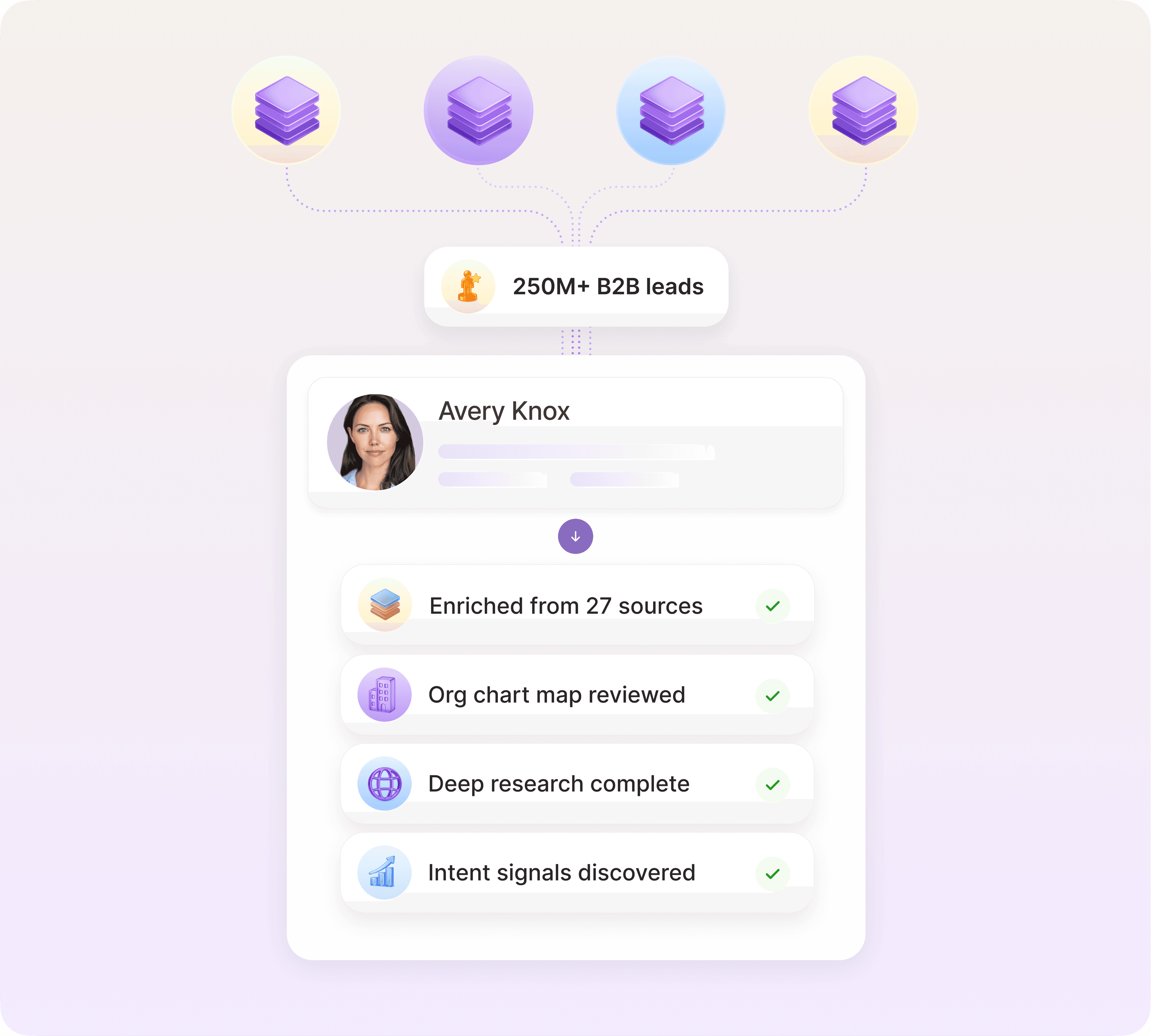
Ava prospects from a comprehensive database of over 300 million B2B, ecommerce, and local leads. She matches leads for cold calling to your ICP to ensure a good match.
Automates Lead Research
Ava researches leads on social and the web, uncovering B2B data like firmographics, tech usage, job titles, phone numbers, and online behavior. This provides reps with a 360-degree view of prospects.
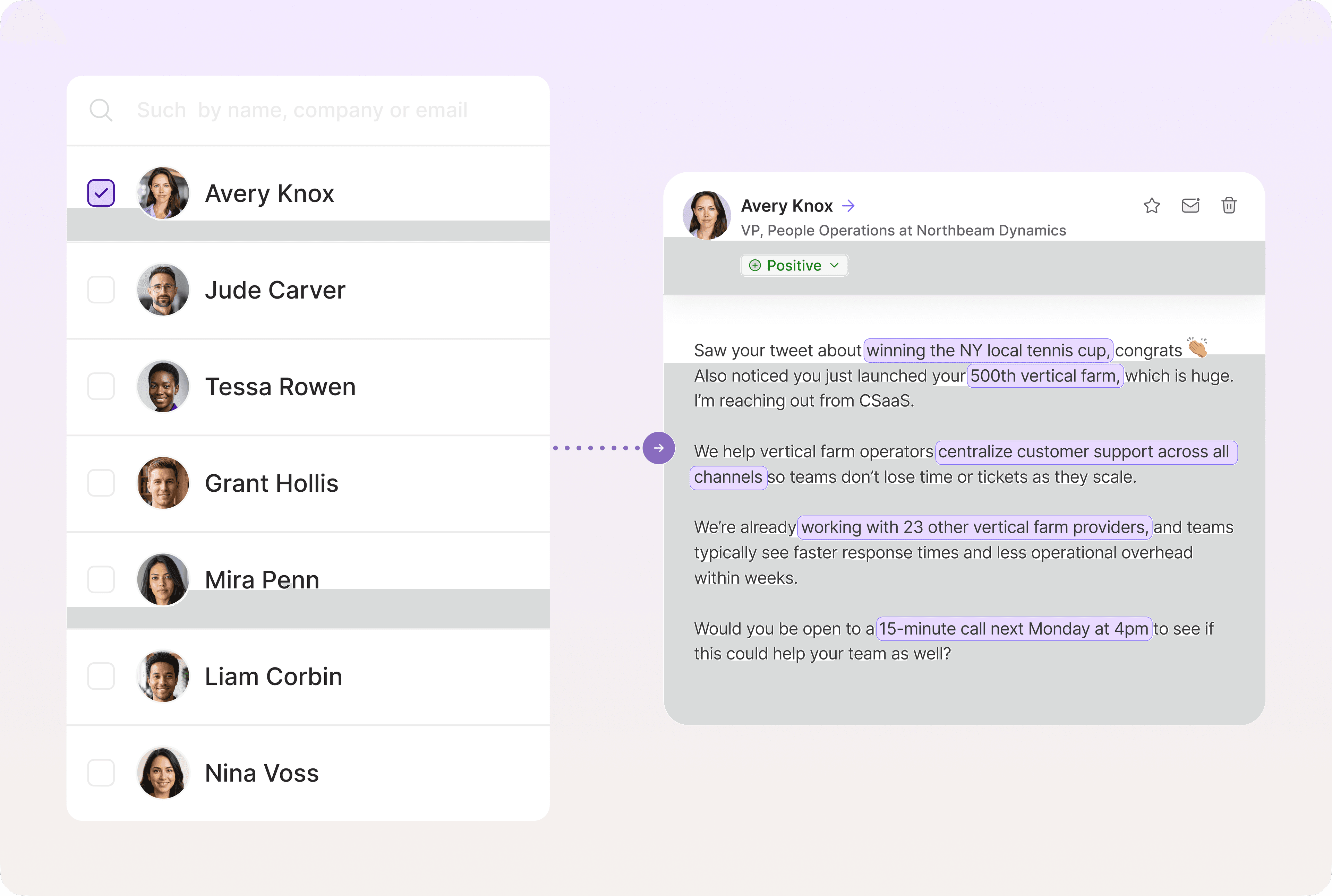
Warm Up Leads With Personalized Outreach at Scale
Ava will create and run personalized multichannel outreach sequences to target leads, nurturing them so they’re more likely to answer, engage, and convert on cold calls.
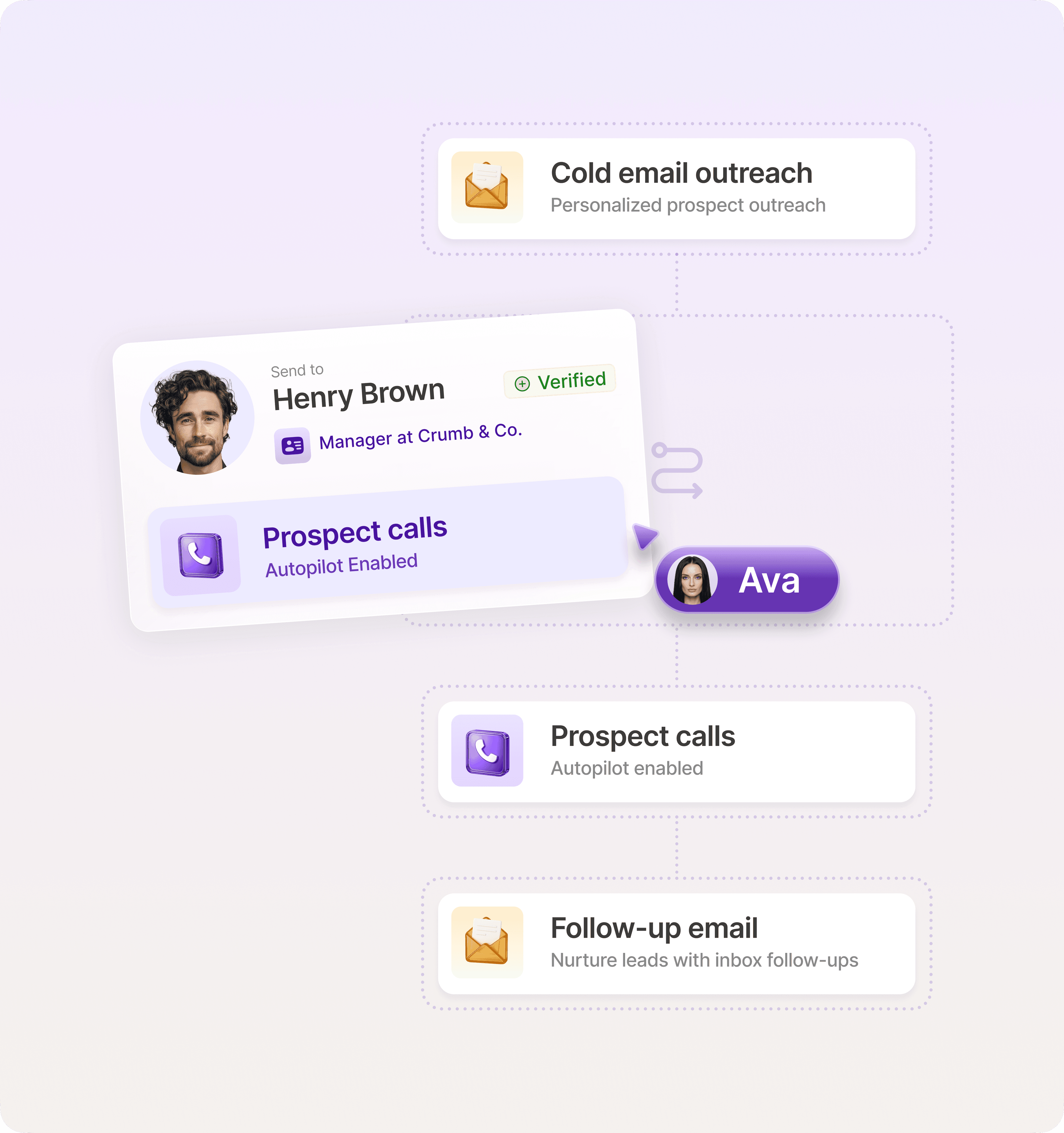
Follow Up With Leads on Autopilot
Ava sends personalized messages to leads across email and social media, so nobody falls through the cracks if they don’t answer your cold call.
The Future of Cold Calling Is Automated (and It’s Working)
Cold calling is and always will be a numbers game. The more dials, the more meetings you’ll book. There’s no getting around this need for volume.
The future of cold calling, therefore, belongs to teams that can make the most dials without sacrificing quality.
How do you do that? You automate 80% of the tasks with AI.
Artisan’s AI BDR, Ava, conducts lead research, list building, and cold email outreach and follow-up, all without human intervention. The result? Your human sales reps can focus their valuable time and effort on having productive conversations on the phone.

Automate your outbound with an AI BDR
Meet Ava—your AI BDR who handles prospecting, outreach, and follow-ups, so your team can focus on closing.

Sam Rinko
SME @ Artisan
Sam Rinko is a former SaaS sales rep turned tech writer. He sold real estate software before writing about lead generation, cold calling, and AI sales tools.