Common Room pricing and reviews (2026)
What Common Room costs in 2026, what its plans include, what reviewers say, and how the pending Zoom acquisition changes the picture for buyers.
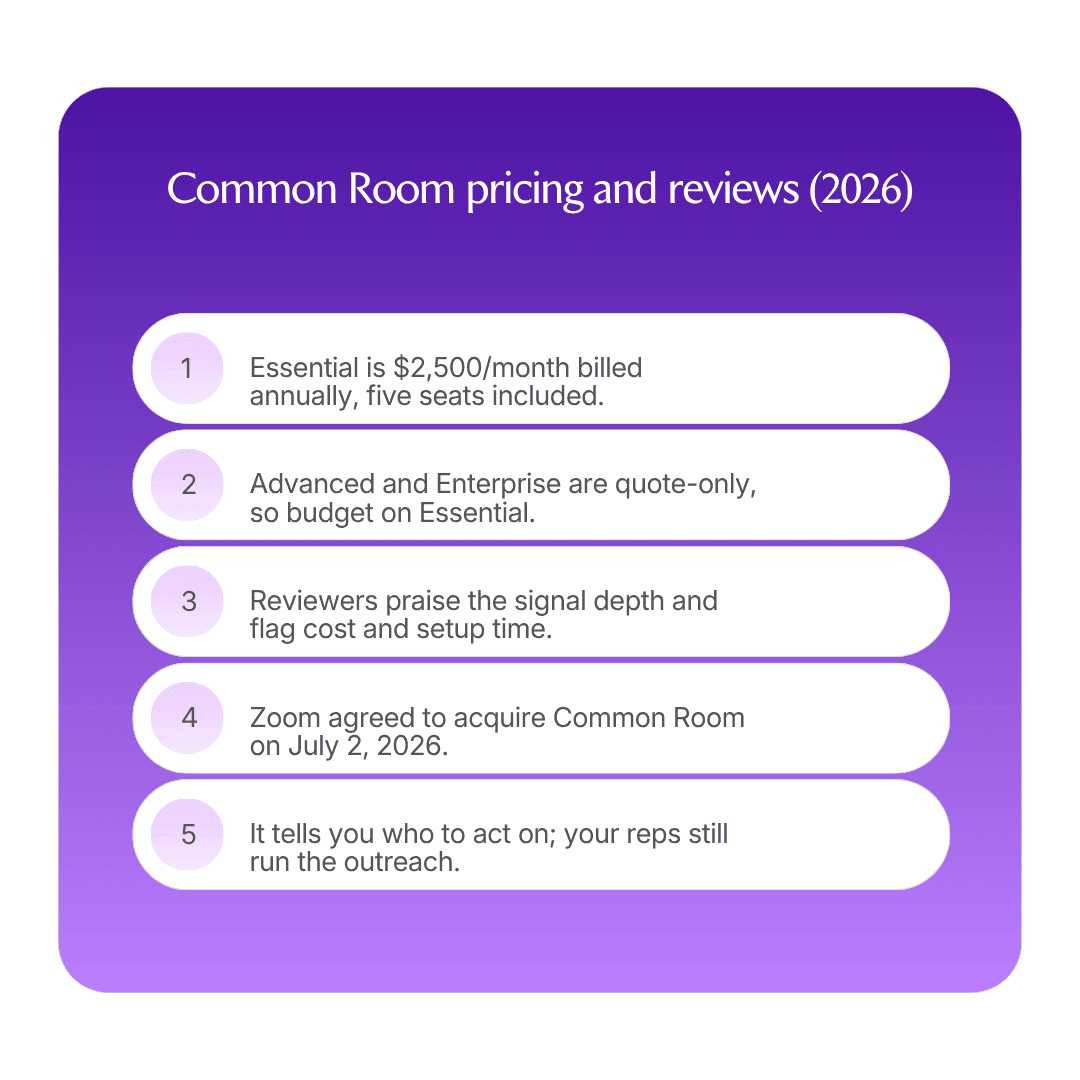
Common Room is a person-level buyer-intelligence platform. Its published entry plan, Essential, is $2,500 per month billed annually, with Advanced and Enterprise quoted custom. Reviewers praise the depth of signal aggregation and the "who to act on" clarity, and flag the price and the setup effort. Zoom agreed to acquire Common Room on July 2, 2026.
How much does Common Room cost in 2026?
Common Room lists one public price: the Essential plan at $2,500 per month, billed annually, which reportedly includes five seats. That works out to roughly $30,000 a year at the entry level. The higher Advanced and Enterprise tiers are not published; they are quoted based on data volume, integrations, and team size. As with most buyer-intelligence platforms, the real number for a larger org lands well above the Essential floor once you add seats and signal sources.
The pricing model is worth understanding before you compare. You are buying an intelligence layer: signal aggregation, identity resolution, and the workflows that find high-intent people and accounts. It is not an execution tool that sends the outreach, so the cost sits alongside whatever you use to actually run campaigns.
Common Room pricing at a glance (2026)
Plan | Price | Seats | What's included |
|---|---|---|---|
Essential | $2,500/mo, billed annually | 5 included | Signal aggregation, person and account intelligence, integrations, core workflows |
Advanced | Custom, contact sales | Custom | Higher volume, more signal sources, advanced automations and routing |
Enterprise | Custom, contact sales | Custom | Enterprise security, admin controls, custom data and support terms |
Figures reflect Common Room's published pricing. The Essential rate is public; Advanced and Enterprise are gated. Confirm current terms with the vendor, especially given the pending Zoom acquisition.
What does Common Room actually cost in practice?
The $2,500 entry is a floor, not a typical spend. A few realities shape the real bill.
Annual commitment. Essential is billed annually, so the entry is effectively a $30,000-a-year decision, not a month-to-month trial. Larger teams that need more seats or more signal depth move to custom pricing quickly.
It is an intelligence layer, not an execution one. Common Room identifies and prioritizes; it does not write and send the campaigns that act on the signals. Most teams pair it with a sequencer or sales-engagement tool, and often a separate outreach and dialer stack, so the true cost of "acting on intent" is Common Room plus the tools that do the acting.
Setup and data plumbing. Connecting product usage, community sources, CRM, and website data to obtain clean person-level intelligence is real work. Reviewers who gain the most value invested in that integration and in defining which signals matter. Teams that bought it and left it lightly configured tend to feel they paid for depth they never used.
Acquisition uncertainty. With Zoom's acquisition announced but not closed, buyers signing an annual contract are betting on a roadmap that may shift once the deal completes. That is not a reason to rule it out, but it is a reason to ask pointed questions about product direction and pricing continuity before committing.
What do reviewers say about Common Room?
Common Room holds a 4.5 out of 5 on G2 from 106 reviews in July 2026. The consensus is strong on capability and cautious on cost and complexity. Here is the split behind that number.
What reviewers praise. Signal depth is the headline. Users credit Common Room with pulling together sources that normally live in separate tools, then identifying the person or account actually worth a rep's time. The identity resolution and the "who is showing intent right now" workflows receive specific praise, and community and product-led teams call it uniquely good at connecting engagement to pipeline. The interface is generally described as polished.
What reviewers complain about. Price is the recurring theme, especially for smaller teams weighing a $30,000 annual entry. Some reviewers report a learning curve and meaningful setup time to configure the signals and make them trustworthy. Others note that the platform's value depends on acting fast on what it reveals, and that the acting still falls on reps, so the intelligence only pays off if the team has the capacity to follow through. A few raise the natural question of what changes under Zoom's ownership.
Who is Common Room best for, and who should skip it?
Common Room best for. Mid-market and enterprise teams, especially product-led and community-driven ones, that have many signal sources to unify and the rep capacity to act on prioritized intent quickly. If your problem is "we have signals everywhere and no single view of who to work," Common Room is one of the strongest answers, and reviewers back that up.
Skip Common Room if. You are a small team, your budget cannot absorb a $30,000 annual entry, or your real gap is executing outreach rather than organizing intent. If you would end up buying Common Room and then still needing a separate engine to run the campaigns, a platform that does both is a better fit.
Artisan: the same signals, with the outreach attached
If you are pricing Common Room, the question underneath is usually "how do we find and act on buying intent." Common Room answers the finding half and hands the acting to your reps. Artisan is an AI outbound platform that does both: it runs the signals natively and fires the outreach the moment a signal hits.
Artisan's signal library covers the same territory a buyer-intelligence tool is built for: funding rounds, newly hired executives, first hire in a department, actively-hiring-for-role, tech-stack intent, topic intent, social post keyword tracking, champion job-change tracking, investor portfolio tracking, and person-level website visitor identification on US traffic with company-level identification globally. On top of that, you can define custom signals in plain English, and Artisan scores them with confidence and evidence URLs. That is the intelligence layer, built in.
The difference is activation. When a signal fires in Artisan, the AI, Ava, does not just reveal a name for a rep to chase. She qualifies the person against your ICP, enriches verified contact details, writes a personalized multichannel sequence, sends it, and works the replies, escalating to a human on plain-language rules you set. Ava also dials the call steps for your reps, who handle the live conversation. Two people caught by the same signal receive two genuinely different messages, not a mail merge. So instead of paying for intelligence and then paying again for the tools and headcount to act on it, you receive the signal and the action in one system. On cost, Artisan is usage-based: you pay for the work performed rather than per seat. Ava can be trialled for free, which lands differently than a $30,000 annual seat-bundle floor. See Artisan pricing and the signals and AI sales agent overview.
To be fair to Common Room: if you specifically want a best-in-class intelligence dashboard to feed an existing, well-staffed outreach machine, and community or product-usage signals are central to your motion, it does that job deeply. Artisan is the better call when you want the signal to trigger the outreach automatically rather than to populate a list a human still has to work.
Frequently asked questions
Is Common Room worth it?
For a mid-market or enterprise team with many signal sources and the rep capacity to act fast, reviewers generally say yes: the depth of signal aggregation and prioritization is a real strength, reflected in its 4.5 out of 5 G2 rating across 106 reviews. The value case weakens for small teams that cannot absorb a $30,000 annual entry or that need the outreach executed for them rather than just organized.
Is Common Room expensive?
The Essential plan at $2,500 per month billed annually, roughly $30,000 a year, puts Common Room at the premium end of buyer-intelligence tools, and Advanced and Enterprise go higher. It is priced on signal depth and identity resolution, not affordability. Remember it is an intelligence layer, so budget for the outreach tools that act on what it reveals.
What happens to Common Room now that Zoom is acquiring it?
Zoom agreed to acquire Common Room on July 2, 2026. As of now the deal is announced, not closed, so the product continues to operate independently and the long-term roadmap and pricing are open questions. Common Room had raised about $32.3M in venture funding, most recently a Greylock-led Series B in March 2021, with no rounds since. If you are signing an annual contract, ask directly about product direction and pricing continuity under Zoom before you commit.
What are alternatives to Common Room?
For intent and visitor identification, alternatives include Warmly, Vector, and RB2B at lower entry price points, and enterprise ABM suites like 6sense and Demandbase, both quote-only, at higher ones. If your goal is to act on signals rather than just view them, Artisan runs the same signal types natively and fires the outreach automatically, so the intelligence and the execution live in one platform.
Does Common Room send outreach?
Common Room is an intelligence and workflow platform: it reveals who to act on and can route those people into your tools, but the actual campaigns are run by your reps in a separate sequencer or engagement tool. That division is worth pricing in, because acting on intent fast is where the value is realized, and the acting still falls to your team.
How does Common Room compare to Artisan on signals?
Both cover funding, hiring, tech-stack, topic intent, champion job changes, and website visitors, and Artisan adds natural-language custom signals with confidence scoring. The core difference is what happens next: Common Room hands the prioritized signal to a rep, while Artisan's AI writes and sends the personalized outreach the moment the signal fires and works the replies, so finding and acting are one motion.
The bottom line
Common Room is a deep, well-regarded buyer-intelligence platform, best for teams that have signals scattered across many sources and the capacity to act on them. Price it as a $30,000-a-year-and-up intelligence layer, watch the pending Zoom acquisition, and remember the outreach still lands on your reps. If you would rather the signal trigger the outreach itself, Artisan runs the same intent natively and Ava acts on it automatically. The AI BDR explainer covers how that works end to end.
Jaspar Carmichael-Jack
Co-Founder & CEO @ Artisan
Jaspar is an entrepreneur with expertise in sales, marketing, and operations. He founded Artisan in 2023, a company automating workflows with AI employees.