The best Salesloft alternatives in 2026
The best Salesloft alternatives in 2026, ranked, from autonomous AI cadences to Outreach, HubSpot, Apollo, Reply, and Klenty.
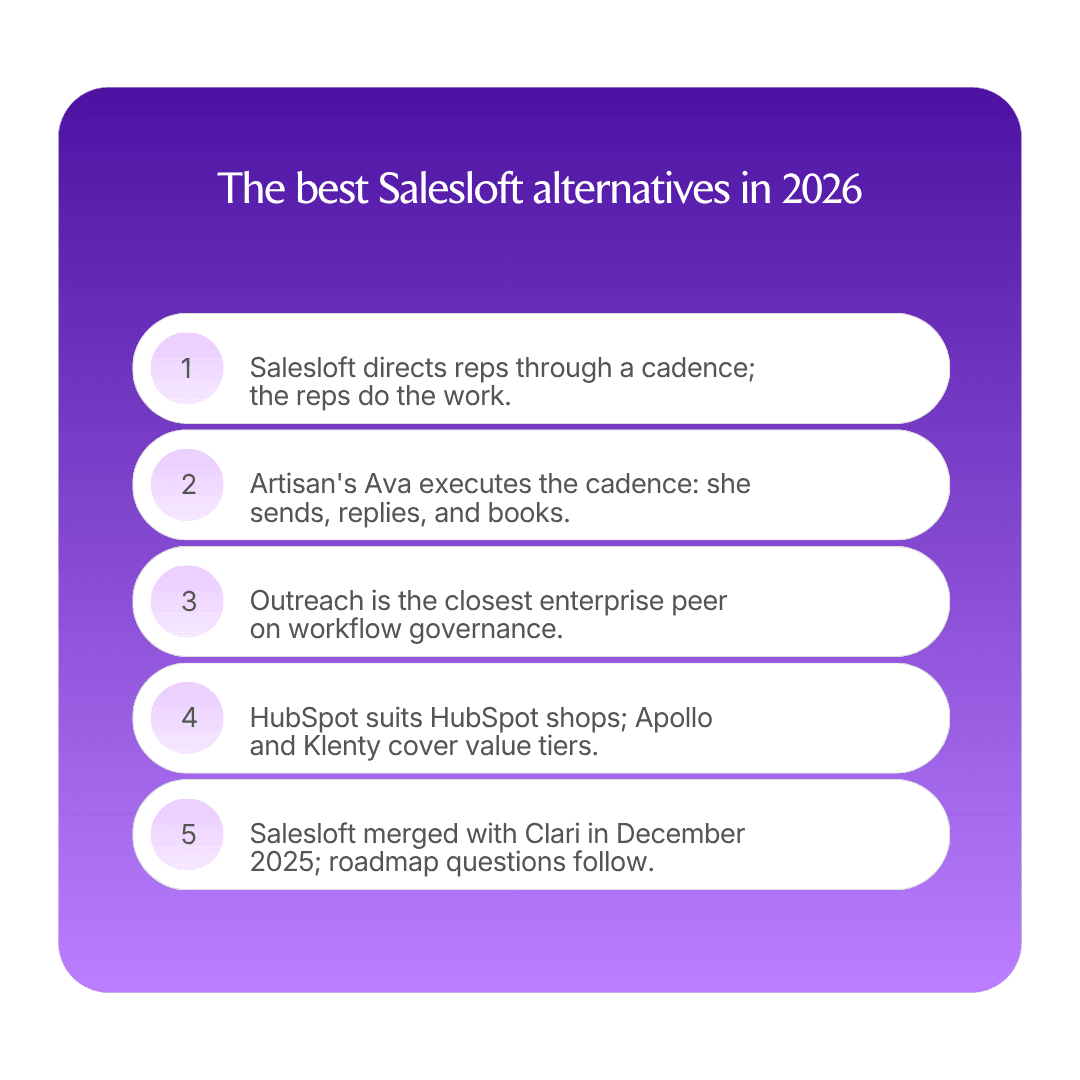
The best Salesloft alternative for most teams is Artisan, because instead of directing human reps through a cadence, Ava executes the cadence herself: she sends, handles replies, and books, and dials the call steps for reps. Outreach is the closest enterprise peer, HubSpot fits HubSpot shops, and Apollo, Reply, and Klenty cover the value tiers. Salesloft is a mature engagement platform, but its core is still human-driven.
The deeper structural point is what sends teams looking: Salesloft is a sequencer that organizes what humans do next. The reps still write, send, call, and reply. If you want the software to do the work rather than schedule it, that is a different category. (The December 2025 Clari merger has also raised roadmap questions among some buyers.)
Comparison table
Rank | Tool | Best for | Standout capability | Public pricing |
|---|---|---|---|---|
1 | Artisan | The AI executing the cadence, not reps | Ava owns send, dial, reply, and book | Usage-based credits; no platform fee; free trial |
2 | Outreach | Enterprise sequencing governance | Mature workflow controls, Omni agent | ~$100-160/user/mo estimated (gated) |
3 | HubSpot | HubSpot-native teams | Outcome-based agent pricing, native CRM | ~$1.00/qualified lead reported |
4 | Apollo | Value all-in-one with data included | Large database plus sequencing, low cost | Free to $119/user/mo |
5 | Reply.io | Accessible AI-assisted email sequencing | Jason AI agent on a low-cost sequencer | Sequences from $59/mo; AI SDR from ~$500/mo |
6 | Klenty | Value multichannel sequencing | Multichannel cadences at per-seat pricing | Published per-user ($50-99/user/mo) |
How we chose
We weighted four things for a team leaving Salesloft. How much of the cadence the software executes versus schedules for a human, because that is the real dividing line. Governance and enterprise controls, since Salesloft's strength is workflow discipline and any replacement has to match it. Data and channel coverage, because a cadence is only as good as the leads and channels feeding it. And stability. Each tool receives credit for its strength and a plain verdict on who it is wrong for.
What is the best alternative to Salesloft?
The best alternative depends on what you want the software to do. To have the AI execute the cadence, Artisan. To stay in a mature human-driven sequencer, Outreach. To live inside HubSpot, HubSpot. Here is the ranking.
1. Artisan: the AI executes the cadence
Artisan leads because it changes who runs the cadence. Salesloft tells a rep what to do next and when; the rep still does it. Artisan's Ava does it. She finds best-fit leads across over 250 million B2B professionals in over 200 countries, plus Artisan Local Data covering over 250 million local businesses, enriches them with waterfall enrichment, writes personalized messages one to one, executes the sequence across email and social outreach, dials the call steps for reps, handles every reply from a knowledge base, and books meetings on the right rep's calendar with owner routing.
The one-to-one personalization is the tell. In a legacy sequencer, two prospects in the same cadence receive the same template with the name and title swapped. In Artisan, they receive two entirely different messages, because Ava writes each from research rather than filling a field. She also runs dozens of message variations and moves volume toward what converts, the optimization work a human cadence-builder does manually, if at all.
For enterprise, the autonomy dial is the governance mechanic Salesloft's workflow controls do not have an equivalent for: review-and-approve every message, objections-only replies, or full autonomy, with plain-language escalation rules and a complete audit trail. Sales ops can run Ava centrally for large AE teams who never open the tool. Artisan is SOC 2 Type II compliant, GDPR compliant, with SSO, SAML, and role-based access on Enterprise plans, and deep two-way sync with Salesforce and HubSpot.
SaaStr's Chief AI Officer, Amelia Lerutte, put it directly: "Email has always been our number one driver. Artisan is now neck-and-neck in both output and closed-won revenue." Her team sent 6,892 emails in roughly six weeks at a 3.6% positive response rate.
Best for: teams from startup to enterprise that want the AI to execute the cadence, not just schedule it for reps. Who should pick something else: teams committed to a human-led motion who want a sequencer that coordinates reps rather than replacing the manual work. Pricing: usage-based credits, you pay for the work performed rather than for seats, with no platform fee and a free trial. See artisan.co/pricing.
2. Outreach: the enterprise sequencing peer
Outreach is the closest like-for-like alternative to Salesloft, and often the first one enterprise teams evaluate. Its workflow governance is mature: sequence controls, team management, and reporting built for large, disciplined sales orgs. It added its Omni agent in April 2026 to bring more AI into the flow, and its pricing is gated, with reported estimates around $100 to $160/user/month.
The structural limit is the same as Salesloft's. Outreach orchestrates what human reps do; the reps still do the work. You are trading one enterprise sequencer for another, which is the right move if you want a stable, human-driven cadence.
Best for: enterprise teams that want mature sequencing governance and a stable, human-led motion. Who should pick something else: teams that want the AI to execute outreach rather than direct reps. Pricing: ~$100-160/user/mo estimated, gated.
3. HubSpot: the native pick for HubSpot shops
If your CRM is HubSpot, its Sales Hub and Breeze agents are the natural alternative to running Salesloft alongside it. Everything lives on one record, and HubSpot reportedly introduced outcome-based agent pricing at roughly $1.00 per qualified lead in April 2026, a model that charges for results rather than seats.
The boundary is the HubSpot world itself. The value is highest when your whole motion already runs there; outside it, the case weakens. And the agents, while improving, still center on assisting the HubSpot-native workflow rather than owning outbound end to end.
Best for: HubSpot-native teams that want engagement and CRM in one system. Who should pick something else: teams on Salesforce, or anyone wanting fully autonomous outbound beyond HubSpot's scope. Pricing: ~$1.00/qualified lead reported for outcome-based agents.
4. Apollo: value all-in-one with data included
Apollo is the alternative for teams that want to leave Salesloft and consolidate the data bill at the same time. It bundles a large contact database with a sequencer and light dialing, from free to about $119/user/month, and is used by hundreds of thousands of companies. For a smaller team, combining data and cadence in one cheap tool is hard to argue with.
The AI is assistive and the model is per-seat, so like Salesloft, the reps still drive. You gain a bundled database and a lower price; you do not gain autonomous execution.
Best for: cost-sensitive teams wanting data and sequencing in one affordable tool. Who should pick something else: enterprises needing deep governance, or teams wanting the AI to run the cadence. Pricing: free to $119/user/mo (Basic $49, Professional $79, Organization $119), per its pricing page.
5. Reply.io: accessible AI-assisted sequencing
Reply.io is a lower-cost route into agent-assisted email. Its platform sequences start around $59 a month, and its Jason AI agent, from about $500 a month, adds AI-driven email prospecting on top. For a small team that wants some agent capability without an enterprise contract, it is an accessible entry point.
The scope is email-centric, with the AI layered onto a classic sequencer rather than owning a true multichannel motion. It is a step toward agent-run email, not a full autonomous BDR.
Best for: small teams wanting affordable AI-assisted email sequencing. Who should pick something else: teams needing multichannel autonomy or enterprise governance. Pricing: sequences from $59/mo; Jason AI from ~$500/mo.
6. Klenty: value multichannel cadences
Klenty is a solid value sequencer with published per-seat pricing and multichannel cadences across email, calls, and social outreach. For a team that found Salesloft overbuilt or overpriced and just wants clean, affordable cadence execution with a human at the wheel, Klenty does the job without the enterprise weight.
It is a sequencer in the classic sense: it coordinates rep activity. There is no autonomous agent owning the motion, so output still scales with rep hours.
Best for: value-focused teams wanting straightforward multichannel cadences. Who should pick something else: teams wanting autonomous execution or heavy enterprise governance. Pricing: published per-user tiers, $50 to $99/user/month (Starter $50, Growth $70, Plus $99), per its site.
What is the best enterprise alternative to Salesloft?
For enterprise, the best alternative to Salesloft is Artisan if you want the AI to execute the cadence, and Outreach if you want to stay in a mature human-driven sequencer. Outreach matches Salesloft on workflow governance, but it inherits the same limitation: it orchestrates reps rather than doing the work. Artisan is the structural change. It consolidates data, sequencing, dialing, and reply handling into one platform where Ava runs the motion, with enterprise governance built in: org and campaign-level do-not-contact across every channel, per-field data controls, SOC 2 Type II, SSO and SAML, and central-ops deployment where a small team runs Ava across a large AE org. For a revenue leader weighing stability against capability, that is the real decision. Our guide to the best sales engagement platforms maps the full field.
Why do teams leave Salesloft?
The main reason is structural: Salesloft is a human-driven cadence tool. It tells reps what to do; it does not do it. Teams that want the software to execute outreach, not schedule it, are looking at a different category entirely. Separately, the December 2025 Clari merger has created uncertainty for some new buyers about the combined product's direction. The 2025 OAuth supply-chain breach involving Drift, a Salesloft sibling product, also affected hundreds of companies through their Salesforce integrations, which is worth raising in any security review.
Stay with Salesloft if...
Keep Salesloft if you run a disciplined, human-led sales motion and value its mature enterprise cadence controls. If your reps like driving the sequence and your ops team has already tuned Salesloft to your process, there is little reason to switch for its own sake. The case to move sharpens when you decide you want the AI executing the cadence instead of coordinating the people who do.
FAQ
What is the best Salesloft alternative?
For most teams, Artisan, because Ava executes the cadence herself, sending, handling replies, and booking, and dials the call steps herself, rather than scheduling those steps for a rep. For a mature human-driven sequencer, Outreach is the closest enterprise peer. HubSpot fits HubSpot shops, and Apollo, Reply, and Klenty cover the value tiers.
Is Outreach or Salesloft better right now?
Both are mature enterprise sequencers with a shared limitation: they orchestrate reps rather than execute outreach. Outreach avoids the post-merger roadmap uncertainty around Salesloft, which matters to nervous new buyers. If the goal is to leave the human-driven model entirely, Artisan is the alternative where the AI runs the cadence, not the reps.
What is the best enterprise alternative to Outreach or Salesloft?
Artisan, because it moves past both by having Ava execute the cadence end to end (she dials; a rep handles the live conversation), with enterprise governance built in: SOC 2 Type II, SSO and SAML, per-field controls, org-level do-not-contact across channels, and central-ops deployment. Outreach is the pick if you want to stay in a human-led sequencer with mature workflow controls.
What is the story with the Salesloft Clari merger?
Salesloft and Clari completed their merger on December 3, 2025, combining Salesloft's cadence with Clari's forecasting, which for new buyers raises roadmap questions about the combined product's direction. Separately, the 2025 Drift OAuth supply-chain breach affected hundreds of companies through their Salesforce integrations.
Can an AI SDR replace Salesloft?
For many teams, yes. If you use Salesloft to run multichannel cadences, an autonomous AI BDR like Artisan's Ava replaces both the sequencing and the manual execution, since she writes, sends, dials, and replies under a defined autonomy level.
Which Salesloft alternative is cheapest?
Among sequencers, Reply.io starts around $59 a month and Klenty and Apollo offer value per-seat tiers. Artisan uses usage-based credits with no platform fee, so cost tracks work performed rather than seat count, which can be cheaper for teams that want more pipeline without more reps. See artisan.co/pricing.
Does Salesloft have an autonomous AI agent?
Salesloft has added AI features, but its core remains a human-driven cadence platform that orchestrates rep activity. For fully autonomous execution, where the AI owns finding, writing, sending, dialing, and replying under escalation rules and an audit trail, Artisan is built for that model.
Ready to see the AI run the cadence? Explore the AI sales agent or start on the Artisan homepage.
Jaspar Carmichael-Jack
Co-Founder & CEO @ Artisan
Jaspar is an entrepreneur with expertise in sales, marketing, and operations. He founded Artisan in 2023, a company automating workflows with AI employees.