Artisan vs Unify: which fits your team?
A stage-by-stage comparison of Artisan and Unify. Where Unify's signal-based plays win, where Artisan's AI-run outreach wins, and how to choose.
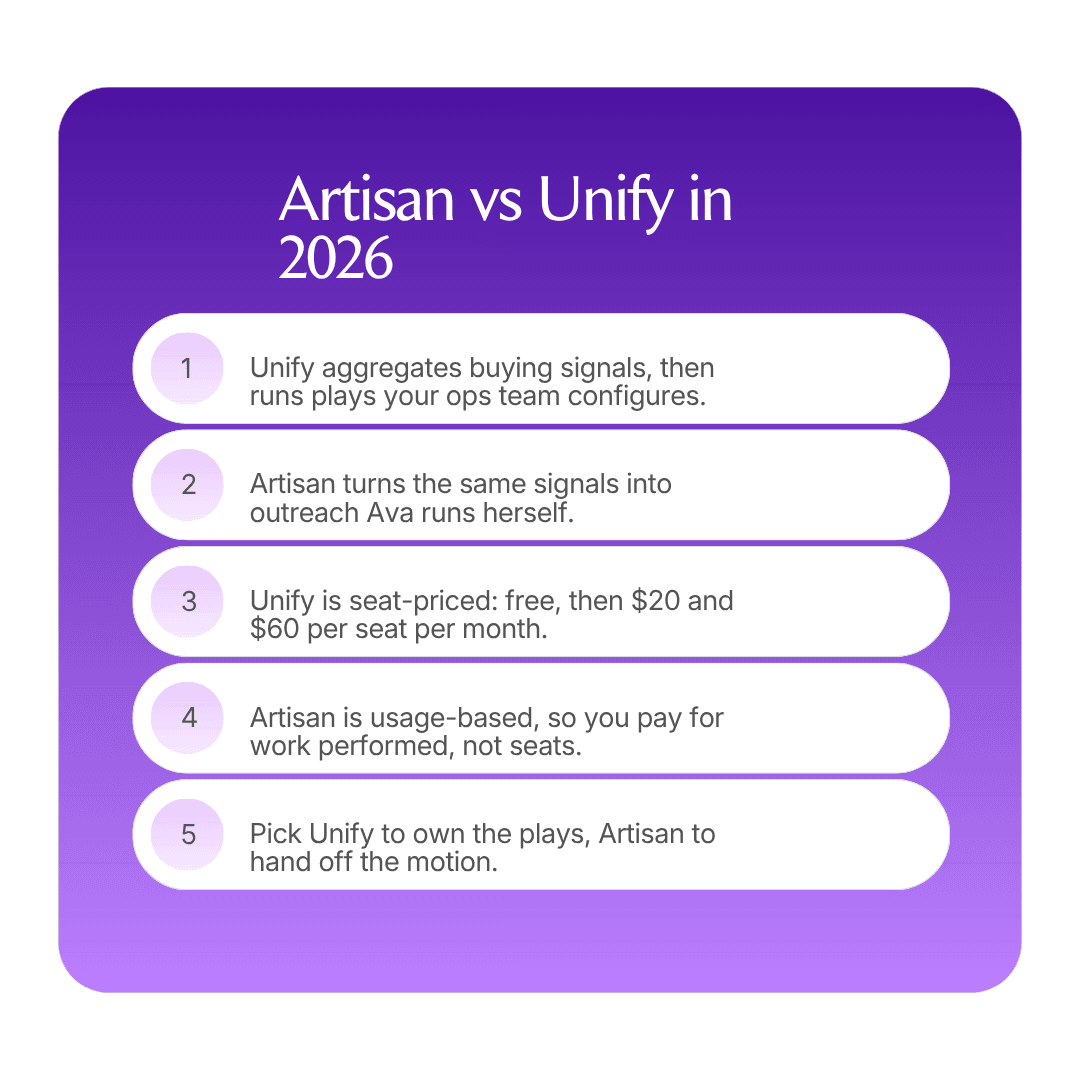
Both Artisan and Unify start from signals: the buying moments that tell you who to reach. Unify is a warm-outbound system of action that aggregates signals and fires automated plays your ops team configures. Artisan turns signals into fully-run outreach: Ava, an AI BDR, catches the trigger and runs the campaign herself. The split is who operates the machine.
Which one fits your situation?
Your situation | Better fit |
|---|---|
You have a RevOps team that enjoys building and tuning signal plays | Unify |
You want signals to trigger fully-run outreach without an operator | Artisan |
You want a low-cost, seat-based entry point to test warm outbound | Unify |
You want data, enrichment, calling, and reply handling in one platform | Artisan |
You're layering signal plays on top of an existing outbound stack | Unify |
You're consolidating a 5-8 tool stack into one AI-run system | Artisan |
You measure success by play sophistication and signal coverage | Unify |
You measure success by booked meetings without added headcount | Artisan |
Prospecting: catching the signal
Unify is strong at the signal layer. It aggregates website visitor data, intent, and buying signals, then feeds them into automated sequences, which is why signal-led teams like it. If your motion is "watch for the right moment, then reach out warm," Unify gives you a clean system to build that on.
Artisan covers the same signal surface and then some, natively. Its signals include funding rounds, recently hired executives, first hire in a department, actively hiring for a role, tech-stack intent, Bombora-powered topic intent, social post keyword tracking, champion job-change tracking, investor portfolio tracking, and website visitor identification. It also supports natural-language custom AI signals: describe any trigger in plain English and Ava scores it with confidence and evidence URLs. The database behind it spans over 250 million B2B professionals across over 200 countries, plus Artisan Local Data with over 250 million local businesses. So the signal and the enriched, ready-to-contact record arrive together.
The difference isn't whether each catches signals. Both do. It's what happens the instant a signal fires.
Activation: does the signal trigger a play or a worker?
Here's the real distinction. When a signal fires in Unify, it triggers an automated play that your ops team designed: the sequence, the copy, the branching logic, the maintenance. Unify runs the play well, but the intelligence is front-loaded into how a human configured it. It's a system of action, and a person is the system's architect and operator.
When a signal fires in Artisan, it triggers Ava. She enriches the lead, writes personalized messaging per contact rather than a shared template, sends across email and social outreach, dials the call steps for a rep to take over, runs dozens of message variations, and shifts volume toward what converts. Two leads that hit the same trigger get two completely different messages. You didn't build the play; the AI runs the motion and adapts it. That's the gap between an ops-configured engine and an AI employee.
It's also the consolidation case. A typical outbound stack runs 5-8 tools at $100K+/year plus the headcount to operate them. Artisan folds the signals, data, enrichment, copywriting, sending, and reply handling into one platform an AI runs.
Booking meetings: who works the reply?
Unify's automated plays send outreach, but the reply handling and booking lean on your team and connected tools. The play gets the message out; a human generally takes it from there.
Ava handles every reply. She qualifies leads, answers objections from a knowledge base you control, chases follow-ups, and books meetings on reps' calendars with CRM-owner routing so the meeting lands with the right rep. Escalation runs on plain-language rules you write, so a person steps in exactly when you want. The signal-to-meeting loop closes inside one system, without a rep watching the inbox, which is what "fully-run outreach" actually means.
Pricing: seats plus credits vs pay for work performed
Unify's pricing has come down and opened up. Its public tiers now start at Free for up to 3 seats, Base at $20/seat/month, and Pro at $60/seat/month, with Business custom, plus usage credits on top. That's an accessible entry point, and the old ~$700/month framing no longer applies. The real cost, as with any ops-configured system, includes the team time to build and tune the plays.
Artisan is usage-based: you pay for work performed rather than per seat, and there is no per-seat platform fee. Calling is built into the platform rather than sold as a separate per-seat dialer. The full model is at https://www.artisan.co/pricing. The comparison to make isn't seat price alone; it's seats-plus-operator-time versus an AI that runs the motion.
Governance and enterprise fit
Both can serve growing teams; Unify has strong signal-led logos and a healthy Series B behind it. Artisan is built for scale on the governance side: SOC 2 Type II, with SSO, SAML, role-based access using built-in and custom roles, and a full audit trail. Large teams commonly run Ava centrally from sales ops for AEs who never log in, and the autonomy dial lets you keep review-and-approve control while the AI does the work. The Enterprise plan adds a forward-deployed strategist and a dedicated CSM.
A customer data point on fully-run outreach. Amelia Lerutte, Chief AI Officer at SaaStr, said: "Email has always been our number one driver. Artisan is now neck-and-neck in both output and closed-won revenue." SaaStr sent 6,892 emails at a 3.6% positive response rate in about six weeks. That's signals and sends running at volume without a team hand-tuning every play.
Choose Unify if
You have a RevOps or growth-engineering function that enjoys designing and iterating on signal-based plays and wants control over each one.
You want a low-cost, seat-based entry point to test warm outbound before committing to a fuller platform.
You're layering signal-triggered sequences on top of an outbound stack you already like, rather than consolidating it.
Your team's edge is the sophistication of your plays, and you'd rather build that yourself than hand it to an AI.
If that's you, Unify is a capable signal-driven system and a fair pick. Artisan wins when you want signals to trigger outreach that an AI actually runs, enrichment through booking, without staffing the operator role.
Frequently asked questions
Is Unify better than Artisan for signal-based outbound?
Unify is a strong signal aggregator and play engine, and if you want to design the plays yourself, it does that well. Artisan covers the same signals, including natural-language custom triggers with confidence scoring, and then runs the outreach itself rather than executing a play your ops team configured. If you want control over each play, Unify; if you want the signal to trigger a worker, Artisan.
How much does Unify cost now?
Unify's public pricing starts at Free for up to 3 seats, Base at $20/seat/month, and Pro at $60/seat/month, with Business custom, plus usage credits. The frequently cited ~$700/month figure is obsolete. Artisan is usage-based: you pay for work performed, not seats. Compare total cost including the team time each model requires to operate.
Does Artisan replace Unify?
For teams whose Unify usage is signal-triggered outbound, generally yes, because Artisan detects the signals, enriches the leads, runs the multichannel outreach, handles replies, and books meetings in one platform. Unify remains a fit for teams that want to build and own their own plays on top of an existing stack. The core difference is ops-configured plays versus an AI that runs the motion.
Can Artisan create custom signals like Unify?
Yes, and it goes further with natural-language custom signals: define any trigger in plain English, and Ava scores it with confidence and evidence URLs, then acts on it automatically. Alongside those, Artisan tracks funding rounds, new executive hires, hiring activity, tech-stack and topic intent, champion job changes, and website visitors. The signal fires and Ava runs the outreach, rather than handing off to a configured play.
Is Unify enterprise-ready?
Unify is a well-funded, capable platform used by notable teams, and it scales for signal-led motions. Artisan carries a broader enterprise governance posture out of the box: SOC 2 Type II, SSO, SAML, role-based access, and a central-ops deployment pattern with a full audit trail. Which matters more depends on whether you need the plays or the governed, AI-run motion.
Which gets to booked meetings faster?
Artisan typically closes the signal-to-meeting loop faster because reply handling and booking are built in and run by Ava, with CRM-owner routing. Unify's plays send outreach effectively, but qualification and booking usually lean on your team downstream. If speed from trigger to meeting without added headcount is the goal, Artisan is the shorter loop.
The bottom line
Unify is a capable warm-outbound system of action, and for teams that want to design their own signal plays at an accessible entry price, it's a reasonable choice. Artisan is for teams that want signals to trigger outreach an AI actually runs: over 250 million B2B professionals across over 200 countries, plus Artisan Local Data with over 250 million local businesses, native and natural-language signals, and an AI BDR who takes it from trigger to booked meeting, as autonomously as you want.
See Ava work on the Artisan homepage, read the AI BDR guide, explore the AI sales agent, or review the pricing model. Comparing enterprise ABM tools? See Artisan vs 6sense.
Jaspar Carmichael-Jack
Co-Founder & CEO @ Artisan
Jaspar is an entrepreneur with expertise in sales, marketing, and operations. He founded Artisan in 2023, a company automating workflows with AI employees.