Automating FMCG distributor management for growth
Learn to improve FMCG distributor management with real-time data and automation. Cut stockouts, optimize inventory, and boost profits.
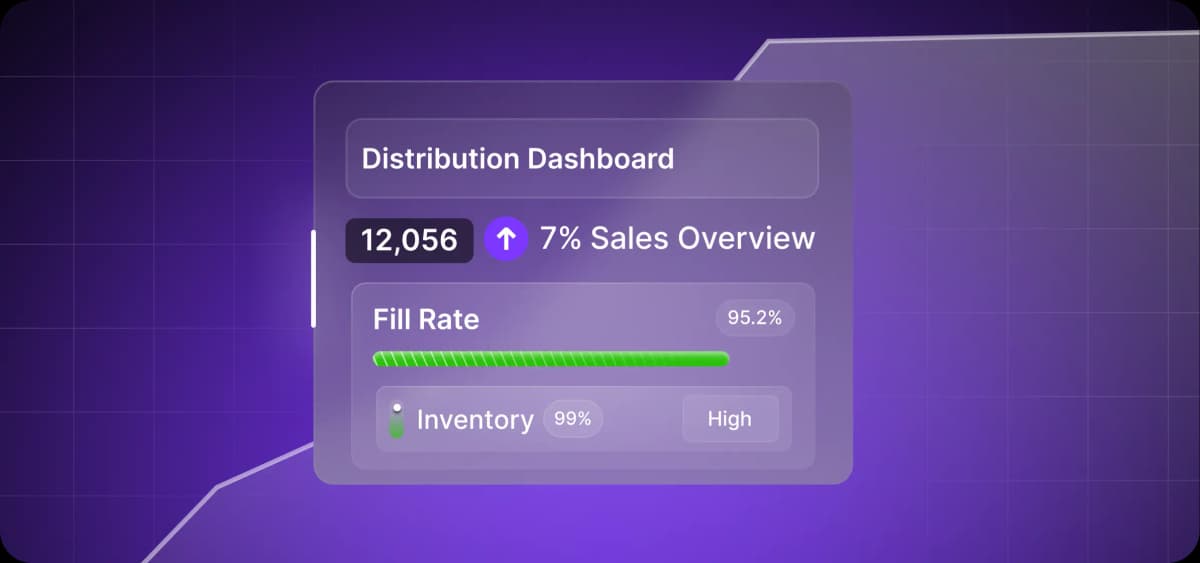
Modern FMCG distributor management workflows are rife with inefficiencies, from incomplete demand data to hazy visibility into distributor performance.
These challenges inevitably hurt revenue and erode trust with retailers.
To overcome them, learn about the three pillars of next-gen FMCG distributor management, key software tools that make up modern tech stacks, and up-to-date best practices.
What Is FMCG Distributor Management?
FMCG distributor management is the strategic process of overseeing and collaborating with distributors. These distributors are responsible for pitching and selling to retailers and transporting your company’s fast-moving consumer goods to the final point of sale.
It’s a key function in FMCG companies that use an indirect sales model. The distributor management team ensures products are available where customers can buy them, whether that’s in an independent store, a restaurant, or a nationwide retail chain.
To drive positive results, distribution managers perform the following tasks:
Find and onboard distribution partners
Negotiate distribution incentives, margins, and rebate programs
Monitor distribution performance metrics like sales volume and market coverage
Create market-adaptive distribution strategies for a competitive advantage
Manage inventory levels across the supply chain
Enable the distributor sales team with technology, training, and support
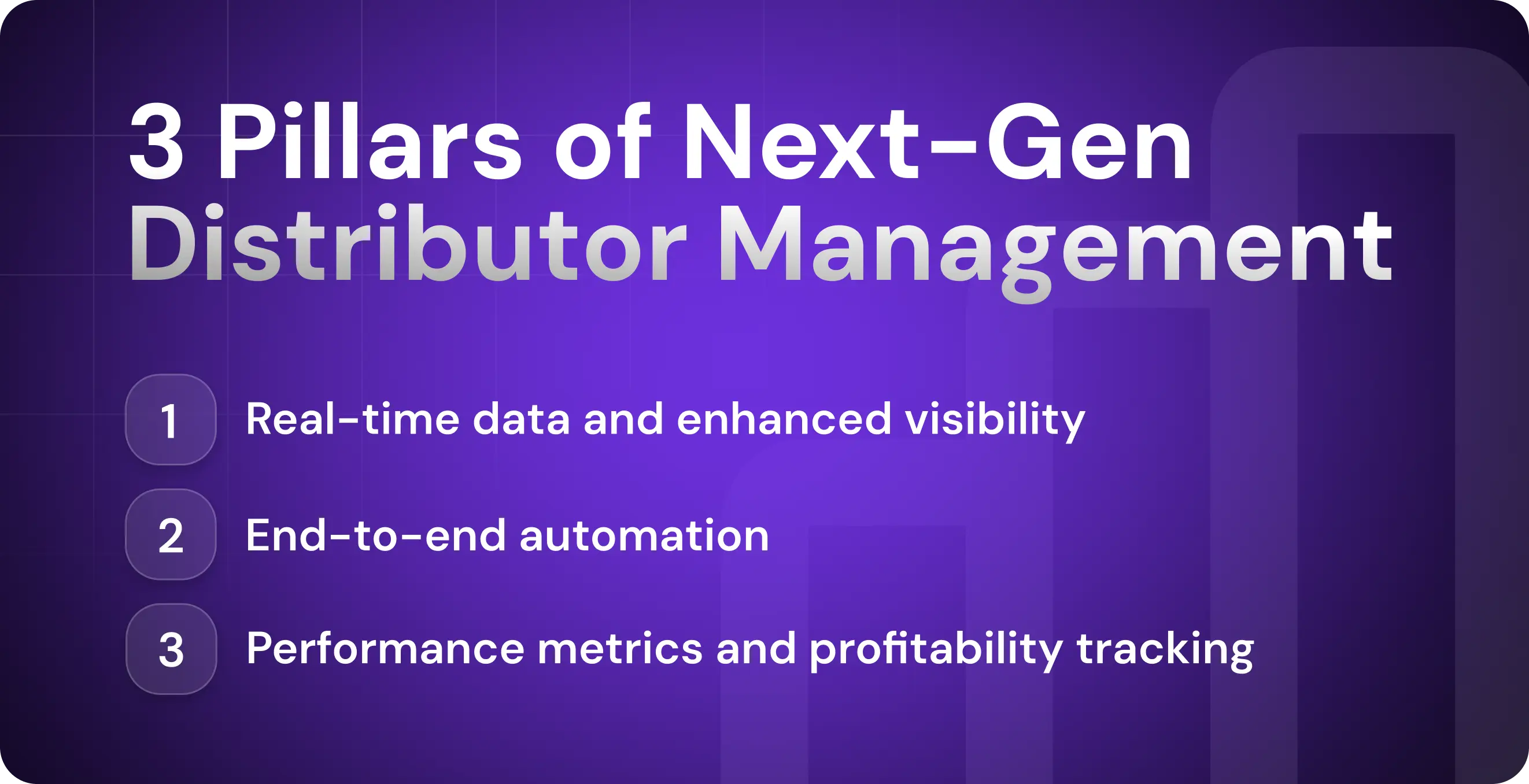
Pillars of Next-Gen Distributor Management
Manufacturing processes, supply chain management, and retail sales have all transformed over the last decade.
In particular, new AI technologies have made it easier than ever to understand and optimize distributor networks. And it’s these technologies that form the basis of a next-gen distributor management strategy.
Real-Time Data and Visibility
To optimize sales volume and inventory management, managers need real-time visibility into their supply chain and the performance of their distributors. The solution comes in the form of a unified distributor management system (DMS).
A DMS platform provides distributor managers with the following capabilities:
Centralized view of distributor performance to monitor and analyze fulfillment rates, order accuracy, and on-time delivery scores in one place.
Secondary sales tracking for understanding how sales flow from distributor to point of sale by monitoring inactive SKUs, penetration insights, and other critical data points.
Custom dashboards to monitor inventory levels, pricing schemes, and every other moving part of the distribution process.
AI forecasting and real-time inventory tracking to help avoid stockouts and overstocking.
Order management to receive and review orders from distributors directly in a centralized system.
End-to-End Automation
Smart, end-to-end automation—of invoicing, claims, orders, and pricing schemes—is how you create a highly efficient distributor management process.
AI and automation tools can handle all of the following tasks:
Compose and deliver outreach messages to distributors about reordering or to pitch new products
Trigger alerts when distributor inventory dips below predefined thresholds
Use predictive forecasting to factor in seasonality and demand when setting pricing
Auto-adjust credit limits based on distributor payment punctuality and order velocity
Track top-performing distributors from an integrated analytics dashboard, rewarding as appropriate
Route exception cases—like overdue payments or pricing conflicts—to managers for review
AI sales platforms like Artisan could also scale your salesforce with AI BDRs, who can identify and research target customers and then send them personalized messages across email and social media.

Performance Metrics and Profitability
Distributor managers need to identify distributor performance metrics that connect to profit and then work to ruthlessly track and improve them.
The core KPIs in distributor management are:
Fill rate: Percentage of ordered items successfully delivered. This impacts retailer satisfaction and their ability to take advantage of rises in customer demand.
Forecast accuracy: A measure of the distance between your demand predictions and actual orders. Low accuracy can lead to stockouts or overstocking.
Cash conversion cycle: The number of days it takes a company to turn its inventory into cash flows from sales. Short cycles indicate better cash flow.
Trade-promo ROI: Revenue generated per dollar spent on distributor schemes and promotions. This helps you identify the marketing investments that actually drive sales volume.
Inventory turnover ratio: The frequency that distributors sell through stock over a monthly, quarterly, and annual period. Tracking it helps you plan production and replenishment, anticipate demand, and avoid stockouts.
Perfect order rate: The percentage of orders delivered on time, undamaged, and complete. This impacts retailer loyalty.
Tactical Playbook for FMCG Leaders
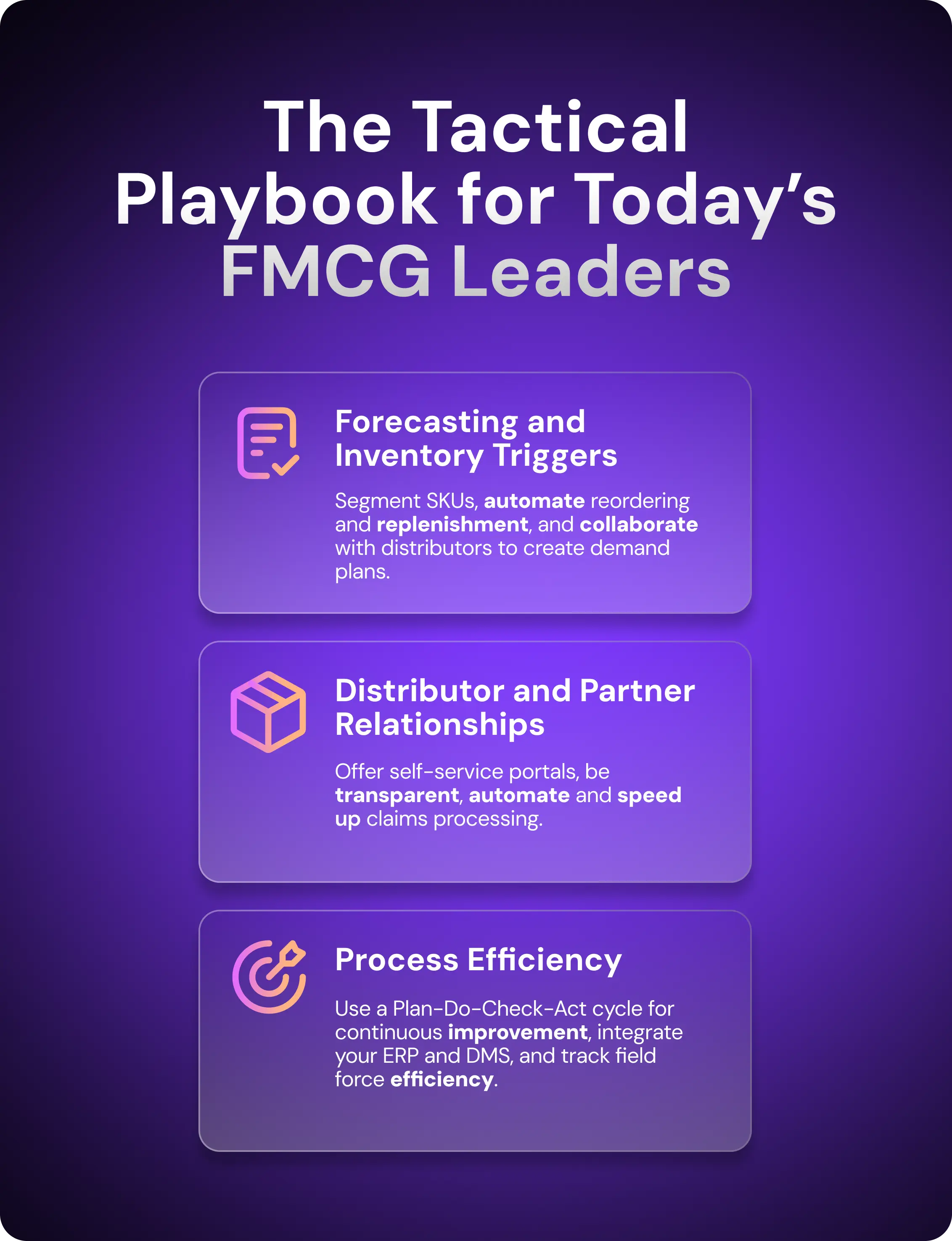
A proven template helps you improve forecasting, optimize distributor and retailer relationships, and ensure process efficiency.
Forecasting and Inventory Best Practices
Distributor management best practices focus on segmenting SKUs, automating reordering, and tapping into your distributors’ local market intelligence.
Here are the three most impactful inventory and forecasting best practices:
Segment SKUs by margin and velocity: Divide your SKUs into categories by margin and velocity. This helps you prioritize and optimize inventory management. For example, Cat A items might be your high-velocity, high-margin products, for which you monitor stock levels closely. Cat C, on the other hand, might be your slow-velocity, low-margin items, which you stock minimally.
Automate reorder points and replenishment: Set dynamic reorder points based on consumption patterns and minimum stock requirements (aka safety stock) for each of your SKU and distributor combinations. Set automations to trigger replenishment orders when inventory hits that reorder point.
Collaborate with distributors on demand plans: Your distributors know their market and have insights into demand and retail trends that are likely hidden from you. Hold monthly demand planning sessions with distributors. Ask them to share upcoming local events, retailer feedback, and other insights that will help you predict demand.
Distributor and Retailer Partnerships
Distributor management involves maintaining open, cooperative relationships with those you depend on to get your product into the hands of your customers.
Here are the best ways to build trust and alignment with distribution and retail partners:
Offer self-service portals and mobile apps for distributors: Empower distributors to place orders, track shipments, check scheme eligibility, monitor credit limits, and perform other tasks on the go and without reaching out to your team (which is likely busy).
Create transparent schemes: Be upfront and clear about scheme eligibility criteria and payout timelines. This is how you build trust with distributors and reduce the likelihood of them gaming your scheme.
Automate the claims process: Manually searching for invoices and validating deductions is enough to drive even the most caffeinated manager insane. Automate this process by enabling distributors to submit claims with photo evidence through a portal, which AI can then validate and flag or approve.
Maintain high product availability: Retailers want to work with FMCG brands they can rely on to fill their stores and make their customers happy. If your distributors can maintain a 95% fill rate, retailers will often give you benefits, such as prime shelf space and increased orders.
Process Efficiency and Continuous Improvement
An efficient distributor management process is essential if you’re looking to scale your operation. Without a strong foundation of systems and automations designed to handle growth, chaos quickly enters the picture.
Here are the best ways to streamline your distributor management processes:
Use a Plan–Do–Check–Act (PDCA) framework: This is a four-step cycle for continuous improvement. First, make a plan to solve a problem. Second, implement it on a small scale—as a test. Third, analyze the results to see if it worked. Fourth, implement it on a large scale if it works. If it didn’t, back to the drawing board. Apply PDCA to initiatives in order fulfillment, scheme payouts, distribution, and delivery scheduling.
to consistently improve distributor operations. It ensures your team is constantly finding bottlenecks and solutions. Apply PDCA to each relevant distributor management workflow, including order fulfillment, scheme payout, and delivery scheduling.
Integrate your ERP and DMS: Connect your ERP and DMS systems to ensure smooth data flow, avoid human errors, and eliminate duplicate entries, which are huge time-wasters. This integration will allow your DMS to become a single source of truth, ensuring all strategists have access to the same, accurate data.
Optimize sales routes: Leverage route optimization software to reach more distributors with a smaller fleet. This cuts delivery costs and ensures your distributors receive their orders quickly (so they can get your products to the retailers in time).
Track field-force efficiency: Monitor delivery and sales team efficiency metrics like distributor visit frequency, order conversion rates, and route adherence to spot performance gaps, coaching opportunities, and mistakes like having too much distributor overlap in one region.
Tools of the Trade: DMS and AI Solutions
The complexity of the AI tech market can leave FMCG leaders wondering, “Which tools do I really need to run a modernized, digital distributor management process?” Fortunately, your tech stack doesn’t need to be excessively complex to give you access to the latest AI functionality.
A DMS with added AI functionality should sit at the core of your tech stack:
Distributor management system (DMS): Modern DMS systems should include offline mode, ERP integrations, and automation features for order management, distributor performance tracking, and reporting.
AI-powered add-ons: AI features like forecasting modules, route optimization, and automatic nudges enable you to automate many aspects of distributor management, giving your team more time back in their day for work that requires human ingenuity.
Without a technology-forward approach, FMCG teams risk drowning in spreadsheets, missing key insights, and scaling inefficiently—hiring for positions doing tasks that could’ve been automated with the right AI business tools.
This also applies to finding new distribution partners. Artisan is an end-to-end sales automation tool powered by an AI BDR called Ava. Ava sends personalized outreach to potential distributors and retailers autonomously, allowing companies to scale operations without hiring new reps.
Measuring Success and ROI
What you don't track, you can’t change. This is especially relevant to distributor management, where the overarching goal is to continuously improve operational efficiency and drive sales growth.
Distributor managers should measure the following KPI categories:
Operational efficiency: Perfect order rate, fill rate, order-to-cash cycle time, inventory turnover ratio, and claims processing time.
Market coverage: SKU penetration per distributor, outlet coverage density, geographic coverage gaps, and weighted distribution.
Financial health of distributors: Days sales outstanding (DSO), distributor margin health, and credit utilization rate.
Sales Growth: Secondary sales velocity, annual sales volume growth per distributor, trade-promo ROI, and average order value.
Consistently tracking these metrics helps you determine if your initiatives are working. They are signs you’re moving in the right, or wrong, direction.
Stop Babysitting Spreadsheets and Let Automation Drive
Automation is how you build a scalable operation without major increases in overhead. DMS platforms, integrated with AI tools, can handle many standard admin tasks for your team, from order tracking to distributor follow-up.
Modern tools can even help you reach new distributors and retailers. Artisan is a next-gen AI automation platform that finds new leads, sends cold outreach, and schedules meetings—just like a human would.

Automate your outbound with an AI BDR
Meet Ava—your AI BDR who handles prospecting, outreach, and follow-ups, so your team can focus on closing.

Sam Rinko
SME @ Artisan
Sam Rinko is a former SaaS sales rep turned tech writer. He sold real estate software before writing about lead generation, cold calling, and AI sales tools.