The best Unify alternatives in 2026
Unify aggregates warm-outbound signals but still needs ops to configure. Here are the best Unify alternatives in 2026, ranked, with honest verdicts.
The best Unify alternative for most teams is Artisan, because it turns buying signals into fully-run outreach automatically rather than into a play someone still has to build. Unify is a good warm-outbound system: it aggregates signals and fires automated plays off them. The gap is that the plays are still configured and maintained by an ops person.
That is the pattern people go looking to escape. Unify tells you an account is warm and can trigger a sequence, but a human designed the sequence, set the thresholds, and keeps the logic current. If you want the signal to trigger outreach that a competent AI actually writes, sends, and follows up on, the alternatives below approach that from different angles.
The best Unify alternatives at a glance
Rank | Tool | Best for | Standout capability | Public pricing |
|---|---|---|---|---|
1 | Artisan | Signals that trigger AI-run outreach automatically | AI BDR that acts on signals end to end | Usage-based credits, no platform fee (pricing) |
2 | Clay | Custom enrichment and signal tables | Over 150 providers, Claygent agents | $167-446/mo public tiers |
3 | Common Room | Person-level buyer intelligence | Deep signal capture across channels | ~$2,500/mo entry (reported) |
4 | Apollo | Value all-in-one data and sequencing | Large contact database with outreach attached | Free to ~$119/user/mo |
5 | Amplemarket | Signal-based selling with a copilot | Data plus the Duo copilot | ~$600/mo entry, higher tiers quoted |
How we chose
We weighted the criteria that matter to a warm-outbound buyer. First, how much of the loop the tool closes on its own versus how much you configure, since Unify's whole value and its main limit both live here. Second, signal depth and breadth: what triggers the tool can actually see. Third, pricing transparency, given Unify sits at the higher end of mid-market. Fourth, deployment fit across a lean growth team and a large enterprise ops function.
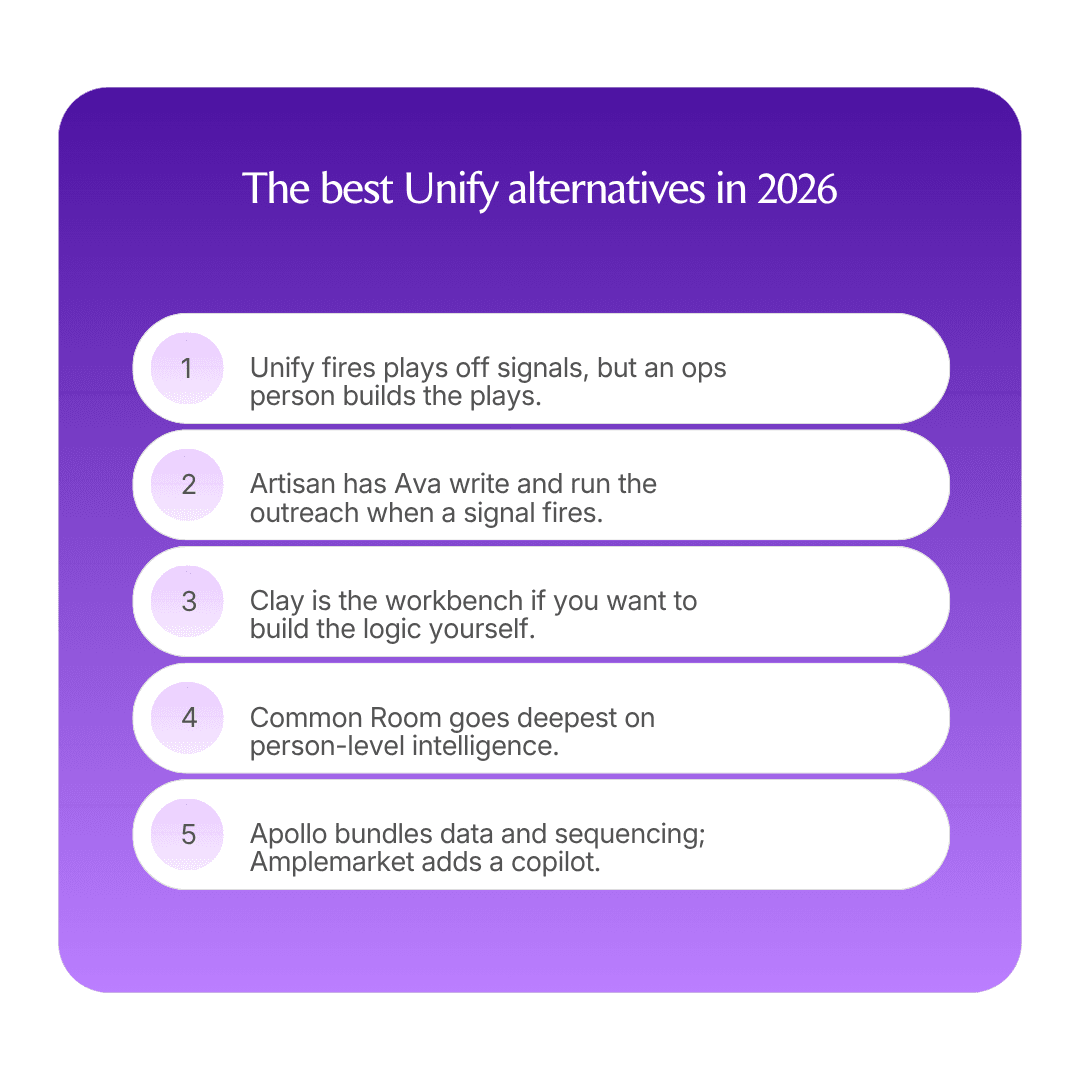
Why do people look for a Unify alternative?
They look because Unify automates the play but not the person who builds it. Unify does real, useful work. It pulls together buying signals, website visits, intent data, and account activity into one place, then lets you trigger automated plays when an account heats up. For teams with a strong ops function it is a legitimate system of action, and the $40M Series B reflects real traction.
The friction shows up in ownership. Someone has to design each play, decide which signal at which threshold justifies which motion, write the templates, and revisit all of it as the market shifts. Unify fires the trigger; a human still supplies the judgment and the maintenance. When that person is busy or leaves, the plays go stale. So teams that expected "signals in, meetings out" often find they bought a powerful engine that still needs a driver. The alternatives below either give you a different kind of engine or, in Artisan's case, an AI that supplies the judgment the play used to require.
The 5 best Unify alternatives in 2026
1. Artisan: signals that trigger fully-run outreach
Artisan is the alternative for teams that want a warm signal to become booked pipeline without anyone building the play. Ava, Artisan's AI BDR, watches the same signal territory Unify covers, funding rounds, recently hired executives, first hire in a department, actively hiring for a role, tech-stack intent, Bombora-powered topic intent, champion job changes, and website visitor identification, and acts on it directly. You can also define a custom trigger in plain English and let Ava score it with confidence ratings and evidence URLs.
The difference is what happens after the trigger. Unify launches a play a human wrote. Ava writes the outreach herself, personalized per lead, across email and social, and dials the call steps for reps, who handle the live conversation. She tests dozens of variations, handles the replies from a knowledge base, and books the meeting on the right rep's calendar. Two people hit by the same signal receive two completely different messages, not the same template with the name swapped. The autonomy is a dial: review and approve, objections-only, or fully autonomous with plain-language escalation rules and a full audit trail.
For larger orgs, Ava runs centrally from sales ops with SOC 2 Type II attestation, SSO and SAML on the Enterprise plan, and website visitor identification at the person level on US traffic feeding straight into campaigns. SumUp used Ava to reach previously unreachable local SMBs at a $52 cost per lead, generating 8 to 15 positive replies a week from segments its team could not work by hand.
Best for: teams from startup to enterprise that want signals to trigger outreach the AI runs, not plays they maintain. Who should pick something else: teams that specifically want to build and own custom play logic in-house, and have the ops staff to do it, may prefer a configurable system. Pricing: usage-based credits, pay for work performed rather than seats, no platform fee, free trial. See pricing.
2. Clay: the enrichment and custom-signal workbench
If your interest in Unify is really about building your own signal and enrichment logic, Clay is the more powerful workbench. It orchestrates over 150 enrichment providers, runs research through Claygent agents, and lets you assemble custom signal tables that no packaged tool ships out of the box. Its $3.1B valuation as of August 2025 reflects how good it is at this.
The trade-off is the same one Unify has, magnified. Clay is infrastructure you operate, usually with a GTM engineer, and it does not send the outreach at all. It produces enriched, signal-scored rows and stops there. Clay gives you the workbench; Artisan gives you the worker.
Best for: teams with technical operators who want to build custom signal and enrichment workflows. Who should pick something else: teams without a dedicated operator, or teams that want the outreach executed, should look at Artisan. Pricing: $167 to $446 a month on public tiers (Enterprise custom); median contracts around $30K a year.
3. Common Room: deep person-level intelligence
Common Room goes deeper than Unify on person-level buyer intelligence, stitching signals across community, product, and web activity into a rich view of who is showing intent. For teams whose motion depends on catching individual champions and users as they engage, it is a serious alternative, with entry around $2,500 a month.
One thing to weigh: Zoom announced an acquisition of Common Room on July 2, 2026, per the companies' announcement, so the standalone roadmap carries the usual post-acquisition questions. And like Unify, Common Room is intelligence and orchestration; the outreach judgment still comes from your team.
Best for: teams that want the deepest person-level signal capture across many channels. Who should pick something else: teams wary of the pending Zoom acquisition, or teams that want the outreach run for them, should consider Artisan. Pricing: reported around $2,500/month entry.
4. Apollo: value all-in-one
Apollo is the pragmatic alternative if you want data, basic signals, and sequencing bundled cheaply rather than a dedicated signal system. It pairs a large contact database with sequencing and is used by hundreds of thousands of companies, acquired Pocus in March 2026 for product and buyer signals, and reportedly crossed $200M in ARR. For a mid-market team, it covers a lot of ground for the price.
Its signal and AI features are broader and shallower than Unify's, and its automation is assistive rather than autonomous. Enterprises tend to use Apollo as a data layer under richer tools rather than as their system of action.
Best for: budget-conscious teams that want data and sequencing with light signals in one place. Who should pick something else: teams that need deep, orchestrated signal plays (Unify, Common Room) or executed outreach (Artisan) will outgrow Apollo's automation. Pricing: free tier up to roughly $119/user/month, per its pricing page.
5. Amplemarket: signals plus a copilot
Amplemarket bundles a contact database, engagement, and the Duo copilot, with a clear lean into signal-based selling. It is a solid all-rounder that packages much of Unify's intent into one subscription, which appeals to teams tired of stitching point tools together.
The constraint is the copilot model. Duo suggests and assists; a human still runs the motion, approving sends and working replies. It is helpful augmentation, not autonomy, so it does not close the signal-to-send loop the way an AI BDR does. Entry is around $600 a month, with higher tiers quoted.
Best for: mid-market teams wanting signals, data, and engagement with AI assistance in one tool. Who should pick something else: teams that want the work performed rather than suggested should choose Artisan. Pricing: around $600/month entry, higher tiers quoted.
What is the best enterprise alternative to Unify?
For enterprises, Artisan is the strongest alternative because it removes the ops dependency that scales badly. A Unify deployment concentrates play logic in a small ops team; the more signals and segments you add, the more plays someone must build and maintain. Artisan runs centrally from sales ops for large AE teams who never log in, with SOC 2 Type II attestation, role-based access, an audit trail, and person-level website visitor identification on US traffic feeding qualified leads straight into campaigns. Named-account lists, signals, and visitor ID come together as native enterprise ABM with the outreach built in, not bolted on.
Common Room is the alternative if the requirement is purely the deepest person-level intelligence and your team is comfortable running outreach separately, with the caveat about its pending Zoom acquisition.
Stay with Unify if...
Stay with Unify if building and owning custom warm-outbound plays is exactly what you want to do, and you have the ops muscle to do it well. If you have a RevOps team that enjoys designing signal thresholds, wiring plays, and tuning the logic as the market moves, Unify is a capable system of action and the $40M Series B says the model has room to run. Its signal aggregation is real, and for a team that treats play design as a competitive advantage rather than a chore, that control is the feature.
If the honest truth is that the plays keep going stale because nobody has time to maintain them, an AI sales agent that supplies the judgment and runs the outreach is the better fit. For the wider category map, see our guide to the best AI GTM platforms.
Frequently asked questions
What is the best alternative to Unify?
For most teams it is Artisan, because it acts on the same warm signals Unify aggregates, funding, new hires, intent, visitor identification, but fires outreach the AI actually writes, sends, and follows up on. Unify automates the trigger; a human still builds and maintains the play. Artisan supplies that judgment itself and closes the loop through to a booked meeting.
How is Artisan different from Unify?
Unify is a system of action you configure: it aggregates signals and launches plays your ops team designs. Artisan is a sales orchestration platform whose AI BDR, Ava, owns the workflow. When a signal fires, Ava writes personalized multichannel outreach, tests variations, handles replies from a knowledge base, and books meetings, with an autonomy dial from review-and-approve to fully autonomous.
Does Artisan cover the same signals as Unify?
Yes, and then some. Artisan tracks funding rounds, recently hired executives, first hires in a department, hiring for specific roles, tech-stack and topic intent, champion job changes, investor portfolios, and website visitors. You can also define any custom trigger in plain English, with confidence scoring and evidence URLs. The difference is that each signal can launch fully-run outreach automatically rather than a play someone maintains.
Is Unify enterprise-ready?
Unify serves mid-market and up, with a free tier for up to 3 seats and paid plans at $20/seat/month (Base) and $60/seat/month (Pro) plus credits, and its signal aggregation is legitimately strong. The enterprise limitation is operational: scaling it means scaling the ops team that builds and maintains plays. For large orgs that want central deployment without that dependency, Artisan runs from sales ops with SOC 2 Type II attestation, SSO, SAML, and role-based access.
What about Common Room versus Unify?
Common Room goes deeper on person-level intelligence, capturing signals across community, product, and web activity, with entry around $2,500 a month. Unify leans more toward packaged plays off aggregated signals. Both leave outreach judgment to your team. Note that Zoom announced an acquisition of Common Room on July 2, 2026, so weigh its standalone roadmap accordingly.
Can one tool replace both Unify and my sequencer?
That is exactly Artisan's pitch. Instead of a signal system feeding a separate sequencer that a rep operates, Ava watches the signals and runs the multichannel outreach herself, then hands qualified meetings to reps. Teams typically consolidate a five-to-eight tool stack this way, replacing signal aggregation, enrichment, sequencing, and reply handling with one platform where the AI runs the motion.
Ready to let the signal trigger the send? Start with Artisan or see how an AI BDR acts on buying signals end to end.
Jaspar Carmichael-Jack
Co-Founder & CEO @ Artisan
Jaspar is an entrepreneur with expertise in sales, marketing, and operations. He founded Artisan in 2023, a company automating workflows with AI employees.