Artisan vs Common Room: which fits your team?
An honest 2026 comparison of Artisan and Common Room, from buyer signals to fully-run outreach and booked meetings.
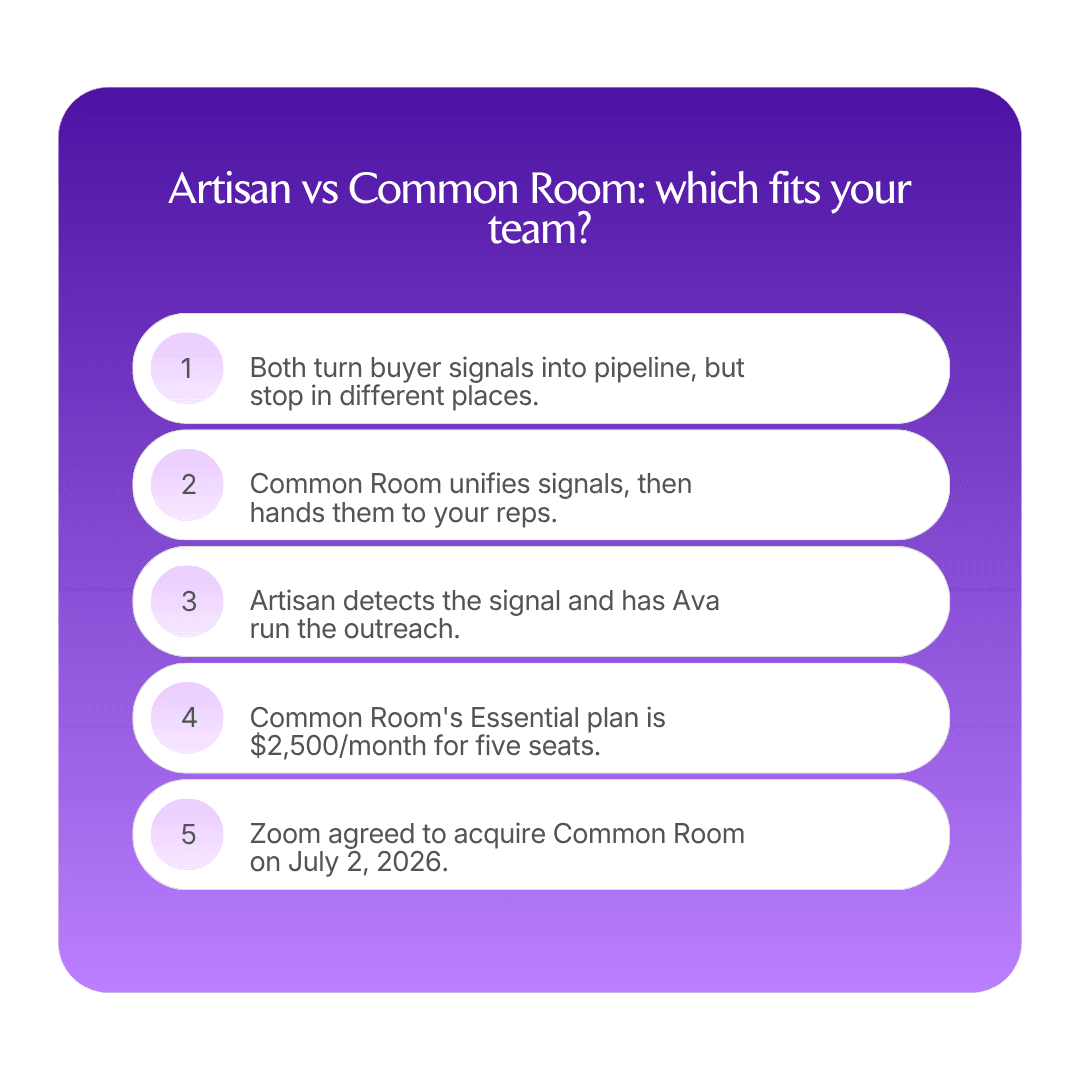
Artisan and Common Room both turn buyer signals into pipeline, but they stop in different places. Common Room unifies signals into buyer intelligence, then hands them to your team to act on. Artisan detects the same signals and has Ava run the outreach automatically. Common Room fits teams that already have reps to activate the intelligence.
Common Room built a strong signal-aggregation engine. It pulls buyer intent from across your data and reveals who is worth reaching. The gap is activation: intelligence still needs a human to write and send the outreach. Artisan closes that loop, firing the outreach the moment a signal lands. This comparison walks the journey from signal to booked meeting and stays fair to what Common Room does well.
How the two compare
Rather than an all-checkmark grid, here is the situation-to-fit map. Find the row that sounds like you.
Your situation | Better fit | Why |
|---|---|---|
You want signals to trigger outreach automatically | Artisan | Ava runs the sequence the moment a signal fires |
You want a deep intelligence layer and have reps to act on it | Common Room | Strong signal unification, human activation |
You want the AI to handle replies and book the meeting | Artisan | Reply handling and CRM-owner booking built in |
You want to unify community, product, and CRM signals in one view | Common Room | Signal aggregation is its core strength |
You want signal detection and outbound on one platform | Artisan | One system, no separate activation tool |
You want to avoid a post-acquisition roadmap unknown | Artisan | Independent product, no pending acquisition |
Who detects the signals?
This is Common Room's strength, and it is a real one. Common Room unifies buyer signals across sources into person-level intelligence, connecting activity from product usage, community, and CRM into a picture of who is showing intent. For teams that want a single pane of glass over scattered signals, it is one of the best at that specific job.
Artisan detects signals natively too, across a broad set: funding rounds, recently hired executives, first hire in a department, actively hiring for a role, tech-stack intent, Bombora-powered topic intent (Artisan resells the same co-op many tools do, and says so plainly), social post keyword tracking, champion job-change tracking, investor portfolio tracking, and website visitor identification. The one that closes the gap with a dedicated intelligence tool is custom AI signals: you define any trigger in plain English, and Artisan scores it with confidence levels and evidence URLs. So if there is a buying trigger specific to your motion, you describe it and Artisan watches for it.
On detection, Common Room and Artisan are both strong, with Common Room leaning further into deep signal unification and Artisan pairing broad native signals with plain-language custom triggers. The separation, as with the visitor-ID tools, is what happens next.
Who acts on the signal?
Here is the difference that decides most purchases. Common Room reveals the signal and the person, then activation is your team's job or a connected tool's. Someone has to decide the play, write the message, send it, and follow up. That is the nature of an intelligence layer: it makes reps smarter, but reps still do the work.
Artisan acts on the signal itself. When a signal fires, the matching contact flows into a campaign and Ava runs personalized multichannel outreach across email, social, and dialer steps, handles the replies, answers objections from a knowledge base, and books meetings with CRM-owner routing. You set the autonomy: review and approve, objections-only, or full autonomy, with plain-language escalation rules and a full audit trail. So a funding round or a champion changing jobs does not become a task in someone's queue; it becomes outreach that goes out while the signal is still fresh.
That is the Artisan angle here: signals that trigger fully-run outreach, not signals that need a human to activate them. It is also the honest failure mode of signal tools generally. Everyone emails a company the week it raises funding; a tool that fires a differentiated, personalized message automatically the moment the signal lands beats a dashboard that waits for a rep to notice.
Pricing transparency, and what the acquisition means
Common Room publishes an entry price, which helps buyers: Essential starts at $2,500/month billed annually for five seats, with Advanced and Enterprise custom. Treat the figure as its published starting point; the higher tiers are quote-only.
Artisan uses usage-based credits across the platform. You pay for the work performed, not for seats, and Ava can be trialled for free. Because Artisan runs the outreach as well as the detection, you are not buying a separate activation tool or sequencer alongside it. Full pricing is at artisan.co/pricing.
There is also the acquisition. Zoom agreed to acquire Common Room on July 2, 2026. The deal was announced, not yet closed, and it belongs in any fair comparison. For some buyers, a larger parent is reassuring. For others, an intelligence product moving under a communications company raises reasonable questions about roadmap, pricing, and focus. If you are evaluating Common Room now, ask how the Zoom transition affects the product you would be buying.
Choose Common Room if...
There are real scenarios where Common Room is the sensible pick:
You want the deepest signal-unification layer and have reps or a connected stack ready to activate the intelligence.
Your priority is a single view of community, product, and CRM signals, and outreach lives elsewhere.
You want person-level buyer intelligence as an input to plays you design and run yourself.
You are comfortable with the pending Zoom acquisition and have confirmed how it affects your roadmap.
If those describe you, Common Room is worth a serious look. Go in clear that activation is your team's job, and factor in the rep time that turns intelligence into sent outreach.
Choose Artisan if...
Artisan is the stronger default for most teams:
You want signals to trigger outreach automatically, so a fresh funding round or job change becomes sent messages, not a task in a queue.
You want the AI to handle replies and book the meeting, not just tell you who to contact.
You want broad native signals plus custom triggers you can define in plain English, with confidence scores and evidence.
You want signal detection and outbound on one platform and one lead timeline.
You run outbound centrally and need owner mapping, escalation rules, an audit trail, and SOC 2 Type II compliance, without a pending acquisition changing the roadmap.
Artisan's customers describe the outcome in numbers. Raise sourced over $700K of ARR in six months with Ava, a 20x return. Signals only pay off when something acts on them fast, and that is what Artisan is built to do.
See how Ava works as your AI sales agent, read the deeper method in signal-based selling: the complete guide to intent signals, or weigh the field in the best buyer intent data and sales signal tools.
Frequently asked questions
Is Common Room better than Artisan for buyer intelligence?
For deep signal unification, pulling product, community, and CRM activity into a single person-level view, Common Room is one of the best at that specific job. Artisan detects a broad set of signals natively and adds custom triggers you define in plain English, but its edge is activation: it runs the outreach on the signal automatically. If you want the richest intelligence layer and will activate it yourself, Common Room; if you want signals that fire outreach without a rep, Artisan.
What does Artisan do that Common Room does not?
Artisan acts on the signal. When a trigger fires, Ava runs personalized multichannel outreach, handles replies, and books meetings with CRM-owner routing, at whatever autonomy level you set. Common Room reveals the signal and the person, then relies on your reps or a connected tool to activate it. Artisan also runs on one platform, so detection and outbound share a lead timeline.
What does the Zoom acquisition mean for Common Room?
Zoom agreed to acquire Common Room on July 2, 2026. The deal was announced, not closed, so the product continues for now, but acquisitions commonly reshape roadmap, pricing, and focus. If you are evaluating Common Room, ask how the Zoom transition affects the product and terms you would be buying, and weigh that against tools without a pending ownership change.
How much do Artisan and Common Room cost?
Common Room's Essential plan starts at $2,500/month billed annually for five seats, with Advanced and Enterprise custom. Artisan uses usage-based credits, so you pay for the work performed rather than per seat, and because it runs the outreach too, you are not buying a separate activation tool alongside it. See artisan.co/pricing.
Can Artisan detect custom signals specific to my business?
Yes. Alongside native signals like funding rounds, new executive hires, hiring activity, tech-stack and topic intent, champion job changes, and visitor identification, Artisan lets you define any buying trigger in plain English. It scores each match with a confidence level and evidence URLs, so a signal specific to your motion becomes something Artisan watches for and acts on automatically.
Does Artisan handle replies and booking after the signal fires?
Yes. Once a signal triggers a campaign, Ava runs the outreach, qualifies and answers replies from a knowledge base, chases follow-ups, and books meetings on the right rep's calendar with CRM-owner routing. You control the autonomy level with plain-language escalation rules and a full audit trail.
Jaspar Carmichael-Jack
Co-Founder & CEO @ Artisan
Jaspar is an entrepreneur with expertise in sales, marketing, and operations. He founded Artisan in 2023, a company automating workflows with AI employees.