The best ZoomInfo WebSights alternatives in 2026
WebSights is company-level visitor ID bundled into an expensive ZoomInfo contract. The best alternatives do more of the job for less, compared honestly.
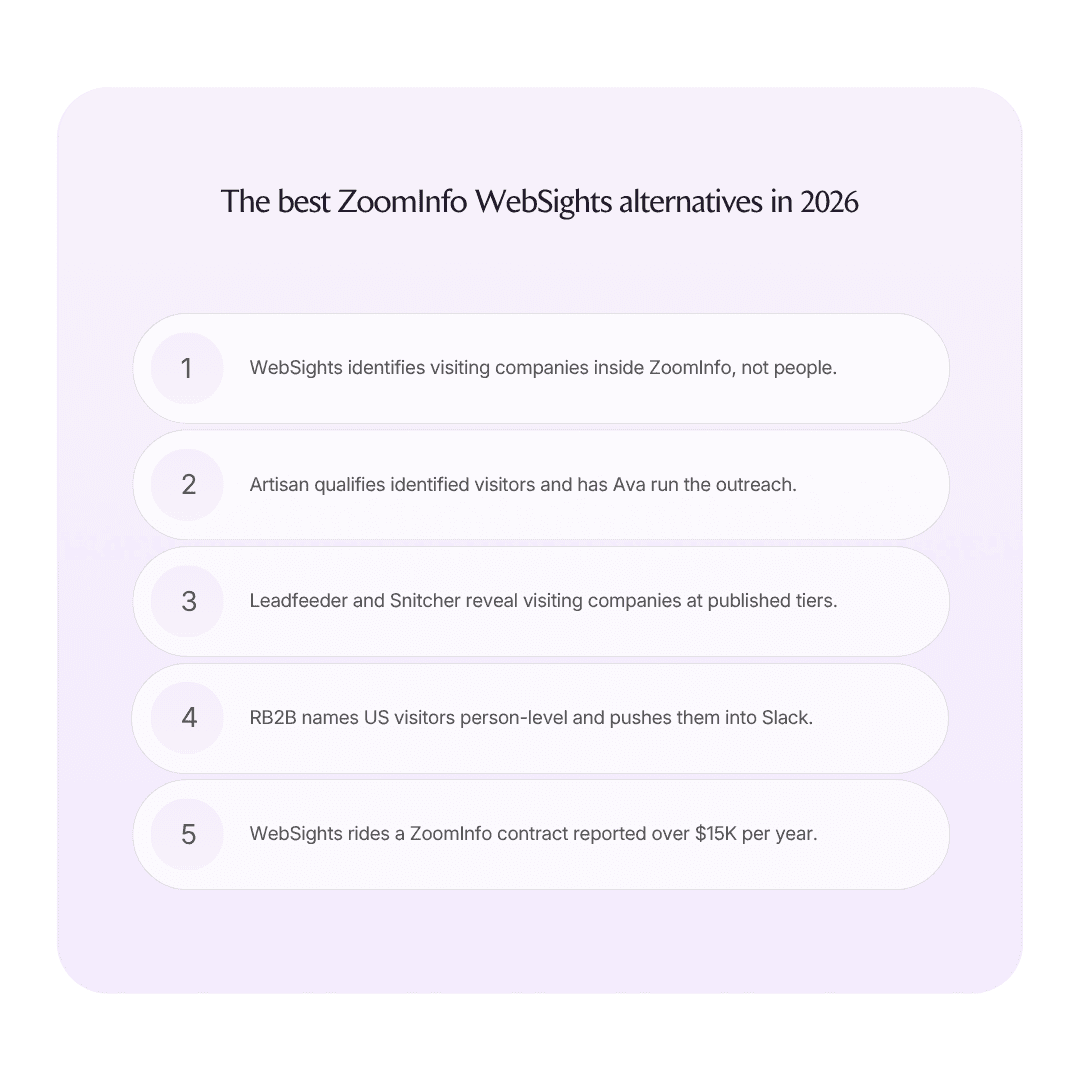
The best ZoomInfo WebSights alternative is Artisan. WebSights identifies visiting companies inside ZoomInfo, but it is company-level only, execution is an add-on, and it rides a gated enterprise contract that ZoomInfo does not price publicly. Artisan identifies visitors, qualifies them against your ideal customer profile (ICP), and has Ava, its AI business development representative (BDR), run the outreach. Leadfeeder, Snitcher, and RB2B fit narrower needs.
How the ZoomInfo WebSights alternatives compare
Rank | Tool | Best for | Standout capability | Public pricing |
|---|---|---|---|---|
1 | Artisan | Turning identified visitors into booked meetings automatically | Company and person-level ID plus outreach in one platform | Usage-based |
2 | Leadfeeder (Dealfront) | EU-first company identification at scale | European coverage plus Dealfront's wider data | Free tier, then EUR 79 to 599/mo |
3 | Snitcher | GA4-connected company identification | Reveal tied to web analytics workflows | $49 to $529/mo |
4 | Albacross | Demand-gen teams feeding ad audiences | EU company ID with LinkedIn Ads integration | EUR 59 to 149/mo, annual |
5 | RB2B | US person-level names pushed to Slack | Person-level reveal in real time | Free tier, then $79 to $199/mo |
6 | Warmly | Small teams wanting live session orchestration | Real-time reveal with signal-based plays | $10K to $30K/yr |
7 | Factors | Company ID tied to account analytics | Account journey and attribution reporting | Published tiers from $199/mo |
Why do people look for a ZoomInfo WebSights alternative?
Cost is usually the first reason. WebSights is not a standalone product. It is a feature inside ZoomInfo, and ZoomInfo's contracts are gated. Vendr's buyer data puts the median at about $33,500 a year across 1,572 purchases, with individual contracts running from roughly $7,000 to $156,000, which is a spread wide enough that no benchmark will tell you what you will pay. You are buying a large data platform and receiving company-level visitor identification with it. For a team whose main need is visitor ID, that is a lot of contract for one capability, and buyers frequently note ZoomInfo's terms, including renewal and auto-renewal specifics, deserve a close read before signing.
The second reason is scope. WebSights identifies visiting companies. That is the account, not the person, and it is where the tool's work ends. Someone on your team still has to judge which accounts fit, find the right contact, research the angle, write the outreach, and send it. ZoomInfo is a data platform first. Execution is layered on top, so even inside its own walls you are stitching identification to a separate motion.
The third is fit. A team that does not otherwise need ZoomInfo's full dataset resents paying platform pricing for a visitor feature. ZoomInfo itself took a $650.5M goodwill impairment in August 2026 and announced a restructuring cutting around 600 roles, which is worth knowing if you are about to sign a multi-year deal. None of this makes WebSights bad. It makes it an expensive way to do one job when cheaper tools do that job and better tools do more of it.
What is the best alternative to ZoomInfo WebSights?
Artisan, if you want the visit to end in a booked meeting rather than a row inside a platform you are overpaying for. WebSights answers "which company is on my site." Artisan answers "which company and person are here, do they fit, and here is the outreach that already went to them." Below, Artisan first, then six real alternatives, each with who it suits and who it does not.
1. Artisan: Identification that becomes outreach
Artisan is an AI-first outbound platform built around Ava, an autonomous AI BDR. Visitor identification is one signal feeding her, not a feature bolted onto a data license. Visitors in the US can be identified down to a named person with title and company. Everywhere else, identification is at the company level, and you can switch person and company identification on or off per domain. Behind her sits a database of over 250 million B2B professionals across over 200 countries, plus Artisan Local Data with over 250 million local businesses, with waterfall email and phone enrichment, so an identified account yields a verified contact rather than a company name.
What WebSights leaves to your reps, Ava does. Every identified account runs through ICP qualification, where she researches each prospect across the web and only pursues the ones that pass every rule you wrote. Then she finds the contact, researches the company, writes a message specific to that buyer, and sends it. You decide whether she sends on her own or drafts everything for your approval, and your escalation rules, written in plain English, say when a conversation goes to a person instead.
SaaStr sent 6,892 emails through Ava in about six weeks, 3,574 of them to net-new leads, at a 3.6% positive response rate and 49.4% acceptance on social media connection requests. Amelia Lerutte, SaaStr's Chief AI Officer, put it this way: "Email has always been our number one driver. Artisan is now neck-and-neck in both output and closed-won revenue." That is identification with the whole outbound engine attached, at a fraction of an enterprise data contract.
Best for: teams from startup to enterprise that want identified accounts converted into pipeline automatically, with governance and an audit trail, without buying a data platform to arrive there. Who should pick something else: a team that already needs ZoomInfo's full dataset for other reasons and wants visitor ID to live inside it. Then the feature is already paid for. Pricing: usage-based, with no per-seat charge and a free trial. See artisan.co/pricing.
2. Leadfeeder (Dealfront): EU-first at scale
Leadfeeder, now part of Dealfront after merging with Echobot, is the heavyweight of EU company-level identification, with strong European coverage and published tiers well below a ZoomInfo contract. For a team whose main need is company reveal, especially in Europe, it does that job at a fraction of the cost.
It is reveal-first, company-level, with outreach left to your team, plus post-merger product questions worth asking during evaluation. The visitor identification product still prices under the Leadfeeder brand while the wider Dealfront platform stays quote-only.
Best for: EU-focused teams that want company identification without enterprise-platform pricing. Who should pick something else: teams wanting person-level US names or automated outreach. Pricing: Lite free, then Discover from EUR 79/month, Activate from EUR 369/month, and Scale from EUR 599/month on annual billing.
3. Snitcher: Identification wired into analytics
Snitcher identifies visiting companies and connects cleanly to Google Analytics 4 (GA4), so the reveal sits next to the analytics your marketing team already reads, at tiers far below a ZoomInfo license. For a team that wants company identification inside its reporting workflow, that integration is the draw, and every integration is included at every tier.
Company-level and analytics-adjacent, same ceiling. You learn the account, and a human runs the outreach.
Best for: teams that want company identification tied to their web analytics, cheaply. Who should pick something else: teams wanting person-level US identification or automated follow-up. Pricing: $49 to $529/month by the number of companies identified.
4. Albacross: EU company ID for demand gen
Albacross is an EU company-level tool demand-gen teams like because identified audiences can feed paid campaigns through its LinkedIn Ads integration on the higher tiers, so one reveal serves both sales and advertising. If advertising is half your motion, that earns its place.
The ceiling is the category's: company-level, EU-first, reveal only, with activation wherever you route the data.
Best for: demand-gen teams feeding both sales and ad audiences from one reveal. Who should pick something else: teams that want outreach automated rather than audiences exported. Pricing: Starter EUR 59/month and Professional EUR 149/month on annual billing, Organisation by quote.
5. RB2B: US person-level names to Slack
RB2B goes where WebSights does not, identifying US visitors at the person level and pushing names to Slack, at a tiny fraction of a ZoomInfo contract. Check the tiers before you buy: the free and Starter plans resolve at company level only, and contact-level identification starts at Pro.
It stops at identification and is US-only at the person level. A Slack ping is not a qualification and outreach system.
Best for: US teams that want low-cost person-level names and reps who act on them. Who should pick something else: teams with heavy international traffic or anyone wanting outreach automated. Pricing: free tier at 150 monthly resolutions, then $79 to $199/month.
6. Warmly: Live orchestration for small teams
Warmly pairs identification with real-time orchestration, showing who is on your site now and firing signal-based plays. For a small team that reacts in the moment, the live reveal earns its keep. HubSpot acquired Warmly in June 2026 and has left contracts, pricing, and product alone so far, though that is worth raising before you sign anything long.
Reps still run the follow-through. Warmly reveals and orchestrates; a human writes and sends, so pipeline scales with headcount.
Best for: small-to-mid teams that want live alerts and will staff the reaction. Who should pick something else: teams that want the outreach itself automated. Pricing: AI Web-Deanonymization $10,000/year, Inbound Chat $20,000/year, AI Inbound Autopilot $30,000/year, with add-on packages at a further $10,000/year each.
7. Factors: Identification tied to analytics and attribution
Factors links company-level identification to account journey analytics and attribution, so you see how identified accounts move through the funnel. For a RevOps team that wants the reporting story as much as the leads, that is a real strength.
The ceiling is the category's: company-level identification and analytics, with activation left to whatever runs your outreach.
Best for: RevOps teams that want visitor ID connected to analytics and attribution. Who should pick something else: teams wanting person-level identification or automated follow-up. Pricing: published tiers from $199/month.
What is the best enterprise alternative to ZoomInfo WebSights?
Artisan, and this is the comparison where it matters most, because WebSights buyers are usually enterprises already. The pitch for staying is consolidation inside ZoomInfo. The problem is that WebSights consolidates identification into a data platform rather than into an outbound motion. There is still no autonomous outreach, no ICP qualification acting on thousands of daily accounts, no owner routing to the right rep, no message being written and sent. Artisan runs the identify-to-outreach loop centrally: sales ops can operate Ava for a large AE team who never log in, with plain-language escalation rules, do-not-contact enforcement across email addresses, company domains, and phone numbers, and a full audit trail. Usage-based pricing means cost tracks work performed rather than a platform license that renews whether you use the feature or not. Artisan is SOC 2 Type II compliant and GDPR compliant, with SSO, SAML and SCIM, role-based access, an audit log, and workspace isolation per brand.
How we chose these alternatives
Four criteria, in order. First, how much of the job the tool does: reveal alone, or reveal through qualification to sent outreach. Second, data and signal depth, meaning company versus person-level and US versus international coverage. Third, pricing transparency and value, where published tiers and usage-based pricing beat a data-platform license with a visitor feature bundled in. Fourth, deployment fit: startup, enterprise, or only the middle. Artisan ranks first because it is the only entry that does the whole job, and it still notes plainly that a team already committed to ZoomInfo for its dataset may as well use the feature it already owns.
We left match-rate percentages out on purpose. Every figure circulating in this category comes from a vendor's own blog, and the one test billed as independent was run and published by a company that placed itself first. There is no neutral benchmark to cite, so we are not citing one.
Stay with ZoomInfo WebSights if...
Keep WebSights if you already run ZoomInfo for its dataset and enrichment, your team lives inside that platform, and company-level visitor identification is a bonus on a contract you were going to pay for anyway. In that case the feature is effectively free at the margin, the data sits in one place, and switching adds friction for a capability you already have. The moment you find yourself paying platform pricing mainly for visitor ID, or you want the visit to end in a booked meeting without a rep writing every message, that is your signal to look at a tool that does the whole job for less.
For the wider category, see our guide to the best website visitor identification tools and how Ava runs inbound and outbound in one place.
FAQ
What is ZoomInfo WebSights?
WebSights is ZoomInfo's website visitor identification feature. It identifies the companies visiting your site at the account level, inside the ZoomInfo platform, using ZoomInfo's dataset for enrichment. It is part of a larger data platform rather than a standalone product, and it identifies accounts, not individual people.
What is the best alternative to ZoomInfo WebSights?
Artisan, for teams that want identification to end in a booked meeting rather than a row in a platform. It identifies visiting companies globally and people on US traffic, qualifies them against your ICP, and has Ava run personalized outreach across email and social media, with call steps queued into the dialer for your reps.
Is WebSights worth the ZoomInfo contract cost?
It depends on whether you need the rest of ZoomInfo. If you already run it for its dataset, WebSights is a low-cost addition. If visitor identification is your main need, buying a gated platform to reach it is expensive. Vendr's buyer data puts the median ZoomInfo contract at about $33,500 a year, and dedicated reveal tools or a full outbound platform like Artisan usually deliver more for that spend.
Does WebSights identify individual visitors?
No. WebSights works at the company level, so you learn the account, not the person. Person-level identification is a US-only phenomenon for every honest vendor. For US person-level names, RB2B's Pro tier or Artisan's US person-level identification fit better.
What is the best enterprise alternative to ZoomInfo WebSights?
Artisan. It runs identification and outreach centrally, so sales ops can operate it for a large AE team with owner routing, escalation rules, do-not-contact enforcement, and an audit trail. It is SOC 2 Type II and GDPR compliant with SSO, SAML and SCIM, and role-based access. WebSights consolidates identification into a data platform, not into an outbound motion.
Do I still need a separate outreach tool with Artisan?
No. Artisan is a full outbound platform, so identification, ICP qualification, personalized outreach, reply handling, and meeting booking happen in one place. Ava, its AI BDR, owns that workflow end to end at the autonomy level you set, which is the difference from a visitor feature inside a data platform.
How accurate is company-level visitor identification?
Nobody outside the vendors has measured it properly, so treat every published percentage with suspicion. Ask the vendor for the denominator: what share of total sessions, at what identity level, on which traffic, measured how. A vendor that answers precisely is telling you something. A vendor that quotes a range from its own blog is not.
Jaspar Carmichael-Jack
Co-Founder & CEO @ Artisan
Jaspar is an entrepreneur with expertise in sales, marketing, and operations. He founded Artisan in 2023, a company automating workflows with AI employees.