Inbound vs outbound sales: Differences, strategies, and when to use each
Compare inbound and outbound sales strategies. Discover how sales teams build pipeline, improve conversion rates, and scale outreach.
Choosing between inbound and outbound is like choosing between peanut butter and jelly.
It's rarely an either/or situation between attraction marketing and cold outreach. Instead, it's a question of ratio and how to make the two work well together.
The ideal balance between inbound and outbound depends on your pipeline needs, available resources, and market situation.
Inbound and outbound sales solve different pipeline problems
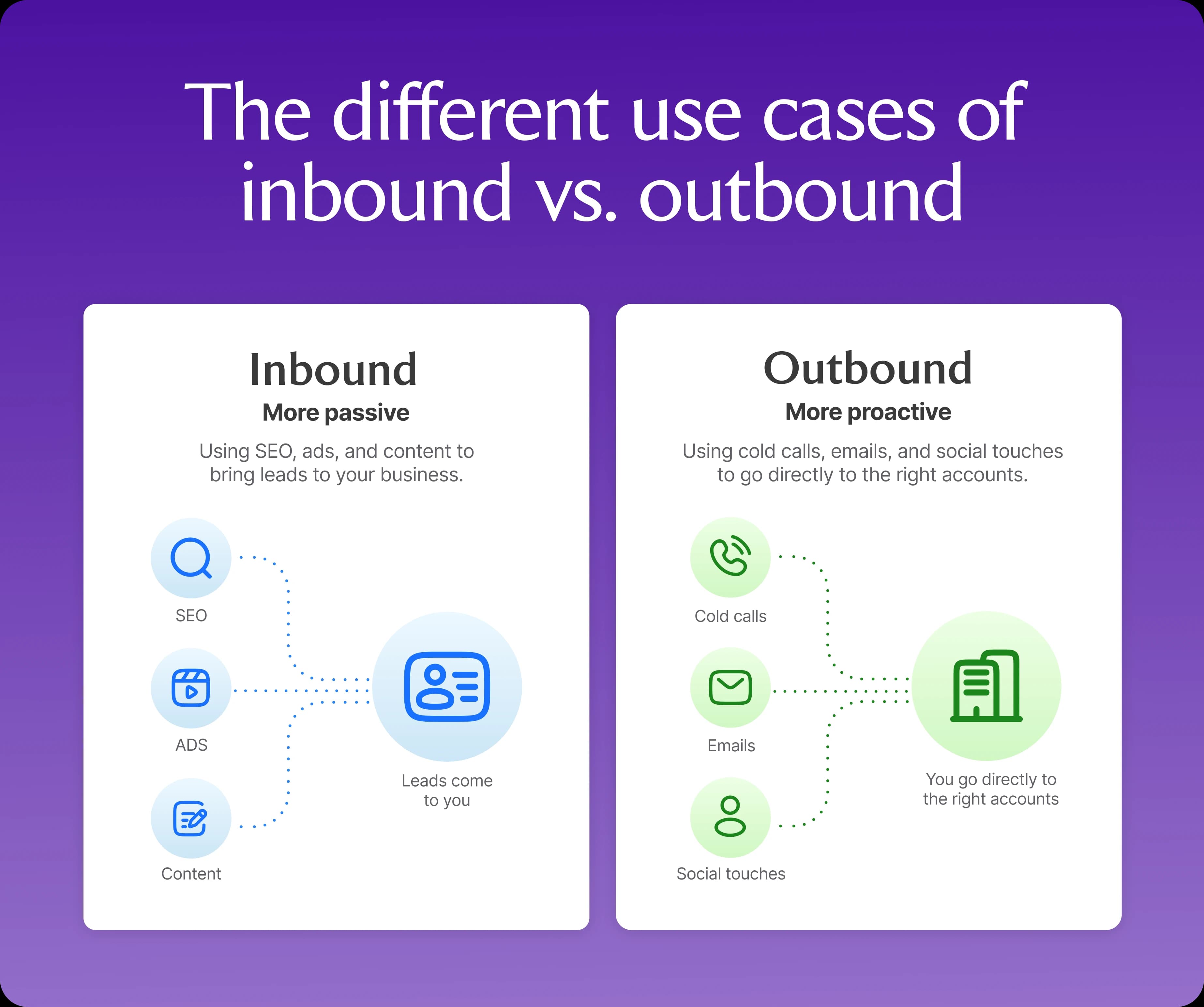
Inbound and outbound sales work well together because they target different types of buyers. Inbound uses marketing assets to attract leads who are already researching their problem. Outbound, on the other hand, targets accounts that aren't there yet but would benefit from your help. Together, these two methods help you capture your TAM and maximize lead generation.
Inbound sales brings in people already looking
Inbound sales is more passive than outbound sales. It's like setting up fishing nets that attract and convert potential customers on autopilot.
For example, at Artisan, we use our blog to attract sales leaders to our website, answer their questions, and point them toward our AI BDR software.
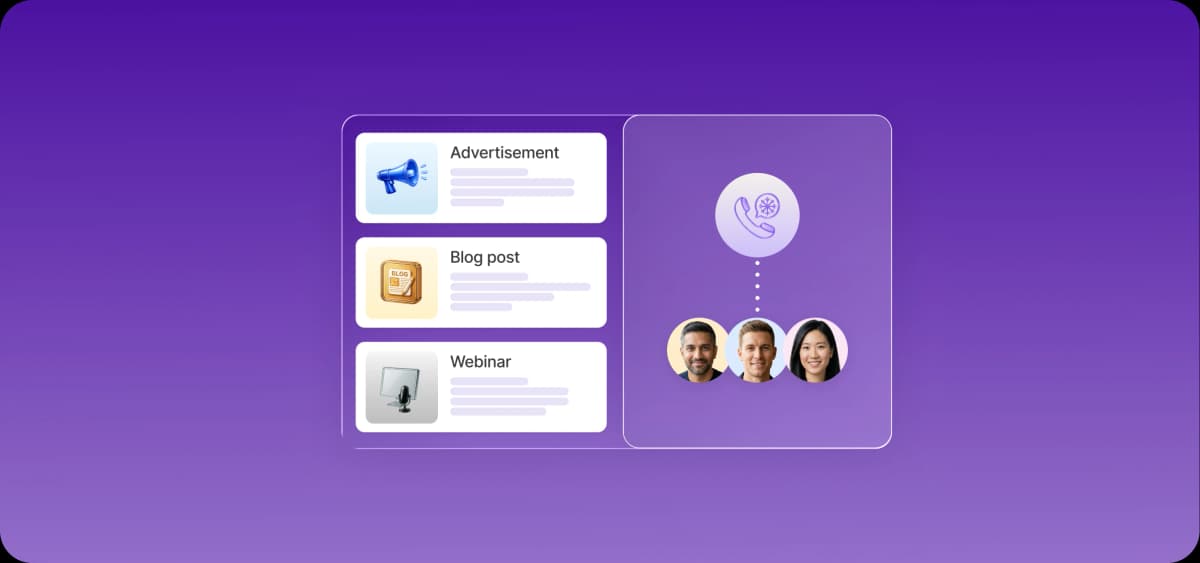
Inbound sales takes three common forms:
SEO: Creating web content that ranks in search engine results pages for queries your target customers ask.
Content marketing: Running webinars and publishing blog posts, newsletters, and other types of content that educate your target audience and regularly plug your products or services.
Referral systems: Incentivizing existing customers to recommend your business to other potential prospects.
These inbound methods showcase your business and encourage leads to move through the sales funnel on their own, resulting in warm leads for your salespeople to close.
To illustrate, let's say a business owner types "how do I automate cold email?" into Google. They click a blog post in the search results, read it, and think, "Oh man, this is so helpful!"
At the bottom of the blog post, they see an option to attend a web demo about outreach automation and sign up. They submit the form, and just like that, the business has generated a lead. Now, it's time for an inbound sales rep to step in and nurture the lead toward a purchase.
Outbound sales goes directly to the right accounts
Unlike inbound sales, which depends on leads taking action, outbound is proactive. The outbound sales rep is a hunter: they've defined their ideal customer, and now they're heading out to engage them with personalized cold emails, pitches, and social media touches.
Outbound sales takes several common forms:
Cold calls: Calling decision-makers, pitching your product or service, and sparking enough interest to book a sales meeting or demo.
Cold email: Emailing potential buyers through personalized sequences that touch on likely pain points and relevant needs.
Social selling: Interacting with decision-makers on social media and messaging them directly to secure a meeting.
The benefit of outbound is that you can target and engage high-value accounts without waiting for them to find your social media ad or blog post.
You can research the business, identify likely pain points, engage decision-makers, and spark interest in your solution through tailored messaging and rapport-building.
In most cases, the goal of all this cold outreach is a booked meeting, where an account executive will hold a discovery call, learn about the business's needs, and nurture the lead to a close.
The main difference is who initiates the interaction
Outbound sales includes a step that inbound does not: prospecting. This is when a sales rep actively identifies leads with a view to initiating a conversation. The rep, often a sales development representative (SDR), sends cold emails, makes cold calls, and attempts to spark the lead's interest in your offer.
With inbound sales, the opposite happens. The lead initiates the sales opportunity, typically by completing a form or reaching out over phone or email after seeing an ad, blog post, or some other piece of marketing content. The inbound sales rep, therefore, only speaks with interested leads who are already familiar with the brand and its offerings.
The differences that actually affect pipeline and revenue
Inbound and outbound differ in more ways than just their lead sourcing methods. They also take distinct approaches to targeting precision, execution complexity, and the metrics that define success.
Understanding these differences can help you make smart choices about which strategy to prioritize and how much to invest.
Targeting and ideal customer profile
Inbound has fantastic reach but lacks the precision of outbound. Your website could receive thousands of visits per day, and your social post could reach millions of people. But the majority of them aren't going to be ideal customers.
While you can certainly create digital marketing assets that attract leads with specific qualities, inbound is never as precise as outbound.
In cold outreach, reps can build accurate ideal customer profiles (ICPs), generate prospecting lists of companies that align with those ICPs, and then target specific decision-makers within them.
Speed and sales cycle
Inbound sales is slower to generate leads than outbound sales. It typically takes longer to build awareness, trust, and purchase intent through digital marketing methods than through direct one-to-one conversations.
If your offer is enticing and your messaging is highly relevant, an outbound sales approach can generate pipeline fast. In theory, you could cold call a lead one day and close the deal within a few weeks.
And since you can target decision-makers directly, you can speak to people with the power to make purchases. Inbound sales, by contrast, often returns form submissions from middle managers or entry-level workers who can't purchase without first convincing their boss, which is inevitably slower than cold calling the CEO.
Channels and execution complexity
Inbound channels like SEO content and social media ads are generally slower to build than outbound techniques, but they have the advantage of compounding over time. They require upfront investment in content strategy, audience targeting, and technology setup, but once your campaigns and marketing assets are up and running, they tend to generate leads relatively passively.
Outbound channels like email, social media, and phone are faster to activate but more labor-intensive to sustain. You can generate a prospecting list and cold-calling script in days, but if you only have 3 outbound SDRs, you can't expect to make more than 150 calls per day. Unless you're using AI tools like Artisan, scaling outbound is harder than scaling inbound.
Metrics and conversion rates
Inbound and outbound sales measure success differently. Typically, sales teams measure inbound effectiveness with metrics like website traffic, content engagement, and lead capture rates. These metrics track how well marketing assets and campaigns are attracting and converting leads.
Sales teams measure outbound success, on the other hand, with KPIs related to sales rep activity (like calls made and emails sent) and lead responsiveness (like email reply rate and number of meetings booked).
Conversion rates are usually lower for outbound since the leads don’t have any prior familiarity with or trust in your brand. But it's worth the high failure rates for those 1–3% of ideal accounts that do take a meeting.
An inbound sales strategy builds demand over time
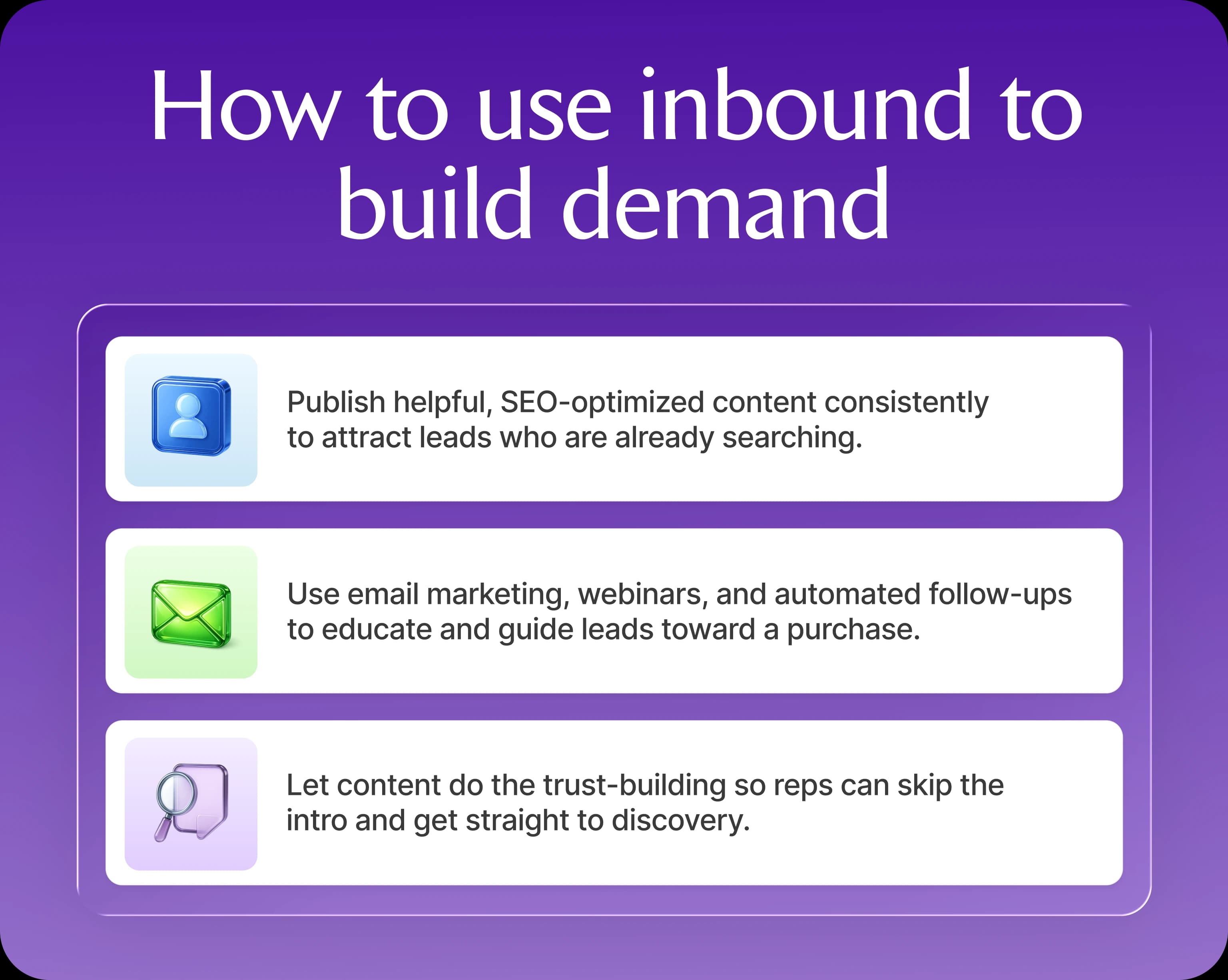
Inbound sales techniques like content marketing and SEO gradually build brand awareness, create trust, and generate warm leads for your sales reps to nurture and close.
Unlike outbound, which generates pipeline on demand, inbound compounds. The more helpful content you publish, the more leads come to you without further effort.
Content and SEO attract qualified leads
By consistently publishing genuinely helpful content, such as educational blog posts and how-to webinars, your business builds a branded library that attracts quality leads and earns trust with your target audience.
With enough consistency, by the time a lead reaches out, they will already understand your offerings and believe in your business, making the job of the inbound sales rep a lot easier.
If your content is evergreen and SEO-optimized, the positive effects compound. Your published materials appear in search results when leads ask relevant questions on Google, AI chatbots, and other search engines.
Nurturing converts inbound leads into opportunities
Once an inbound lead expresses interest and enters your sales pipeline, sales and marketing teams use lead nurturing tactics to move that lead from curious to committed.
The right mix of personalized content, dispensed automatically and aligned with the lead's unique interests, guides them through the buyer's journey. The result is either a purchase or, in more complex sales, a meeting with a salesperson.
The following lead nurturing tactics are among the most effective:
Email marketing: Automated email sequences that deliver personalized content based on a lead's behavior and stage in the buyer's journey.
Webinars: Live or on-demand videos that teach a lead how to overcome a problem while also introducing your product or service.
Sales follow-ups: Automated emails, sent from a salesperson's account, that trigger when a lead takes a specified action, such as viewing a product demo or signing up for a live workshop. You can create these automated follow-ups in your CRM or AI sales tool so sales reps don't have to remember to send them.
Trust is built before a salesperson steps in
In inbound sales, by the time a lead speaks with a sales rep, they've likely already done lots of product research and formed opinions about your business.
As a result, inbound reps can skip the introduction phase of the sales conversation and jump straight into discovery, asking questions to qualify the lead and better understand their needs.
If you track how much a lead engages with your content, such as by monitoring page visits or ebook downloads, inbound sales reps can review CRM data before a discovery call or live demo. They can then come prepared with an in-depth understanding of the lead's journey, pain points, and interests. That preparation allows them to run a more personalized meeting.
Outbound sales strategies create pipeline on demand
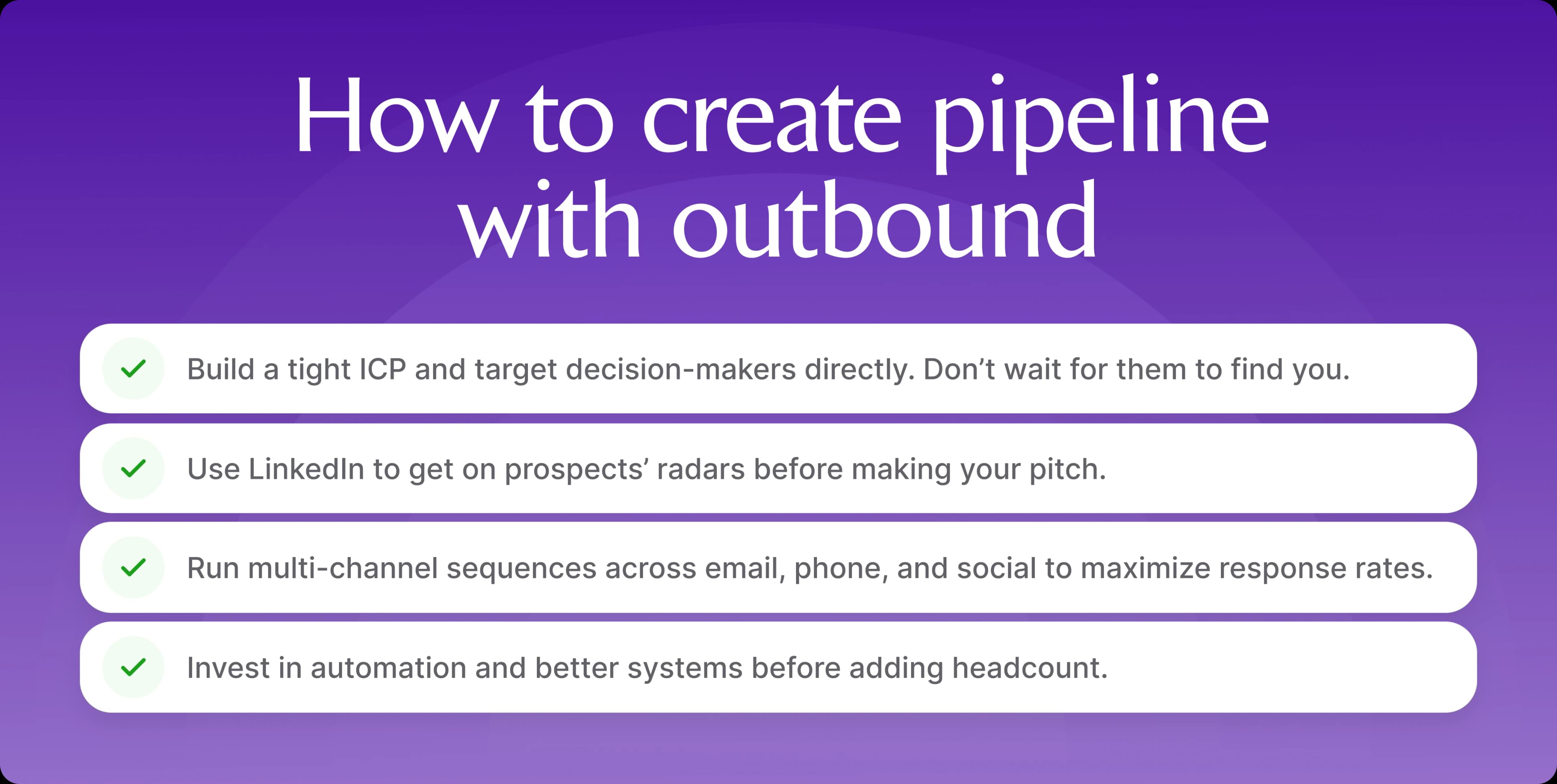
A hunter has much more agency than a trap-setter. Unlike an inbound sales rep, who waits patiently for leads to come to them, an outbound seller can pick up the phone, fire off 30 cold emails, or run a multichannel sequence, generating opportunities on demand.
Cold outreach targets the right people
Every form of successful cold outreach starts by identifying companies that fit a well-defined ICP. From there, reps build a prospecting list of specific decision-makers, such as VPs, directors, and owners. This precise targeting delivers messages to people who have both a need for a certain solution and the power to say "yes."
While you can target certain buyer personas in inbound lead generation, it's never as precise as outbound. Many low-value leads outside your ICP's parameters will fall into your funnel. With outbound, every meeting you set will be with a well-qualified lead, assuming you have the right systems in place, of course.
Social selling reaches decision-makers directly
Social media is another strong channel for cold outreach. Reps can directly message decision-makers, comment on their posts, and post thought leadership content that appears in their newsfeeds. This approach extends reach beyond the inbox, where prospects may already receive dozens of cold emails per day.
Social selling allows you to appear on a decision-maker's radar quickly and start building a relationship. When you finally make your pitch and ask for a sales meeting, they'll be familiar with you as a person. That rapport can do wonders for conversion rates.
Multi-channel sequences improve response rates
The multi-channel sequence is one of the most effective and widely used outbound strategies around. This is a 7- to 14-day cadence of sales messages spread across email, phone, and social media.
Here's an example of a multi-channel sequence:
Day 1: Email and social media connection request
Day 3: Cold call
Day 6: Follow-up email
Day 10: Follow-up email and social media message
Day 14: Follow-up email and call
This approach works because it engages leads in multiple places, which increases the chances of winning their attention. In fact, in a study of 100,000 sales campaigns, Apollo found that multi-channel campaigns using auto-email and social media produced a 14% increase in booked meetings compared to single-channel campaigns that only used auto-email.
Why execution is where most outbound fails
Despite its effectiveness, outbound is hard to get right. Its success is often limited by manual prospecting, poor-quality contact data, ineffective messaging, and inconsistent follow-ups.
It's also difficult to scale. To boost outreach volume, most companies make the mistake of hiring more entry-level sales reps rather than investing in time-saving automation and technology.
Fortunately, AI tools help solve these problems while making your outbound sales strategy far more scalable. Artisan is one example. It's an AI outbound platform that comes with an AI BDR called Ava that automates prospecting, lead enrichment, and multichannel outreach.

When to use inbound vs outbound sales
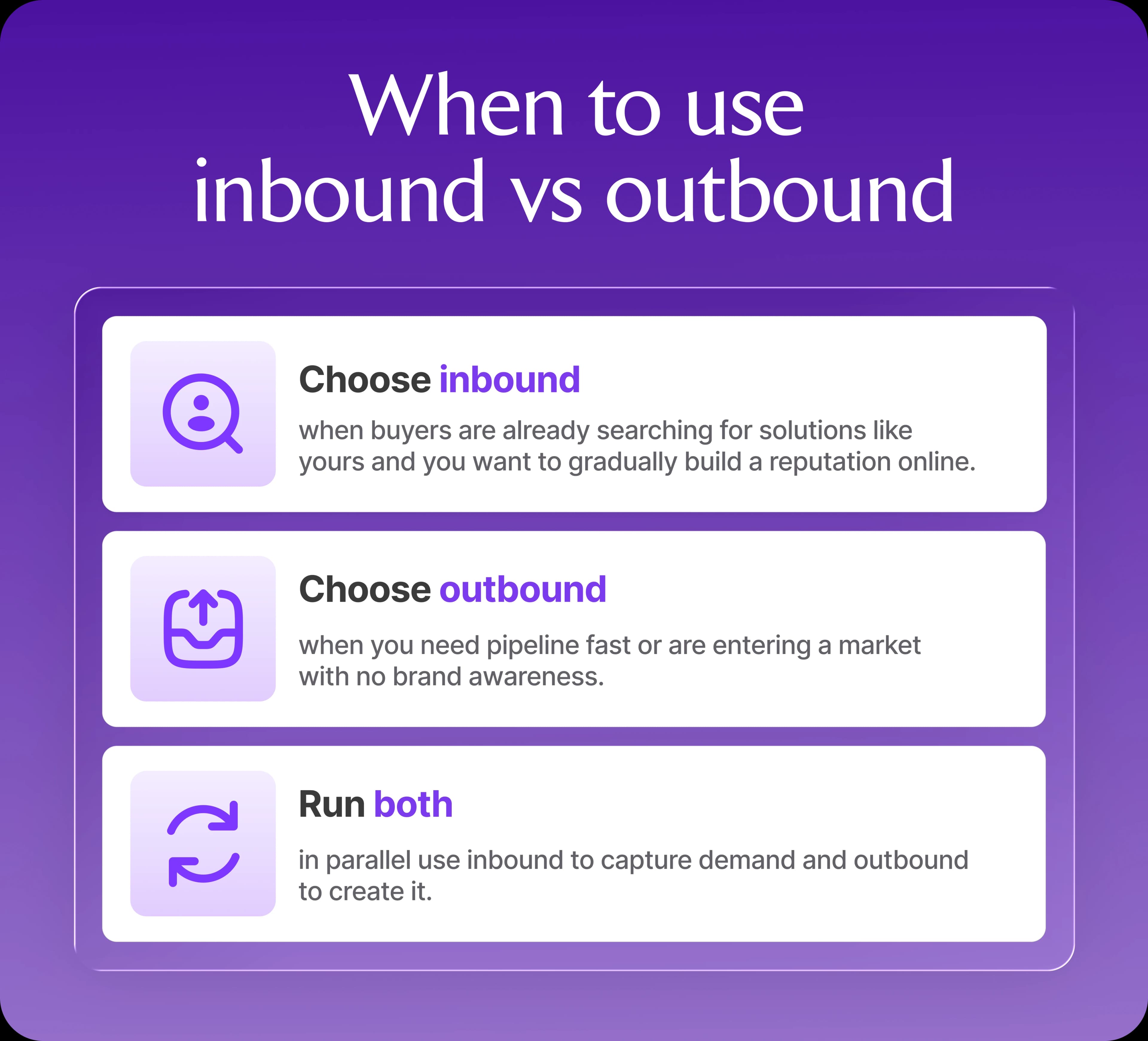
The right sales approach depends on how quickly you need to generate leads and whether your target audience is already looking for what you sell. In most cases, businesses don't choose one or the other. Instead, they use inbound to capture demand and outbound to create it.
Why inbound works when demand already exists
Inbound is most effective in markets where buyers are already searching for solutions like yours. They’re likely to find your online content and respond positively to the pitches in it. It’s also a long-term play. With inbound, it takes more time to start seeing the fruits of your efforts compared to outbound.
Inbound sales fits best in the following markets:
Markets with high-stakes purchases: When costs are high, buyers typically research independently before talking to sales. SaaS, financial services, healthcare, and manufacturing are all examples.
Established business categories: These industries have been around for a while, so prospects already Google familiar terminology like "CRM software for small businesses" and "financial advisor in Chicago."
Enterprise B2B products and services: Buyers need to build trust with the company before they're open to a pitch, which often means a period of initial research.
Outbound works when you need pipeline now
Outbound lead generation is ideal for companies that can't wait for customers to come to them, either because they need to generate pipeline ASAP or because they're launching a new business or product that people are unlikely to search for online. Outbound also puts you in control of timing, letting you engage potential buyers before they've started searching.
Outbound works best in the following situations:
Launching new products: When you're introducing something the market doesn't know to search for yet, outbound puts it in front of the right leads immediately.
Entering new markets: Breaking into a new industry or region means starting from zero brand awareness. Outbound is a quick way to gain attention and avoid being crowded out by established competitors who already have a presence online.
Focusing on account-based targeting: If you have a list of high-value accounts you want to reach, outbound lets you target them directly.
Most B2B sales teams combine both
To make sure they're reaching all potential leads, most B2B sales teams run hybrid approaches that include both inbound and outbound.
They use inbound to attract and nurture contacts already in research mode while building long-term brand authority and a digital presence.
In addition, they run outbound to proactively target high-value prospects and leads who may not actively be searching for their solution but would benefit from it nonetheless.
For example, at Artisan, we publish SEO blog posts and social media content, but we also perform cold outreach via email and social media. Or to be more accurate, our AI BDR Ava does the outreach for us.
Three common mistakes that slow down growth
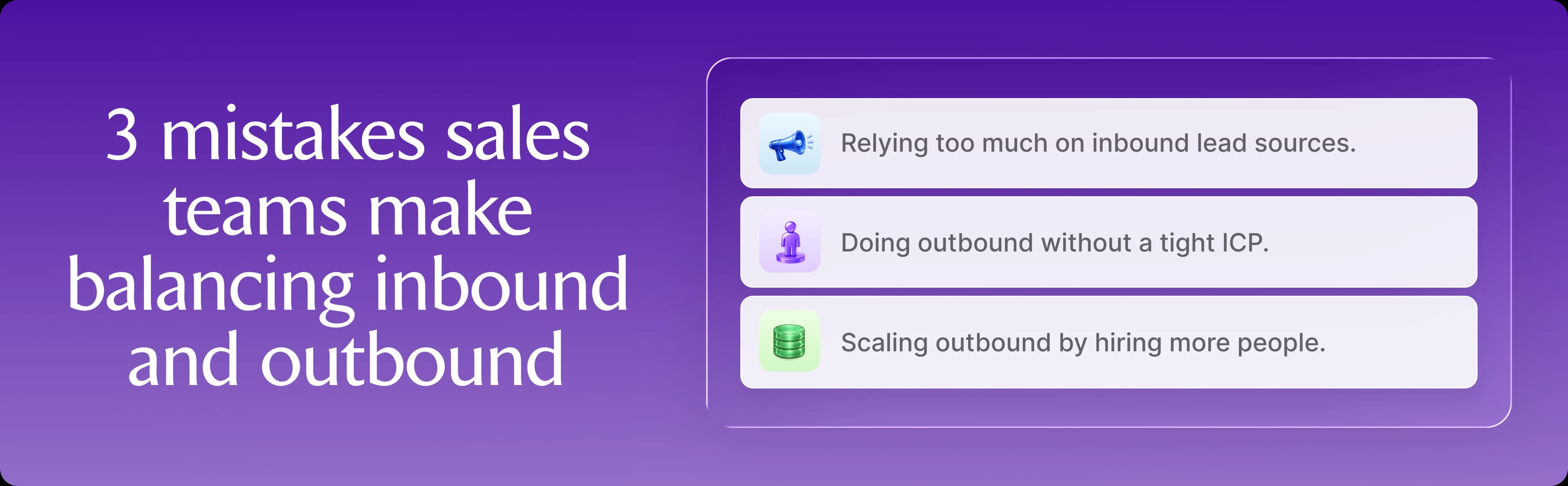
There are many mistakes that can cause your sales team to lose leads, waste time, and miss out on revenue. The cause is usually either overreliance on a single channel or poor strategic execution.
Relying only on inbound traffic
Relying on inbound leads alone is almost like going to a trade show, setting up a booth, wearing a stylish suit, and hoping people stop by. Some will trickle in, no doubt. But you have no control over the booth's performance.
The most successful brands create an inviting booth, but they also send salespeople out to find potential leads, start conversations, and draw people into the booth to watch the demo and learn more.
In the same way, outbound gives you much-needed control over pipeline growth. For all you know, one well-placed cold call could generate six figures in annual recurring revenue (ARR).
Doing outbound without clear targeting
Running outbound sales with a weak or overly broad ICP can destroy conversion rates. When your target audience is too broadly defined, it's impossible to create highly relevant messaging, which means your cold outreach is more likely to be ignored.
If I were to target all restaurants in the world, instead of restaurants in New York with Google ratings of 3.5 or lower, I'd almost certainly generate little to no interest. But if I made a list of 500 similar restaurants in the same city, there’s a strong likelihood they would share goals, pain points, and challenges.
That's a much easier place to start when crafting outbound messaging. I could write a single cold email sequence that resonates with every one of those business owners. The results would be more booked meetings and fewer potential leads annoyed at my irrelevant, generic emails.
Scaling outbound with more people instead of better systems
The old way to scale outbound was to hire more SDRs. The problem is that sales reps cost a pretty penny, and if your outbound workflows are inefficient, adding more headcount won't fix them. If sales reps were drafting emails from scratch, forgetting to follow up, and using untested scripts, adding more people just compounds these issues.
Most B2B sales teams will see far better results from improving, or better yet automating, their outbound workflows with modern technology.
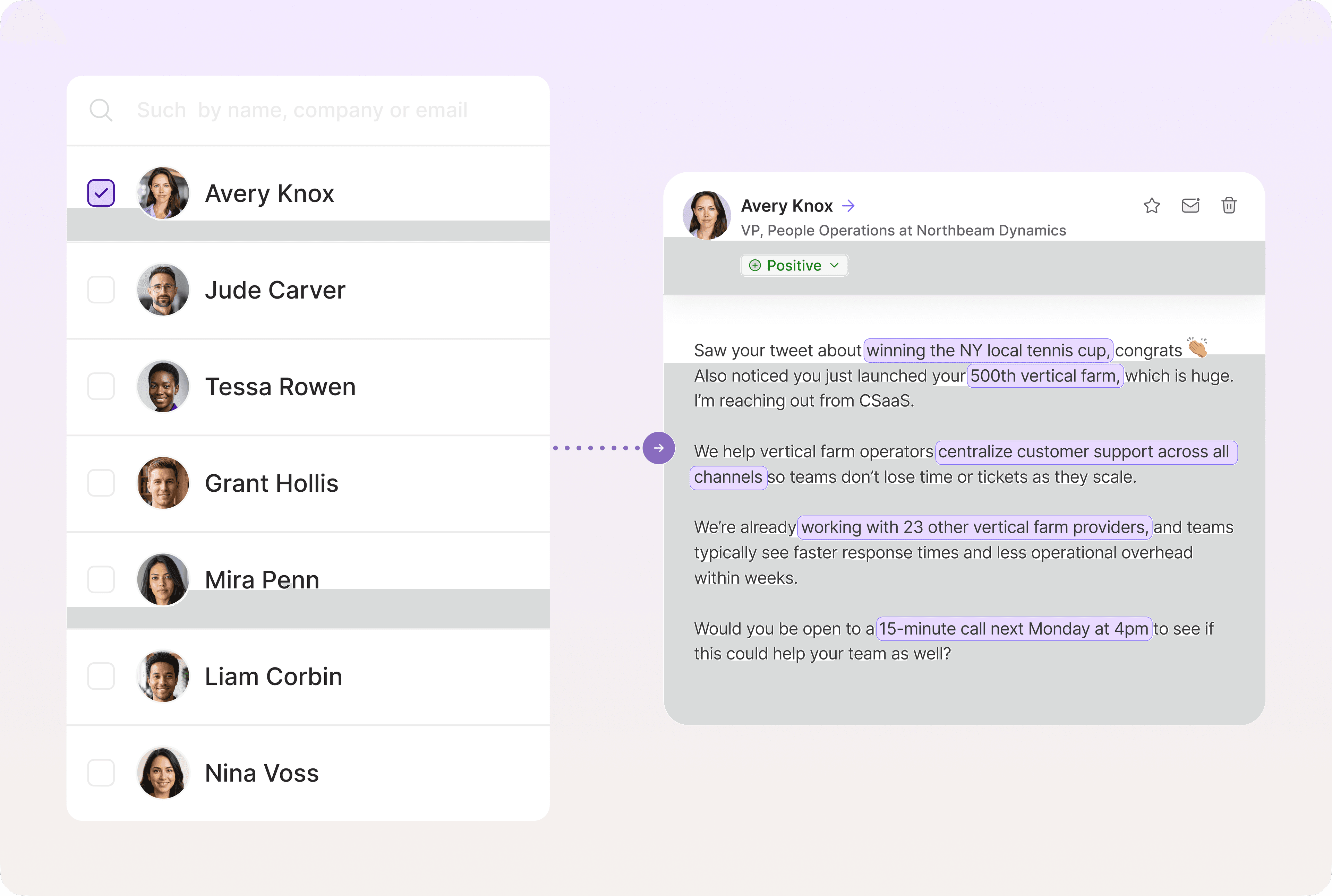
Artisan, for example, reaches out to decision-makers with deeply personalized messages on email and social media and books meetings on autopilot. This allows you to multiply outreach volume without increasing the size of your team.
Combining inbound and outbound into one system
Running inbound and outbound in parallel creates a feedback loop where each method constantly sharpens the other. Inbound behavioral data helps you refine your outbound messaging, while real-time outbound conversations give you qualitative insights to shape customer-facing campaigns.
Inbound data improves outbound targeting
One of the best arguments for using inbound sales tactics like content marketing and advertising is that you acquire a lot of behavioral data about your customers, such as page visits, email open rates, and likes on social posts.
This intel helps you understand your audience at a deeper level and identify messaging that inspires them to take action. This, in turn, helps you create more resonant outbound scripts, emails, and pitches.
Inbound data also helps you refine your ICP. You might think you know who your ideal customers are, but you never know for sure until you put something online and see who visits and converts.
For example, imagine you start posting marketing content on social media and discover that the users interacting most frequently are not VPs of Finance but compliance managers in tech. Now you've identified a new audience segment to target.
Outbound insights improve marketing strategy
Just as inbound data informs outbound strategy, outbound insights help you refine your inbound marketing.
When I was an SDR doing cold calling, my benevolent manager told me that, even if I failed to book a meeting on a call, I had still succeeded as long as I learned something about the customer. The outbound rep is both a hunter and a scout.
Real conversations with leads and prospects reveal pain points. Your marketing team can use these pain points to create more effective marketing campaigns, sales pages, and webinars.
How automation connects the full sales process
When you run inbound and outbound in parallel, there are lots of moving parts to track and weave together into a cohesive sales process. Automation tools help by ensuring that outreach, follow-up, and CRM workflows never operate in silos. Each lead action triggers the next.
For example, if a lead replies to an outbound email, that signal should update the CRM status, notify the sales rep, and launch a relevant nurturing campaign. That way, no leads fall through the cracks, and they each receive the right marketing and sales touches at the right time.
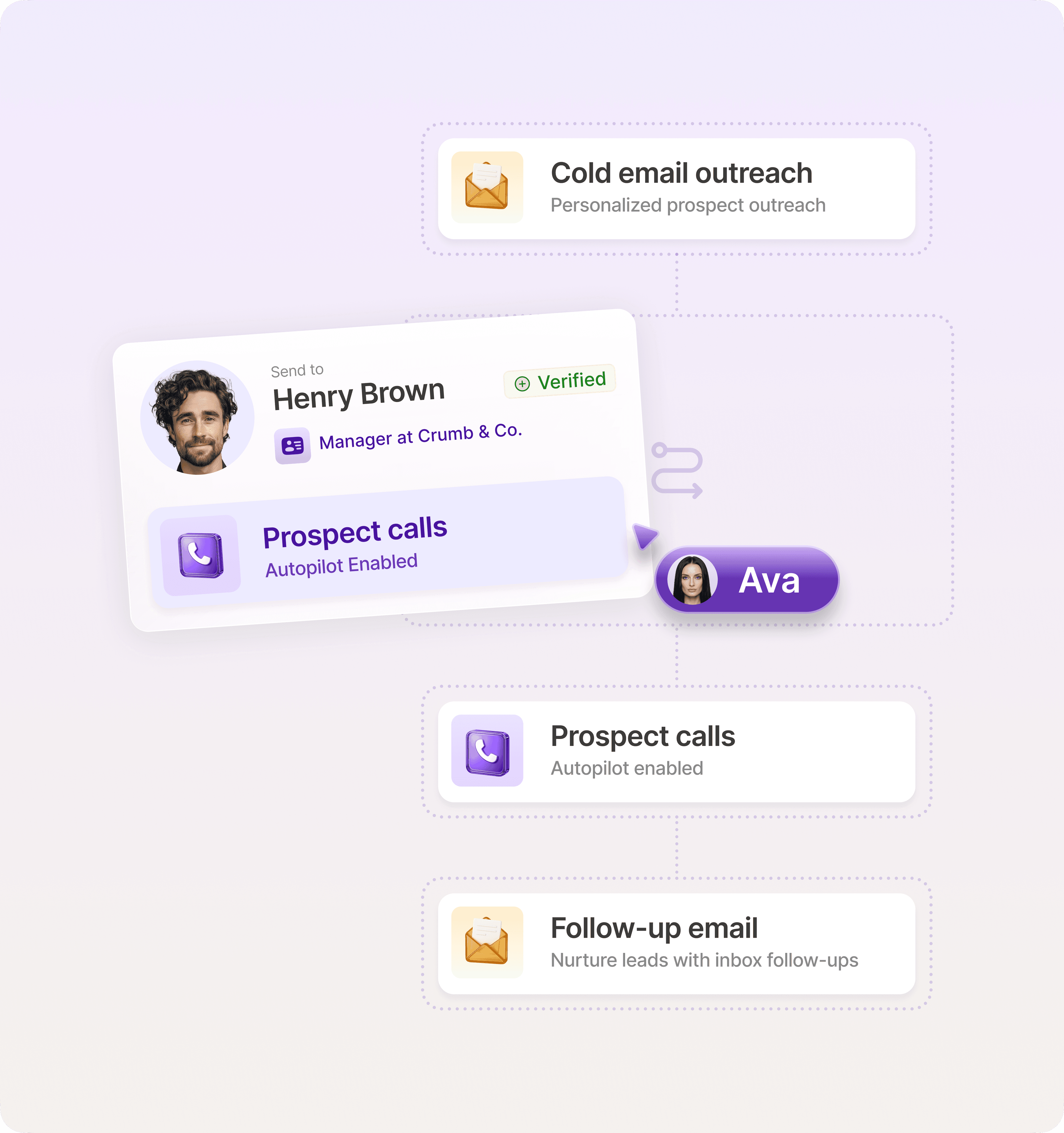
Many B2B teams are using Artisan to streamline and connect sales activities in exactly this way. Ava, an AI BDR around whom the platform is built, can automatically handle sequencing and personalized outreach without human intervention. She generates leads on autopilot while your sales team focuses on talking to high-intent prospects.
The best sales teams don't choose a channel; they build a system
If you look at the most successful B2B brands, you'll find they rarely rely on a single channel. They combine outbound methods like cold calling with inbound tactics like content marketing.
To pull off this hybrid approach without introducing too much operational complexity, the right tech stack is key.
With Artisan, you can automate 80% of your outbound sales. AI BDR Ava will prospect leads using a database of over 300 million decision-makers, run multi-channel sequences (including follow-ups), and book meetings. That's how you make outbound as scalable and passive as inbound without sacrificing personalization.

Automate your outbound with an AI BDR
Meet Ava—your AI BDR who handles prospecting, outreach, and follow-ups, so your team can focus on closing.

Sam Rinko
SME @ Artisan
Sam Rinko is a former SaaS sales rep turned tech writer. He sold real estate software before writing about lead generation, cold calling, and AI sales tools.