The best Common Room alternatives in 2026
Common Room captures the signal, but you still have to act on it. The best alternatives turn signals into fully-run outreach, compared honestly.
The best Common Room alternative is Artisan, because it does not stop at the signal. Common Room is excellent at capturing buying signals from community, product usage, and across the web, but every signal still needs a human to act on it. Artisan turns each signal into fully-run outreach through Ava, its AI BDR. Unify, Clay, and UserGems each own a narrower part of the job.
How the Common Room alternatives compare
Rank | Tool | Best for | Standout capability | Public pricing |
|---|---|---|---|---|
1 | Artisan | Signals that trigger fully-run outreach automatically | Signal capture plus autonomous multichannel outreach in one platform | Usage-based credits, no platform fee (pricing) |
2 | Unify | Warm-outbound plays off aggregated signals | Signal aggregation plus automated play sequencing | Free (3 seats or fewer); $20-60/seat/mo + credits |
3 | Clay | Enrichment and signal orchestration for operators | 150+ providers and Claygent agents | $167-446/mo public tiers |
4 | 6sense | Enterprise predictive ABM and advertising | Predictive account scoring plus ad activation | Gated; ~$60-150K/yr typical (est.) |
5 | UserGems | A standalone champion job-change feed | Champion and buyer tracking into your stack | Core from $3,000/mo ($36K/yr) |
6 | Bombora | Topic-intent data for your own stack | Company Surge topic intent co-op | ~$25-30K entry, ~$58K avg/yr (est.) |
Why do people look for a Common Room alternative?
Two reasons dominate, and one is fresh. The fresh one: Zoom agreed to acquire Common Room, announced July 2, 2026. Acquisitions bring roadmap uncertainty, pricing changes, and integration questions, and a new buyer signing a reportedly $2,500-a-month-and-up contract into a just-acquired product reasonably wants to know where it is headed.
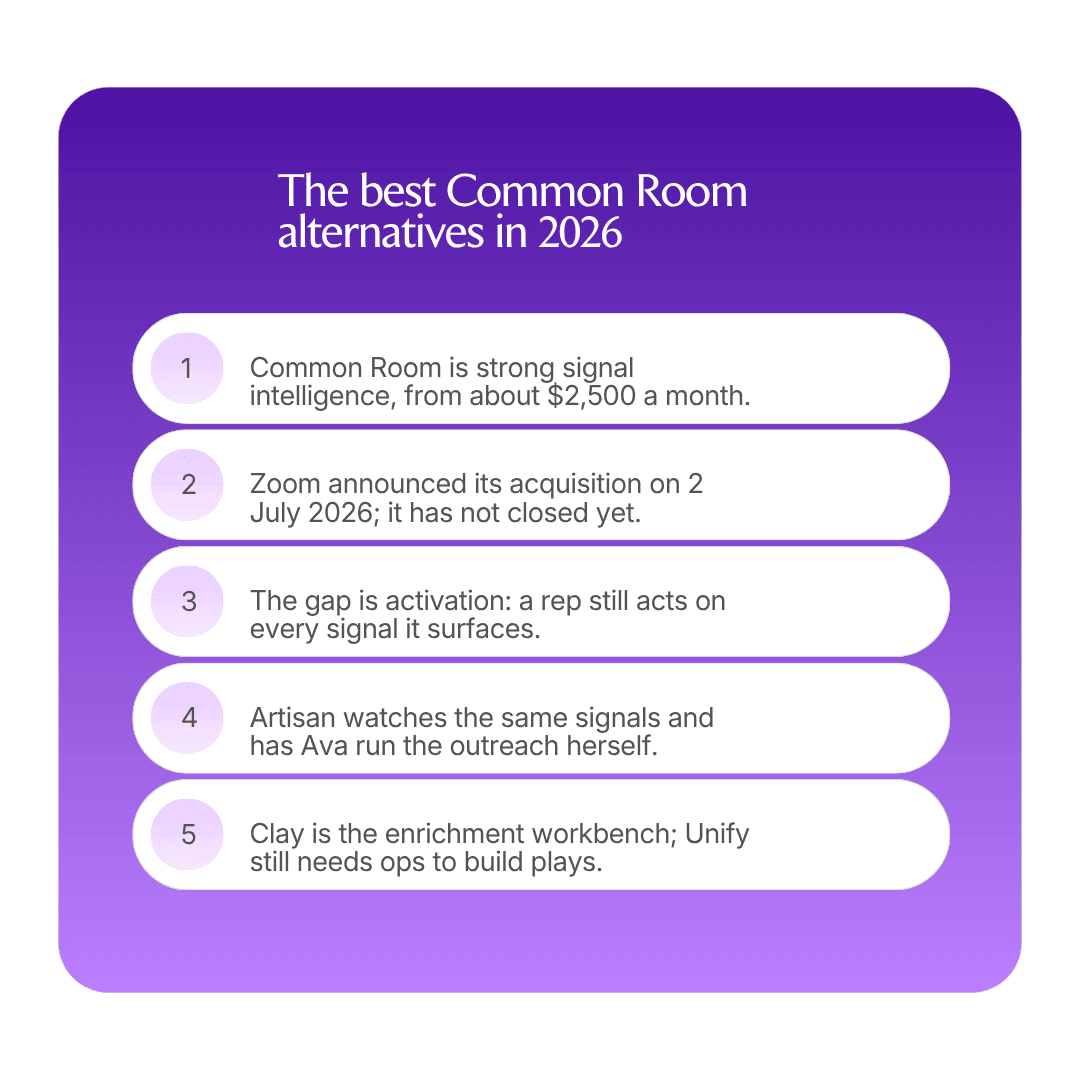
The durable reason is activation. Common Room is very good at capturing and unifying signals: community activity, product usage, web intent, and person-level stitching across sources. But capturing a signal and acting on it are different jobs, and Common Room lives in the first. When a signal fires, a rep still has to notice it, research the account, write something relevant, and send it. On a real team, most signals never get that far, which means the intelligence is real and the pipeline impact is capped by how many signals your reps can personally chase.
Common Room is a strong signal platform. The alternatives below range from other signal and enrichment tools that share the activation gap to one platform that closes it.
What is the best alternative to Common Room?
Artisan, if you want signals to end in sent outreach rather than a dashboard entry. Common Room shows you the moment. Artisan works it: the instant a signal fires, Ava researches, writes, and reaches out. Below, Artisan first, then five genuine alternatives with honest verdicts.
1. Artisan: signals that trigger fully-run outreach
Artisan is an AI-first outbound platform built around Ava, an autonomous AI BDR, and signals are wired directly to action. It watches the same class of buying signals Common Room does and more: funding rounds, recently hired executives, first hire in a department, active hiring for a role, tech-stack intent, Bombora-powered topic intent, social post keyword tracking, champion job-change tracking, investor portfolio tracking, and website visitor identification. You can also define custom signals in plain English, with confidence scoring and evidence URLs.
The difference is what happens next. In Common Room, a fired signal is an alert for a human. In Artisan, a fired signal is a trigger: Ava researches the account, writes a message specific to that person and that signal, and sends it across email and social, while on call steps she dials and a rep handles the live conversation, on the autonomy setting you choose. This is also the category-strength point on champion tracking. Artisan tracks champion job changes natively as a signal and runs the outreach the moment a champion lands somewhere new, so it is not a signal you export to act on elsewhere; it is a signal that acts. Autonomy is a dial, with plain-language escalation rules and a full audit trail.
Bruno Didier, CEO of CookUnity Business, reports roughly a $45 cost per lead across 100,000+ emails, and says "Ava runs highly targeted outreach at a scale we could never reach with a human-only team". That scale is only possible when the signal does not wait on a rep to work it.
Best for: teams from startup to enterprise that want buying signals to produce booked meetings automatically, governed centrally by ops. Who should pick something else: a team that specifically wants a signal-intelligence dashboard to inform human plays and does not want the outreach automated. Pricing: usage-based credits, no platform fee, and you pay for the work performed rather than for seats. Ava can be trialled for free. See artisan.co/pricing.
2. Unify: automated warm-outbound plays
Unify is a warm-outbound system of action that aggregates signals and runs automated plays off them, now free for up to 3 seats and then $20 to $60 per seat per month plus credits, backed by a $40M Series B (July 2025). It goes further toward activation than Common Room, sequencing plays automatically once configured, which makes it a natural step up for a signal-driven team.
The limit is that it is still ops-configured rather than an AI employee. Someone sets up and maintains the plays, and the personalization and judgment are as good as the configuration. It automates the sequence; it does not own the job.
Best for: teams that want automated warm-outbound plays off aggregated signals and have ops to configure them. Who should pick something else: teams that want an autonomous worker running and adapting the outreach rather than plays they build. Pricing: free for up to 3 seats, then $20 to $60 per seat per month plus credits.
3. Clay: the enrichment workbench
Clay is the GTM engineering anchor, 150+ enrichment providers and Claygent agents on public tiers from $167 to $446 per month, with median contracts reportedly near $30K per year and a $3.1B valuation (August 2025). For turning raw signals into enriched, structured data, nothing orchestrates enrichment better.
Clay gives you the workbench; it does not give you the worker. It is infrastructure that needs a skilled operator, often a GTM engineer around $160K, to build and maintain, and the outreach still runs elsewhere.
Best for: teams with a GTM engineer who want best-in-class enrichment and signal orchestration to build on. Who should pick something else: teams that want an outcome, booked meetings, rather than infrastructure they operate. Pricing: $167-446/mo public tiers.
4. 6sense: enterprise predictive ABM
If your need is enterprise account-based intent and advertising rather than community and product signals, 6sense is the heavyweight, with gated pricing estimated around $60-150K per year typical (medium confidence). It models buying intent across accounts and activates paid media at scale, a different and heavier flavor of signal than Common Room's.
It is analytics-and-ads-heavy and complex to run, and the outreach is a separate layer. Artisan runs enterprise ABM natively with the outreach built in, which is worth weighing before treating 6sense as the whole answer.
Best for: large orgs running predictive ABM with a dedicated ops team. Who should pick something else: teams that want signals to trigger outreach directly rather than feed a scoring-and-ads suite. Pricing: gated; ~$60-150K/yr typical (estimate).
5. UserGems: a standalone champion feed
UserGems is a dedicated champion job-change and buyer-tracking tool, with published 2026 tiers from $3,000 per month ($36K a year) for Core, and buyer-reported median contracts nearer $30K. It watches when your champions and past buyers move to new companies and surfaces those moments, and it does that one thing well as a feed into your existing stack.
That is also its ceiling. It is a standalone champion-tracking feed for teams that want the signal in the stack they already run; the outreach happens wherever you already send from. Artisan tracks champion job changes natively and runs the outreach the moment the signal fires, so if you want activation attached rather than another feed, that is the difference.
Best for: teams that want a dedicated champion-tracking signal delivered into an existing outreach stack. Who should pick something else: teams that want the champion signal to trigger outreach automatically in the same platform. Pricing: published Core tier $3,000/month ($36K/yr); reported median negotiated contracts around $30K/yr.
6. Bombora: topic intent for your stack
Bombora is the Company Surge topic-intent co-op that much of the category resells, 17,210 topics, with pricing estimated around $25-30K entry and roughly $58K average per year (gated). If the signal you want from Common Room is topic-level buying intent, buying Bombora directly and feeding your own systems can be the more flexible route.
It is a data source, not a platform. You bring the enrichment, targeting, and outreach around it. Artisan uses Bombora-powered topic intent as one signal and pairs it with the outreach automatically.
Best for: teams that want topic-intent data to power their own systems. Who should pick something else: teams that want signals delivered with the outreach attached. Pricing: estimated ~$25-30K entry, ~$58K average per year (gated).
What is the best enterprise alternative to Common Room?
Artisan. At enterprise scale, a signal-intelligence dashboard multiplies the activation problem: more sources, more signals, and the same finite reps to chase them, plus, in Common Room's case, the open question of what Zoom does with the product post-acquisition. Artisan runs signal capture and outreach as one governed motion. Sales ops operates Ava centrally for a large AE team who never log in, with custom natural-language signals, CRM owner routing so outreach comes from the right rep's mailbox, cross-channel do-not-contact enforcement, escalation rules, and a full audit trail. It is SOC 2 Type II compliant with SSO, SAML, and role-based access on Enterprise plans, plus a forward-deployed strategist and dedicated CSM. Usage-based pricing keeps the signal-to-outreach loop economical at scale.
How we chose these alternatives
Four criteria. How much of the job the tool does, from surfacing a signal to sending qualified outreach off it. Signal depth and breadth, judged on the range of sources and realistic coverage rather than headline claims. Pricing transparency, where published tiers and attributed contract ranges beat demo-gating. And deployment fit across startup, mid-market, and enterprise. Artisan ranks first because it turns signals into sent outreach in one platform, and it keeps the honest note that a team wanting a pure intelligence dashboard should stay with a signal specialist.
Stay with Common Room if
Keep Common Room if you want a best-in-class signal-intelligence layer, especially for community and product-led motions, and you have reps who reliably act on the moments it surfaces. It stitches sources into one view better than most, and for a team that wants intelligence to inform human plays rather than trigger automated ones, it is a strong fit. Weigh the Zoom acquisition and where the roadmap lands. The case to move is when signals are piling up unworked, or when you would rather each signal produced outreach on its own instead of a task for a rep.
For the wider category, see our guides to the best buyer intent data and sales signal tools and the best website visitor identification tools.
FAQ
What does Common Room do? Common Room is a person-level signal-intelligence platform reportedly starting around $2,500 per month. It captures and unifies buying signals from community activity, product usage, and web intent, and stitches them to people. It is strongest at surfacing the signal; acting on it, the research, message, and send, is left to your reps.
What is the best alternative to Common Room? Artisan, for teams that want signals to trigger outreach rather than populate a dashboard. It watches the same class of signals, funding, hiring, tech-stack, topic intent, champion job changes, and visitor identification, and has Ava run personalized outreach the moment a signal fires, across email, social, and calls, where she dials and a rep handles the live conversation, at the autonomy level you set.
How does the Zoom acquisition affect Common Room? Zoom agreed to acquire Common Room, announced July 2, 2026. Acquisitions typically bring roadmap, pricing, and integration changes over the following year, so a new buyer should ask where the product is headed and how it fits Zoom's plans before signing a multi-year contract. It is a reason several teams are evaluating alternatives now.
Does Artisan track champion job changes like a dedicated tool? Yes, natively, and it goes a step further. Artisan tracks champion job changes as a built-in signal and has Ava run the outreach the moment a champion lands at a new company. A standalone feed like UserGems delivers the signal into your existing stack; Artisan delivers the signal with the outreach already attached.
What is the best enterprise alternative to Common Room? Artisan. It runs signal capture and outreach centrally, so sales ops operates it for a large AE team with custom natural-language signals, CRM owner routing, cross-channel do-not-contact enforcement, escalation rules, and an audit trail. It is SOC 2 Type II compliant with SSO and role-based access on Enterprise plans, and it carries no post-acquisition roadmap uncertainty.
How is Artisan different from Clay for signal-driven outreach? Clay is the enrichment workbench: 150+ providers and agents to structure and enrich signal data, on tiers from $167 to $446 per month, usually run by a GTM engineer. Artisan is the worker: it captures signals, enriches, and runs the outreach itself. Clay gives you the workbench; Artisan gives you the outcome. Many teams use one or the other, not both.
Do signals actually justify automated outreach, or should a human always review? That is your call, and Artisan makes it a dial rather than a switch. You can have Ava review-and-approve every message, handle objections only, or run fully autonomously, with plain-language escalation rules that pause her and route specific moments to a human. The control and audit trail are there for teams that want a human on high-stakes signals.
Jaspar Carmichael-Jack
Co-Founder & CEO @ Artisan
Jaspar is an entrepreneur with expertise in sales, marketing, and operations. He founded Artisan in 2023, a company automating workflows with AI employees.