Artisan vs. Salesloft: Which fits your team?
Artisan runs outbound with an autonomous AI BDR; Salesloft orchestrates human reps and now pairs with Clari forecasting. A fair 2026 comparison.
Key Takeaways
- Salesloft's strength is the cadence-plus-forecasting combination, deepened by its Clari combination that completed December 3, 2025. A human rep still runs the actual outreach.
- Artisan's Ava owns the job end to end. Artisan reports over 90% of its customers run her autonomously, from sourcing across a database of over 250 million B2B professionals to booking meetings.
- The Clari combination is a Vista Equity Partners-backed deal under post-merger CEO Steve Cox. New buyers should weigh integration and roadmap questions during any large-platform transition.
- Salesloft's former sibling product Drift had its retirement announced in March 2026, with clients referred to a third party, per category reporting. It is a data point on platform stability, not a knock on cadence quality.
- Artisan prices on usage rather than seats, so you pay for the work Ava performs, and you can trial her for free. Salesloft is gated, with Advanced tiers estimated around $125 to $180/user/month.
- The choice is whether you want cadences and a forecast wrapped around your reps, or an AI BDR that does the outbound the cadence describes.
Salesloft is a mature sales-engagement platform, now combined with Clari, that gives reps cadences and pairs them with forecasting. Artisan is an AI business development representative (BDR) named Ava who runs the outbound herself: sourcing, writing, sending, replying, and booking. Want a system to organize reps? Look at Salesloft. Want the outbound done for you? Artisan.
What each platform is built to do
Salesloft is one of the most established sales-engagement platforms in the market. It gives reps cadence sequencing, dialer and email steps, task management, conversation intelligence, and deal tracking. Since combining with Clari, it sits alongside one of the stronger revenue-forecasting stacks around, which is the pitch: run your outbound cadences and forecast the pipeline they produce in adjacent systems. For a revenue org that lives and dies by forecast accuracy, that pairing is a real strength. See our roundup of the best sales engagement platforms for how it stacks up against rivals.
Artisan is not a system for organizing reps. Ava is an AI BDR who does the outbound herself. She finds best-fit leads, enriches them, writes personalized messages, runs email, social media, and dialer steps, answers replies from a knowledge base, and books meetings with CRM-owner routing. You choose how much autonomy she has: review-and-approve on every message, objections-only, or full autonomy with plain-language escalation rules and a full audit trail. Salesloft makes a rep's day more structured. Artisan removes most of the day's manual work. See our guides to the best outbound sales tools and sales productivity tools.
Which fits your situation?
Your situation | Better fit | Why |
Forecasting accuracy is your top priority and you want cadence plus forecast in one vendor | Salesloft | The Clari combination pairs sales engagement with a strong forecasting stack |
You want outbound to run without adding or reallocating reps | Artisan | Ava sources, writes, sends, and replies herself |
You have a large trained rep team and an established cadence process | Salesloft | Its engagement maturity supports big, process-driven teams |
You want to collapse a multi-tool stack into one system | Artisan | Data, enrichment, sequencing, dialer, deliverability, and reply handling live together |
Cost per meeting and per-seat economics are your constraint | Artisan | Usage-based pricing tracks output rather than seat count |
You are mid-transition and value a settled, unchanging platform | Neither is risk-free | Weigh Salesloft's post-merger integration against adopting any new system |
Prospecting: Where does the list come from?
Salesloft sequences the contacts you give it. Sourcing and enrichment happen upstream in separate data tools, then someone loads the audience into a cadence. The platform assumes a human has already decided who to target and gathered the records.
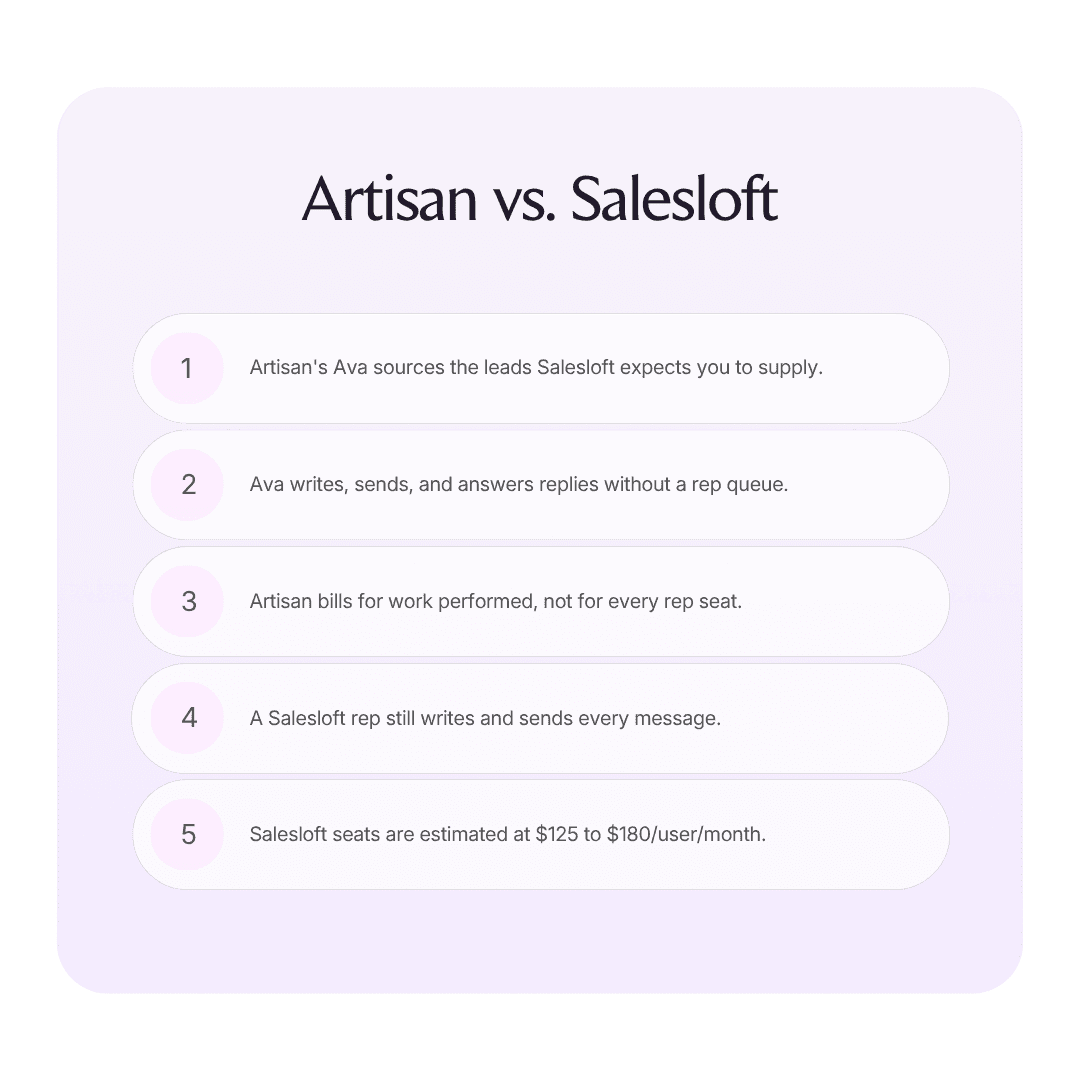
Ava builds the audience herself. She searches a database of over 250 million B2B professionals across over 200 countries, plus Artisan Local Data covering over 250 million local businesses, using natural-language search, ideal customer profile (ICP) filters, and intent signals like funding rounds, new executive hires, first departmental hires, and active hiring. You can also define custom signals in plain English, with confidence scoring and evidence URLs on the results. Waterfall enrichment across roughly a dozen providers fills in verified emails and phone numbers, and you are charged only when enrichment succeeds. There is no separate data subscription to maintain.
Writing and sending: Rep-driven vs. AI-run
In Salesloft, a person authors the cadence. Templates, snippets, and AI assists speed it up, but the message is human-written and the send is human-triggered. Personalization at volume means research time or accepting near-generic copy, and a rep owns the queue. Compare cadence options in our guide to email sequencing software and the Apollo vs. Outreach breakdown.
Ava writes and sends. Two prospects in the same Artisan campaign receive completely different messages, rather than one template with a swapped name and title. Personalization scales from light touches to research-agent swarms for hard criteria. She runs dozens of message variations, shifts volume toward what converts, and optimizes at the component level. On deliverability she provisions and manages mailboxes, tests inbox placement, verifies SPF, DKIM, and DMARC, monitors mailbox health with dashboards and alerts, applies dynamic send limits, rotates inboxes, and auto-pauses mailboxes showing bad bounce patterns. In Salesloft, deliverability hygiene mostly falls to your team and connected tools.
SaaStr saw the difference in output. Amelia Lerutte, Chief AI Officer at SaaStr, put it plainly: "Email has always been our number one driver. Artisan is now neck-and-neck in both output and closed-won revenue." In roughly six weeks, Ava sent 6,892 emails, 3,574 of them to new leads, at a 3.6% positive response rate, alongside a 49.4% social media connection acceptance rate.
Handling replies and forecasting
When a lead replies in Salesloft, a rep handles it. The platform tracks the thread and the deal, and with Clari alongside, the resulting pipeline feeds the forecast. A human is the responder and the qualifier.
Ava handles replies herself. She qualifies, answers objections from your knowledge base, chases follow-ups, and escalates on plain-language rules. She books meetings on the right rep's calendar. On the reporting side, Artisan logs activities natively on the CRM record timeline and supports pipeline-influenced revenue reporting, so you can attribute pipeline to Ava's work inside Salesforce or HubSpot. If a single-vendor forecast stack is the deciding factor, Salesloft's Clari pairing is the stronger story. If the deciding factor is who does the outbound, Ava does.
Pricing and platform stability
Salesloft is gated. It does not publish tier pricing, and independent estimates put its Advanced tiers around $125 to $180/user/month. Costs scale with seats, so a large team pays for every rep regardless of monthly output. The Clari combination, completed December 3, 2025 under CEO Steve Cox and backed by Vista Equity Partners, is a substantial platform event. Combinations of this size bring integration work and roadmap questions, which a new buyer should ask about directly. Separately, Salesloft's former sibling product Drift had its retirement announced in March 2026, with clients referred to a third party, per category reporting. This does not reflect on Salesloft's cadence engine, but platform continuity is a fair thing to weigh. For a fuller breakdown, see Salesloft pricing and reviews.
Artisan prices on usage. You pay for the work Ava performs rather than for seats, and you can trial her for free. See Artisan pricing. This model means cost tracks output, and pipeline economics improve as Ava carries more volume. Chain of Events, the team behind RAISE Summit, sourced over $700K in annual recurring revenue (ARR) in six months with Ava, a 20x return on a $28K annual investment.
Choose Salesloft if...
Forecasting is central to how you run revenue, and you want cadence and forecast from one combined vendor. The Clari pairing is a real advantage for this buyer.
You have a large, trained rep team with an established engagement process, and the value is in structuring and measuring their activity rather than automating it.
You are already invested in Salesloft with integrated reporting and admin expertise, and a mature motion you do not want to rebuild.
You prefer human reps to own every message and want a platform to keep them consistent and measurable.
For this profile, Salesloft is a capable, proven choice, and its forecasting combination is a genuine differentiator.
Choose Artisan if...
You want outbound to run without hiring or reallocating reps. Ava does the sourcing, writing, sending, and replying.
You want to consolidate a data tool, an enrichment layer, a sequencer, a dialer, and a deliverability tool into one system, and drop the ops overhead of stitching them together.
You want control without manual work: review-and-approve, objections-only, or full autonomy, with plain-language escalation and an audit trail. Over 90% of Artisan customers run Ava autonomously.
Per-seat pricing for a large rep team no longer fits your cost per meeting.
Frequently asked questions
Is Salesloft better than Artisan for forecasting?
For teams that want cadence and forecasting from one combined vendor, Salesloft's Clari pairing is the stronger single-stack story. Artisan is not a forecasting suite. It logs activity natively on the CRM timeline and supports pipeline-influenced revenue reporting inside Salesforce and HubSpot, which covers attribution, but if best-in-class forecast modeling is the deciding purchase, Salesloft has the edge. If the deciding factor is who actually runs the outbound, Ava does.
How does the Clari combination affect a new Salesloft buyer?
The combination closed December 3, 2025 under CEO Steve Cox and is backed by Vista Equity Partners. It strengthens the forecasting pitch, but any combination of this size involves integration work and roadmap decisions. A new buyer should ask directly about product continuity, pricing, and where investment is going. These are reasonable questions during a large-platform transition, not a verdict on the cadence engine.
What happened with Drift, and does it matter?
Salesloft's former sibling product Drift had its retirement announced in March 2026, with clients referred to a third party, per category reporting. This does not reflect on Salesloft's core sales-engagement quality. It is a data point on platform stability worth weighing if long-term continuity matters to you.
Does Artisan replace my reps the way Salesloft manages them?
No. Ava removes the grunt work of prospecting, sending, and first-line replies so reps focus on selling and closing. Salesloft structures and measures reps who do this grunt work themselves. Your account executives (AEs) still own deals and relationships, and Ava feeds them booked meetings.
How much does Salesloft cost compared to Artisan?
Salesloft is gated and does not publish pricing. Third parties estimate its Advanced tiers around $125 to $180/user/month, scaling with seats. Artisan is usage-based, so you pay for the work Ava performs rather than for a fixed seat count, and you can trial her for free. For a large team, the per-seat difference compounds.
Is Artisan enterprise-ready compared to Salesloft?
Yes. Artisan is SOC 2 Type II compliant and GDPR and CCPA compliant, with regular third-party penetration testing, a Trust Center, and a standard data processing agreement (DPA). Single sign-on (SSO), SAML, and role-based access are available on Enterprise plans, with a forward-deployed strategist and a dedicated customer success manager (CSM). Global fintechs run Ava centrally from sales ops for large AE teams who never log in.
The bottom line
Salesloft is the right pick if your motion is human reps and you want cadence plus forecasting in one combined platform. This pairing is its real strength. Artisan wins when the goal is the outbound outcome instead of the orchestration: an AI BDR who sources, writes, sends, replies, and books, as autonomously as you allow, on a system that consolidates the stack. For teams that are choosing between managing reps better and buying the work itself, Ava is the answer.
Compare more: Artisan vs. Outreach, Artisan vs. Gong Engage, Gong Engage pricing and reviews, the AI BDR explainer, and Ava the AI sales agent.

Artisan Team
Expert insights from the team at Artisan
Our writing team blends direct operational experience, in-house data, and thorough research to bring you the very latest insights and updates about sales and GTM automation.