Artisan vs. Outreach: Which fits your team?
Artisan runs the outbound cadence with an AI BDR; Outreach orchestrates human reps. Pricing, autonomy, and who each one fits.

Key Takeaways
- Outreach is a rep-productivity system. It structures cadences, tracks activity, and enforces process, but a human still does the sending, personalizing, and replying. Artisan's Ava owns this work end to end.
- Artisan reports that over 90% of its customers run Ava autonomously, from finding best-fit leads across a database of over 250 million B2B professionals to booking meetings on a rep's calendar.
- Outreach rebranded to outreach.ai in 2026 and now sells its Amplify tiers (Core, Plus, Pro) on a gated seat-plus-AI-credit model; third parties estimate roughly $100 to $165/user/month before credit consumption.
- Artisan is usage-based, so you pay for the work Ava performs rather than for seats, and you can trial her for free.
- Outreach's Omni agent launched April 27, 2026 as an assistive layer on top of the rep workflow. Ava was built as the worker, not an add-on to one.
- The buyer question is not which tool has more cadence controls. It is whether you want to run the motion or have it run for you.
Artisan and Outreach approach outbound from opposite ends. Outreach is a mature sequencing platform that orchestrates human reps. Artisan is an AI business development representative (BDR) named Ava who runs the cadence herself: she finds leads, writes the messages, sends them, and handles the replies. Pick Artisan when you want the work done rather than only managed.
What each tool actually is
Outreach has been a category anchor in sales engagement for years. It gives revenue teams cadence sequencing, task management, deal and pipeline tracking, conversation intelligence, and a governance layer that large orgs lean on: shared sequence libraries, permissions, reporting, and process enforcement across big account executive (AE) and sales development representative (SDR) teams. In 2026 Outreach repositioned itself as outreach.ai and layered its Omni agent over this foundation. The core stays the same. Outreach makes human reps faster and more consistent. For the wider category, see the best sales engagement platforms.
Artisan starts from a different premise. Ava is an AI BDR, not a productivity tool for a human one. She works the whole job: sourcing leads, enriching them, writing personalized outreach, running email, social media, and dialer steps, testing message variations, answering replies from a knowledge base, and booking meetings with CRM-owner routing. The autonomy is a dial rather than a switch. You can keep Ava in review-and-approve mode where a person signs off on every message, move her to objections-only, or hand her full autonomy with plain-language escalation rules and a complete audit trail.
This is the split. Outreach orchestrates people. Artisan removes the busywork so the people you have can sell.
Which fits your situation?
Your situation | Better fit | Why |
You have a large rep team and need process, permissions, and cadence governance | Outreach | Its sequencing and admin controls are built for enforcing a shared motion across many reps |
You want outbound to run without adding or reallocating headcount | Artisan | Ava does the sourcing, writing, sending, and replying herself |
You already live inside a heavy Outreach deployment and want to augment reps | Outreach | Omni and the existing workflow keep your current process intact |
You want to consolidate a 5 to 8 tool stack into one system | Artisan | Data, enrichment, sequencing, dialer, deliverability, and reply handling sit in one place |
Your bottleneck is rep capacity and cost per meeting | Artisan | Usage-based cost tracks output rather than headcount |
You need mature, battle-tested cadence analytics for a big org | Outreach | Its reporting and forecasting maturity is a real strength |
Prospecting: Who finds the leads?
Outreach expects your list to arrive from somewhere else. It sequences contacts, but sourcing and enrichment live in separate tools like a data provider and an enrichment layer, which your team stitches together and maintains. Reps or an ops person build the audience, then load it in. For competing options, see Outreach.io alternatives.
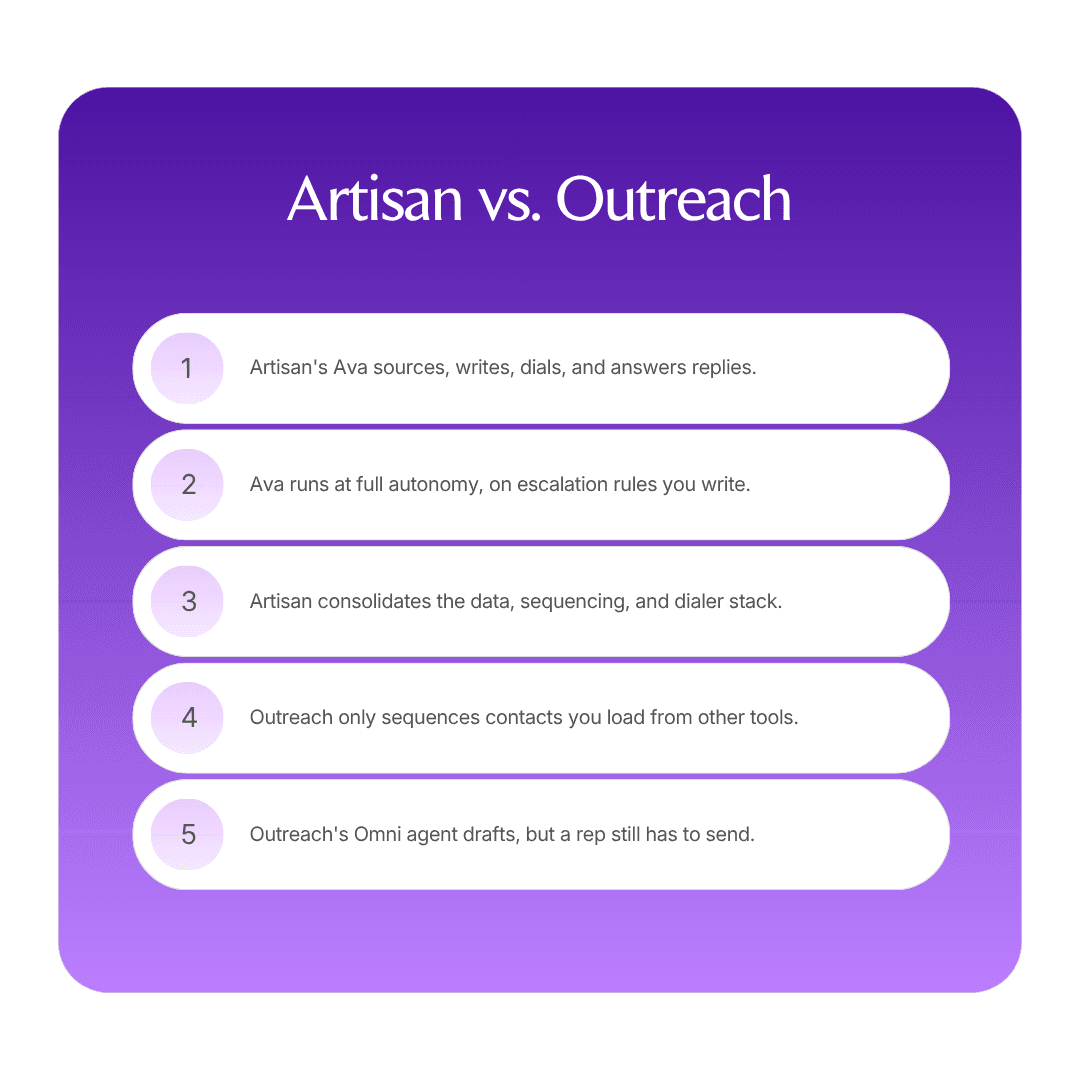
Ava sources the audience herself. She searches a database of over 250 million B2B professionals across over 200 countries, plus Artisan Local Data covering over 250 million local businesses, using natural-language search, ideal customer profile (ICP) filters, and intent signals: funding rounds, new executive hires, first hire in a department, hiring for a role, tech-stack signals, topic intent, and custom signals you define in plain English, with confidence scoring and evidence URLs on the results. She runs waterfall enrichment across roughly a dozen providers for verified emails and phone numbers, and charges only when enrichment succeeds. You do not maintain a separate data stack. For the wider category, see outreach tools.
Outreach: Writing and sending the messages
This is the clearest difference. In Outreach, a person writes the sequence. Templates and AI assists help, but the message is human-authored and human-triggered, and personalization at scale means someone doing research or accepting generic copy. Omni can suggest and draft, yet a rep remains in the loop on execution.
Ava writes and sends. Two people enrolled in the same Artisan campaign receive two completely different messages, not one template with a swapped name and title. Personalization runs from light touches up to research-agent swarms that dig for hard criteria. She runs dozens of message variations, shifts volume toward what converts, and optimizes at the component level. On deliverability she provisions and manages mailboxes, tests inbox placement, checks SPF, DKIM, and DMARC, watches mailbox health with dashboards and alerts, applies dynamic send limits, rotates inboxes, and auto-pauses unhealthy mailboxes on bad bounce patterns. In Outreach, deliverability hygiene is largely your team's responsibility. For how this is automated, see outreach automation.
Handling replies and booking
When a prospect replies in Outreach, a rep reads it, decides, and responds. The system routes and tracks, and a human answers. This is by design, since Outreach is built to make reps efficient at exactly this.
Ava handles the reply herself. She qualifies, answers objections from your knowledge base, chases follow-ups, and escalates on rules you write in plain language ("if the lead mentions pricing, escalate to a human"). She books meetings directly on the right rep's calendar using CRM-owner routing. Your rep walks into a booked meeting instead of managing the thread that produced it.
CookUnity's Bruno Didier put the scale difference plainly: "Ava runs highly targeted outreach at a scale we could never reach with a human-only team." His team sent over 100,000 emails at roughly a $45 cost per lead. On Ava the AI sales agent, this scale comes with governance built in, which matters for an enterprise buyer weighing Outreach. For a related comparison, see Artisan vs. Gong Engage.
Pricing: Seats and credits vs. work performed
Outreach prices per seat on a gated model. After its 2026 rebrand to outreach.ai, the Amplify Core, Plus, and Pro tiers add AI-credit consumption on top of seat costs, and pricing is quote-based. Independent estimates put seats in the range of roughly $100 to $165/user/month before those credits, though Outreach does not publish figures. For a fuller breakdown of the vendor, see Outreach pricing and reviews. For a large team, seats multiply whether or not any given rep is productive that month.
Artisan charges for work performed rather than for seats. Pricing runs on usage-based credits, and you can trial Ava for free, so cost tracks output rather than headcount. See Artisan pricing for the current shape. The practical effect is that you are not paying a fixed per-seat fee for reps who may or may not run their sequences, and pipeline economics improve as Ava handles more of the volume. Chain of Events, the team behind RAISE Summit, replaced the workload of five human BDRs with Ava on a $28K annual investment. For another head-to-head, see Apollo vs. Outreach.
Choose Outreach if...
You run a large, established sales org where the priority is enforcing a consistent process across many human reps, and cadence governance, permissions, and shared libraries are non-negotiable.
Your reps are your engine and you want to make them faster instead of automating their work. Outreach's whole design is rep augmentation, and it is good at it.
You are already deep in an Outreach deployment with trained admins and integrated reporting, and the switching cost of moving a mature motion outweighs the gains.
Your forecasting and pipeline analytics needs are heavy and you value years of maturity in this reporting.
If these describe you, Outreach is a defensible, capable choice, and its enterprise workflow depth is real. For other options, see the best Outreach alternatives.
Choose Artisan if...
You want outbound to run without hiring, reallocating, or babysitting reps through cadences. Ava does the sourcing, writing, sending, and replying.
You are tired of stitching a data tool, an enrichment layer, a sequencer, a dialer, and a deliverability tool into one motion, plus an ops person who keeps it running. Artisan consolidates this stack.
You want control without manual labor: review-and-approve, objections-only, or full autonomy, with plain-language escalation and an audit trail. Over 90% of Artisan customers run Ava autonomously.
Cost per meeting is your constraint, and per-seat pricing for a large rep team no longer makes sense.
Frequently asked questions
Is Outreach better than Artisan for cadence governance?
For a large team that needs to enforce one shared process across many human reps, Outreach's governance, permissions, and cadence libraries are more mature. This is its home turf. Artisan offers its own governance (autonomy modes, plain-language escalation rules, org-level coaching and banned phrases, a full audit trail), but it governs an AI worker instead of orchestrating dozens of human ones. Pick Outreach if managing reps is the job; pick Artisan if you would rather the job ran itself.
Does Artisan replace my sales team the way Outreach organizes it?
No. Ava removes the grunt work of prospecting, sending, and first-line replies so your reps spend time selling and closing. Outreach makes reps more efficient at doing this grunt work themselves. Artisan takes it off their plates. Your AEs still own relationships and deals, and Ava feeds them booked meetings.
How much does Outreach cost compared to Artisan?
Outreach is gated. Its Amplify Core, Plus, and Pro tiers combine seats with AI-credit consumption, and third parties estimate seats around $100 to $165/user/month before credits. Artisan is usage-based, so you pay for the work Ava performs rather than for a fixed seat count, and you can trial her for free. For a large rep team, that difference compounds.
Can Artisan handle enterprise security and compliance like Outreach?
Yes. Artisan is SOC 2 Type II compliant and GDPR and CCPA compliant, with regular third-party penetration testing, a Trust Center, and a standard data processing agreement (DPA). Single sign-on (SSO), SAML, and role-based access controls are available on Enterprise plans, alongside a forward-deployed strategist and a dedicated customer success manager (CSM). Global fintechs run Ava centrally from sales ops for large AE teams who never log in.
What is Outreach's Omni agent, and does Artisan have an equivalent?
Omni, launched April 27, 2026, is Outreach's AI agent layered on its rep workflow to assist with drafting and suggestions. It sits on top of the human motion. Artisan's Ava is not an assist on a rep workflow. She is the worker who runs the workflow. The difference is architectural: augment a rep, or remove a rep's busywork.
Which one is faster to launch?
Outreach deployments at large orgs typically involve admin setup, sequence building, and rep training on the platform. Artisan starts with a free trial and a natural-language ICP, and Ava begins sourcing and drafting quickly, with a forward-deployed strategist on the Enterprise plan. Time to first campaign is generally shorter when the tool does the building for you.
The bottom line
Outreach is the right tool if your motion is human reps and you need to run them consistently at scale. It has earned its place in that job. Artisan wins when the goal is the outcome instead of the orchestration: an AI BDR who finds the leads, writes and sends the outreach, answers the replies, and books the meetings, as autonomously as you allow. For most teams asking whether to buy more rep-management or buy the work itself, the answer is Ava.
Compare more: Artisan vs. Salesloft, the AI BDR explainer, and Artisan.
Related reading

Artisan Team
Expert insights from the team at Artisan
Our writing team blends direct operational experience, in-house data, and thorough research to bring you the very latest insights and updates about sales and GTM automation.