The best Amplemarket alternatives in 2026
Amplemarket is a solid data and engagement all-rounder, but a human still runs it. Here are the best Amplemarket alternatives in 2026, ranked and honest.

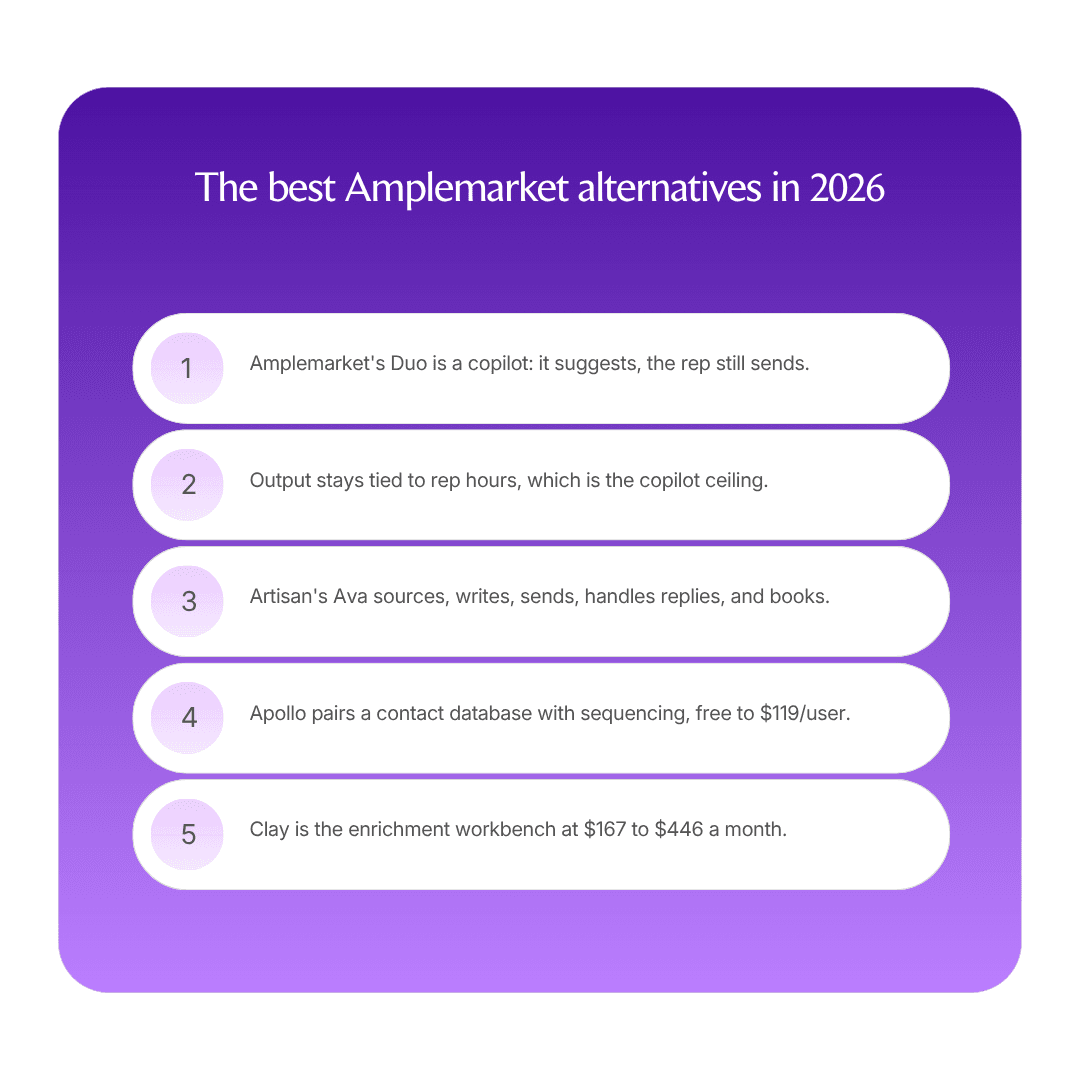
The best Amplemarket alternative for most teams is Artisan, because it runs the outbound job autonomously end to end rather than sitting beside a rep as a copilot. Amplemarket is a capable all-rounder: data, engagement, and the Duo copilot in one place. The limit is right there in the model. Duo assists; a human still runs the motion.
That is the difference people go looking for. Amplemarket makes a rep faster. It does not remove the rep from the loop. If you want the sourcing, writing, sending, replying, and booking handled for you, the alternatives below get you closer to that from different directions.
The best Amplemarket alternatives at a glance
Rank | Tool | Best for | Standout capability | Public pricing |
|---|---|---|---|---|
1 | Artisan | Teams that want outbound run autonomously end to end | AI BDR that owns the full job | Usage-based credits, no platform fee (pricing) |
2 | Apollo | Value all-in-one data and sequencing | Large database with outreach attached | Free to ~$119/user/mo |
3 | AiSDR | Transparent AI-SDR pricing and fast setup | Outbound plus inbound with the Ami agent | $250-$2,500/mo |
4 | Clay | Bespoke enrichment orchestration | 150+ providers, Claygent agents | $167-446/mo public tiers |
5 | Reply.io | Accessible agent on a sequencer | Jason AI on top of native sequencing | Sequences from $59/mo; agent ~$500-800/mo |
How we chose
We weighted four criteria against how Amplemarket buyers actually work. First, how much of the job the tool does on its own, since the copilot-versus-autonomous gap is the reason most people are shopping. Second, data and signal depth, because Amplemarket's signal-based selling is a genuine strength to match. Third, pricing transparency, given Amplemarket's entry price is not published. Fourth, deployment fit from a lean startup team through a large enterprise sales org.
Why do people look for an Amplemarket alternative?
They look because Amplemarket is a copilot, and a copilot has a ceiling. Amplemarket does a lot well. It combines a contact database, multichannel engagement, and the Duo copilot, with a real emphasis on signal-based selling. For a rep who wants better data and smarter suggestions in one tool, it is a strong pick, and the all-rounder breadth is legitimate.
The ceiling is structural. Duo suggests messages, surfaces signals, and speeds up the workflow, but a human still decides, approves, sends, and works every reply. That means output per rep goes up while pipeline stays tied to headcount: to double pipeline you roughly double the team. Teams that hoped to scale outbound without scaling hiring hit that wall. The alternatives below either lower the cost of the human-run model or, in Artisan's case, remove the requirement that a human run it at all.
The 5 best Amplemarket alternatives in 2026
1. Artisan: autonomous end to end
Artisan is the alternative for teams that want the outbound job owned, not assisted. Ava, Artisan's AI BDR, does what a copilot suggests you do: she sources best-fit leads from a database of over 250 million B2B professionals across over 200 countries, plus Artisan Local Data covering over 250 million local businesses, runs waterfall email and phone enrichment across roughly a dozen providers, and prioritizes by conversion likelihood. Then she writes personalized multichannel outreach across email, social, and dialer steps, tests dozens of message variations, and shifts volume to what converts.
The part that breaks the copilot ceiling is what comes next. Ava handles every reply, qualifies, answers objections from a knowledge base, chases follow-ups, and books meetings on the right rep's calendar with CRM-owner routing. Pipeline stops scaling with headcount because the AI, not the rep, runs the motion. Autonomy is a dial: review and approve each message, objections-only, or fully autonomous with plain-language escalation rules and a full audit trail.
Amplemarket's signal-based selling is a real strength, and Artisan matches it: funding rounds, new hires, tech-stack and topic intent, champion job changes, and website visitor identification all trigger campaigns directly. For enterprises, Ava runs centrally from sales ops with SOC 2 Type II attestation, SSO and SAML, and role-based access. SaaStr's Chief AI Officer, Amelia Lerutte, put it plainly: "Email has always been our number one driver. Artisan is now neck-and-neck in both output and closed-won revenue," after sending 6,892 emails in roughly six weeks at a 3.6% positive response rate.
Best for: teams from startup to enterprise that want outbound run autonomously, not a faster rep. Who should pick something else: teams that specifically want a human in the loop on every send, with AI only assisting, may prefer a copilot like Amplemarket. Pricing: usage-based credits, pay for work performed rather than seats, no platform fee, free trial. See pricing.
2. Apollo: value all-in-one
Apollo is the pragmatic alternative if you want Amplemarket's all-rounder breadth at a lower, transparent price. It pairs a large contact database with sequencing and is used by hundreds of thousands of companies, acquired Pocus in March 2026 for product and buyer signals, and reportedly crossed $200M in ARR. Data, sequencing, and basic signals live in one place from a free tier upward.
The trade is depth and autonomy. Apollo's AI is assistive like Duo, so it shares the same copilot ceiling, and enterprises often treat it as a data layer feeding richer tools rather than a system of action. If your issue with Amplemarket is price rather than the copilot model, Apollo is the natural move.
Best for: budget-conscious teams that want data and sequencing with light signals in one tool. Who should pick something else: teams that want to break the copilot ceiling should look at Artisan; teams needing deep enrichment should look at Clay. Pricing: free tier up to roughly $119/user/month, per its pricing page.
3. AiSDR: transparent AI-SDR pricing
If you like Amplemarket's direction but want more of the work handled and clearer pricing, AiSDR is a closer step toward an agent. It runs outbound and inbound through its Ami agent, sets up fast, and publishes its tiers at $250, $900, and $2,500 a month, which is refreshingly transparent in a category full of "talk to sales."
The limits are scope and governance. AiSDR's center of gravity is SMB and lower mid-market, and its enterprise story, security posture, central deployment, audit depth, is thinner than what large orgs need. It is a good pick for a smaller team that wants an agent running email without a heavy contract.
Best for: SMB and lower mid-market teams that want transparent AI-SDR pricing and quick setup. Who should pick something else: enterprises needing deep governance and central ops deployment should choose Artisan. Pricing: $250 to $2,500 a month, per its pricing page.
4. Clay: the enrichment workbench
If the part of Amplemarket you rely on most is data and signals, Clay is the deeper specialist. It orchestrates 150+ enrichment providers, runs research through Claygent agents, and lets you build custom enrichment and signal tables no packaged tool ships. Its $3.1B valuation as of August 2025 reflects best-in-class orchestration.
Clay is the opposite of a copilot in one sense and the same in another: it does not assist a rep at all, but it also does not send anything. It is infrastructure you operate, usually with a GTM engineer around $160K, producing enriched rows that another tool acts on. Clay gives you the workbench; Artisan gives you the worker.
Best for: technical teams that want to build custom enrichment and signal workflows. Who should pick something else: teams without an operator, or teams that want executed outreach, should look at Artisan. Pricing: $167 to $446 a month on public tiers; median contracts around $30K a year.
5. Reply.io: an accessible agent on a sequencer
Reply.io is the low-friction way to add an email agent to a familiar sequencer. Its Jason AI agent sits on top of native sequencing, so you can start with classic cadences from about $59 a month and layer the AI SDR on for roughly $500 to $800 a month. For teams that want to test agent-run email without a big commitment, it is an easy on-ramp.
The constraint is that it is an email-centric agent on a traditional sequencer, so the deeper multichannel and autonomous-reply handling of a purpose-built AI BDR is not the core. It is a step past Amplemarket's copilot on email specifically, not a full end-to-end owner of the job.
Best for: teams that want an affordable agent bolted onto a sequencer they already understand. Who should pick something else: teams that want multichannel, fully autonomous outbound should choose Artisan. Pricing: sequences from $59/month; the AI SDR agent around $500-800/month.
What is the best enterprise alternative to Amplemarket?
For enterprises, Artisan is the strongest alternative because it breaks the link between pipeline and headcount that a copilot cannot. Amplemarket makes each rep more productive, but scaling still means hiring. Artisan runs centrally from sales ops for large AE teams who never log in, with SOC 2 Type II attestation, SSO and SAML, role-based access, an audit trail, and a forward-deployed strategist plus a dedicated CSM. Signals, named-account targeting, and person-level website visitor identification on US traffic come together as native enterprise ABM with the outreach built in. Bruno Didier, CEO of CookUnity Business, said "Ava runs highly targeted outreach at a scale we could never reach with a human-only team," at roughly a $45 cost per lead across 100,000+ emails.
If the requirement is transparent AI-SDR pricing for a smaller team rather than enterprise governance, AiSDR is the alternative worth a look.
Stay with Amplemarket if
Stay with Amplemarket if you want your reps in the driver's seat with a capable copilot beside them. If your motion depends on human judgment on every send, if reps value Duo's suggestions and signal surfacing, and if you are comfortable scaling pipeline by scaling the team, Amplemarket is a solid all-rounder that bundles data, engagement, and AI in one place. The signal-based selling is real, and for a team that wants augmentation rather than autonomy, the copilot model is a feature, not a flaw.
If the honest goal is to grow pipeline without growing headcount, an AI sales agent that owns the job end to end is the better buy. For the full category picture, see our guide to the best AI GTM platforms. See also the best sales engagement platforms, Artisan vs Outreach, Artisan vs Salesloft, and Artisan vs Gong Engage.
Frequently asked questions
What is the best alternative to Amplemarket?
For most teams it is Artisan, because it does the job Amplemarket's Duo copilot only assists with. Ava sources, enriches, writes, sends, handles replies, and books meetings autonomously, which breaks the copilot ceiling where pipeline scales only with headcount. Autonomy is a dial, from full autonomy down to review-and-approve when you want a human in the loop.
How is Artisan different from Amplemarket?
Amplemarket is a data-and-engagement platform with an AI copilot: it speeds up a rep who still runs the motion. Artisan is an AI BDR that owns the motion. The practical result is that Amplemarket increases output per rep, while Artisan decouples pipeline from headcount because the AI, not a person, does the sending and replying. Both do signal-based selling; only Artisan acts on the signal autonomously.
Is Amplemarket worth the price?
Amplemarket's entry runs around $600 a month, and its all-rounder breadth, data, engagement, and the Duo copilot, justifies that for teams that want augmentation. Whether it is worth it depends on your goal. If you want reps to work faster, yes. If you want pipeline to grow without adding reps, a copilot cannot get you there, and a usage-based autonomous platform where you pay for work performed is usually the better economics.
What is a cheaper alternative to Amplemarket?
Apollo is the most common lower-cost swap, starting free and reaching about $119 per user per month with data and sequencing included. AiSDR publishes transparent AI-SDR tiers from $250 a month if you want more of the work automated. Both trade some depth for price. If cost matters because a copilot still requires paid reps to run it, moving to a pay-for-work model can lower total spend more than switching copilots.
What is the best enterprise alternative to Amplemarket?
Artisan, because it removes the headcount dependency that a copilot leaves in place. It deploys centrally from sales ops, holds SOC 2 Type II attestation, offers SSO, SAML, and role-based access, and runs native enterprise ABM with signals, visitor identification, and outreach built in. Per-seat economics stay flat as the team grows, unlike a model where more pipeline means more reps.
Does Artisan do signal-based selling like Amplemarket?
Yes, and it acts on the signals rather than surfacing them for a rep. Artisan tracks funding rounds, new hires, tech-stack and topic intent, champion job changes, and website visitors, and you can define custom triggers in plain English with confidence scoring. When a signal fires, Ava launches personalized multichannel outreach automatically instead of waiting for someone to approve the play.
Ready to move from copilot to autonomous? Start with Artisan or see how an AI BDR owns the full outbound job. Compare tools in Apollo vs Outreach, outbound sales tools, sales productivity tools, and email sequencing software.
Jaspar Carmichael-Jack
Co-Founder & CEO @ Artisan
Jaspar is an entrepreneur with expertise in sales, marketing, and operations. He founded Artisan in 2023, a company automating workflows with AI employees.