Gong Engage pricing and reviews (2026)
What Gong Engage costs in 2026, its bundled platform fee plus per-seat model, the call-intelligence-to-outreach differentiator, and honest reviews.
Key Takeaways
- Gong Engage pricing is gated and bundled. It is sold as part of the Gong platform, rather than as a standalone product with a public price.
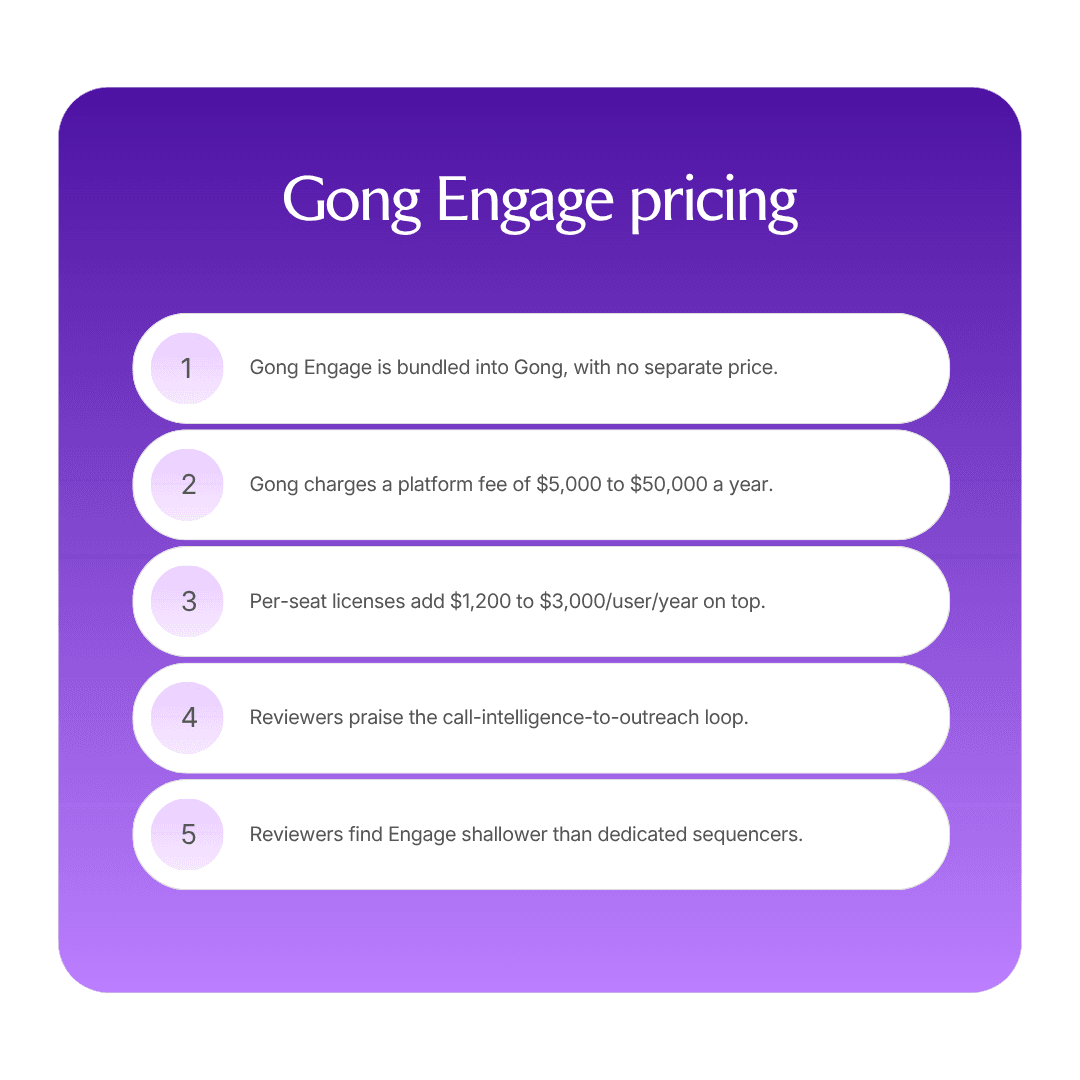
- Gong charges a mandatory platform fee, reported at roughly $5,000 to $50,000 a year depending on company size, plus a per-seat license of roughly $1,200 to $3,000/user/year.
- The Engage-only price is not disclosed, so most buyers price it as an add-on to a Gong contract they already hold or are negotiating.
- Engage's differentiator is the conversation-intelligence-to-engagement loop: outreach informed by what Gong's call analysis learned.
- Gong's annual recurring revenue (ARR) passed $500M in May 2026, up over 55% year over year, across more than 5,000 customers, so this is a scaled, well-funded vendor.
Gong Engage is the sales-engagement module inside Gong's Revenue AI platform, and it is sold bundled and gated. Expect a mandatory platform fee of roughly $5,000 to $50,000 a year by company size, plus around $1,200 to $3,000 per seat annually. The Engage-only price is not disclosed. Reviewers praise the call-intelligence-to-outreach loop.
Gong Engage pricing at a glance (2026)
Component | What it covers | Pricing (as of 2026) |
Platform fee | Base access to the Gong Revenue AI platform | Custom, contact sales (estimated $5,000 to $50,000/year by size) |
Per-seat license | User licenses across the platform, Engage included in the bundle | Custom, contact sales (estimated $1,200 to $3,000/user/year) |
Engage module | Sequencing and engagement built on Gong's call intelligence | Not disclosed separately, bundled |
Every figure is gated and estimated from third-party buyer reports, rather than a published rate. The structure matters more than any single number: Gong prices a base platform fee first, then per-seat licenses on top, and Engage rides inside this bundle without carrying its own line item.
How much does Gong Engage cost in practice?
Budget for two layers rather than one. The platform fee is a fixed annual cost that scales with company size, and it applies before you count a single seat. On top of this sits the per-seat license. For a 25-seat team, the reported per-seat range alone lands somewhere between roughly $30,000 and $75,000 a year, and the platform fee can add anywhere from a few thousand to tens of thousands more. The total is a meaningful five-to-six-figure annual commitment.
Because Engage is bundled, the practical question is rarely "what does Engage cost?" It is "what does adding engagement to our Gong contract cost?" Teams already running Gong for call intelligence are extending an existing spend. Teams that are not are buying the whole platform to reach the engagement layer, which is a larger decision than picking a standalone sequencer. Reviewers report that the value is real when call-analysis data is already central to how a team sells, and harder to justify when it is not.
What makes Gong Engage different from a standalone sequencer?
The differentiator is the loop between conversation intelligence and outreach. Gong built its name on call and deal analysis, and Engage uses what this analysis learns to inform sequences, follow-ups, and rep actions. In principle, the outreach is smarter because it is grounded in what actually happened on calls and in deals, instead of in a static cadence a rep set up weeks ago.
This is a genuine edge, and it is also the honest limit. Engage launched in 2023 and is newer and less mature at pure sequencing depth than a dedicated platform like Outreach or Salesloft. It is not sold to be a best-of-breed standalone sequencer. It is sold as the engagement layer that comes with the intelligence platform. If conversation data is the center of gravity for your revenue team, this pairing is the whole point. If you just need deep sequencing, a specialist may go further. For the category, see the best sales engagement platforms.
What are the hidden costs of Gong Engage?
The layered pricing is the first surprise. Buyers who anchor on a per-seat number can forget the platform fee, which is mandatory and size-based. The second is bundling. Because Engage is not sold or priced alone, you are usually committing to the broader Gong platform to use it, so the true cost is the whole contract rather than an incremental module fee.
Add the usual enterprise realities: annual terms, negotiated pricing that varies by buyer, and implementation and admin time to see value from both the intelligence and the engagement sides. For context on the vendor's footing, Gong's ARR passed $500M in May 2026 at over 55% year-over-year growth with more than 5,000 customers, and a reported secondary valuation around $4.5B (down from a $7.25B primary in 2021), with no announced IPO. This is a stable, scaled company. It also prices like one.
What do reviewers say about Gong Engage?
The consensus is that Gong is exceptional at conversation and deal intelligence, and that Engage is a strong, still-maturing engagement layer that shines specifically because it sits on top of this intelligence. Reviewers report that grounding outreach in call insights is the standout, that the analytics and coaching are best in class, and that having intelligence and engagement in one platform reduces context-switching for reps.
The criticisms are about scope and cost. Reviewers report that Engage is less deep than dedicated sequencers for teams whose main need is sequencing, that pricing is opaque and bundled with a platform fee, and that the total commitment is high enough that it makes most sense for teams already invested in Gong. Some note that setup and adoption take real effort. The fair read is to buy it for the intelligence-to-engagement loop instead of as a pure sequencer. For the tooling category, see email sequencing software.
Who is Gong Engage best for, and not for?
Gong Engage best fits mid-market and enterprise revenue teams that already run Gong, or plan to, and want their outreach informed by call and deal intelligence in one platform. If conversation data drives how your team coaches and sells, extending it into engagement is a natural, high-value step.
It fits less well for teams that mainly need deep, standalone sequencing, for small teams that cannot absorb a platform fee plus per-seat licenses, and for buyers who want AI to run outbound instead of a smarter cockpit for reps. Engage informs and speeds up human outreach. The prospecting, the sending, and the replies still come from your reps. If the constraint is headcount rather than rep insight, the intelligence loop does not change this. See also our roundup of outbound sales tools.
Worth considering: Artisan
If you are drawn to Gong Engage because you want outreach driven by real signals instead of static cadences, it is worth looking at a tool that pairs signals with activation and then runs it. Gong learns from calls and hands smarter sequences to reps. Artisan puts the signals and the outreach in one system and lets AI run the motion. Ava, Artisan's AI business development representative (BDR), works off funding rounds, newly hired executives, hiring activity, tech-stack intent, Bombora-powered topic intent, champion job changes, website visitor identification, and custom signals you define in plain English, with confidence scoring and evidence URLs on the results, then launches the outreach the moment a signal fires.
She owns the full loop rather than the insight alone: sourcing from a database of over 250 million B2B professionals across over 200 countries plus Artisan Local Data covering over 250 million local businesses, waterfall email and phone enrichment, personalized multichannel campaigns across email, social media, and the dialer, reply handling and objection responses from a knowledge base, and meeting booking with CRM-owner routing. It runs on an autonomy dial, review-and-approve, objections-only, or fully autonomous, with plain-language escalation and a full audit trail, and over 90% of customers run Ava autonomously. You buy one platform instead of an intelligence suite plus a separate stack to act on it. See also our roundup of sales productivity tools.
On cost, Artisan's model is different in kind. Artisan is usage-based, so you pay for the work Ava performs rather than for seats, and you can trial her for free. See Artisan pricing. Bruno Didier, CEO of CookUnity Business and an Artisan customer, said, "Ava runs highly targeted outreach at a scale we could never reach with a human-only team," at roughly $45 cost per lead across over 100,000 emails. For a team weighing Gong Engage, the question is whether you want intelligence that makes reps sharper or AI that turns a signal into qualified pipeline on its own. For a direct comparison, see Artisan vs. Gong Engage.
Frequently asked questions
How much does Gong Engage cost?
Gong Engage is priced as part of the Gong platform, and pricing is gated. Expect a mandatory platform fee, reported at roughly $5,000 to $50,000 a year by company size, plus a per-seat license of roughly $1,200 to $3,000/user/year. The Engage-only price is not disclosed separately. Treat these as estimates from third-party buyers, rather than published rates.
Can you buy Gong Engage on its own?
Not really. Engage is the sales-engagement module inside Gong's Revenue AI platform, and it is sold bundled instead of as a standalone product with its own price. Most buyers add it to a Gong contract they already hold or are negotiating. If you do not want the broader Gong platform, a dedicated sequencer may be a cleaner fit.
Is Gong Engage better than Outreach or Salesloft?
It depends on what you need. Gong Engage's edge is the call-intelligence-to-outreach loop, so outreach is informed by what your calls and deals reveal. For pure sequencing depth, Outreach and Salesloft are more mature dedicated platforms. Engage launched in 2023 and is newer at sequencing. Choose Engage if conversation intelligence is central to how your team sells.
Why is Gong Engage so expensive?
The cost reflects a layered, enterprise model: a mandatory platform fee that scales with company size, plus per-seat licenses, sold as a bundle instead of a cheap add-on. Gong is a scaled vendor, with ARR past $500M in May 2026 and more than 5,000 customers, and it prices accordingly. The value case is strongest for teams already invested in Gong's intelligence.
Does Gong Engage replace SDRs?
No. Engage informs and accelerates human outreach by grounding it in call and deal intelligence, but sales development representatives (SDRs) still prospect, send, and reply. If you want the prospecting-to-booking job handled by AI instead of made smarter for humans, that is a different category. Artisan's Ava owns the outbound workflow end to end, with human review and escalation controls.
What are alternatives to Gong Engage?
For dedicated sequencing, look at Outreach and Salesloft (both gated). For AI that pairs signals with activation and runs outbound itself, instead of a bundle of intelligence plus a rep-driven engagement layer, Artisan uses a usage-based model, so you pay for the work Ava performs, and you can trial her for free. The right pick depends on whether you want sharper reps or an autonomous motion. Weigh the field in the best Gong Engage alternatives and the head-to-head on Artisan vs. Outreach.
Compare the category on our Outreach pricing and reviews and Salesloft pricing and reviews pages, see what an AI BDR does, compare Apollo vs. Outreach, or explore Artisan's AI sales agent.
Related reading

Artisan Team
Expert insights from the team at Artisan
Our writing team blends direct operational experience, in-house data, and thorough research to bring you the very latest insights and updates about sales and GTM automation.