The best Default alternatives in 2026
Default orchestrates RevOps but does not source pipeline. The best Default alternatives in 2026, from an autonomous AI BDR to Clay, LeanData, Chili Piper, and Unify.

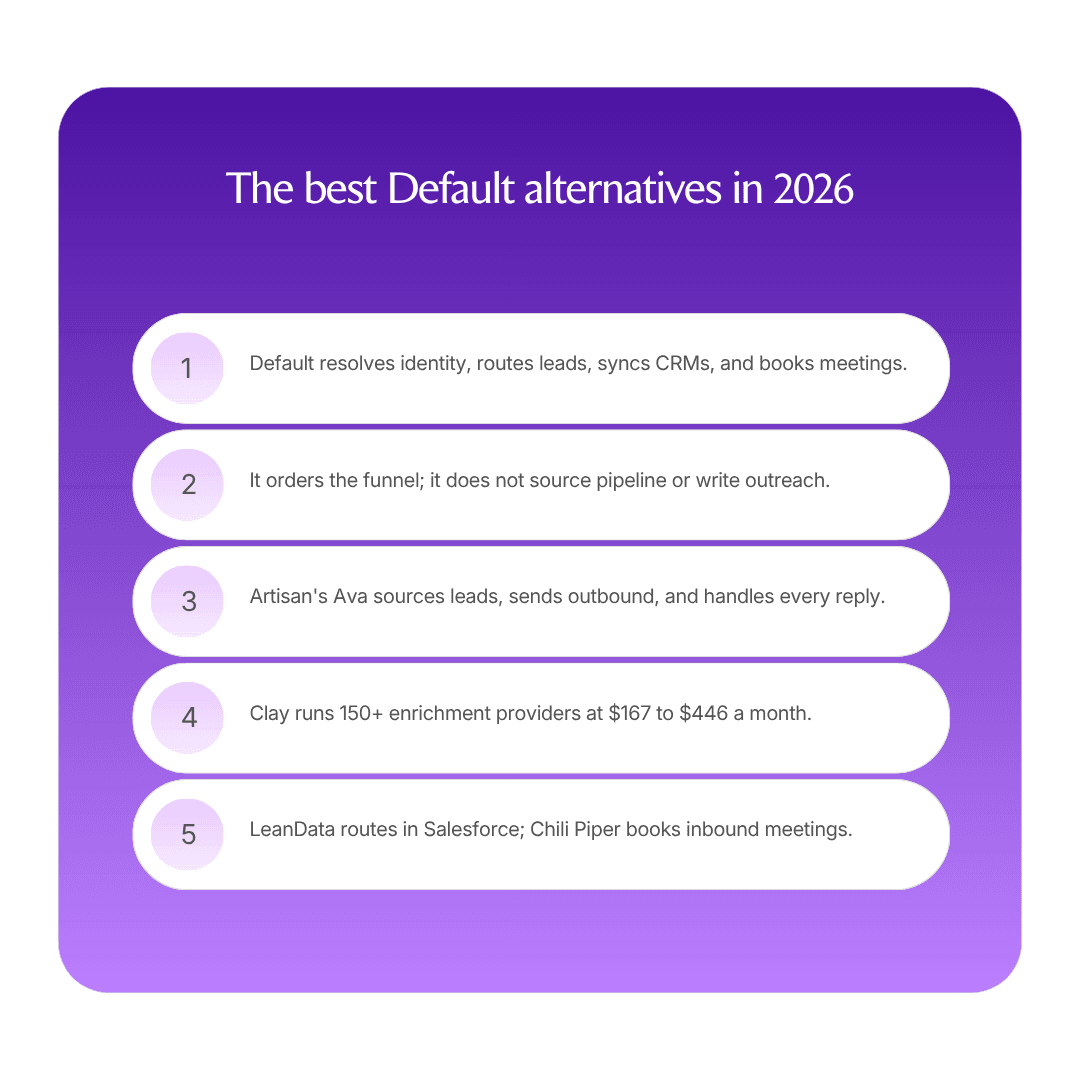
The best Default alternative for most teams is Artisan, because it runs the full outbound and inbound motion rather than running the revenue operations beneath it. Default is an agentic GTM and RevOps orchestration platform, positioned as AI infrastructure for revenue teams. It unifies a real-time GTM data layer, a revenue agent called Dot, and native routing, enrichment, and scheduling tools under a governance layer. Founded by Nico Ferreyra and Victor Papyshev, Default has raised about $20M, a Series A led by 8VC in May 2026 on top of a $6.6M seed in 2023.
The gap is that Default orchestrates operations; it does not source net-new pipeline or run outbound. It resolves identity, syncs bidirectionally with Salesforce and HubSpot, routes leads, enriches records, and books meetings. It does not build an outbound target list from an ICP, write personalized outreach, or work replies the way an AI BDR does. The alternatives below either own that whole motion or bring the routing, scheduling, and enrichment depth a RevOps team leans on.
The best Default alternatives at a glance
Rank | Tool | Best for | Standout capability | Public pricing |
|---|---|---|---|---|
1 | Artisan | Teams that want autonomous outbound and inbound owned | AI BDR plus Ava Inbound in one platform | Usage-based credits, no platform fee (pricing) |
2 | Clay | Custom enrichment and data orchestration | 150+ providers, Claygent agents | $167-446/mo public tiers |
3 | LeanData | Salesforce-native lead routing at scale | Lead-to-account matching and flow-based routing | Gated, per its site |
4 | Chili Piper | Inbound scheduling and conversion | Instant booking and inbound routing | Per-seat pricing, per its site |
5 | Unify | Warm-outbound system of action | Signal aggregation plus automated plays | Free (≤3 seats); $20-60/seat/mo + credits |
How we chose
We weighed four criteria against what Default buyers usually need next. First, how much of the motion the tool runs on its own, since Default's orchestration scope is the reason most teams are shopping. Second, data and enrichment depth, because that is a core Default strength any alternative should match. Third, whether it handles inbound and outbound or only one side. Fourth, deployment fit from a lean team through a large, governed RevOps org.
Why do people look for a Default alternative?
They look because Default orchestrates revenue operations, and orchestration does not source pipeline. Default does the RevOps and inbound plumbing well: resolving identity, keeping Salesforce and HubSpot in sync, enriching records through waterfall lookups, routing leads to the right owner, and scheduling meetings, all governed by approvals, audit logs, and one-click rollback. For a RevOps team that wants clean data and a reliable inbound path, that is real value, and the Dot revenue agent turning plain-language requests into workflows fits a serious operations mandate.
The gap is everything before and after the funnel you already have. Default does not build a net-new outbound target list from an ICP, write personalized multichannel outreach, run a dialer, or work replies until a meeting is booked. It optimizes the leads that already arrive. Teams that want autonomous outbound, pipeline generated rather than routed, and inbound leads actually engaged and qualified rather than handed off, look for something that runs the motion. The alternatives below either own outbound and inbound end to end or bring the routing, scheduling, and enrichment a RevOps team wants.
The 5 best Default alternatives in 2026
1. Artisan: the full outbound and inbound motion in one platform
Artisan is the alternative for teams that want the whole motion owned, not just the funnel routed. On outbound, Ava, Artisan's AI BDR, sources best-fit leads from a database of over 250 million B2B professionals across over 200 countries, plus Artisan Local Data covering over 250 million local businesses, runs waterfall email and phone enrichment across roughly a dozen providers, writes personalized multichannel outreach across email, social, and dialer steps, tests dozens of message variations, and shifts volume to what converts. That is the pipeline generation an orchestration layer never touches.
On inbound, Ava Inbound covers the ground Default optimizes, then keeps going. Live chat greets and qualifies website visitors, answers from the same knowledge base as autonomous replies, and books meetings with CRM-owner routing (deal owner, then contact owner, then company owner). Form-fill follow-ups send instantly, and identified visitors flow into campaigns. So the inbound capture, routing, and scheduling Default handles run natively here, with the difference that Ava also engages, qualifies, and replies rather than just directing traffic. Autonomy is a dial from review-and-approve to fully autonomous, with a full audit trail.
The data and ops depth match a RevOps mandate: waterfall enrichment across roughly a dozen providers, bidirectional Salesforce and HubSpot sync with owner mapping and field-level export control, and native signals. For enterprises, Ava deploys centrally from sales ops with SOC 2 Type II attestation, SSO and SAML, and role-based access. SumUp's growth lead Karlo Biuk reported a $52 cost per lead and 8 to 15 positive replies a week from previously unreachable local SMBs.
Best for: teams from startup to enterprise that want outbound generation and inbound handling run as one motion. Who should pick something else: teams that only need lead routing and RevOps orchestration under an existing engagement stack, with no need to run outreach, may be served by focused infrastructure. Pricing: usage-based credits, pay for work performed rather than seats, no platform fee, free trial. See pricing.
2. Clay: the enrichment workbench
Clay is the deeper specialist if the part of Default you value most is data and enrichment. It orchestrates 150+ enrichment providers, runs research through Claygent agents, and lets you build custom enrichment and signal tables no packaged tool ships. Its $3.1B valuation as of August 2025 reflects best-in-class orchestration, and median contracts run around $30K a year.
Clay is infrastructure, like Default, but pointed at data depth rather than end-to-end orchestration. It does not run outreach and it does not route inbound; it produces enriched rows another tool acts on, usually operated by a GTM engineer around $160K. If your real need is richer, more flexible data than Default's built-in enrichment, Clay is the specialist. If you need the motion run, it is not that. Clay gives you the workbench; Artisan gives you the worker.
Best for: technical teams that want to build custom enrichment and data workflows beyond an orchestration layer. Who should pick something else: teams without an operator, or teams that want executed outreach, should look at Artisan. Pricing: $167 to $446 a month on public tiers; median contracts around $30K a year.
3. LeanData: Salesforce-native routing
LeanData is the pick if the Default capability you rely on most is lead routing inside Salesforce. It does lead-to-account matching and flow-based routing at enterprise scale, sending the right record to the right owner across large, complex org structures. For a RevOps team standardized on Salesforce, it is the routing backbone many stacks are built around.
The trade is scope. LeanData routes and matches; it does not source outbound, write outreach, or handle inbound conversation. Like Default, it is orchestration rather than a selling motion, so pipeline still depends on the engagement tools downstream. If routing is the piece you want to isolate and get right, LeanData is the specialist. If you want the motion run, it is not that.
Best for: Salesforce-heavy RevOps teams that want routing and matching handled precisely. Who should pick something else: teams that want outbound sourced and run, plus inbound engaged, should choose Artisan. Pricing: gated, quoted by deployment; confirm current terms with LeanData.
4. Chili Piper: inbound conversion and scheduling
Chili Piper is the alternative if the Default job you care about is inbound conversion: qualifying form fills, booking meetings instantly, and routing inbound to the right rep. It is strong at compressing the time between a form submission and a booked meeting, which is exactly the funnel-speed problem Default addresses on the inbound side.
The limit is the same shape as Default's. Chili Piper converts and schedules inbound; it does not generate net-new outbound pipeline or run multichannel outreach. It optimizes the leads that arrive rather than sourcing new ones, so a team that needs outbound still pairs it with an engine that does. It is a focused inbound-conversion specialist, not a full motion.
Best for: teams that want fast, reliable inbound scheduling and routing. Who should pick something else: teams that want net-new outbound plus inbound run as one motion should choose Artisan. Pricing: per-seat pricing, per its pricing page.
5. Unify: a warm-outbound system of action
Unify is a strong pick if your interest in Default is turning signals into action on the outbound side. It aggregates intent and website signals and fires automated plays off them. The company positions it as a warm-outbound system of action, now free for up to 3 seats and then $20 to $60 per seat per month plus credits, backed by a $40M Series B in July 2025. Compared with Default's orchestration focus, Unify pushes into signal-driven outbound.
The limit is that Unify is still ops-configured, not an AI employee. A team sets up the plays, thresholds, and sequences, and maintains them. It automates warm outbound well, but it does not source and run the full motion or handle inbound conversation the way an AI BDR does. It is a step toward action, still short of an autonomous owner.
Best for: teams that want to convert signals into automated warm-outbound plays. Who should pick something else: teams that want the motion sourced and run for them, plus inbound, should choose Artisan. Pricing: free for up to 3 seats, then $20 to $60 per seat per month plus credits; $40M Series B, July 2025.
What is the best enterprise alternative to Default?
For enterprises, Artisan is the strongest alternative because it runs outbound and inbound as one governed motion instead of wiring together the operations around a selling stack. Default resolves identity, syncs CRMs, routes, enriches, and schedules; Artisan sources net-new pipeline, runs the outreach, engages and qualifies inbound through Ava Inbound, and books meetings, all centrally from sales ops for large teams. It holds SOC 2 Type II attestation, offers SSO, SAML, and role-based access, keeps a full audit trail, and includes a forward-deployed strategist plus a dedicated CSM. Deep CRM sync with owner mapping and field-level export control gives RevOps the control it expects, with the motion actually run on top rather than handed off.
If the real requirement is data-orchestration depth for an existing stack rather than a full motion, Clay is the specialist worth a look.
Stay with Default if
Stay with Default if your need is orchestration and nothing more: identity resolution, bidirectional CRM sync, waterfall enrichment, lead routing, and scheduling, with clean data across the funnel and the Dot agent turning requests into governed workflows, feeding an engagement stack you are happy with. Its pricing reflects that focus, with an Essentials plan reported around $750 a month billed annually for about 5 seats and up to 250 qualified leads a month, plus custom Growth and Enterprise tiers. Default counts teams like Perplexity, Owner, Cortex, Hex, OpenPhone, Bland, and StackBlitz among its customers, and a routing and orchestration layer is the right buy when you want to tighten operations, not run the selling motion. If you are weighing the engagement layer, see the best sales engagement platforms, Apollo vs Outreach, the best Gong Engage alternatives, and the best Outreach alternatives.
If the honest goal is to generate pipeline and run outbound and inbound as one motion, an AI sales agent that owns the job is the better buy. For the full category, see our guide to the best AI SDRs. For direct comparisons, see Artisan vs Outreach, Artisan vs Salesloft, and Artisan vs Gong Engage.
Frequently asked questions
What is the best alternative to Default?
For most teams it is Artisan, because it runs the outbound motion Default only orchestrates around. Ava sources net-new leads, writes and sends multichannel outbound, and through Ava Inbound greets, qualifies, and books website visitors and form fills, with CRM-owner routing built in. So the inbound capture and routing Default handles run natively, plus outbound generation and reply handling Default never touches.
How is Artisan different from Default?
Default is an agentic GTM and RevOps orchestration platform: it resolves identity, syncs CRMs, enriches, routes, and schedules under a governance layer. Artisan runs the selling motion on both sides. Ava generates outbound pipeline and works every reply, while Ava Inbound engages and qualifies inbound rather than just directing it. Default keeps your operations and data clean; Artisan actually sources, sends, replies, and books. One is orchestration, the other is a working AI BDR.
Does Artisan handle inbound like Default?
Yes, and it goes further than routing. Ava Inbound offers live chat that greets and qualifies visitors, answers from the same knowledge base as autonomous replies, and books meetings with CRM-owner routing (deal owner, contact owner, company owner). Form-fill follow-ups send instantly, and identified visitors flow into campaigns. Default routes and schedules; Ava Inbound also engages and qualifies the lead in conversation.
What is a cheaper alternative to Default?
It depends what you need next. If you want routing and enrichment isolated, LeanData and Chili Piper are focused specialists, while Clay's public tiers run $167 to $446 a month for deeper enrichment. Each changes scope rather than just cost. Artisan's usage-based model, where you pay for work performed, avoids per-seat overhead and covers the full motion, which can lower total stack spend. For the broader tooling, see outbound sales tools, sales productivity tools, and email sequencing software.
Can Default generate outbound pipeline?
Not on its own. Default's strength is GTM and RevOps orchestration, identity resolution, routing, enrichment, and scheduling, so it optimizes the leads that already arrive rather than sourcing net-new ones. Teams that need outbound pipeline generated pair or replace it with an outbound engine. Artisan does both: it sources and runs outbound while also handling inbound through Ava Inbound, so one platform covers the whole motion.
What is the best enterprise alternative to Default?
Artisan, because it runs outbound and inbound as one governed motion instead of wiring together the operations around a stack. It deploys centrally from sales ops, holds SOC 2 Type II attestation, offers SSO, SAML, and role-based access, and provides deep bidirectional CRM sync with owner mapping and field-level export control, so RevOps keeps its data governance while the selling motion actually runs on top.
Ready to run the whole motion, not just wire it together? Start with Artisan or see how an AI BDR owns outbound and inbound.
Jaspar Carmichael-Jack
Co-Founder & CEO @ Artisan
Jaspar is an entrepreneur with expertise in sales, marketing, and operations. He founded Artisan in 2023, a company automating workflows with AI employees.