The best Gong Engage alternatives in 2026
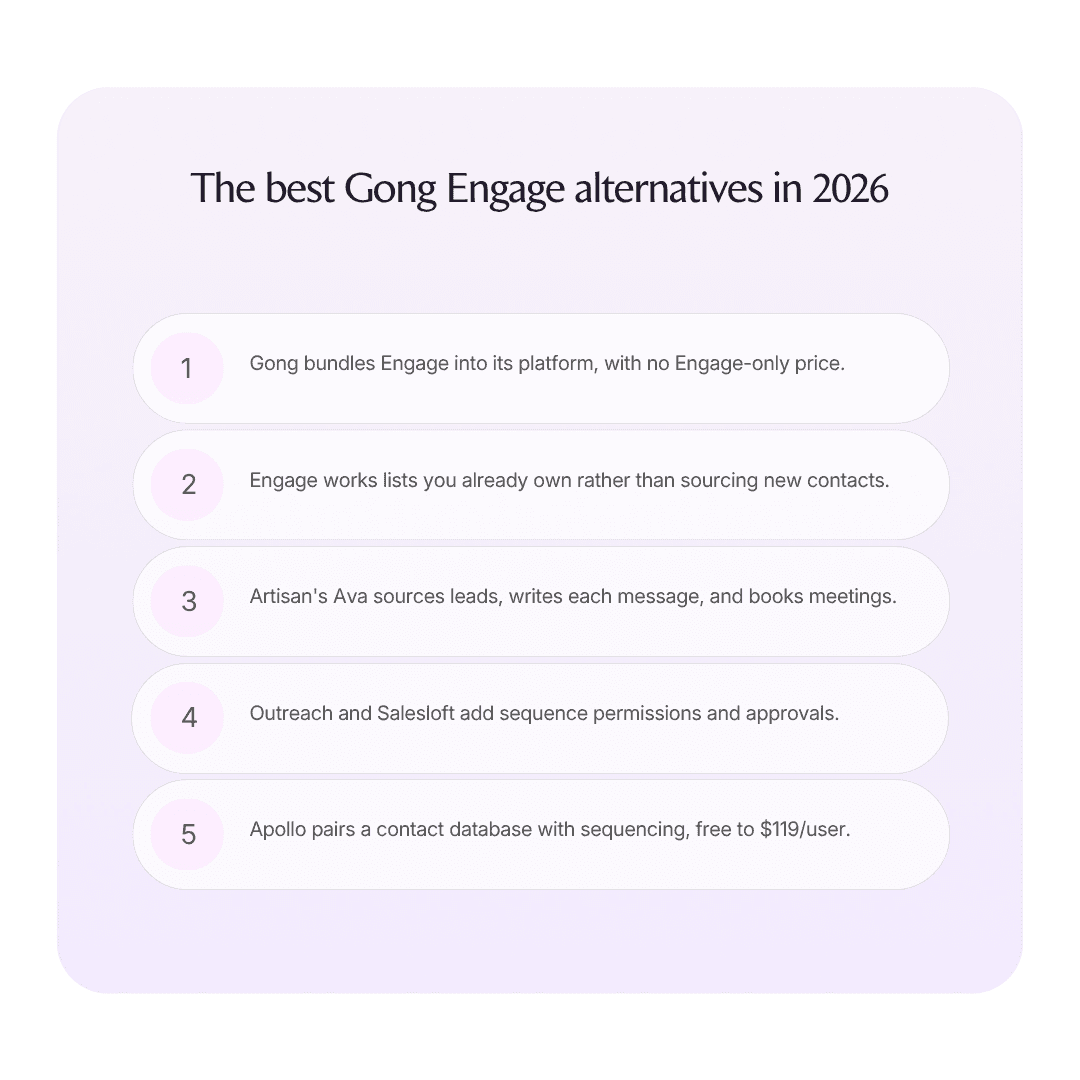
Gong Engage is bundled, gated on price, and still human-run. The best Gong Engage alternatives in 2026, from an autonomous AI BDR to Outreach, Salesloft, and Apollo.
The best Gong Engage alternative is Artisan, whose AI BDR Ava runs the outreach herself instead of handing reps a sequence to work. Outreach, Salesloft, Apollo, HubSpot Sales Hub, and Reply.io are the other real options. Gong Engage is a strong engagement module, but it is bundled into Gong's platform, gated on price, and still human-run.
Why do teams look for Gong Engage alternatives?
Three reasons come up most. Pricing is the first: Engage is not sold on its own. Gong bundles it into the Revenue AI platform behind a mandatory platform fee (reported roughly $5,000 to $50,000 a year by company size) plus per-seat licensing (reported around $1,200 to $3,000 per user a year), and the Engage-only number is not published. Buyers who want just the engagement layer end up paying for the whole platform. For the full cost picture, see Gong Engage pricing and reviews.
The second is sequencing depth. Engage launched in 2023 and its edge is the conversation-intelligence-to-engagement loop, outreach informed by what Gong's call analysis learned. That loop is useful. But as a pure sequencer it is younger and less mature than Outreach or Salesloft, which have spent a decade building cadence tooling. The third reason is the one every platform in this category shares: humans still run it. Engage makes your reps more informed, but the reps still write, send, call, and reply. If your bottleneck is rep hours rather than rep insight, a more mature sequencer or a fully autonomous agent solves more of the problem. This page covers both paths.
The best Gong Engage alternatives, compared
Rank | Tool | Best for | Standout | Public pricing |
|---|---|---|---|---|
1 | Artisan | Having the AI run the motion, not the reps | Ava owns sourcing to booking autonomously | Usage-based credits, no platform fee (pricing) |
2 | Outreach | Enterprise sequencing governance | Mature cadence tooling, Omni agent | Gated, ~$100-$165/user/mo est. |
3 | Salesloft | Cadence plus forecasting in one | Clari combination, forecasting | Gated, ~$125-$180/user/mo est. |
4 | Apollo | Price-accessible data plus sequencing | Large database in an all-in-one | Free-$119/user/mo (annual) |
5 | HubSpot Sales Hub | HubSpot-native teams | CRM-native sequences, Breeze agents | $0-$150/seat/mo; Breeze credits |
6 | Reply.io | An accessible entry with an AI SDR layer | Jason AI on a classic sequencer | Sequences ~$49-59; AI SDR $500-800+ |
How we chose
Four tests, in order. How much of the job the tool actually does (direct reps, or run the motion itself). Data and signal depth (can it source net-new leads, or does it only work lists you own). Pricing transparency (published and self-serve, or gated and bundled). And deployment fit (governance, security, and CRM depth for a large team). Every entry gets a best-for verdict and a who-should-pick-else line, because a page that flatters one tool is not worth citing.
1. Artisan: the AI that runs the motion
Artisan is the top Gong Engage alternative because Ava, its AI BDR, executes the outreach herself rather than handing a rep a cadence to work. She finds best-fit leads across over 250 million B2B professionals across over 200 countries, plus Artisan Local Data covering over 250 million local businesses, enriches and prioritizes them with waterfall email and phone enrichment, writes a distinct message for every recipient, runs multichannel steps across email, social, and the dialer, handles every reply from a knowledge base, and books meetings on the right rep's calendar by CRM ownership. Two people in the same campaign get two completely different messages, not one template with the fields swapped.
That is the structural difference from every engagement platform, including Engage. Gong Engage informs reps; Ava does the work. Autonomy is a dial, not a switch: review-and-approve every message, objections-only replies, or full autonomy, with plain-language escalation rules ("if the lead mentions pricing, escalate") and a full audit trail. Deliverability is managed with mailbox provisioning, inbox placement testing, and bounce-pattern detection that auto-pauses unhealthy mailboxes. The dialer runs as call steps inside the same sequence, with AI talking points, rather than as a separate product bolted alongside it.
The economics are the opposite of a bundled platform fee. Pricing is usage-based credits with no platform fee and no per-seat tax, so cost stays flat as a team scales, and enterprise deployments add a forward-deployed strategist, a dedicated CSM, and audit logs. Artisan is SOC 2 Type II compliant, with SSO, SAML, and role-based access, and syncs bidirectionally with Salesforce and HubSpot at the field level. CookUnity ran 100,000+ emails through Ava at roughly $45 cost per lead, and Bruno Didier, CEO of CookUnity Business, said "Ava runs highly targeted outreach at a scale we could never reach with a human-only team." Artisan is backed by investors including Y Combinator and HubSpot Ventures. For a direct comparison, see Artisan vs Gong Engage.
Best for: teams from startup through enterprise that want the AI to run the outbound job, not just inform the reps who run it. Who should pick something else: teams whose core need is conversation-intelligence coaching on their reps' live calls rather than autonomous outreach. Pricing: usage-based credits, no platform fee, free trial. See Artisan pricing.
2. Outreach: enterprise sequencing governance
Outreach is the most mature sequencer in the category and the natural pick if what you want is deeper cadence tooling than Engage without leaving the human-run model. Its workflow governance, permissions, and reporting are built for large orgs, and it launched its Omni agent on April 27, 2026, moving toward AI-assisted execution. Pricing is gated, reported around $100 to $165 per user a month.
What it does not change is who does the work. Outreach orchestrates reps; the reps still send, call, and reply. It makes a large team consistent and governable, which is real value, but pipeline still scales with headcount. If your goal is more output without more people, that is the ceiling. For deeper comparisons, see Artisan vs Outreach and Apollo vs Outreach.
Best for: large teams that want the deepest, most governable human-run sequencing. Who should pick something else: teams that want the agent to run the motion instead of the reps. Pricing: gated, reported ~$100-$165/user/mo.
3. Salesloft: cadence plus forecasting
Salesloft pairs its cadence engine with forecasting, and after completing its combination with Clari on December 3, 2025, it sits inside a broader revenue-operations suite. For a team that wants engagement and forecasting from one vendor, that combination is the draw. Pricing is gated, reported around $125 to $180 per user a month.
Two cautions. The core is still human-driven, same as Engage and Outreach. And the post-merger picture is worth watching: Drift, its former sibling product, suffered an OAuth breach in August 2025 affecting 700-plus organizations per Google Threat Intelligence coverage, and its retirement was announced in March 2026. None of that touches the cadence engine directly, but it is context a new buyer should weigh. For a direct comparison, see Artisan vs Salesloft.
Best for: teams that want engagement and forecasting from one combined suite. Who should pick something else: teams that want autonomous outreach, or buyers wary of post-merger roadmap uncertainty. Pricing: gated, reported ~$125-$180/user/mo.
4. Apollo: value data plus sequencing
Apollo is the value alternative if you want data and light sequencing in one affordable place. It pairs a large contact database with an all-in-one workspace at free through $119 per user a month on annual billing, serves hundreds of thousands of companies, and acquired Pocus in March 2026. Unlike Engage, it sources net-new contacts rather than only working your CRM.
The tradeoff is that the AI is assistive and the model is per-seat. You still target, write, and reply, and larger orgs tend to use Apollo as a data layer feeding other tools. It is a strong value buy, not an autonomous engine.
Best for: cost-conscious teams that want data and basic sequencing in one workspace. Who should pick something else: teams that want outreach and replies owned, not assisted. Pricing: free-$119/user/mo (annual, 3-seat minimum); Enterprise custom.
5. HubSpot Sales Hub: for HubSpot-native teams
If your team lives in HubSpot, Sales Hub is the natural engagement layer, with sequences native to the CRM and Breeze AI agents attached. Seats run free through $150 a month (Starter $7, Professional $90, Enterprise $150 per seat on annual billing), and Breeze is priced as bundled HubSpot Credits at roughly $0.010 per credit, an outcome-leaning model worth knowing about.
The scope is the catch. Sales Hub is excellent inside the HubSpot world and weaker as a standalone prospecting engine that sources net-new pipeline at scale. It sequences the contacts you have well; it is not built to fill the top of the funnel the way a dedicated BDR is.
Best for: HubSpot-committed teams that want native sequences and CRM-resident agents. Who should pick something else: teams that need to source net-new pipeline at scale beyond their CRM. Pricing: $0-$150/seat/mo; Breeze via HubSpot Credits (~$0.010/credit).
6. Reply.io: an accessible AI SDR layer
Reply.io offers Jason AI, an AI SDR layer, on top of a classic sequencing platform, and it is one of the cheaper ways to add agent-led email to your motion. Sequences start around $49 to $59 a month, with the AI SDR tier reported from $500 to $800 a month and up. For a small team that wants a taste of agent-run outreach without a platform commitment, the low entry is real.
The scope is the catch. This is an email-centric agent on a traditional sequencer, so it does not own multichannel prospecting, dialing, and reply handling the way a purpose-built BDR does. Fine as a first step, limited as a destination.
Best for: small teams that want an affordable entry into agent-led email. Who should pick something else: teams that need multichannel outbound with autonomous reply handling and dialing. Pricing: sequences ~$49-59/mo; AI SDR $500-800+/mo.
Stay with Gong Engage if
Switching is not free, so here is when to stay. Keep Gong Engage if you are already on Gong for conversation intelligence and the engagement module is doing its main job for you: feeding reps outreach shaped by what your call analysis learned. That loop is Engage's genuine differentiator, and if your reps rely on it and your sequences are performing, ripping it out to save on a bundled line item may not pay off this quarter. Migration means re-provisioning mailboxes, rebuilding cadences, and re-mapping CRM fields.
But if you are evaluating fresh, weigh what you are actually buying. Engage's price is bundled and undisclosed, its sequencing is younger than the dedicated platforms, and like all of them it still needs your reps to do the work. If your bottleneck is rep hours, the strongest answer is not a better sequencer for humans to run. It is an agent that runs the sequence.
How to choose
Want the AI to run the outbound motion, not the reps? Artisan.
Want the deepest human-run sequencing governance? Outreach.
Want engagement plus forecasting in one suite? Salesloft.
Want affordable data with light sequencing? Apollo.
Live entirely in HubSpot? HubSpot Sales Hub.
Want a cheap entry into agent-led email? Reply.io.
For the wider category, see the best sales engagement platforms, the best Default alternatives, and the best Outreach alternatives, or the AI BDR guide. To see how Ava runs the motion, meet her on the Artisan homepage or the AI sales agent page.
FAQ
What is the best alternative to Gong Engage?
Artisan, because its AI BDR Ava runs the outreach herself (sourcing, personalized messaging, replies, and booking) rather than handing reps a cadence to work, with a control dial and full audit trail. Outreach and Salesloft are the mature human-run sequencers, Apollo is the value data-plus-sequencing pick, HubSpot Sales Hub fits HubSpot-native teams, and Reply.io is a low-cost agent-led email entry.
Is Gong Engage sold separately from Gong?
No. Engage is the sales-engagement module inside Gong's Revenue AI platform, bundled with a mandatory platform fee (reported roughly $5,000 to $50,000 a year by size) plus per-seat licensing (reported around $1,200 to $3,000 per user a year). The Engage-only price is not disclosed, so buyers who want just the engagement layer effectively pay for the platform.
How much does Gong Engage cost?
Gong does not publish an Engage-only figure. It is bundled into the Revenue AI platform behind a platform fee plus per-seat licensing, both reported estimates rather than published prices. Gong overall is a large company (ARR past $500M as of May 2026, 5,000-plus customers). By contrast, Artisan uses usage-based credits with no platform fee, so you pay for work performed, not seats.
Is Gong Engage a full AI SDR?
No. Engage is a sales-engagement layer whose differentiator is the conversation-intelligence-to-engagement loop, informing reps with what Gong's call analysis learned. It makes reps more informed, but the reps still send, call, and reply. A full AI SDR like Artisan's Ava runs those steps herself, from sourcing net-new leads to booking the meeting.
Which Gong Engage alternative sources net-new leads?
Engage, Outreach, Salesloft, and HubSpot mostly work lists and CRM records you already own. Apollo sources net-new contacts from its own database. Artisan sources from over 250 million B2B professionals across over 200 countries, plus Artisan Local Data covering over 250 million local businesses, with waterfall enrichment, then turns those contacts into live multichannel outreach automatically rather than handing you a list to work.
Do these alternatives include a dialer?
Coverage varies and most treat calling as an add-on or a separate product. Artisan's dialer is built in, running as call steps inside the same multichannel sequence with AI talking points, with compliance (calling hours, DNC, consent-aware recording) enforced automatically per lead and CRM logging to the right rep.
Should I switch from Gong Engage or stay?
Stay if you are already on Gong, rely on the conversation-intelligence-to-engagement loop, and your sequences perform, since migration means rebuilding cadences and re-mapping CRM fields. Switch if the bundled and undisclosed pricing, the younger sequencing depth, or the human-run model are the constraints, and you want an agent that runs the motion instead of reps who run it.
The takeaway
Gong Engage is a capable engagement module, but it is bundled into Gong's platform, priced opaquely, and, like every sequencer, still run by your reps. The strongest alternative is not a better cadence tool for humans to operate. It is an AI employee that runs the motion end to end. See how it works on the Artisan homepage, review the pricing model, or read the AI BDR guide.
Related reading
Jaspar Carmichael-Jack
Co-Founder & CEO @ Artisan
Jaspar is an entrepreneur with expertise in sales, marketing, and operations. He founded Artisan in 2023, a company automating workflows with AI employees.