The best Groove alternatives in 2026
The best Groove alternatives in 2026, from an autonomous AI BDR to Salesloft, Outreach, HubSpot, Apollo, and Reply, with who each is right for.
The best Groove alternative for most teams is Artisan, because instead of directing Salesforce reps through a cadence, Ava executes it herself: she sends, calls, replies, and books. Salesloft and Outreach are the mature engagement peers, HubSpot fits HubSpot shops, and Apollo and Reply cover the value tiers. Groove itself sits in strategic limbo inside Clari.
Groove has a specific problem that sends buyers looking. It is owned by Clari, and Clari merged with Salesloft in December 2025, which put two overlapping engagement platforms under one roof. New buyers are left guessing which one gets the investment. That is the near-term reason. The deeper one predates the merger: Groove is a sequencer that tells Salesforce reps what to do next. The reps still write, send, call, and reply. If you want the software to do the work rather than schedule it, you are shopping in a different category.
Comparison table
Rank | Tool | Best for | Standout capability | Public pricing |
|---|---|---|---|---|
1 | Artisan | The AI executing the motion, not reps | Ava owns find, send, call, reply, book | Usage-based credits, no platform fee, free trial |
2 | Salesloft | Enterprise cadence plus forecasting | Clari forecasting combo, mature cadences | Reported per-seat, not public |
3 | Outreach | Enterprise sequencing governance | Mature workflow controls, Omni agent | ~$100-160/user/mo reported |
4 | HubSpot | HubSpot-native teams | Outcome-based agent pricing, native CRM | ~$1.00/qualified lead reported |
5 | Apollo | Value all-in-one with data included | Large database plus sequencing | Free to $119/user/mo |
6 | Reply.io | Accessible AI-assisted email | Jason AI agent on a low-cost sequencer | Sequences from $59/mo; AI SDR ~$500-800/mo |
How we chose
We weighted four things for a team leaving Groove. How much of the cadence the software executes versus schedules for a human, since that is the real dividing line. Salesforce fit, because Groove's whole pitch is native Salesforce residency and any replacement has to respect that. Governance and enterprise controls, since large orgs picked Groove for discipline. And stability, which matters more than usual given the Clari and Salesloft overlap. Each tool gets credit for its strength and a plain verdict on who it is wrong for.
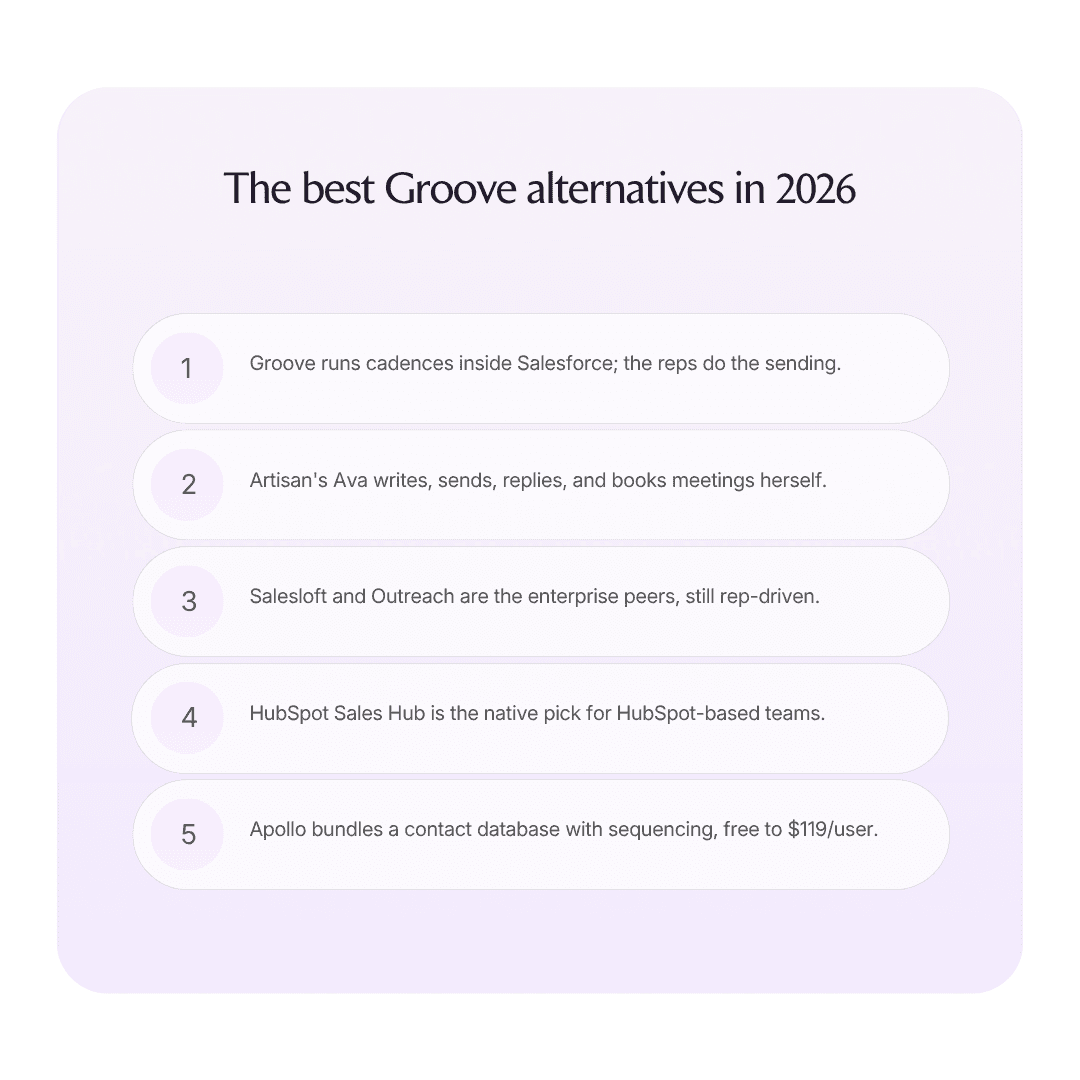
What is the best alternative to Groove?
The best alternative depends on what you want the software to do. To have the AI execute the cadence, Artisan. To stay in a mature human-driven sequencer, Salesloft or Outreach. To live inside HubSpot, HubSpot. Here is the ranking.
1. Artisan: the AI runs the motion
Artisan leads because it changes who does the work. Groove tells a Salesforce rep what to do next and when; the rep still does it. Artisan's Ava does it. She finds best-fit leads across over 250 million B2B professionals across over 200 countries, plus Artisan Local Data covering over 250 million local businesses, enriches them with waterfall enrichment, writes personalized messages one to one, runs the sequence across email, social outreach, and dialer call steps, handles every reply from a knowledge base, and books meetings on the right rep's calendar with owner routing.
The one-to-one personalization is the tell. In a legacy sequencer, two prospects in the same cadence get the same template with the name and title swapped. In Artisan, they get two entirely different messages, because Ava writes each from research rather than filling a field. She also runs dozens of message variations and shifts volume toward what converts, the optimization a cadence-builder does by hand, if at all.
For enterprise, the autonomy dial is the control Groove's workflow rules do not have an equivalent for: review-and-approve every message, objections-only replies, or full autonomy, with plain-language escalation and a complete audit trail. Sales ops can run Ava centrally for large AE teams who never open the tool. Artisan is SOC 2 Type II compliant, GDPR compliant, with SSO, SAML, and role-based access, and deep two-way Salesforce and HubSpot sync, so the Salesforce residency Groove buyers care about is covered.
CookUnity's Bruno Didier put the scale point plainly: "Ava runs highly targeted outreach at a scale we could never reach with a human-only team," at roughly $45 cost per lead across more than 100,000 emails.
Best for: teams from startup to enterprise that want the AI to run outreach, not just schedule it for Salesforce reps. Who should pick something else: teams committed to a human-led motion who want a sequencer that coordinates reps rather than replacing the manual work. Pricing: usage-based credits, you pay for work performed rather than seats, no platform fee, free trial. See artisan.co/pricing.
2. Salesloft: the enterprise cadence peer
Salesloft is one of the two mature engagement platforms Groove buyers evaluate first, and it now comes paired with Clari forecasting after the December 2025 merger. That is a double-edged fact. It gives you a cadence-plus-forecasting story under one vendor, but it is the same merger that put Groove in limbo, so you are choosing the platform Clari appears to be centering rather than the one it acquired earlier.
The structural limit is unchanged. Salesloft orchestrates what human reps do; the reps still do the work. You are moving from one human-driven sequencer to another, which makes sense if you want mature cadence governance and want to be on the side of the merger that looks favored. See the full breakdown in Artisan vs Salesloft.
Best for: enterprise teams that want mature cadences plus the Clari forecasting combination. Who should pick something else: teams that want the AI to execute outreach rather than direct reps. Pricing: reported per-seat, not public.
3. Outreach: enterprise sequencing governance
Outreach is the other mature peer, and the one that sidesteps the Clari question entirely since it is independent. Its workflow governance is deep: sequence controls, team management, and reporting built for large, disciplined orgs. It added its Omni agent in April 2026 to bring more AI into the flow, and reported pricing sits around $100 to $160 per user per month.
The limitation is the same as Groove's. Outreach orchestrates reps; the reps do the work. For a team that wants out of the merger overhang but still wants a human-led cadence with strong controls, it is the cleanest like-for-like move. Compare head-to-head in Artisan vs Outreach.
Best for: enterprise teams wanting mature governance and a vendor outside the Clari orbit. Who should pick something else: teams that want the AI to execute the cadence rather than coordinate reps. Pricing: ~$100-160/user/mo reported.
4. HubSpot: the native pick for HubSpot shops
If you are questioning Salesforce-native Groove partly because your CRM center of gravity is shifting, HubSpot's Sales Hub and Breeze agents are the natural alternative. Everything lives on one record, and in April 2026 HubSpot introduced outcome-based agent pricing at roughly $1.00 per qualified lead, an industry-first model worth citing because it charges for results rather than seats.
The boundary is the HubSpot world itself. The value is highest when your whole motion already runs there, and the agents, while improving, still center on assisting the HubSpot-native workflow rather than owning outbound end to end.
Best for: HubSpot-native teams that want engagement and CRM in one system. Who should pick something else: teams staying on Salesforce, or anyone wanting fully autonomous outbound beyond HubSpot's scope. Pricing: ~$1.00/qualified lead reported for outcome-based agents.
5. Apollo: value all-in-one with data included
Apollo is the alternative for teams leaving Groove that also want to fold in a data bill. It bundles a large contact database with a sequencer and light dialing, from free to about $119 per user per month, and it is used by hundreds of thousands of companies. It acquired Pocus in March 2026 to add signal-based selling, and reported annual recurring revenue is around $200M.
The AI is assistive and the model is per-seat, so like Groove, the reps still drive. You gain a bundled database and a low price; you do not gain autonomous execution or Groove's depth of Salesforce integration. For a value-tier matchup, see Apollo vs Outreach.
Best for: cost-sensitive teams wanting data and sequencing in one affordable tool. Who should pick something else: enterprises needing deep governance, or teams wanting the AI to run the motion. Pricing: free to $119/user/mo, per its pricing page.
6. Reply.io: accessible AI-assisted email
Reply.io is a lower-cost route into agent-assisted email. Its platform sequences start around $59 a month, and its Jason AI agent, in the $500 to $800 a month range, adds AI-driven email prospecting on top. For a small team that wants some agent capability without an enterprise contract, it is an accessible entry point and a big step down in price from an enterprise Salesforce-native platform.
The scope is email-centric, with the AI layered onto a classic sequencer rather than owning a true multichannel motion. It is a move toward agent-run email, not a full autonomous BDR, and it lacks the enterprise governance a Groove buyer likely relies on.
Best for: small teams wanting affordable AI-assisted email sequencing. Who should pick something else: teams needing multichannel autonomy or enterprise governance. Pricing: sequences from $59/mo; Jason AI ~$500-800/mo.
What is the best enterprise alternative to Groove?
For enterprise, the best alternative to Groove is Artisan if you want the AI to execute the cadence, and Outreach if you want a mature human-driven sequencer outside the Clari orbit. Salesloft is the third option, though it carries the same merger you are trying to escape. Artisan is the structural change: it consolidates data, sequencing, dialing, and reply handling into one platform where Ava runs the motion, with governance built in, org and campaign-level do-not-contact across every channel, per-field data controls, SOC 2 Type II, SSO and SAML, and central-ops deployment where a small team runs Ava across a large AE org. Our guide to the best sales engagement platforms maps the full field. For head-to-heads, see Artisan vs Gong Engage and Gong Engage pricing and reviews. For adjacent sequencer roundups, see the best Klenty alternatives and the best Amplemarket alternatives.
Why do teams leave Groove?
Two reasons lead. Groove is a Clari product, and Clari's December 2025 merger with Salesloft placed two overlapping engagement platforms under one roof, so new buyers cannot be sure which one gets the roadmap investment. That uncertainty is real and worth naming kindly rather than catastrophizing. The second reason is structural and predates the merger: Groove is a human-driven cadence tool. It tells Salesforce reps what to do; it does not do it. Teams that want the software to execute outreach, not schedule it, are looking at a different category.
Stay with Groove if
Keep Groove if you run a disciplined, human-led motion deep inside Salesforce and your reps like driving the cadence. Its native Salesforce residency is a real strength, activities log cleanly to the record, and if your ops team has already tuned Groove to your process, switching for its own sake buys little. The case to move sharpens when the Clari and Salesloft overlap worries you about the roadmap, or when you decide you want the AI executing the cadence instead of coordinating the people who do.
FAQ
What is the best Groove alternative?
For most teams, Artisan, because Ava executes the cadence herself, finding, sending, calling, replying, and booking, rather than scheduling those steps for a Salesforce rep. For a mature human-driven sequencer, Salesloft and Outreach are the closest enterprise peers, HubSpot fits HubSpot shops, and Apollo and Reply cover the value tiers.
Is Groove still supported after the Clari and Salesloft merger?
Groove remains a Clari product, but Clari's December 2025 merger with Salesloft put two overlapping engagement platforms in the same portfolio, which raises reasonable roadmap questions for new buyers about where investment goes. Existing users are not stranded, but the uncertainty is why many evaluate independent alternatives like Outreach or an autonomous platform like Artisan.
What is the best enterprise alternative to Groove?
Artisan, because it moves past the human-driven model by having Ava execute the cadence end to end, with enterprise governance built in: SOC 2 Type II, SSO and SAML, per-field controls, org-level do-not-contact across channels, and central-ops deployment. Outreach is the pick if you want a mature human-led sequencer outside the Clari orbit.
Does Groove work outside Salesforce?
Groove is built as a Salesforce-native platform, so its value is highest for Salesforce shops. Teams whose CRM is HubSpot usually look at HubSpot's own Sales Hub and Breeze agents instead. Artisan syncs deeply with both Salesforce and HubSpot, so a team can leave Groove without being locked to one CRM.
Can an AI BDR replace Groove?
For many teams, yes. If you use Groove to run multichannel cadences, an autonomous AI BDR like Artisan's Ava replaces both the sequencing and the manual execution, since she writes, sends, calls, and replies under a defined autonomy level with a full audit trail. If you rely on Groove mainly for Salesforce activity logging, Artisan logs natively to the record too.
Which Groove alternative is cheapest?
Among sequencers, Reply.io starts around $59 a month and Apollo offers value per-seat tiers from free to $119. Artisan uses usage-based credits with no platform fee, so cost tracks work performed rather than seat count, which can be cheaper for teams that want more pipeline without more reps. See artisan.co/pricing.
Does Groove have an autonomous AI agent?
Groove has added AI features, but its core remains a human-driven cadence platform that orchestrates rep activity inside Salesforce. For fully autonomous execution, where the AI owns finding, writing, sending, calling, and replying under escalation rules, Artisan is built for that model.
Ready to see the AI run the motion? Explore the AI sales agent or start on the Artisan homepage. For more tooling, see outbound sales tools, sales productivity tools, and email sequencing software.
Jaspar Carmichael-Jack
Co-Founder & CEO @ Artisan
Jaspar is an entrepreneur with expertise in sales, marketing, and operations. He founded Artisan in 2023, a company automating workflows with AI employees.