Artisan vs. Supersonik: Which fits your team?
Artisan's AI AE demos and closes as part of a full AI sales team on one platform. Supersonik is a focused live-demo agent. Here's how to choose.
Key Takeaways
- Supersonik is a single-purpose demo agent: it joins live calls and embeds on your site, navigates the real product UI with synthetic voice in over 70 languages, and runs 24/7. It does this one job well.
- Artisan's AI AE runs live, personalized demos too, and it sits downstream of Ava, the autonomous AI business development representative (BDR), so the same platform prospects, handles inbound chat, books the meeting, and then demos.
- Supersonik raised a $5M seed led by a16z in September 2025, with founders including former Typeform CEO Joaquim Lechà. It is early and specialized by design.
- Artisan has raised over $35M from investors including Y Combinator and HubSpot Ventures, and reports over 90% of its customers run Ava autonomously.
- One knowledge base powers Artisan across prospecting, inbound answers, and the demo, so a prospect hears the same story from first touch to close.
- Supersonik pricing is gated and scales with monthly demo volume; Artisan's AI AE is priced separately, so talk to sales.
Both put an AI agent in front of your prospects. Supersonik is a focused live-demo agent that screen-shares your real product on video calls and your website. Artisan's AI account executive (AE) runs the same demo, but as one member of a full AI sales team that also prospects, works inbound, and books meetings, on one platform with one shared knowledge base.
Artisan vs. Supersonik at a glance
Neither tool is a checkbox winner across the board. The honest question is what job you're actually trying to fill.
Your situation | Better fit |
You already have prospecting and booking handled and only need an AI to run product demos | Supersonik |
You want the demo to be part of one system that also finds leads, writes outreach, and books meetings | Artisan |
You need a demo agent that navigates your live product UI with voice in dozens of languages, today | Supersonik |
You want one AI sales team and one knowledge base from first touch through the demo | Artisan |
You're a product-led team bolting an AI demo onto an existing website motion | Supersonik |
You're consolidating a multi-tool outbound stack and want the close layer included | Artisan |
What does Supersonik actually do well?
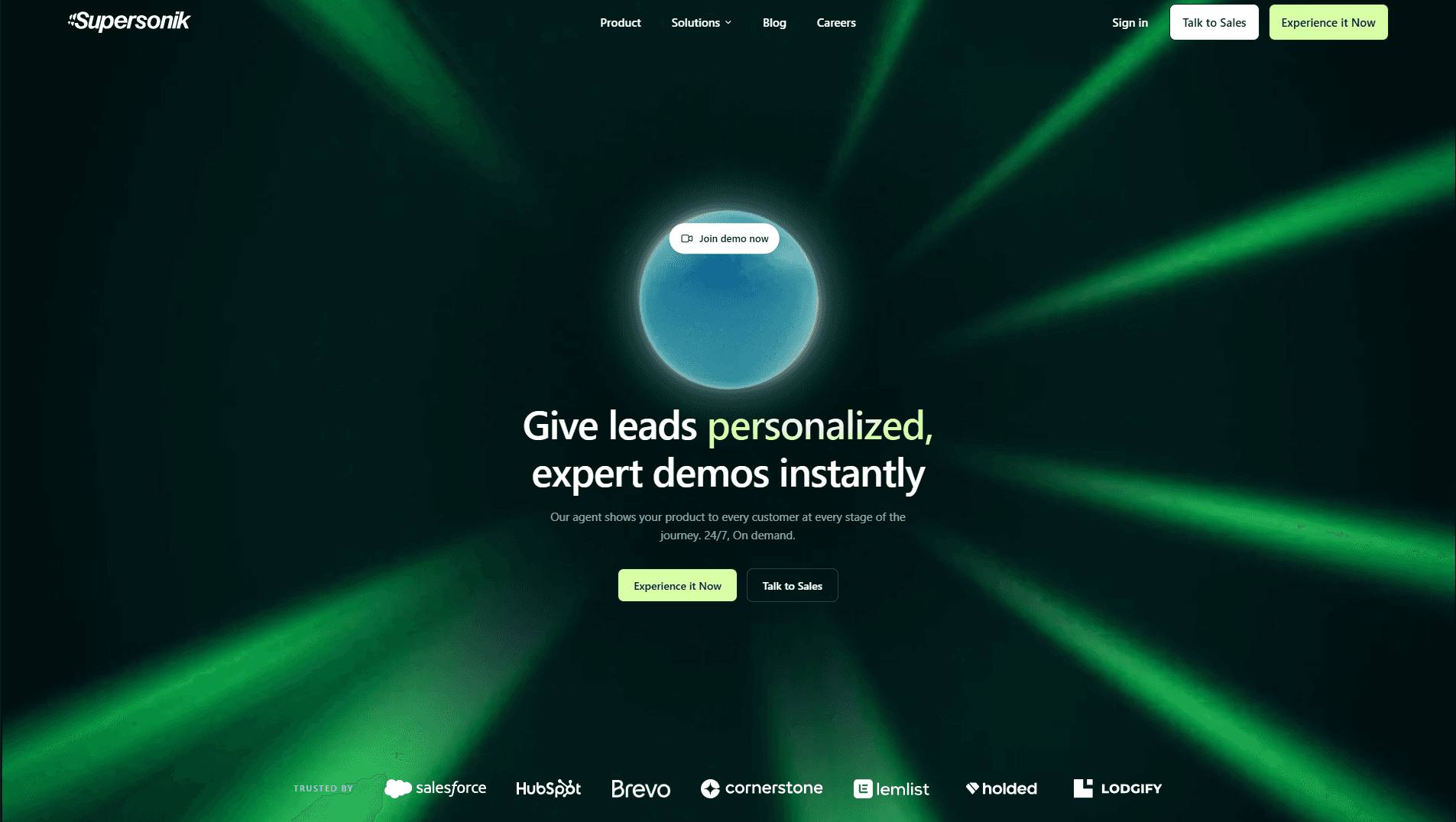
Supersonik is an AI sales engineer, and it is good at the narrow thing it was built for. It joins live video calls and embeds directly on your website, then drives your real product interface in real time using synthetic voice. There's no avatar; the prospect watches the product, not a face. It speaks over 70 languages and runs around the clock, so a buyer in another timezone receives a live walkthrough at 2 a.m. without a human present.
That focus is a strength. The Barcelona team, with founders including ex-Typeform CEO Joaquim Lechà, has built a demo agent that a serious buyer will respect, and the customer logos it publishes (Salesforce, HubSpot, Brevo, Lemlist, Lodgify) suggest it lands with product-led companies that already generate demand and just want the walkthrough automated. Supersonik holds SOC 2 Type II and states GDPR compliance. If your only gap is "we can't staff enough live demos," it fills this gap cleanly.
The limit is scope, and it's a deliberate one. Supersonik demos. It does not prospect, it does not run your outbound sequences, and it does not qualify inbound traffic and route it. These are separate problems you solve with separate tools. That's fine if you've already solved them. It's a stack-management cost if you haven't.
How is Artisan's AI AE different?
Artisan's AI AE is the close layer inside a full AI sales team, not a standalone product. It runs live, personalized product demos grounded in your knowledge base, answers questions and handles objections in real time, and drives the next step, whether that's starting a trial or qualifying and booking a human AE. So far, this overlaps with Supersonik.
The difference is everything around the demo. The same platform runs Ava, the autonomous AI BDR who finds best-fit leads across a database of over 400M contacts, enriches and prioritizes them, launches personalized multichannel campaigns, handles every reply, and books meetings on your reps' calendars. Ava Inbound greets and qualifies visitors on your website from the same knowledge base and can hand a "show me a demo now" visitor straight to the AI AE. The prospect who receives a cold email, replies, chats on your site, and then watches a demo is talking to one coordinated system the whole way. For how these roles compare across vendors, see the best AI BDRs and the best AI SDRs.
This matters because the demo is only as good as the context that feeds it. When prospecting, inbound, booking, and the demo share one knowledge base, the AI AE already knows why this account is a fit, what signal triggered the outreach, and what the prospect asked earlier. A bolt-on demo agent starts cold every time.
Which one connects to your pipeline?
This is the clearest split. Supersonik is the demo; your pipeline lives elsewhere, in whatever prospecting and CRM tools you already run, and you wire the demo agent into it. For a team with a mature go-to-market (GTM) stack and a dedicated ops function, this integration work is manageable.
Artisan is the pipeline. Ava sources the lead, runs the outreach, and books the meeting, then the AI AE demos it, and every touch logs to Salesforce or HubSpot with owner routing so activity lands on the right rep's record. There's no seam between "who booked this" and "who's demoing it," because it's one platform. For a team that would otherwise buy a prospecting tool, a data tool, an inbound chat tool, and a demo agent, consolidation is the point. Typical enterprise outbound stacks run five to eight tools at over $100K a year before headcount; folding the demo into the same system removes one more vendor and one more integration. Teams comparing the wider category can review the best AI GTM platforms and the 15 best AI sales tools.
How autonomous is each, and how much control do you keep?
Supersonik runs autonomously within its lane. It handles the live demo without a human on the call, which is exactly what you want from a demo agent.
Artisan's autonomy is a dial, not a switch, across the whole motion. On the outbound side, Ava can run in review-and-approve mode where a human signs off on every message, an objections-only mode, or full autonomy, with plain-language escalation rules ("if the lead mentions pricing, escalate") and a full audit trail. Artisan reports over 90% of its customers run Ava autonomously. The AI AE inherits this same philosophy: it drives the demo and the next step, but high-intent leads can route to a human AE while the AI handles volume and off-hours. For an enterprise buyer, the governance story that spans the entire funnel, not just the demo, is usually the deciding factor.
Choose Supersonik if...
Your prospecting, inbound qualification, and booking are already handled by tools you like, and the one missing piece is automated live demos.
You're a product-led company where buyers arrive ready and you mostly need scale and 24/7 coverage on the walkthrough itself.
You want a demo agent that drives your real product UI in many languages and you don't need it tied to an outbound engine.
You'd rather buy the best-in-class point solution for demos and integrate it into an existing GTM stack yourself.
Supersonik is early and specialized, backed by a $5M seed. If the demo really is your only gap, this focus is a feature.
Choose Artisan if...
You want the demo to be one part of a single AI sales team that also prospects, runs inbound, and books.
You're consolidating a multi-vendor outbound stack and want the close layer inside the same platform, not a fifth tool to integrate.
You want one knowledge base and one lead timeline from cold outreach through inbound chat to the live demo.
You need enterprise governance, autonomy controls, and a full audit trail across the whole funnel, not just the demo.
What customers say
Artisan's proof is on the pipeline side that feeds the demo. Raise sourced over $700K of annual recurring revenue (ARR) in six months with Ava, a 20x return. SaaStr's Jason Lemkin reports a 3.55% positive response rate, and says "the AI emails are actually better than what our humans produced. Consistently better." A demo agent only matters if there are qualified demos to run; this is the half of the problem the rest of the platform solves before the AI AE ever picks up.
FAQ
Is Supersonik better than Artisan for live product demos?
For the demo alone, Supersonik is a mature, focused choice: it drives your real product UI with synthetic voice in over 70 languages, 24/7, and publishes strong logos. Artisan's AI AE runs live demos too, but its advantage is context. It shares one knowledge base with the prospecting and inbound agents, so it walks in knowing the account, the trigger, and the earlier conversation.
Does Artisan's AI AE replace my human account executives?
No. It handles volume, off-hours, and the repetitive walkthrough, and it routes high-intent or complex deals to a human AE. The point is to remove the grunt work so your reps spend time on the demos that need a human, not to take the team off the field.
Can Supersonik prospect or run outbound?
No. Supersonik is a demo agent by design; it joins calls and embeds on your site to run product walkthroughs. Prospecting, sequencing, and inbound qualification are separate tools in your stack. Artisan runs all of these on one platform, with the demo as the final layer.
How is each one priced?
Supersonik uses gated, usage-based pricing that scales with your monthly demo volume, so you request a quote. Artisan's AI AE is priced separately from the core platform, so talk to sales. Artisan's core outbound platform is usage-based: you pay for work performed, not seats, with no platform fee. See the pricing page.
Is Supersonik or Artisan a safer bet for an enterprise buyer?
Both hold SOC 2 Type II. Supersonik is a $5M-seed specialist, so you're betting on a young, narrow product plus your own stack around it. Artisan has raised over $35M from investors including Y Combinator and HubSpot Ventures, ships governance and audit trails across the full funnel, and offers single sign-on (SSO), SAML, and role-based access on Enterprise plans.
What if I only need the demo automated right now?
Then Supersonik is a reasonable, focused pick, and you can wire it into your existing tools. Just know that if you later want the prospecting and inbound that feed these demos automated too, you'll be buying and integrating more vendors. Artisan bundles this path into one platform from the start.
The bottom line
If the demo is your only gap and the rest of your GTM stack is set, Supersonik is a sharp, focused tool built for exactly that. If you want the demo to be one job inside a coordinated AI sales team that prospects, works inbound, books, and closes on one platform and one knowledge base, that's Artisan.
See how the AI sales team works on the Artisan homepage, read about Ava the AI BDR who feeds the demos, explore the AI sales agent, or check Artisan pricing.
Related reading
Jaspar Carmichael-Jack
Co-Founder & CEO @ Artisan
Jaspar is an entrepreneur with expertise in sales, marketing, and operations. He founded Artisan in 2023, a company automating workflows with AI employees.